

Choosing the right growing system is one of the biggest factors behind healthy, productive plants. Every plant grows a little differently, so giving it the environment that suits it best makes a real difference. It also saves time and effort later on.
Whether you prefer raised beds, containers, hydroponics, or planting straight into the ground, the right choice depends on root depth, watering needs, sunlight, and the space you actually have.
Keep reading to discover which growing system makes the most sense for the plants you want to grow.
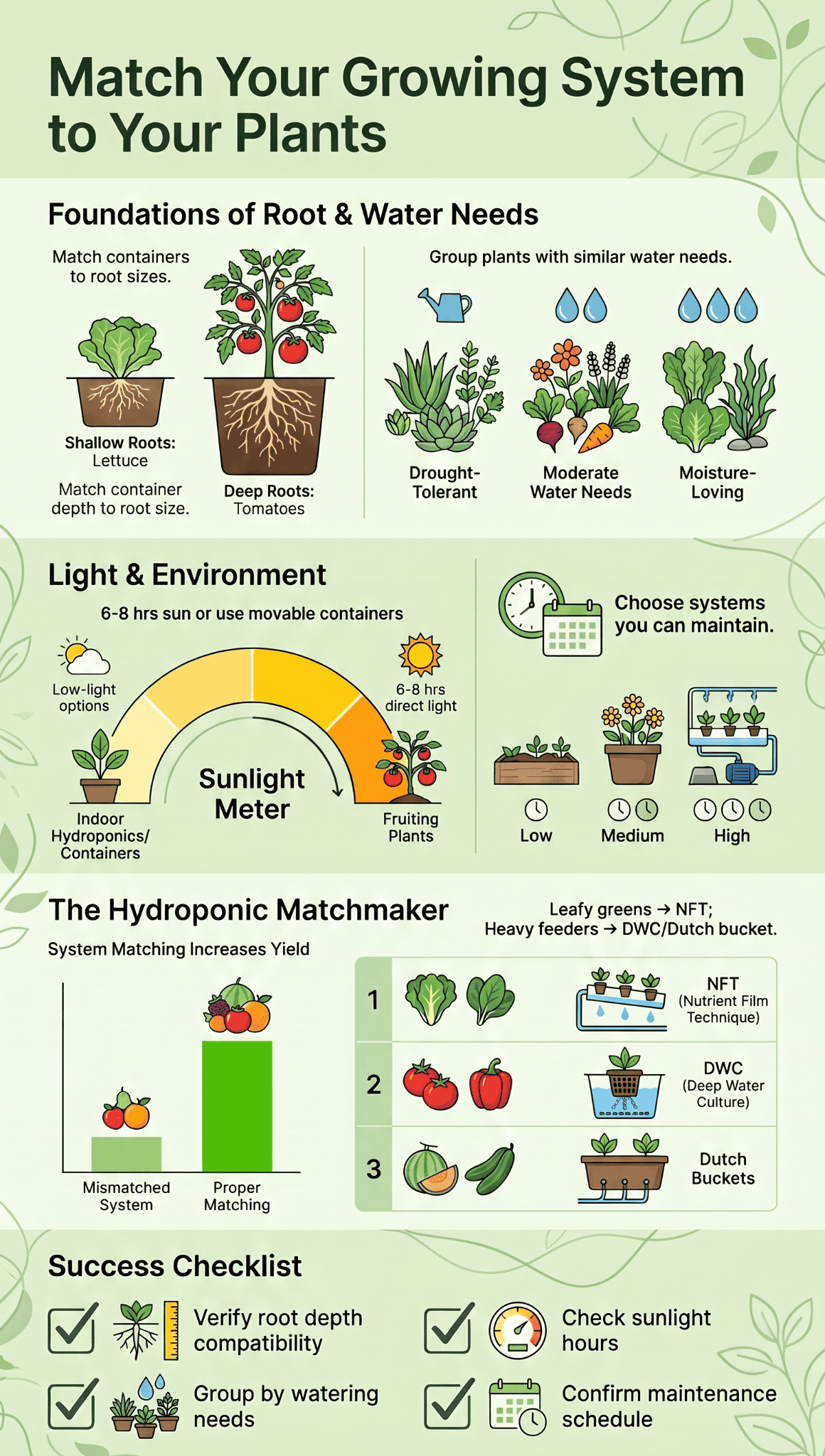
Quick Match Recap
Choosing the right growing system starts with understanding your plants, your space, and the time you can commit. Use this checklist to match plant needs with the most suitable setup, helping you avoid common mistakes and support healthier, more productive growth.
- Check root depth before choosing container size or growing method.
- Group plants with similar watering needs for easier irrigation.
- Measure available sunlight before deciding between indoor and outdoor systems.
Why Does Matching Your Growing System Matter?
Why does matching your growing system matter?
Simple. Plants thrive when their environment matches the way they naturally grow. Many gardening problems begin because the setup doesn’t fit the plant.
Picture a tomato squeezed into a tiny container. Or one lonely lettuce planted in an oversized raised bed. Neither plant is really at fault. The growing system is.
Instead of forcing a plant to adapt, start with what you can realistically provide. Look at your space. Your sunlight. Your schedule. Then choose plants and a system that fit those conditions. It feels backwards at first. But it works.
Over the years, I’ve learned that every growing method is a trade-off between convenience and control.
For instance, my wooden raised beds are a blessing in the early spring because they warm up weeks ahead of the ground soil, but I’ve also learned the hard way that they require twice as much monitoring during the heat of July because they dry out rapidly.
Hydroponic systems deliver nutrients directly to the roots. They need regular attention and a dependable power source.
I rely on container gardens when I need flexibility; being able to chase the sun across my patio is a huge advantage.
However, because these pots have limited soil volume, I’ve learned they inevitably dry out faster than in-ground beds, meaning I must commit to a daily watering routine during the summer months.
In ground gardens give roots almost unlimited space. Still, you’re working with whatever soil nature gave you.
Choose the wrong setup and gardening becomes harder than it should be. You might notice things like:
- Slow or stunted growth
- Roots circling inside the container
- Constant wilting or soil that stays too wet
- More mold and mildew problems
- Fewer flowers and less fruit
- Yellowing leaves that never seem to improve
Experienced gardeners rarely begin by buying equipment. They usually start with questions instead. What do I actually want to grow? How much sunlight does this area receive? What is my soil like?
Only after answering those questions do they decide whether a raised bed, containers, hydroponics, or an in ground garden makes the most sense. It saves money. It also prevents that frustrating moment halfway through the season when a plant suddenly outgrows its space.
Research supports this approach. Studies from organizations like the USDA show that plants matched with suitable growing conditions stay healthier, produce better harvests, and require less ongoing maintenance.
Which Plant Characteristics Should You Evaluate First?

Don’t choose a plant just because it looks healthy at the nursery. Take a closer look at what it actually needs. Five characteristics matter most. Root depth. Water requirements. Sunlight. Mature size. Life cycle.
Get those right from the beginning and everything becomes easier. Really.
Root depth deserves the most attention because it often determines which growing system will work. Lettuce, for example, develops shallow roots. It grows well in systems that require very little growing medium, including NFT channels or the Kratky method.
Tomatoes are completely different. Their roots spread deep and wide to support a large, heavy plant. They need deep containers, tall raised beds, or hydroponic buckets with enough room for strong root development. Try growing one in a shallow tray and you’ll probably end up with a stressed, weak plant.
Next, think about the plant’s mature size. A basil plant stays comfortable in a small six inch pot. A zucchini can easily fill an entire four by four foot raised bed. Some plants climb and need vertical support. Others spread outward and need plenty of width.
Finally, consider how long the plant will stay in your garden. Fast growing lettuce finishes its life in just a few weeks. A perennial herb may stay productive for years. Different lifespans call for different homes.
The goal is straightforward. Match the plant’s natural growth habits with a growing system that supports them. Life gets easier that way. Gardening does too.
How Does Sunlight Steer Your Choice?

Credits : NT Hydroponics
Light comes first. Nothing replaces it.
No expensive equipment can make up for a location that doesn’t receive enough natural light. If your garden gets plenty of sunshine, almost any outdoor growing system becomes possible. If sunlight is limited, your choices become more focused.
Most vegetables, including tomatoes, peppers, and cucumbers, need six to eight hours of direct sunlight every day to produce well. If your space receives that much light, you’re in good shape. Raised beds, outdoor containers, in ground gardens, and hydroponic systems like Dutch buckets can all work beautifully.
But what if your garden sits in the shade?
Things change. Not impossible though.
Containers become incredibly useful because you can move them throughout the day to follow the sun.
Indoor hydroponic systems paired with LED grow lights provide another dependable option. They let you grow herbs and leafy greens throughout the year regardless of outdoor conditions.
You can also focus on crops that naturally tolerate lower light levels, such as spinach, lettuce, mint, or parsley. Many of these perform especially well in shallow hydroponic systems like the Kratky method.
One last thing. Sunlight is not only about the number of hours. Heat matters too. A south facing wall that receives intense afternoon sun may become too hot for delicate greens during summer, even if the light itself is ideal. Sometimes a little shade cloth is all that’s needed.
Always evaluate the real conditions in your garden, not the perfect conditions shown in gardening catalogs. That’s where smart system choices begin. And honestly, that’s where growing gets a whole lot easier.
Which Gardening Systems Work Best for Different Plants?
Let’s be clear: there’s no universal winner. Each setup is a tool, good for some jobs and bad for others. Picking the right one saves you a world of trouble and gets you a better harvest.
I often tell beginners that gardening is all about the right tools; you wouldn’t try to eat soup with a shovel, and you shouldn’t try to grow a sprawling zucchini in a tiny window box.
By matching the plant’s natural growth habit to the system’s capacity, you stop fighting your own setup and start seeing a real harvest.
| Plant Type | Recommended Hydroponic System | Why It Works Best |
| Leafy Greens (Lettuce, Spinach) | Nutrient Film Technique (NFT) | Shallow roots thrive with a continuous flow of nutrient-rich water. |
| Tomatoes | Deep Water Culture (DWC) | Supports larger root systems with constant access to water and nutrients. |
| Peppers | Deep Water Culture (DWC) | Encourages stable growth and consistent moisture for fruit production. |
| Fruiting Crops (Cucumbers, Eggplants) | Dutch Bucket System | Provides strong root support and efficient nutrient delivery for heavier plants. |
The rule of thumb from experienced growers is simple: put leafy greens in water-based systems, and put heavy-feeding fruiting plants in systems with lots of root space and steady nutrients. Start with the plant you want, then choose the system built for it.
How Do Root Systems Determine the Right Setup?
Think of a plant’s roots as its hidden engine room. They hold it up, drink the water, and grab all the food. If you cram that engine into a tiny box, the whole plant suffers, less growth, fewer leaves, and puny fruit. So, choosing how much room you give the roots is one of your most important jobs.
As noted by Journal of Plant Nutrition
“By 45 days after transplanting, leaf area and plant dry weight was diminished proportional to container volume.” – Journal of Plant Nutrition
Which plants do fine in shallow setups?
These are your easy-going, compact growers. Their roots don’t go deep, so they’re perfect for systems that don’t have a lot of soil or media.
- Lettuce
- Spinach
- Kale
- Basil
- Most culinary herbs (like cilantro, chives)
- Microgreens
This is why they’re the stars of shallow hydroponic channels, simple Kratky jars, or small pots. They just don’t need much depth to be happy. Many of these crops are also considered some of the easiest hydroponic plants because they adapt quickly to simple systems and require very little root space.
Which plants absolutely need deep systems?
These are the heavyweights. They build massive root systems to support big, productive plants above ground.
- Tomatoes
- Peppers
- Cucumbers
- Eggplant
- Squash and Zucchini
- Fruit Trees (they’re in a league of their own)
Heavy-feeding crops demand deep root space to reach their full potential. I always ensure tomatoes and peppers get at least 18 inches of depth in raised beds or a full 5-gallon volume in containers to prevent early root-binding.
In hydroponic setups, the choice of growing medium also influences root support, moisture retention, and overall plant stability as crops mature.
Tomatoes rarely perform well in shallow NFT channels because the limited root space quickly becomes a constraint as the plants mature. Choosing a hydroponic system with sufficient depth from the beginning helps support healthy root development and eliminates the frustration of transplanting stressed, root-bound plants later in the growing cycle.
Also, remember that plants grow. A seedling starts in a tiny cup, but it can’t stay there. You need to pot it up into progressively larger homes as it grows. If you see roots circling tightly at the bottom of the pot or growth suddenly stalling, it’s screaming for more space.
Getting the root depth right from the beginning means less stress for the plant, better access to water and food, and a much healthier grower all season long.
Should You Group Plants with Similar Water Needs?
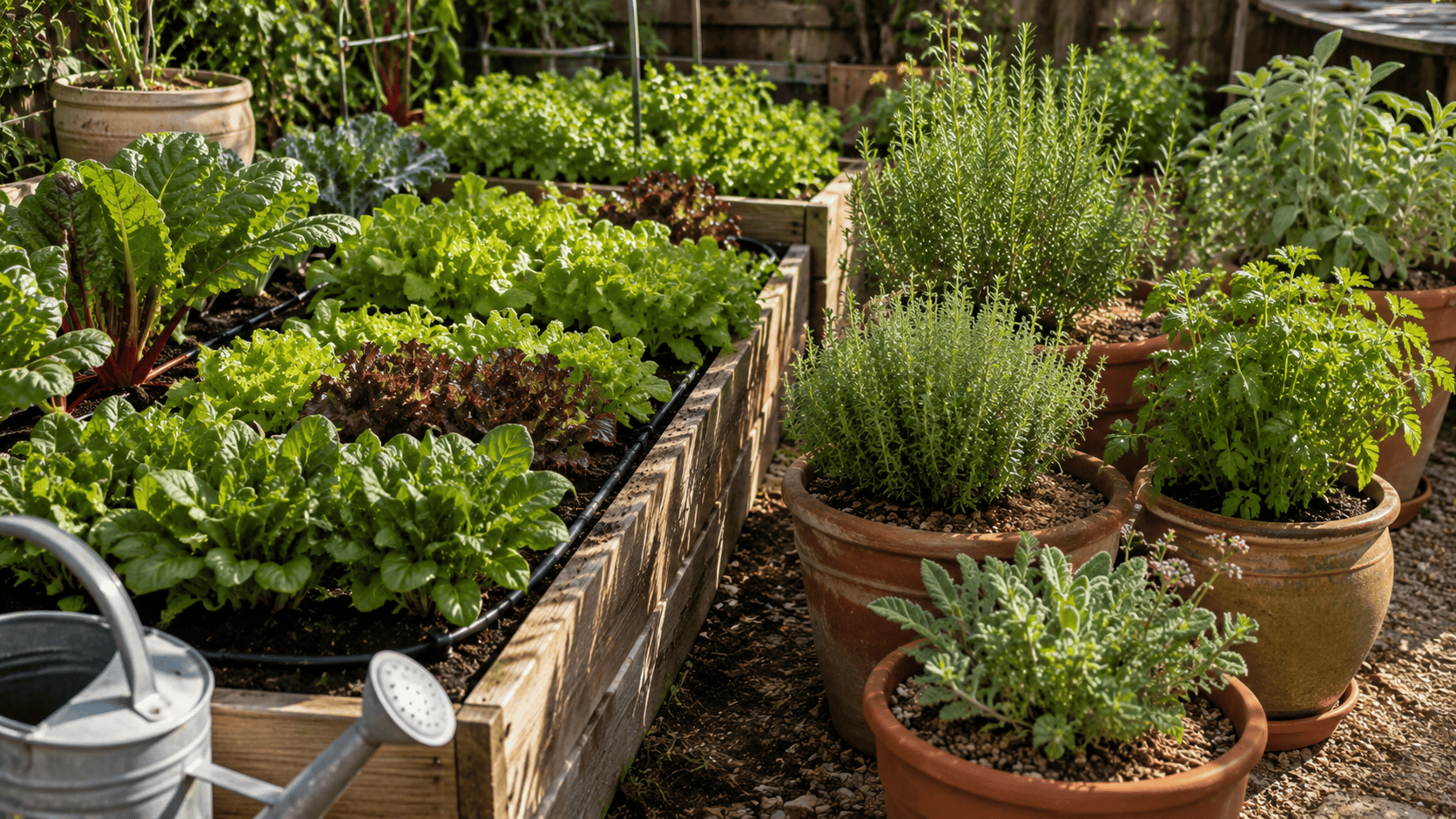
Absolutely. It’s one of the simplest ways to make your life easier and keep your plants happy.
Inconsistent irrigation is the most frequent cause of garden failure. Even with premium soil amendments and high-quality fertilizer, improper hydration will cause plant stress and severely limit your overall yield.
Putting plants together that like the same level of moisture means you can water the whole group the same way. No more guessing, and no more drowning one plant while another is parched.
Think about it: a thirsty head of lettuce wilts fast and needs consistently damp soil. A rosemary plant, on the other hand, prefers to dry out completely between waterings. Put them in the same pot or bed, and you can’t win. One will always be stressed.
Data from International Journal of Horticultural Science and Technology,
“In response to the 6-day and 3-day irrigation intervals, raised-bed furrow irrigation, with black polyethylene mulch, resulted in a significantly higher yield (96.46 t/ha and 102.19 t/ha) compared to the effect of no mulch on the yield (77.70 t/ha and 82.04 t/ha), respectively.” – International Journal of Horticultural Science and Technology
Good Plant Pairs (they like similar drinks):
- Lettuce and spinach
- Basil and parsley
- Tomatoes and peppers
- Cucumbers and beans
- Kale and Swiss chard
Grouping these makes your watering routine straightforward. You can set up a drip system or a watering schedule that works for the whole bunch. The same principle applies in hydroponics, where selecting plants that can share a hydroponic system helps simplify nutrient management and irrigation scheduling.
Bad Plant Pairs (their needs clash):
- Succulents or lavender with lettuce or celery
- Tomatoes with lettuce in the same hydroponic tank
- Rosemary or thyme with moisture-loving greens
This is also crucial in hydroponics. Plants don’t just drink water; they absorb specific nutrients at different strengths. Tomatoes, for example, need a much stronger nutrient solution (higher EC) than lettuce. If you put them in the same circulating system, one will be underfed while the other gets burned. It’s a common mistake.
For soil gardens, grouping by water need lets you use tools effectively. A drip line on a timer is perfect for a bed of thirsty veggies. For a bed of drought-tolerant herbs, you’d run that same drip line less often or for a shorter time.
Matching plants by their thirst takes a little planning upfront, but it saves daily hassle and prevents a whole category of problems.
Which System Is Easiest for Beginners?
Forget the complex, shiny setups. When you’re starting out, simple is reliable. Complicated systems that need constant tweaking just give you more ways to mess up. You want something that lets you focus on learning the plants, not babysitting equipment.
The Best Places to Start Are:
- Raised Beds: These are the classic for a reason. They warm up fast in spring, drain well so you don’t drown roots, keep weeds somewhat manageable, and are easy on your back. You can grow almost any vegetable in them without needing pumps or electricity. It’s just you, soil, plants, and water.
- Container Gardens: Pots on a patio, balcony, or windowsill. They’re incredibly flexible. If a spot gets too much sun or not enough, you can move them. They’re perfect for herbs, salad greens, peppers, and small tomato varieties. You learn watering rhythms quickly because pots dry out faster.
- The Kratky Method (Hydroponics): This is the simplest gateway into growing without soil. You put a plant in a net pot, suspend it over a jar of nutrient water, and walk away. No pumps, no timers, no electricity. The plant drinks as it needs. It’s almost foolproof for things like lettuce, basil, and kale, and it teaches you the basics of nutrient feeding.
Hold off on these until you’ve got a season or two under your belt:
- NFT or Aeroponics: These require pumps, constant water flow, and careful monitoring. A small clog or pump failure can kill your entire crop in hours.
- Large Recirculating Systems (like big DWC or Dutch buckets): While great for big plants, a problem with the water’s pH or nutrients affects every single plant at once. They need daily check-ins.
Your goal in year one is to keep plants alive and get a harvest. Choose a system that matches the time you actually have to give. A simple, well-managed raised bed will always beat a high-tech hydroponic rig that you don’t have time to maintain.
FAQ
How does root depth affect choosing the right growing system?
Container depth for plant roots directly affects healthy growth because shallow containers can restrict development. Think about root depth container sizing before planting. Deep-rooted crops need more space, while shallow-rooted plants grow well in smaller containers. Matching root size to the system is one of the easiest ways to understand how to match a system to your chosen plants successfully.
Which hydroponic system works best for different vegetables?
Hydroponic system selection by plant type depends on how each crop grows. NFT hydroponics leafy greens are ideal for lettuce, while DWC hydroponics tomatoes peppers supports larger root systems with steady water access. Dutch bucket system fruiting plants is another strong option for heavy crops. Choosing the right setup improves growth, maintenance, and harvest quality.
Why should sunlight and soil influence system selection?
Healthy plants depend on more than watering. Sunlight requirements garden system selection helps determine whether containers, raised beds, or hydroponics fit best. At the same time, soil type gardening system match matters because clay, sandy, acidic, or alkaline soils affect root health. Considering both factors leads to better choosing gardening system for plants in any space.
How can watering methods improve plant performance?
Different crops need different moisture levels, so plant water needs irrigation method should guide your setup. Irrigation system for vegetable types varies based on growth habits. For example, peppers drip irrigation system helps maintain even moisture, while moisture loving plants drip irrigation reduces water stress. Matching irrigation to plant needs supports healthier roots and more consistent growth.
When should plants stay in containers instead of garden beds?
Containers work well when plants need flexibility or controlled conditions. Herbs container gardening system is ideal for herbs that benefit from easy access, while partial shade plants container mobility lets you move plants throughout the day. This approach also supports right plant right place gardening, making it easier to match growing conditions with each plant’s requirements.
Choose the Right System First, Then Let Your Plants Thrive
When your growing setup doesn’t match what your plants actually need, you’ll spend more time fixing problems than enjoying the results. Small mistakes, like using the wrong container or ignoring light, can hold plants back fast. It’s that simple.
The easiest way to avoid frustration is to match your setup to the plants you want to grow. Check your space first, then choose a system that supports healthy growth from the start. A little planning now saves time later and helps you get better results with less effort.
References
- https://www.tandfonline.com/doi/abs/10.1080/01904169209364507?journalCode=lpla20
- https://agris.fao.org/search/en/records/66700b1d193b065bdb440fb6
Related Articles
- https://tophydroponicgarden.com/easiest-hydroponic-plants/
- https://tophydroponicgarden.com/what-is-the-role-of-a-growing-medium/
- https://tophydroponicgarden.com/which-plants-can-share-a-hydroponic-system/
Was this helpful?
I’m Barrie L., a passionate hydroponic gardening enthusiast dedicated to cultivating thriving, soil-less gardens. With a focus on all things hydroponic, I share my expertise on innovative growing techniques and sustainable practices through my blog, tophydroponicgarden.com. As a seasoned hydroponics specialist, my goal is to inspire and guide fellow gardeners in harnessing the power of water-based cultivation for bountiful and eco-friendly harvests. I’m also an author of the book “Hydroponics For Absolute Beginners: Your Step By Step Guide For How To Create An Hydroponics System At Home Without Soil, For Growing Vegetable, Fruit And Herbs.” which is sold on Amazon. Join me on a journey of redefining the way we cultivate plants, one nutrient-rich solution at a time. Happy growing!