

Water temperature affects more than most people think. Even a small change can influence plant growth, dissolved oxygen, and how well water-based equipment works. Keeping it stable isn’t about using a bigger heater or cooler.
It’s about measuring the temperature correctly, reducing heat loss, and choosing equipment that fits your setup. A few smart adjustments can make water easier to manage while using less energy. Keep reading to learn the simple steps how to manage water temperature effectively at home!
Water Temperature Management Basics
- Keeping water at the right temperature isn’t about buying the biggest heater or the strongest chiller.
- Focus on the basics first. Measure the temperature correctly. Keep the water moving. Reduce heat loss where you can. Then choose equipment that fits the size of your system.
- Those few steps make temperature much easier to manage over time. Small changes. Better results.
Why Water Temperature Changes Slowly
Water behaves differently than many other materials. It has a high specific heat capacity, which means it takes a lot of energy to heat up or cool down. That’s good news in many cases.
A large tank of water usually stays more stable than a small one. But there’s a tradeoff. Bigger reservoirs also need more time and energy to change temperature. Think about it this way. A small bucket sitting in the sun can warm up quickly. A large reservoir may stay close to the same temperature for hours.
Several things affect how quickly water gains or loses heat:
- Water volume
- Room temperature
- Pump heat
- Water movement
- Tank insulation
- Direct sunlight
Most people focus on the heater first. But poor insulation or full sun can create bigger problems than a heater can solve. Look at the whole system instead.
Measure Temperature Before Making Changes

Good temperature control always begins with good measurements. If the reading isn’t correct, every adjustment after that is based on bad information. Even the best heater or chiller can only react to what the sensor reports.
The National Institute of Standards and Technology (NIST) recommends using properly calibrated sensors because accurate measurements lead to better control. One mistake shows up again and again. People attach a sensor to the outside of a pipe. It seems convenient, but the pipe and surrounding air affect the reading before the sensor notices changes in the water.
A stainless-steel sheathed immersion probe placed directly in active circulation prevents boundary-layer thermal lag, ensuring real-time accuracy across the entire liquid body. If the probe sits beside a heater, it may show the water is warm enough while another part of the tank is still cooler. That difference can affect plant roots, fish, or brewing temperatures.
Place the sensor where water is actively circulating. That gives a reading that better represents the entire system.
Common Temperature Sensors
| Sensor | Best use | Main benefit |
| RTD | Industrial systems | Very accurate |
| Thermocouple | High-temperature equipment | Fast response |
| Digital immersion probe (DS18B20 / RTD) | Home use, aquariums, hydroponics | Factory-calibrated digital signal; requires ice-bath testing (0 °C) to account for thermal sheath latency |
No matter which sensor you use, proper placement makes the biggest difference.
Why Water Circulation Matters
Water isn’t always the same temperature from top to bottom. Warm water rises while cooler water sinks. This natural layering is called thermal stratification.
Research from the Harvard ADS database shows:
“A prominent response of thermal stratification to weather conditions is found, being controlled by the stratifying effect of solar radiation and the mixing effect of wind disturbance.” – Harvard ADS
This means that without something to artificially mix the water (like a pump), external factors like heat and light will create distinct temperature zones. Without circulation, one part of the tank may be several degrees warmer than another. A sensor in only one spot may not show what’s happening throughout the reservoir.
That’s why circulation matters. A pump keeps the water mixed, helping maintain a more even temperature across the entire tank. It also makes temperature readings more reliable because the sensor measures well-mixed water instead of one isolated area.
And there are other benefits. Moving water spreads nutrients more evenly in hydroponic systems. It also improves dissolved oxygen and helps reduce stagnant areas where algae and harmful microbes can grow. For many home systems, better circulation solves more problems than people expect.
Closed-Loop Temperature Control
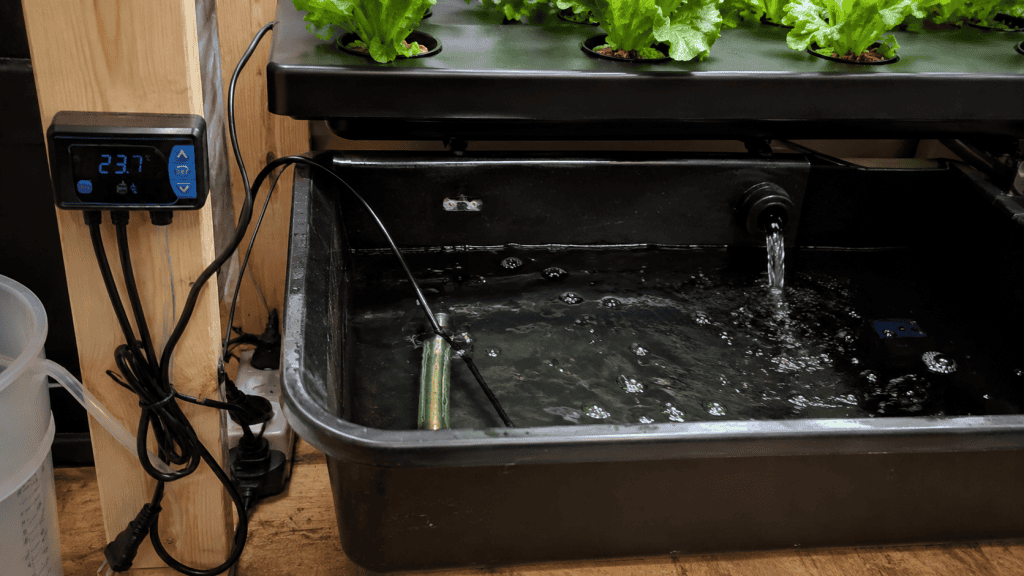
Manual adjustments can work for a while. But conditions change throughout the day, making it hard to keep temperatures steady. That’s where automatic control helps.
A closed-loop system checks the water temperature over and over. If the temperature changes, the controller adjusts the heater or chiller without waiting for someone to step in.
The process is straightforward:
- The sensor measures the water temperature.
- The controller compares it to the target.
- The heater or chiller adjusts.
- The cycle repeats.
Because the system keeps checking itself, temperatures stay much more consistent. Most home systems use one of two controller types. Basic mechanical thermostats rely on bang-bang ON/OFF control with a fixed deadband (hysteresis gap). This causes continuous temperature oscillation around the target setpoint.
A PID controller takes a different approach. Instead of waiting until the water gets too hot or too cold, it reacts earlier and makes smaller adjustments. That helps reduce temperature swings.
Professional sous-vide cookers often use PID control because they can keep water within about ±0.1°C when properly tuned. Still, even the smartest controller can’t fix poor circulation or a badly placed sensor. Those parts need to work together.
Choose the Right Heating Method
Not every system needs the same heater. The best option depends on how much water you have, how fast it moves, and how closely you need to control the temperature.
For many home setups, electric immersion heaters are a solid choice. Nearly all the electricity they use turns into heat inside the water, so very little energy goes to waste.
Here are a few common heating options:
- Immersion heaters
- Inline heaters
- Heat exchangers
- Aquarium heaters for small hydroponic reservoirs
Each one has a place. Small reservoirs usually do well with an immersion heater because it’s easy to install and heats the water directly. Larger systems often use heat exchangers. These keep the heating fluid separate from the water while handling much higher volumes.
Before buying a larger heater, check the water flow first. Poor circulation can create hot spots around the heating element. That uneven heating may stress plant roots, affect nutrient quality, or reduce efficiency. In many cases, improving circulation fixes the problem without adding more heating power. Worth checking first.
Pick a Cooling Method That Fits Your System
Cooling works best when it matches the amount of heat that needs to be removed. A small cooling system may struggle during hot weather. But one that’s too large can switch on and off too often, wasting energy and putting extra wear on the equipment.
For hydroponics, stable water temperatures help roots stay healthy. They also support better oxygen levels and more consistent nutrient uptake. Several cooling methods are commonly used.
| Cooling method | Best for | Keep in mind |
| Compressor chiller | Large reservoirs | Strong cooling power |
| Evaporative cooling | Mild climates | More water loss |
| Thermoelectric cooler | Small systems | Limited cooling |
| Frozen water bottles | Short-term cooling | Need regular replacement |
Compressor chillers provide the most reliable cooling for large reservoirs. Smaller systems may only need better airflow or a little shade. Sometimes the easiest fix is moving the reservoir away from direct sunlight.
Adding insulation can also reduce heat gain, which means the cooling equipment doesn’t have to work as hard. Several small improvements often save more energy than relying on one expensive upgrade.
Natural Cooling Can Make a Difference
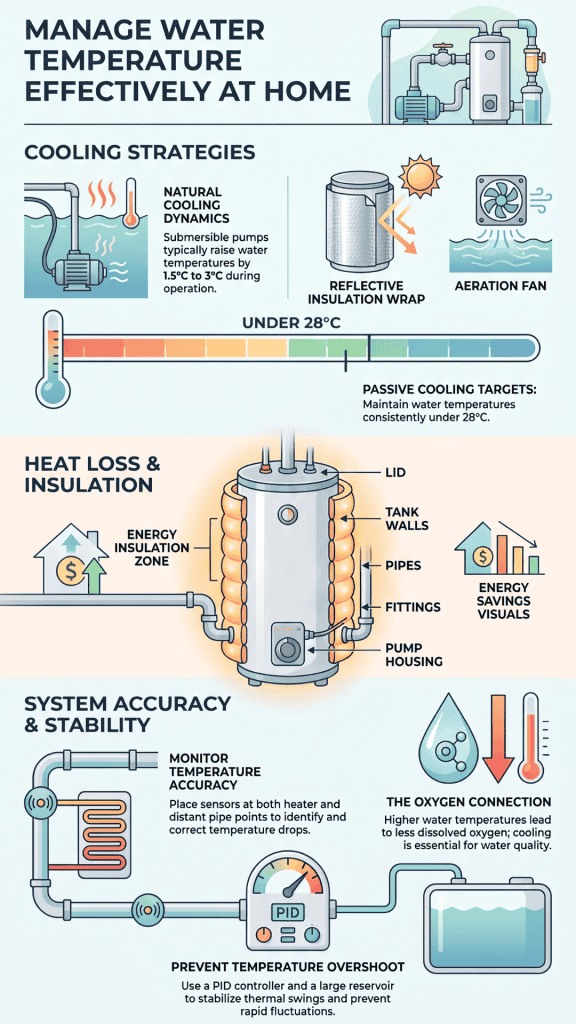
Mechanical cooling isn’t always needed. Continuous-duty submersible water pumps transfer parasitic heat directly into small reservoirs, often raising water ambient temperatures by 1,5°C to 3°C.
Passive heat dissipation techniques, such as reflective insulation wraps and surface aeration fans, manage minor thermal gains but fail when ambient room air exceeds 28°C. These changes won’t replace a chiller during extreme heat. But they can reduce daily temperature swings and lower energy costs. Most people overlook that.
Reduce Heat Loss to Save Energy
Heating water takes energy. Keeping that heat inside the system usually costs less than adding a bigger heater. The U.S. Department of Energy recommends insulating tanks and pipes because it reduces standby heat loss and improves efficiency.
Heat escapes from more places than people expect:
- Tank walls
- Lids
- Pipes
- Fittings
- Pump housings
Every exposed surface allows heat to move into the surrounding air. Closed-cell foam insulation, neoprene sleeves, and insulated covers can all help slow heat loss. In hydroponic systems, insulation also helps reduce temperature swings between warm days and cool nights.
Still, insulation isn’t a magic fix. If the reservoir sits in direct sunlight or the pump adds too much heat, temperatures may still climb. Looking at the whole setup usually leads to better results.
Why the Displayed Temperature Isn’t Always Right
The number on the controller tells you what the sensor measures. It doesn’t always tell you the exact temperature where the water is being used. As water travels through pipes, fittings, or equipment, it can gain or lose heat before it reaches its destination.
Coffee machines are a good example. The boiler may show the correct temperature, yet the water leaving the group head can be a few degrees cooler. The same thing can happen in hydroponics. A sensor near the heater may report the ideal temperature while water reaching the far side of the reservoir is warmer or cooler.
As noted by the University of Maine:
“Water temperature affects the amount of dissolved oxygen and other gases that water can hold at specific atmospheric pressure. A rise in temperature decreases the ability of water to hold oxygen molecules”. – University of Maine
Get confirmation. A few quick checks can give you a much better picture:
- Measure during normal operation.
- Check more than one location.
- Use calibrated sensors.
- Test with water circulating.
Those extra measurements often reveal problems that a single display misses.
Prevent Temperature Overshoot
Thermal overshoot occurs when high-wattage heating elements retain residual energy after the relay cuts power. Several things can cause it. A slow sensor may react too late. Heating elements stay warm even after power is turned off.
And a controller that’s poorly adjusted can allow temperatures to climb higher than expected. Tuning Proportional-Integral-Derivative (PID) parameters pulses energy dynamically, eliminating post-cutoff temperature spikes.
A well-adjusted controller reduces unnecessary cycling and puts less strain on heaters, pumps, and chillers. Larger reservoirs also help because they change temperature more slowly. That makes sudden swings less likely. Small improvements add up over time.
Best Practices for Different Home Systems
Mastering Hydroponic Water Temperature & Quality
Credit: Everything Hydroponics
Every setup is a little different. But the same basic ideas apply almost everywhere. Measure the temperature accurately. Keep the water moving. Use equipment that’s the right size. Reduce unwanted heat gain and heat loss whenever possible.
Here’s how those ideas fit common applications:
- Aquariums: Use a heater with an external temperature controller.
- Coffee brewing: A PID controller helps keep brewing temperatures steady.
- Sous-vide cooking: An immersion circulator provides precise control.
- Home plumbing: A thermostatic mixing valve helps deliver consistent outlet temperatures.
- Hydroponics: Combine a reservoir sensor, steady circulation, insulation, and automatic heating or cooling.
No matter what system you’re using, regular monitoring makes it easier to spot small problems before they become expensive ones.
FAQ
Does water pump heat affect reservoir temperature?
Yes. Water pump heat can gradually raise reservoir temperatures, especially in small systems that run continuously. The extra heat may reduce dissolved oxygen levels and make it harder to maintain the optimal water temperature. Choosing an efficient pump, improving water circulation, and checking water temperature monitoring regularly can help prevent unnecessary heat buildup.
Can beneficial microbes improve root health in warm water?
Beneficial microbes support root health management by helping break down organic matter and competing with harmful organisms. However, they cannot solve problems caused by excessive heat. If hydroponic water temperature stays too high, the risk of root rot prevention and Pythium prevention becomes more difficult. Keeping the root zone temperature stable remains the most effective solution.
Is a digital water thermometer accurate enough for home hydroponics?
A digital water thermometer is accurate enough for most home hydroponic systems when it is properly calibrated and placed in moving water. It provides reliable water temperature monitoring and helps you spot changes before they affect plants. Checking the thermometer regularly also improves water temperature regulation and supports better hydroponic system maintenance.
How can I cool a reservoir naturally without expensive equipment?
Cooling a reservoir naturally works well when temperatures only rise slightly. Move the reservoir into the shade, improve airflow, use a cooling fan for the reservoir, and add reservoir insulation to reduce heat gain. These water cooling techniques help maintain water temperature balance, improve hydroponic climate control, and support healthy hydroponic growing conditions without relying on costly equipment.
Smarter Water Temperature Management for Long-Term Success
Managing water temperature can become frustrating when your system keeps shifting and your plants or aquatic setup start showing the effects. You don’t need constant adjustments, you need a reliable way to keep conditions steady. Consistency matters more than chasing every small change.
Tophydroponicgarden helps simplify water temperature management with dependable monitoring and control support. It gives you a practical way to stay ahead of problems and maintain better system performance over time. A smarter setup starts with making temperature control easier to manage.
References
- https://ui.adsabs.harvard.edu/abs/2018JMetR..32..219Y/abstract
- https://gyre2.umeoce.maine.edu/php/variable_description.php
Related Articles
- https://tophydroponicgarden.com/what-temperature-should-deep-water-culture-be/
- https://tophydroponicgarden.com/water-pumps-for-aquaponics/
- https://tophydroponicgarden.com/what-is-a-good-ph-level-for-hydroponics/
Was this helpful?
