

Large hydroponic reservoirs are easier to manage when water quality, nutrient levels, temperature, circulation, and water use are checked together. Tophydroponicgarden can follow a consistent routine that records these changes over time.
Regular measurements make it easier to spot shifts early and decide when a top-off, adjustment, or closer inspection is needed.
Large Hydroponic Reservoir Quick Wins
Managing a large hydroponic reservoir comes down to consistent testing, trend tracking, and reliable system control.
- Test source water, pH, EC, temperature, and dissolved oxygen instead of relying on assumptions.
- Use EC and water-level trends to guide top-offs and nutrient concentration management, while recognizing that EC cannot identify individual nutrient imbalances.
- Treat circulation, temperature control, sanitation, automation, and backup equipment as parts of one reservoir-management system.
What Should You Monitor in a Large Hydroponic Reservoir?
A large hydroponic reservoir is easier to manage when you track pH, EC, water temperature, dissolved oxygen, and water level together. Each reading can affect the others.
For a reservoir over 100 gallons, the larger water volume can help slow changes in temperature and nutrient strength. But there’s a catch. Once a problem starts, it may take more time to correct.
Commercial hydroponic systems can follow Virginia Tech’s guidance by checking pH and EC daily. Continuous dissolved oxygen (DO) monitoring can also help reduce root health problems in high-volume recirculating systems.
Your crop will set the right targets. As a starting point, many leafy greens do well at a pH of 5.5 to 6.2 and an EC of 1.2 to 2.0 mS/cm. Fruiting crops may need different levels.
A basic monitoring routine can include:
- Check pH and EC daily
- Check water temperature
- Check the water level
- Measure dissolved oxygen when needed
- Look at roots and plant growth
- Check flow and pump performance
Write down each reading. Don’t rely on memory. A record can show a slow change before it turns into a larger problem.
Keep the numbers together. That makes it easier to spot changes and respond before they affect the crop.
Why Does Reservoir pH Keep Drifting?
Persistent pH drift often points to source-water alkalinity, nutrient uptake, aeration, or dosing behavior, not a simple lack of pH Up or pH Down. High alkalinity gives water more buffering capacity. Repeated acid additions may cause temporary changes, followed by another rise in pH.
As highlighted by University of Kentucky Nursery Crop
“Alkalinity is the measure of the water’s ability to neutralize acids. High-alkalinity water neutralizes added acid quickly. This reaction pushes your pH back up. Because hydroponic water lacks natural buffers, your pH can bounce out of range within hours.” – University of Kentucky Nursery Crop
A stable pH routine starts with source water. Test its pH, EC, alkalinity, and major dissolved ions before adjusting the reservoir. If you need to raise the pH in your reservoir, make gradual corrections after the solution has circulated.
Let the reservoir circulate after dosing. An immediate reading may show a local concentration, not the final mixed solution. Don’t blame bubbling for every pH issue. Air stones can add oxygen, so measure DO and pH trends instead.
How Can You Keep Reservoir pH Stable?

Stable hydroponic pH depends on consistent source water, controlled nutrient additions, good mixing, calibrated meters, and gradual corrections.
A large hydroponic system should follow the same pH management steps:
- Measure the reservoir after it has circulated.
- Compare the reading with the crop target.
- Check recent EC, water additions, and nutrient dosing.
- Make a small adjustment.
- Let the reservoir circulate.
- Test again before adjusting it further.
Don’t react to every small change. A reservoir may shift slightly as plants take up water and nutrients. That can be normal. Constantly forcing the pH back to one exact number can cause more trouble.
For larger commercial systems, automated pH control can cut down on manual work. But it shouldn’t replace regular checks. A faulty pH sensor can turn a small calibration problem into a large dosing event.
How Should You Manage EC and Nutrient Concentration?
EC measures the electrical conductivity of dissolved ions. So, it shows overall nutrient concentration, not the full nutrient balance.
Virginia Tech notes that EC can show changes in total fertilizer concentration and help guide adjustments with stock fertilizer or water. Its hydroponic guidance also shows that the right EC depends on the crop and growth stage.
In a large hydroponic reservoir, EC becomes more useful when you track it with water use. A rising EC may mean plants are using water faster than nutrients. A falling EC may mean nutrient uptake is faster than water loss, or that the system recently received low-EC water.
The trend matters more than one reading.
To spot trends before your crop shows stress, keep a clipboard right next to your reservoir. Log these six data points every morning at the exact same time:
- Total Reservoir Volume (Gallons/Liters)
- Pre-Top-Off EC vs. Post-Top-Off EC
- Exact Nutrient Dose Added (mL or grams)
- Daily Water Consumption Rate (Gallons lost per day)
- Current Growth Phase (Vegetative vs. Bloom)
- Ambient Canopy Temp & Humidity
Nutrient mixing also needs care. Virginia Tech recommends mixing fertilizers separately, following the label directions, before adding them to the reservoir.
What Does Rising or Falling EC Tell You?
A rising EC usually means dissolved ions are becoming more concentrated. A falling EC can point to dilution or higher nutrient uptake compared with water loss.
Consider a 100-gallon reservoir that loses 10 gallons through transpiration. If you replace those 10 gallons with low-EC water, the measured concentration may drop without adding nutrients. Add concentrated fertilizer instead, and EC could rise too high if the reservoir is already concentrated.
So, measure the reservoir before topping it off.
When EC rises while the water level drops, plants may be taking up water faster than dissolved nutrients. A common correction is to top off with pure RO water to the baseline level, allow the pump to circulate the reservoir for 20 minutes, and then retest EC before adding stock nutrients.
This approach helps confirm the actual nutrient concentration after the reservoir has mixed. Further nutrient adjustments can then be based on the new EC reading rather than an immediate measurement. If both EC and water level fall, plants may be taking up nutrients faster than water. But EC alone can’t show which specific nutrients are low.
Should You Replace a 100+ Gallon Reservoir on a Fixed Schedule?
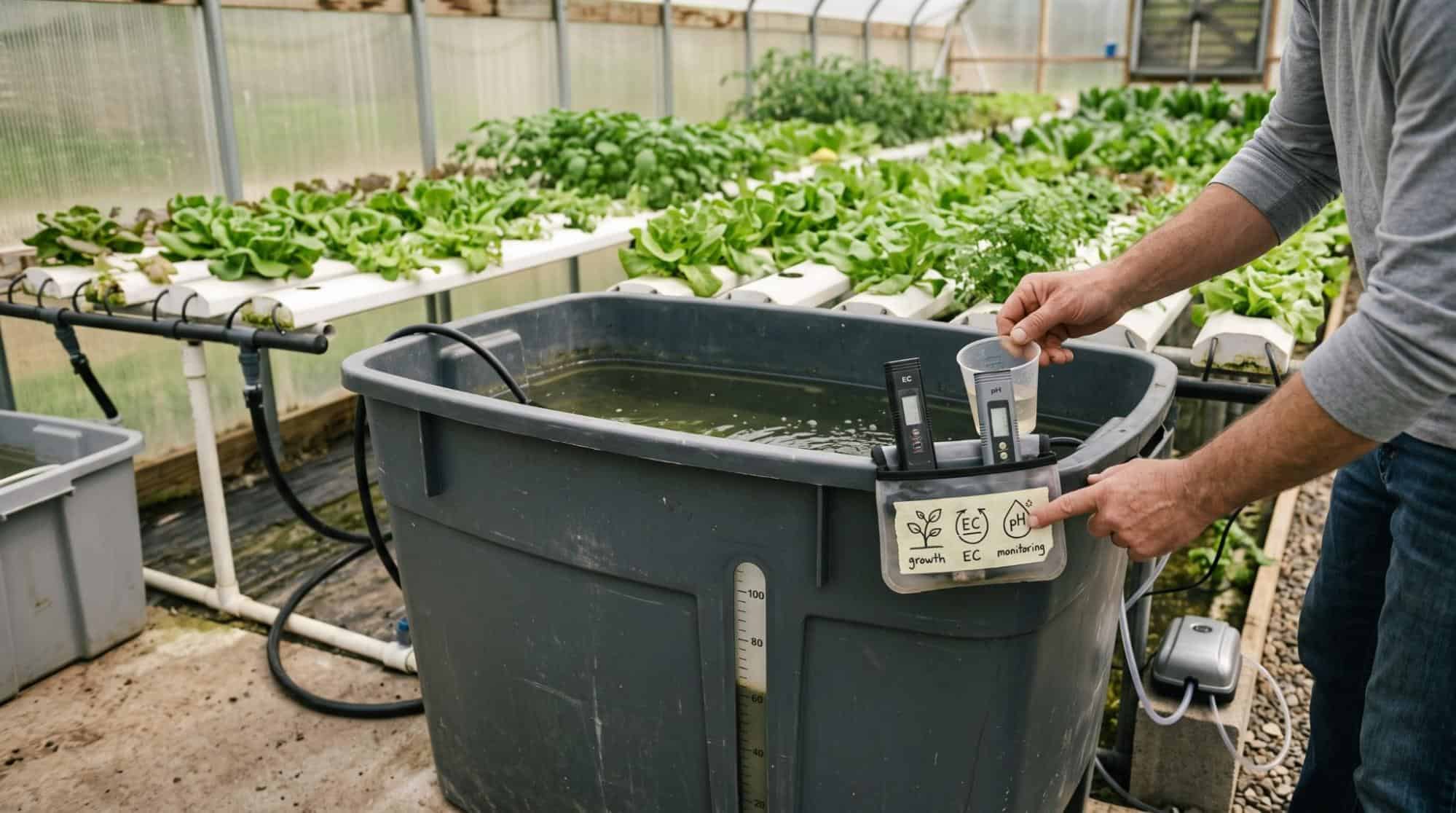
A 100+ gallon reservoir doesn’t automatically need a full change every 7 or 14 days. The timing should depend on water quality, crop demand, nutrient balance, contamination, and system performance. Fixed schedules can be useful as a basic rule, but they may waste fertilizer when the solution is still suitable.
Research from Greenhouse Grower shows
“However, maintaining a constant solution EC does not guarantee an adequate, long term nutrient supply. A recent e-GRO Edibles Alert from researchers at the University of Arkansas provides a real-world scenario where maintaining a target solution EC resulted in nutrient deficiency” – Greenhouse Grower
So, the better question isn’t only when to dump the reservoir. It’s whether the solution still suits the crop.
A measured refill approach can cut waste. Track total top-off volume, EC trends, plant performance, source-water makeup, and, when needed, lab nutrient tests.
When Does a Full Reservoir Change-Out Make Sense?
Replace the full nutrient solution if the reservoir is contaminated, nutrient levels are far out of balance, EC starts acting strangely, disease is suspected, or unwanted ions have built up too much.
In a recirculating system, plants don’t use every nutrient at the same rate. Some nutrients can build up while others get depleted. So, even when EC looks normal, the nutrient mix may no longer suit the crop.
For commercial growers, lab testing can help decide what to do. If the results look good, keep using the solution. If they don’t, replace it with a fresh mix.
How Can You Prevent Nutrient and Salt Imbalances?

Credits: Monster Gardens
Good nutrient management starts with the source water. Test it before adding fertilizer, and know what it brings into the final nutrient mix. Source water may contain calcium, magnesium, sodium, chloride, sulfate, bicarbonate, and other ions. These can affect your nutrient mix and may build up in a recirculating system.
Different nutrient refill methods can also cause different buildup over time. Calcium, magnesium, and sulfate may change in different ways. EC can’t tell you which ion is building up. Two reservoirs can have the same EC but very different nutrient levels.
A full water-quality check should include:
- EC and pH
- Alkalinity
- Calcium and magnesium
- Sodium and chloride
- Sulfate
- Source-water contaminants
- Crop nutrient needs
Reverse osmosis water can help when source water has too much salt or alkalinity. But not every hydroponic system needs RO water.
Why Does Source-Water Quality Matter in Large Reservoirs?
Source-water quality matters because every dissolved ion added to a large reservoir stays part of the system. When choosing a food-safe hydroponic reservoir, the tank material and water-contact surfaces also deserve attention.
Before production, get an irrigation-water test. Repeat the test at least once a year. The results can show excess minerals and give you the alkalinity level needed for pH management.
In a 100-gallon reservoir, even a small amount of a dissolved mineral can add up after repeated top-offs. That buildup can become harder to ignore over time.
This matters even more in recirculating hydroponic systems. Plants don’t take up every nutrient at the same rate, while water keeps leaving the system through transpiration and evaporation.
How Should You Manage Dissolved Oxygen?
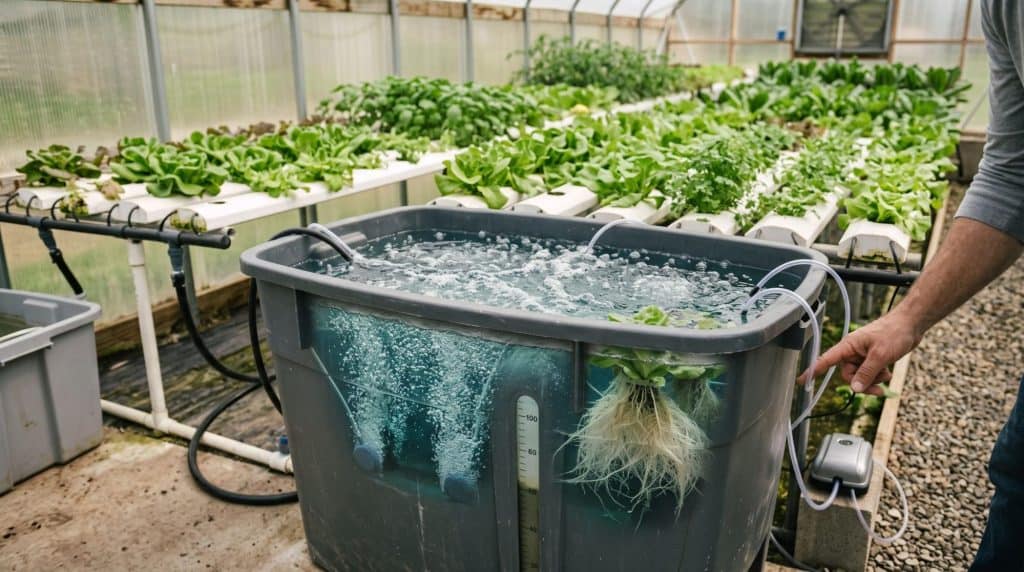
Large hydroponic reservoirs need enough dissolved oxygen (DO) for healthy roots. Use measured oxygenation, good water movement, and temperature control. Don’t assume bubbles alone are enough.
A DO level of 7 to 10 ppm can support strong growth and help lower disease risk. Some system guidance also sets about 4 ppm as a minimum.
Recent 2025 research on Deep Water Culture (DWC) systems found stronger growth in leafy greens when dissolved oxygen (DO) levels stayed above 15 mg/L. In a kale system, raising DO from the standard 8 mg/L range to 14 mg/L with micro-bubblers was followed by visibly thicker root structures within two weeks.
These findings suggest that dissolved oxygen levels can affect root development in DWC systems. However, results from one system should not be treated as a universal target for every crop or setup.
Those numbers aren’t universal targets. Oxygen levels depend on the crop, water temperature, oxygen demand, and equipment.
Are Air Stones Always the Best Choice for Large Reservoirs?
Air stones can work in large reservoirs, but they aren’t the only option. Check DO before deciding that the tank needs more bubbling.
The main issue with a large tank is getting even mixed. In a 150-gallon tank, relying only on air stones can leave areas with poor circulation.
A submersed 800 GPH wavemaker paired with a Venturi intake can improve water movement and help reduce temperature differences across the reservoir. In one facility, this setup kept dissolved oxygen (DO) at about 8.5 ppm across the tank.
The results show why circulation equipment matters in large reservoirs. Air stones can provide oxygen, but additional water movement may be needed to improve mixing throughout the tank.
Some growers prefer wavemakers in large systems. That can be useful field experience, but it isn’t the same as controlled research.
The better rule is simple: check DO, look at the roots, and make sure water moves throughout the reservoir.
How Does Water Temperature Affect Reservoir Oxygen?
Cooler water can hold more dissolved oxygen than warmer water. So, keeping reservoir temperature in the right range matters for root health.
A 2025 study noted this link between water temperature and DO. In one study, cooling a cucumber root zone from 33°C to 22°C raised DO from about 5 to 8 mg/L.
That doesn’t mean every crop needs the same water temperature. Crop needs vary, and water that gets too cold can cause problems too.
For a large reservoir, set a temperature range that fits the crop and keep an eye on it. Continuous monitoring can help when temperature changes may affect plant growth.
Why Can Large Reservoirs Develop Temperature Gradients?
Large reservoirs can have different water temperatures in different areas. Tank shape, pump heat, room temperature, sunlight, insulation, and equipment placement can all affect the water.
A sensor near the return line may not show the temperature near the plant roots. The same issue can happen with a chiller. It may keep the water near its sensor cool while another part of the tank stays warmer.
So, check more than one spot when needed. Don’t rely on a single probe without knowing what it’s measuring.
Insulate exposed tanks, block direct sunlight, and remove avoidable heat sources before adding a chiller. These steps can reduce the cooling load.
A chiller isn’t always needed. In a climate-controlled room with an insulated reservoir, passive cooling may be enough. In a warm commercial setup, active cooling can make more sense.
How Can You Improve Circulation in a 100+ Gallon Reservoir?
A large reservoir needs good circulation to keep nutrients, temperature, and dissolved gases fairly even. It also helps prevent stagnant areas and settled material.
Use a pump that can run continuously and can handle the system’s flow and head pressure. Larger systems often use centrifugal pumps instead of small submersible pumps.
Pump placement matters too. Aim the outlets across the tank so water reaches the whole reservoir. Opposing outlets, angled returns, or well-placed circulation pumps can help reduce dead spots.
Protect the irrigation system as well. Check filters, tubing, emitters, valves, and pump intakes on a regular basis. Sediment and biological material can leave the reservoir and cause problems farther down the line.
Where Should Circulation Equipment Be Positioned?
Set up the pumps and return lines so water moves around the whole tank. Don’t let all the flow stay in one part of the reservoir.
Aim the return lines toward areas where water may sit still. Keep pump intakes away from settled debris when you can, but make sure they still pull water from the main body of the reservoir.
If your system has several tanks or long runs of pipe, check temperature and EC at different points during setup. If the numbers don’t match, you may have a circulation problem that one sensor won’t show.
How Should You Automate Reservoir Top-Offs Safely?
Safe automated top-off requires a level sensor, a controlled water supply, independent high-level protection, and a tested shutdown system.
A float valve can maintain water level mechanically, while an electronic level sensor can control a solenoid or pump. Either approach can fail, so large systems should avoid relying on one component as the only flood protection.
A robust setup can include:
| Component | Primary function | Backup consideration |
| Level sensor | Detect falling water | Independent high-level sensor |
| Solenoid or pump | Add water | Manual shut off |
| RO holding tank | Supply low-salt water | Limited tank capacity |
| High-level switch | Stop filling | Separate control circuit |
| Overflow route | Contain failure | Drain to safe location |
| Controller | Automate operation | Manual override |
Top-off water should be measured before nutrient dosing. If you need to top off your hydroponic reservoir, check its current EC and water level first. If transpiration has concentrated the reservoir, adding more fertilizer before restoring volume can exaggerate the EC increase.
How Can You Prevent an Auto-Top-Off Flood?
An automated top-off should have more than one way to stop the water. If a float, sensor, or solenoid fails, another safety device should stop the fill.
Use a separate high-level shutoff, add a maximum fill timer when it makes sense, and keep a manual shutoff where it’s easy to reach. Test what happens when each part fails before leaving the system alone.
This matters even more with large reservoirs. A stuck valve on a 10-gallon tank is one problem. A stuck valve connected to a large RO supply can cause a much bigger mess.
What Maintenance Schedule Works for a Large Hydroponic Reservoir?
A good maintenance schedule combines daily readings with regular equipment checks, water testing, and cleaning when needed.
| Frequency | Main tasks |
| Daily | Check pH, EC, temperature, water level, plants, and water flow |
| Several times weekly | Review trends and check circulation |
| Weekly | Inspect pumps, tubing, filters, sensors, fittings, and air equipment |
| Periodically | Test source water and check nutrient balance |
| As needed | Clean and sanitize equipment based on the manufacturer’s instructions |
Check pH and EC regularly. Some hydroponic systems may need these checks two or three times a week. Large commercial reservoirs may need more frequent checks because a problem can affect more plants and take longer to fix.
What Should You Check During a Daily Inspection?
Check the reservoir every day. Look at the water chemistry, level, temperature, circulation, and plants before a small change turns into a bigger problem.
Check pH and EC first. Then look at the water temperature and level. Make sure the pump is running, tubing and filters look clear, and the roots or plants show no obvious problems.
Write down every change you make. A basic log with pH, EC, water added, fertilizer added, and temperature can show a pattern that one reading might miss.
What Backup Equipment Should a Large Reservoir Have?
A large hydroponic system should have backup equipment and a documented failure procedure because pump or power failures can affect the entire crop quickly.
At minimum, consider:
- Backup circulation pump
- Rapid drainage pump or dedicated drain
- Spare tubing, fittings, and clamps
- Spare pH and EC sensors
- Backup air or oxygen equipment when required
- Independent overflow protection
- Backup power for critical controls where practical
- Written emergency procedures
How Can You Prepare for Pump or Power Failure?
Prepare before something goes wrong. Know how long your plants can stay safe without normal water circulation, oxygenation, or climate control.
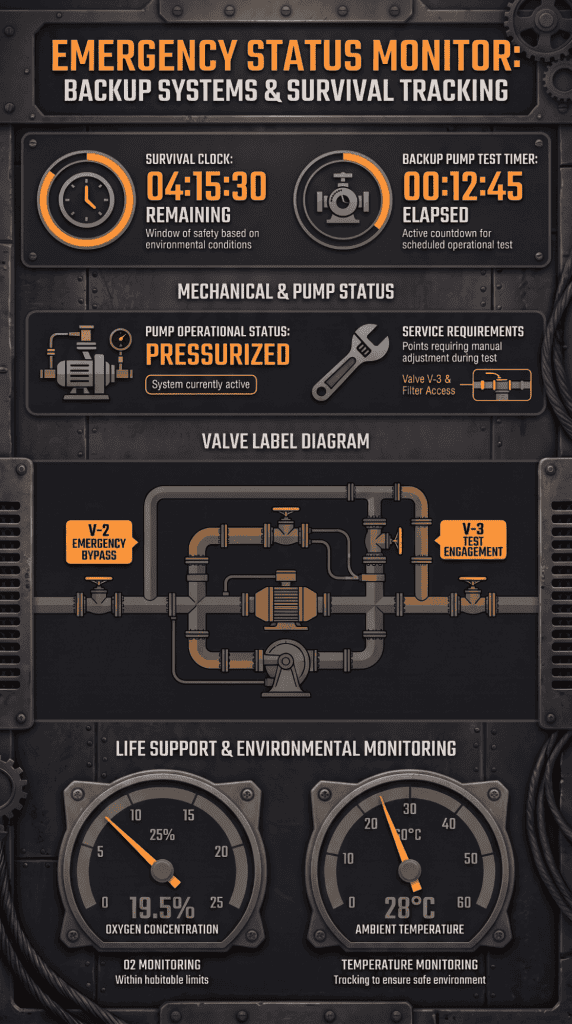
Test the backup pump before you need it. Label valves and electrical connections so they’re easy to find. Keep spare parts nearby instead of putting them somewhere hard to reach.
For commercial systems, have a clear emergency plan. It should say who shuts down the pumps, who checks the reservoir, who checks DO and temperature, and who gets the irrigation running again.
Turning Large-Reservoir Management Into a Repeatable System
Hydroponic can manage large reservoirs with regular checks, clear routines, and useful automation. Fixed rules don’t always fit every crop or water source. The main tasks should connect. Check the reservoir, keep the water moving, manage nutrients, control top-offs, and keep maintenance records.
A monitoring system can put pH, EC, temperature, water level, and DO on one dashboard. Automated dosing can use these readings, but an operator should still be able to take over manually. The goal isn’t to run the whole system without people. It’s to make problems easier to spot and reduce mistakes that could throw the reservoir out of balance.
How Can You Turn Reservoir Management Into a Repeatable Routine?
A good routine uses the same checks under the same conditions. Record them in the same place each time.
For example, check the reservoir at the start of each production day. Record pH, EC, temperature, water level, and DO. Then compare those numbers with the last set of readings.
This makes changes easier to spot. A slow shift may need a small adjustment. A sudden change could point to a failed pump, contamination, wrong dosing, or a bad sensor.
Automation needs the same care. A controller shouldn’t react to every reading. Set safe limits, give the water time to mix, and send an alert when a reading moves outside the normal range.
FAQ
How do I decide when a large reservoir needs a complete water change?
A complete water change makes sense when the nutrient solution becomes difficult to correct, contaminated, or chemically unbalanced. During large hydroponic reservoir management, repeated adjustments can gradually change the solution profile.
Track EC, pH, water quality, and plant response first. If corrections no longer work, follow your hydroponic water change schedule and replace the solution instead of adding more nutrients.
What should I do if my reservoir water level keeps dropping between checks?
First, check for leaks, clogged plumbing, evaporation, and unusually high plant uptake. Then compare the current reservoir level with your normal nutrient solution volume. For hydroponic water level management, top off with suitable water and record how much you add.
Frequent reservoir top-offs can dilute nutrients, so check EC afterward and investigate sudden changes instead of repeatedly adding water.
How can I tell whether my source water is causing nutrient problems?
Start by testing your source water before mixing nutrients. Check pH, alkalinity, EC, and other relevant water quality measures. High alkalinity can make pH management more difficult, while inconsistent source water can affect nutrient solution mixing.
If your local water quality varies, choose a treatment method based on test results. Regular hydroponic water testing helps separate water-related problems from nutrient or crop problems.
When should I clean and sanitize a large reservoir between crop cycles?
Clean and sanitize the reservoir when the system shows signs of contamination, heavy biofilm, algae buildup, or root debris. Planned cleaning between crop cycles also reduces the risk of carrying problems into the next crop.
Hydroponic reservoir cleaning should include the tank, plumbing, pumps, and other surfaces that contact the nutrient solution. Proper sanitation supports root pathogen prevention and consistent hydroponic reservoir maintenance.
What records should I keep to spot problems in a large recirculating system?
Record water additions, nutrient additions, EC, pH, temperature, alarms, cleaning dates, and unusual crop changes. In large-scale hydroponics, these records make hydroponic reservoir monitoring easier because you can compare normal readings with sudden changes.
Track trends rather than isolated measurements. Over time, your log can reveal recurring problems with nutrient concentration management, water quality, or equipment across growing cycles.
What Is the Best Way to Manage a 100+ Gallon Hydroponic Reservoir?
Managing a 100+ gallon hydroponic reservoir can feel demanding because small changes affect a lot of solutions, and problems may take longer to notice. Reality check, bigger reservoirs don’t remove the need for consistent monitoring.
The practical approach is to track your reservoir closely and adjust it based on your crop’s needs. Tophydroponicgarden can be a helpful shortcut when you want straightforward guidance for managing a larger hydroponic system, especially when you’re building a routine around water quality, nutrients, and equipment checks.
References
- https://nursery-crop-extension.mgcafe.uky.edu/sites/nursery-crop-extension.ca.uky.edu/files/knv_alkalinity_0.pdf
- https://www.greenhousegrower.com/production/tips-on-nutrient-replenishment-in-hydroponic-production/
Related Articles
- https://tophydroponicgarden.com/choosing-a-food-safe-hydroponic-reservoir/
- https://tophydroponicgarden.com/how-to-top-off-your-hydroponic-reservoir/
- https://tophydroponicgarden.com/how-to-raise-the-ph-in-your-reservoir/
Was this helpful?

I’m Barrie L., a passionate hydroponic gardening enthusiast dedicated to cultivating thriving, soil-less gardens. With a focus on all things hydroponic, I share my expertise on innovative growing techniques and sustainable practices through my blog, tophydroponicgarden.com. As a seasoned hydroponics specialist, my goal is to inspire and guide fellow gardeners in harnessing the power of water-based cultivation for bountiful and eco-friendly harvests. I’m also an author of the book “Hydroponics For Absolute Beginners: Your Step By Step Guide For How To Create An Hydroponics System At Home Without Soil, For Growing Vegetable, Fruit And Herbs.” which is sold on Amazon. Join me on a journey of redefining the way we cultivate plants, one nutrient-rich solution at a time. Happy growing!