

Hydroponic peppers grow faster, produce higher yields, and often deliver more consistent fruit quality than soil-grown plants.
One study on the Istra hybrid pepper reported yields of 12.36 kg/m² in a hydroponic rockwool system, showing what’s possible when growing conditions are carefully controlled.
And that’s a big reason so many growers choose hydroponics. It puts nutrition, water, oxygen, and climate under direct control, whether you’re growing bell peppers, chili peppers, or other Capsicum annuum varieties.
Keep reading to learn which systems, feeding strategies, and growing techniques help produce strong plants and heavy harvests.
Pepper Hydro Basics You Should Not Miss
A quick wrap-up of the most important foundations before growing peppers in a hydroponic system. These points help you avoid common mistakes and keep plant growth stable from seedlings to harvest.
- Stable nutrient environment is non-negotiable
Peppers perform best when pH stays between 5.5 and 6.5, and EC levels are monitored regularly. This keeps nutrient uptake efficient and prevents deficiencies that slow growth or reduce fruit quality. - System capacity must match plant size and demand
Choose a hydroponic setup that can support deep root development and long growth cycles. Peppers are not lightweight crops, so weak or shallow systems often lead to stress and poor yields. - Consistency in environment matters more than frequent changes
Instead of constant adjustments, focus on maintaining stable conditions, light, temperature, humidity, and nutrient levels. This reduces plant shock and supports steady flowering and fruiting over time.
Which Hydroponic System Works Best for Peppers?
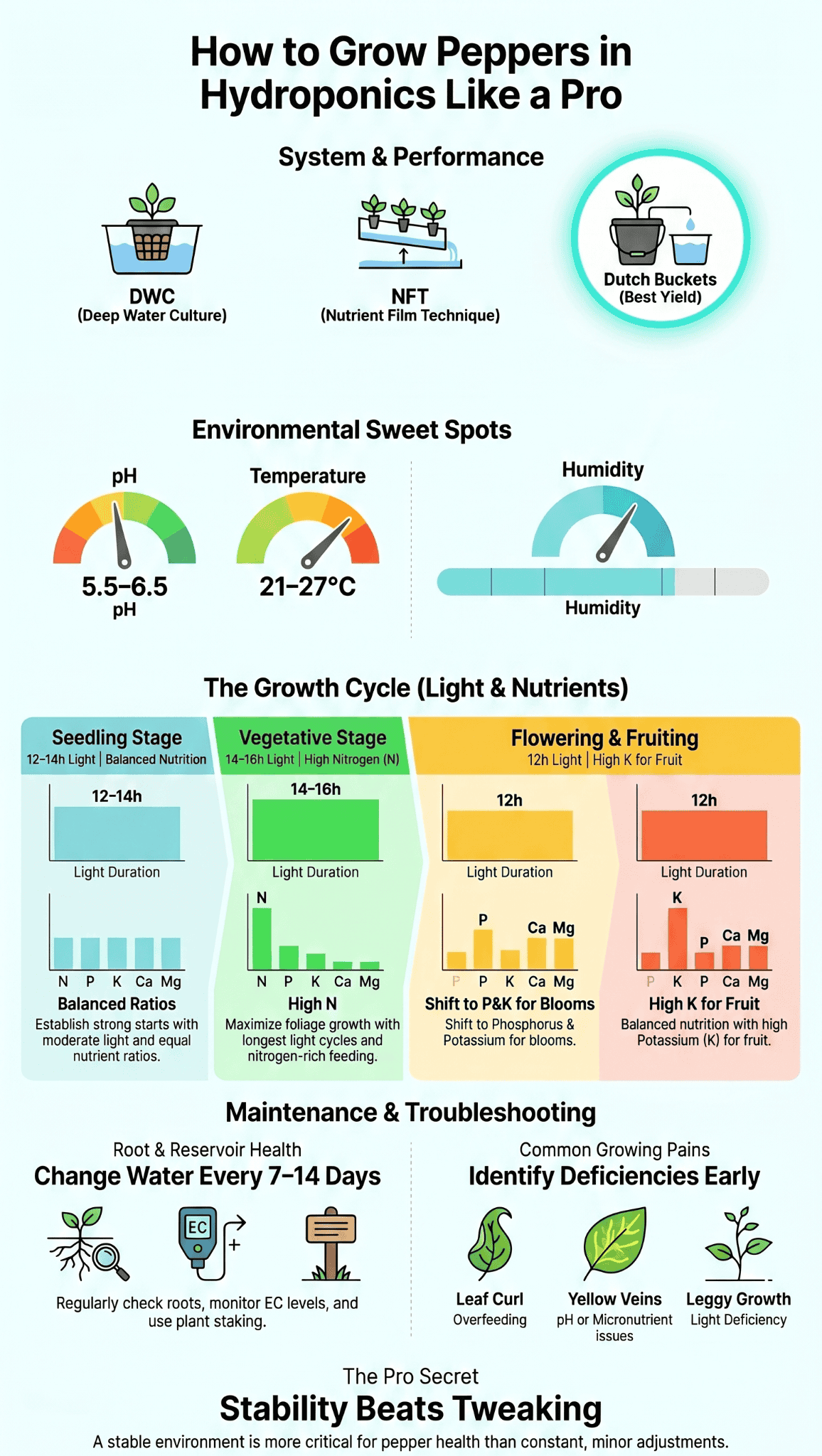
So, which hydroponic system is best for peppers? For a big, productive plant, most experienced growers point to Dutch Buckets.
Peppers are heavy feeders with sprawling roots. The system you use has a direct impact on how sturdy your plant gets, how big the fruit swells, and ultimately, how much you harvest.
Why Pepper Roots Need Room
It’s simple: a bigger plant needs a bigger foundation. A mature pepper develops a dense, thirsty root ball. Cram that into a small space, and you’re asking for trouble, disease can spread easier, roots fight for food, and the plant’s growth gets stunted.
Many growers find a single pepper plant can easily fill the space of a 4-gallon bucket by the time it’s producing.
Let’s look at three popular choices.
Deep Water Culture (DWC) is the go-to for beginners. You suspend the plant’s roots in a nutrient-rich, oxygenated bath. It’s straightforward, but there’s a cap on how many plants you can fit per reservoir.
Nutrient Film Technique (NFT) is a favorite for its water efficiency. A shallow stream of nutrient solution constantly flows past the roots in a sloped channel. The catch? It demands vigilant monitoring; a pump failure can wipe out a crop in hours.
Dutch Buckets are the heavyweight champs for peppers. They give roots a large, loose medium to expand into, like perlite or clay pebbles, and deliver nutrients via a drip system. This offers incredible support and precise feeding control for large fruiting plants. The trade-off is a higher upfront cost for the buckets and irrigation lines.
In practice, DWC is common in home setups, while Dutch Buckets are a standard for commercial hydroponic pepper operations. The stability and root space they provide are hard to beat for a high-yield crop.
If you’re planning to grow multiple crops together, understanding which plants can share a hydroponic system also helps you avoid overcrowding and nutrient competition.
How Much Light Do Hydroponic Peppers Need?
Peppers are sun-worshippers. To flower heavily and produce dense fruit indoors, they need intense light. It’s the non-negotiable fuel for their growth. As many growers put it, photons are literally their food.
While sunlight is ideal, indoor growers typically use full-spectrum LED lights. They deliver the necessary punch without the excessive heat of older HID systems.
The key isn’t the light source itself, but the sheer amount of light energy you provide, especially once the plant starts flowering.
Weak light leads to weak plants. It directly controls how fast your peppers grow, how many flowers they set, and ultimately, the size and number of fruits.
This becomes even more important when growing compact or dwarf plant varieties, since maximizing light efficiency helps them produce consistently in limited space.
A common mistake is blaming poor growth on nutrients and cranking up the feed, when the real issue is simply not enough light.
A Lighting Schedule by Growth Stage
| Growth Stage | Light Duration | Primary Nutrient Focus | Key Goal |
| Seedling | 12–14 Hours | Mild/Balanced | Root establishment |
| Vegetative | 14–16 Hours | High Nitrogen | Structural & Leaf growth |
| Flowering/Fruiting | 12 Hours | P, K, Calcium, Magnesium | Flower & Fruit development |
The bottom line? Don’t skimp on light. Investing in a quality light with high intensity (measured in PPFD) is the single most important factor for a successful indoor pepper harvest.
What Environmental Conditions Produce Healthy Pepper Plants?

For hydroponic peppers to thrive and fruit well, consistency is key. Stable temperature, controlled humidity, and good airflow aren’t just nice-to-haves, they’re the foundation for healthy roots, effective pollination, and problem-free harvests.
Aim for daytime temperatures between 21°C and 27°C. Letting it drop a few degrees at night mimics natural conditions. Avoid letting things climb above 32°C for long periods; heat stress will shut down growth.
Don’t forget to check your reservoir water temperature too, as warm roots are unhappy roots.
Keep relative humidity in the 50-70% range. Too high, and you invite fungal diseases; too low, and the plant struggles with transpiration. This is where fans become essential.
Constant, gentle airflow around the foliage prevents stagnant, humid pockets and strengthens plant stems. It also helps the plant move calcium effectively, which is crucial for preventing issues like Blossom End Rot.
As noted by International Society for Horticultural Science,
“Research published by the International Society for Horticultural Science demonstrates the direct link between humidity and calcium transport in peppers. The study found that fruits grown under high humidity (85-90%) had 40% more calcium in their distal half than those grown under drier conditions. Conversely, fruits affected by Blossom End Rot had 56.3% less calcium in that same area. The research also noted a remarkable increase of up to 27.8% in the number of vascular bundles in fruits from humid environments, which is essential for nutrient transport and directly supports the prevention of this common disorder.” – International Society for Horticultural Science
Speaking of which, research points to extreme conditions as a primary trigger for Blossom End Rot. When temperatures soar past 35°C and humidity climbs above 90%, the plant’s ability to transport calcium breaks down, making the disorder much more likely.
The pro move is to install oscillating fans. They don’t just cool things down; they build tougher plants and create an environment where diseases struggle to take hold.
How Do You Germinate and Transplant Pepper Seedlings?
A strong harvest begins with a vigorous seedling. The process is straightforward but requires attention to a few key details.
The easiest method is to use a sterile starter medium. Most growers use pre-soaked rockwool cubes or coconut coir plugs. Place your seeds about 6mm deep. Keep them warm, aim for a steady temperature between 25°C and 28°C for the fastest, most even germination.
The medium should be moist but never waterlogged. Once the sprouts break the surface, give them gentle light to prevent leggy growth.
Don’t rush the move to your main system. Wait for clear signs the seedling is ready:
- It has developed 3 to 4 sets of true leaves (not just the initial seed leaves).
- A network of healthy, white roots is visibly escaping the starter cube.
- The plant is showing active, new growth.
Transplanting at this stage minimizes shock. Gently place the entire starter cube, roots and all, into its final home in your Dutch Bucket or DWC system. The existing roots will quickly colonize the new, larger root zone.
Which Nutrients Do Peppers Need at Each Growth Stage?
You can’t feed a seedling and a fruiting plant the same way. Pepper nutrient needs shift dramatically as they grow, and getting the ratio right makes all the difference.
Changing Focus by Stage
- Seedling Stage: Start with a mild, balanced nutrient solution. The goal is steady growth without overwhelming the young plant.
- Vegetative Stage: As leaves and stems shoot up, the plant craves more Nitrogen. This fuels the green, structural growth that will later support fruit.
- Flowering Stage: When blooms appear, switch the priority. Phosphorus becomes key for flower development and strong root systems, while Potassium supports overall plant health and prepares it for fruiting.
- Fruiting Stage: Maintain a balanced feed that supports the swelling fruit. Potassium remains crucial here for fruit quality and ripening.
Don’t get fixated only on the big three (N-P-K). Calcium is a silent hero. It’s vital for building strong cell walls, which directly prevents issues like Blossom End Rot and improves fruit firmness. Magnesium is the core of chlorophyll; without it, photosynthesis suffers. Both need to be consistently available in your solution.
In a recent analysis by Journal of Plant Nutrition,
Research published in the Journal of Plant Nutrition examined calcium uptake in bell peppers grown hydroponically. The study found that calcium uptake was highest at bloom and during fruit expansion, making the fruit development stage the highest demand period. Critically, the research demonstrated that tissue calcium levels in the blossom-end of the fruit were reduced whenever ammonium (NH4⁺) was included with the nitrogen supplied, and that pepper yields are higher when nitrate (NO3⁻) is the predominant form of nitrogen. This strongly suggests that calcium fertilizer applications should precede the bloom period and continue during fruit development to ensure adequate calcium availability.” – Journal of Plant Nutrition
An interesting study on Beti-R bell peppers found that a 75% strength nutrient solution actually outperformed a full-strength mix, yielding 24.19 tons per hectare. This is a useful reminder: more isn’t always better.
Pushing a too-strong feed can harm roots and disrupt uptake, especially if other factors like light or environment aren’t optimal. The best approach is to start with a manufacturer’s recommendation for peppers and adjust based on how your specific plants look.
Why Is pH Important in Hydroponic Pepper Growing?
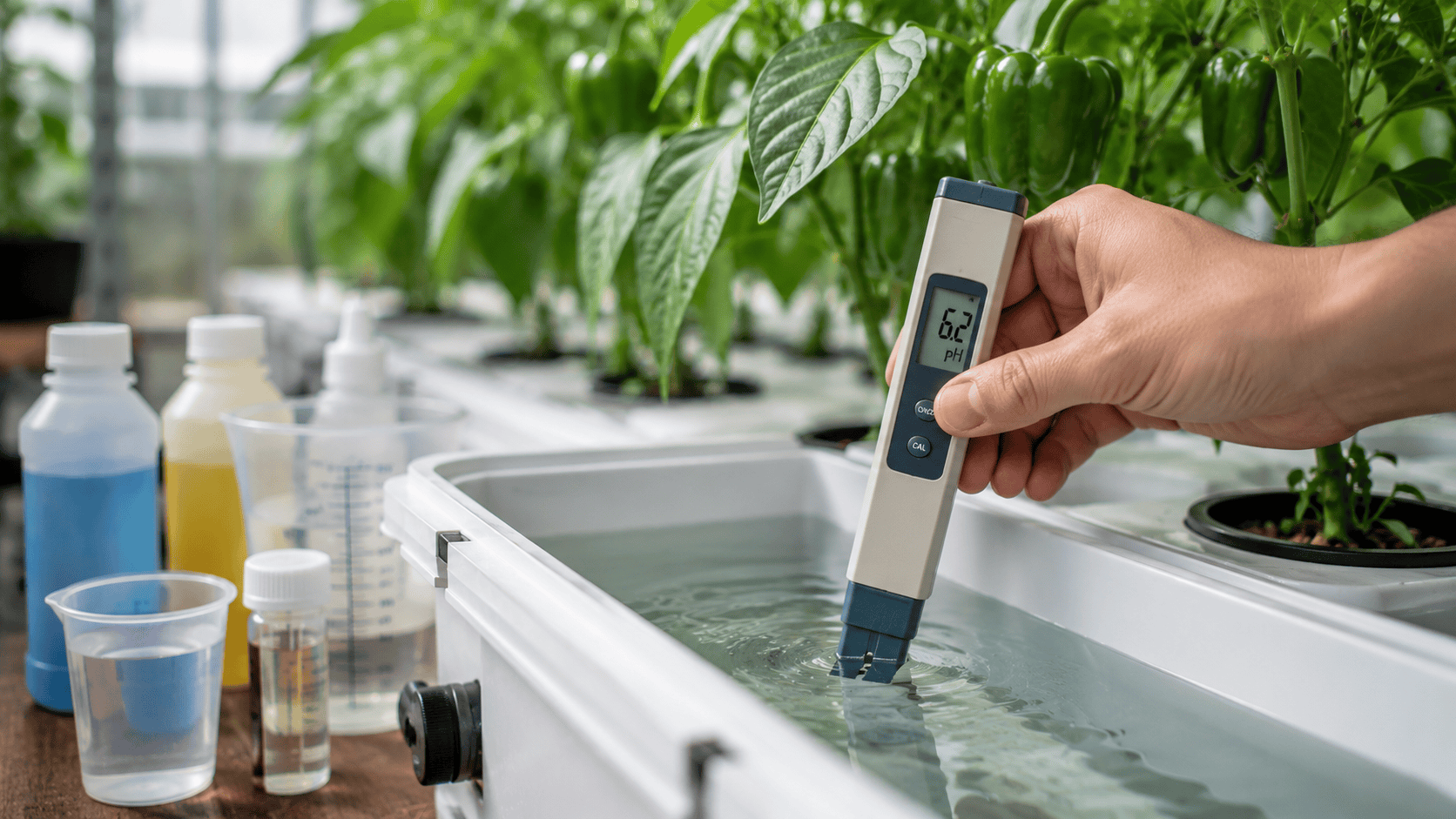
Getting the nutrient mix right is only half the battle. If your water’s pH is off, your plants can’t access that food, no matter how perfect your formula is.
For peppers, you want to maintain a pH between 5.5 and 6.5. This slightly acidic range is where all the essential nutrients dissolve properly and remain available for the roots to absorb. Large swings outside this window can lock out key elements, leading to mysterious deficiencies even in a well-fed system.
You can hit a perfect pH of 6.0 on your meter and still have problems. The culprit is often your source water. If it has high alkalinity (lots of dissolved carbonates), it acts as a buffer, constantly fighting to pull your pH back up.
This creates instability and can lead to nutrient lockout over time. In areas with very hard water, using a reverse osmosis filter to purify your water before adding nutrients is often the only way to achieve real stability.
Research, like the work from New Mexico State University, consistently backs the 5.5-6.5 range. It’s not just about availability; it also prevents nutrients from precipitating out as solid salts, which clogs systems and wastes fertilizer.
Check and adjust your pH regularly, it’s the most basic, yet most critical, daily task in hydroponics.
What Is the “Over-Care” Mistake New Growers Make?
New hydroponic growers often make one critical mistake: they care too much. In an effort to optimize everything, they constantly tweak the pH, fiddle with nutrient strength, or change the light schedule.
This flood of small adjustments creates instability, which stresses plants more than a slightly imperfect setting ever would.
It’s easy to think that more monitoring and more correction automatically lead to better results. In reality, plants operate on a delay. They need time, often days, to visibly respond to a change in their environment.
Changing the inputs again before they’ve had that chance only confuses them. You end up chasing your tail, creating new problems like wild nutrient fluctuations.
Experienced growers learn to observe first, intervene only when necessary, and then let the system settle. This approach reduces plant stress, allows the roots to adapt, and ultimately builds a more resilient crop.
The goal isn’t a perfectly dialed-in number on a meter every single hour; it’s a stable environment where the plant can establish a steady rhythm.
As many in grower forums will tell you, the urge to over-manage is a leading cause of disappointing yields. Watch your plants, not just your instruments. If they look healthy and are growing, sometimes the best thing to do is nothing at all.
How Do You Pollinate and Prune Hydroponic Peppers?

credits : Pepper Geek
Growing peppers indoors means you take on jobs that nature usually handles. Without wind or bees, you become the pollinator. And without the competition of an outdoor garden, you need to guide the plant’s growth through pruning.
Manual Pollination is Simple
When flowers are open and healthy, you have a few easy options. Gently shaking the plant stem can dislodge pollen. A small, soft paintbrush lets you carefully collect pollen from one flower and dab it onto the stigma of another.
The key is to do this regularly throughout the flowering period. It only takes a minute, but it’s essential for fruit to set.
To Prune or Not to Prune?
For many pepper varieties, especially larger ones, strategic pruning pays off. “Topping” the main stem, snipping off the very top growth tip, encourages the plant to bush out, creating more side branches.
More branches mean more potential sites for flowers and fruit. It also creates a sturdier, more manageable plant structure.
Support is non-negotiable for a loaded plant. Set up stakes, a trellis net, or cages early, long before the fruits start weighing down the branches. Trying to prop up a heavy, leaning plant later often leads to snapped stems.
A mature, fruiting pepper plant will need regular attention. Setting aside time each week for checking flowers, light pruning, and training vines onto supports is just part of the indoor growing routine. It’s hands-on work, but it directly translates to a better harvest.
Why Does Reservoir Management Matter More Than Most Growers Think?
Many growers focus on the leaves and fruit, but the real trouble often starts unseen, in the nutrient tank. Imbalances build up there long before your plants show any clear signs of distress.
It’s tempting to just add water to the reservoir as it evaporates. But this is a slow path to problems. As water is taken up by the plants or lost to evaporation, the dissolved salts and minerals in the solution don’t disappear, they become more concentrated.
This rising concentration can “lock out” certain nutrients, making them unavailable to the roots. You might also end up with an unbalanced ratio of nutrients as some elements are absorbed faster than others.
The better method is to replace the entire nutrient solution on a schedule, typically every 7 to 14 days. This resets the chemical balance and flushes out any waste products the roots have released.
Don’t just dump and refill blindly. Track the Electrical Conductivity (EC) over time; a steady climb between changes confirms salts are building up. Understanding EC in hydroponics makes it much easier to recognize when nutrient concentration is drifting before it affects plant growth.
Always check the roots themselves, they should be a healthy white or light tan, not brown or slimy. And ensure your air stones or water pumps are working properly; oxygen in the water is just as critical as the nutrients dissolved in it.
Ignoring the reservoir is like ignoring the foundation of a house. Everything else might look fine, until it suddenly isn’t.
How Can You Troubleshoot Yellow Leaves, Curling, and Poor Growth?
When your pepper plants look sick, the instinct is often to add more nutrients. Usually, that’s the wrong move. Most issues stem from the plant’s environment or its ability to absorb what’s already in the water, not from a lack of fertilizer.
Common Symptoms and Their Real Causes
- Leaves curling upward: Often points to a nutrient imbalance or toxicity, not a deficiency. Overfeeding can cause this.
- Yellowing between leaf veins (interveinal chlorosis): This classic sign usually indicates a micronutrient problem, frequently iron or magnesium, which is often tied to incorrect pH locking it out.
- Weak, spindly growth: Check your light intensity first. The plant might be starving for photons, not food. Overfeeding can also suppress growth.
- Older leaves yellowing and dropping: Could be normal aging. But if it’s widespread, it’s a sign of stress, often from root issues or a major nutrient imbalance.
A black, sunken spot on the bottom of a fruit isn’t a sign you need more calcium in your tank. It’s almost always a calcium transport issue. The nutrient is there, but the plant can’t move it to the fruit. Common culprits are excessive heat (above 35°C), erratic humidity, or damaged, suffocated roots that simply can’t uptake water effectively.
Your Diagnostic Checklist
Before you mix a new nutrient batch, run through this list:
- pH: Is it stable between 5.5 and 6.5?
- EC/PPM: Are your nutrient strength levels in range, or have they spiked?
- Roots: Are they white and healthy, or brown, slimy, and smelly?
- Water Temperature: Is your reservoir too warm (above 22°C)?
- Light: Are your plants actually getting enough intensity for their stage of growth?
Start here. Fixing the underlying condition, whether it’s a pH swing, root rot, or not enough light, solves the problem. Adding more chemicals on top of a broken system usually makes it worse.
Can You Increase Yield Without Adding More Nutrients?
You absolutely can increase your pepper harvest without ever touching the nutrient bottle. In many cases, chasing a higher PPM is counterproductive. The real gains come from refining the environment and the basics of plant care.
More fertilizer doesn’t mean more food for the plant. Past a certain point, it means more salt stress for the roots. A sky-high nutrient concentration can actually reduce the plant’s ability to absorb water and minerals, leading to lockout. You’re not feeding it; you’re slowly poisoning it.
Focus on these factors instead:
- Climate Stability: Peppers hate surprises. Keeping temperature and humidity in their ideal zones without big swings prevents stress that directly costs you fruit.
- Adequate Space: Crowded plants compete for light and air, leading to weaker growth and disease. Give each plant the room its mature size demands.
- Root Zone Health: White, robust roots are the engine of growth. This means maintaining good water oxygenation, avoiding root rot, and keeping reservoir temps cool.
- Consistent Feeding: A regular, reliable fertigation schedule is better than erratic, heavy feeds. The plant thrives on routine.
- Balance Over Strength: As the Beti-R pepper study showed, a 75% strength solution beat full strength. It’s about providing everything the plant needs in the right proportions, not at the highest possible dose.
The research snapshot tells a clear story. The highest yields came from controlled environments (like the Istra hybrid trial), balanced nutrition (the 75% solution), and managing stress factors (preventing Blossom End Rot with climate control). Your biggest lever for a bigger harvest isn’t the fertilizer mixing bucket. It’s the daily discipline of providing stable, consistent growing conditions.
FAQ
How do I balance nutrient solution, EC, and pH in hydroponic peppers?
Keeping nutrient solution stable is key for bell peppers and chili peppers in hydroponics. Check electrical conductivity (EC) and ppm levels regularly to avoid nutrient lockout. Maintain proper pH balance so mineral uptake stays efficient. Reservoir management matters because water alkalinity can shift values quickly. If issues appear, reverse osmosis water helps reset conditions and supports consistent hydroponic yield.
Is deep water culture safe for peppers without oxygenation problems?
Deep water culture works well for capsicum annuum if oxygenation is strong. Use an air stone to prevent root rot and support healthy roots. Water temperature must stay stable to avoid stress and salt stress buildup. Poor oxygen levels reduce plant vigor and increase risk of hydroponic effluent problems. With proper hydroponic system care, growth rate stays steady indoors.
What is best for seedling germination and transplant in hydroponics?
For seedling germination, rockwool cubes or coconut coir are commonly used growing mediums. They support stable moisture and root formation before seedling transplant. Strong seedlings reduce nutrient deficiency risks later in hydroponic gardening. Managing substrate quality early improves stem diameter and plant height. This step is critical for both indoor farming and greenhouse peppers aiming for high crop yield.
How do flowering, fruit set, and nutrient balance affect pepper yield?
During flowering stage and fruiting stage, manual pollination can improve fruit set and reduce blossom drop. Proper hydroponic nutrients with balanced nitrogen, phosphorus, potassium, plus calcium magnesium supplement prevent blossom end rot. Nutrient deficiency or nutrient lockout reduces fruit mass and blossom development. Good fertigation and irrigation control directly influence hydroponic yield and overall crop yield consistency.
How should grow lights, pruning, and spacing be managed indoors?
LED grow lights are essential for indoor gardening and indoor cultivation of peppers. Proper plant spacing and plant density improve airflow and reduce disease risk. Pruning and staking or trellis systems support plant height and structure. Environmental control, including humidity control, ensures stable growth through vegetative stage to ripening. These horticultural practices increase hydroponic yield and improve harvest timing accuracy.
The Real Secret to Bigger Hydroponic Pepper Harvests
Growing hydroponic peppers can be frustrating when plants look healthy but still produce small yields or develop fruit issues. That’s the challenge. Success comes from giving your peppers a stable environment where they can focus on growing instead of dealing with constant stress.
The good news is that you don’t need to chase perfect numbers every day. A consistent routine, healthy roots, strong lighting, and balanced nutrition will do far more for your harvest. If you want an easier way to stay on track, following proven guidance from your preferred hydroponic resource can help you avoid common mistakes and grow peppers with more confidence.
References
- https://www.scilit.com/publications/625cf74a51ef81c60dc1d6cc3043bb21
- https://ishs.org/ishs-article/559_61/
Related Articles
- https://tophydroponicgarden.com/which-plants-can-share-a-hydroponic-system/
- https://tophydroponicgarden.com/best-dwarf-plant-varieties-for-hydroponics/
- https://tophydroponicgarden.com/what-is-ec-in-hydroponics-and-why-it-matters/
Was this helpful?

I’m Barrie L., a passionate hydroponic gardening enthusiast dedicated to cultivating thriving, soil-less gardens. With a focus on all things hydroponic, I share my expertise on innovative growing techniques and sustainable practices through my blog, tophydroponicgarden.com. As a seasoned hydroponics specialist, my goal is to inspire and guide fellow gardeners in harnessing the power of water-based cultivation for bountiful and eco-friendly harvests. I’m also an author of the book “Hydroponics For Absolute Beginners: Your Step By Step Guide For How To Create An Hydroponics System At Home Without Soil, For Growing Vegetable, Fruit And Herbs.” which is sold on Amazon. Join me on a journey of redefining the way we cultivate plants, one nutrient-rich solution at a time. Happy growing!