

Yes, you can grow healthy plants from cuttings in a hydroponic system, and it’s often one of the fastest ways to multiply new plants without soil. With the right conditions, many herbs like basil and mint can show root emergence in 7–10 days, but reaching 1–2 inches may take 4–6 weeks for most species.
Humidity, temperature, and light conditions play important roles in how quickly cuttings develop roots and successfully establish new growth. Maintaining the right environment can improve rooting success and help prevent common mistakes that slow down the propagation process.
Quick Start Blueprint: Hydroponic Cutting Success at a Glance
Growing plants from cuttings in hydroponics is straightforward when you focus on proper cutting preparation, an optimal rooting environment, and careful transplant timing.
- Prepare healthy cuttings. Select a healthy, non-flowering stem, make the cut just below a node using sterile tools, and place the cutting into a suitable rooting medium such as Rockwool, sponge, or an aerated water system.
- Maintain optimal rooting conditions. Keep humidity high (90–95%) during the initial rooting stage, maintain the nutrient solution at pH 5.5–6.5, and ensure adequate oxygenation and sanitation throughout the rooting process.
- Transplant at the right stage. Move the cutting to its growing system once roots reach approximately 1–2 inches in length, prioritizing healthy root development rather than relying on expensive equipment.
What Is Hydroponic Propagation and Why Does It Work?
Hydroponic propagation roots cuttings in water or inert media instead of soil, giving growers greater control over oxygen, nutrients, and moisture.
Hydroponic cutting propagation eliminates many variables associated with soil. Instead of relying on a potting mix, cuttings receive water, dissolved oxygen, and carefully controlled nutrition directly at the rooting zone.
The process is commonly called hydroponic plant cloning because each cutting becomes a genetic copy of the parent plant. For growers who want consistent harvests, this approach creates uniform plants with predictable growth habits.
Some propagation studies suggest sub-mist systems may achieve higher post-transplant survival than overhead mist systems due to better root-zone moisture control.
Research from University of Maine
“When comparing post-transplant performance, survival rate for plants grown from cuttings propagated under overhead mist was 53%, significantly lower than the submersed cuttings with a 95% survival rate.” – University of Maine
Several factors contribute to faster root development:
- Constant access to water
- High oxygen availability
- Reduced soil-borne disease pressure
- Consistent environmental control
Water temperature also influences dissolved oxygen availability. In general, cooler nutrient solutions retain more dissolved oxygen than warmer solutions, helping support root respiration during the early stages of propagation.
Regular water replacement and proper sanitation further reduce biofilm buildup and help maintain a healthy rooting environment.
Which plants respond best?
Soft-stemmed herbs such as basil and mint are generally among the easiest plants to propagate hydroponically, often producing roots within 7–10 days under favorable conditions.
Fruiting crops such as tomatoes, peppers, and cucumbers may require slightly longer, while ornamental plants such as petunias vary depending on the cultivar and growing environment.
Many herb cuttings hydroponics projects root within 7–10 days under stable conditions.
How Do You Choose the Right Cutting?

Select vigorous stems with active growth and no flowers. When selecting propagation material, remember that a clone is a snapshot of the mother plant’s exact physiological state.
We never take cuttings from stems displaying reproductive growth; if a stem has begun bud or flower initiation, its internal phytohormones are heavily skewed toward gibberellins and abscisic acid rather than the auxins required for root formation.
Reverting a flowering cutting back to a vegetative state wastes valuable weeks and drastically lowers your success rate.
Look for:
- Healthy green growth
- No signs of disease
- Multiple nodes
- Firm stems
- Active shoot tips
Most successful hydroponic cuttings measure 4–6 inches long and contain at least three nodes.
Should you remove leaves?
Yes. Remove excess leaves hydroponic cutting protocols are widely recommended because cuttings lose water through foliage before roots develop.
Keep:
- Top 2–3 leaves
- Active growing tip
Remove:
- Lower leaves
- Damaged foliage
- Flower buds
Clonex remains one of the most recognized rooting products used in hydroponic cloning systems.
How Should You Prepare a Cutting Before Rooting?
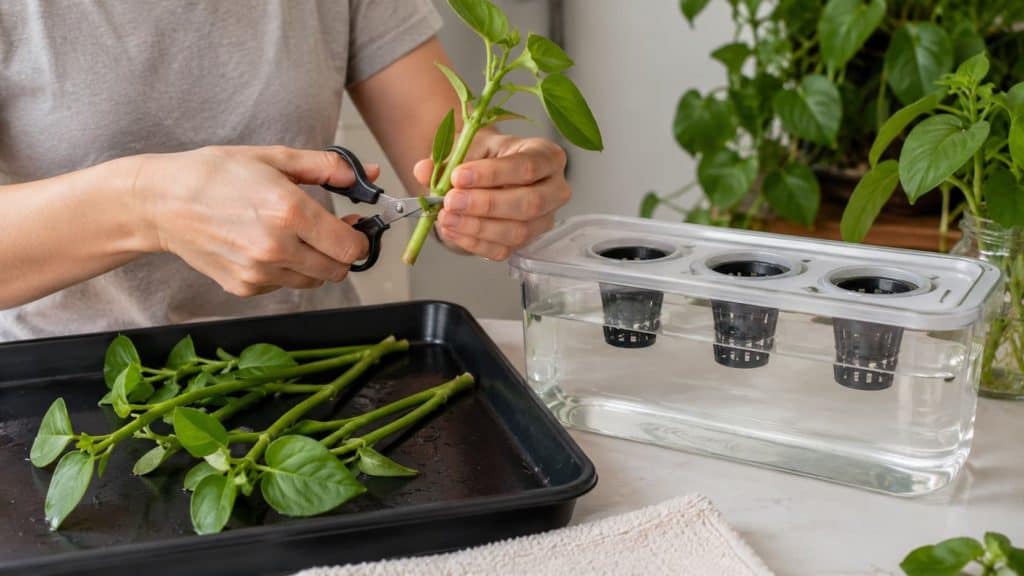
Make a clean cut below a node and place the cutting into water or media immediately.
Timing matters. The longer a cutting remains exposed to air, the greater the risk of dehydration and stress.
A hydroponic cutting node cut should occur directly below a leaf node because root initials commonly form in this region.
Many growers use a hydroponic cutting scalpel cut or sharp razor hydroponic cutting technique to create a clean wound.
Why cut below a node?
Cutting just below a node is generally recommended because nodes contain actively dividing cells and vascular tissues that are more responsive to root initiation than internodal stem sections.
After the cutting is made, auxins naturally accumulate near the wound site, stimulating the formation of adventitious roots.
A clean cut also minimizes tissue damage, helping maintain water uptake while reducing the risk of infection during the early rooting stage.
Does the underwater cutting technique help?
Some propagators make the final cut underwater to reduce the possibility of air entering the xylem, the tissue responsible for transporting water throughout the plant.
This practice is thought to help maintain water movement within the cutting during the early stages of propagation, although its effectiveness may vary among species.
Commercial propagation references suggest making the final cut approximately 25 mm (1 inch) below a node.
Pro Tip: Sterilize pruning shears, scalpels, and gardening tools before every propagation session.
Which Hydroponic Cloning Method Should You Use?
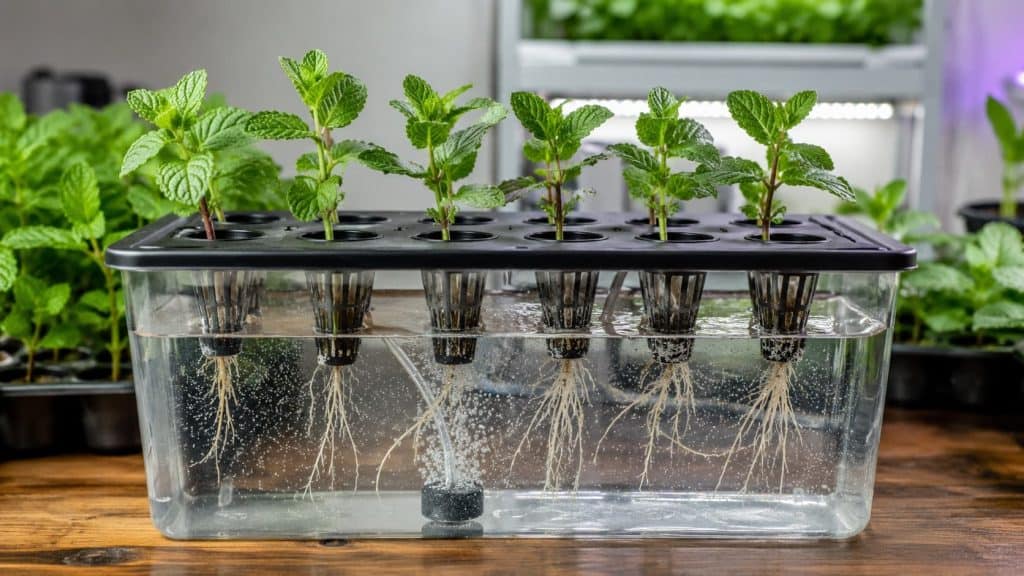
Beginners usually succeed fastest with Rockwool and aerated water systems.
Several systems support growing cuttings in water hydroponics environments, especially when choosing between DIY setups and full hydroponic systems designed for cloning efficiency.
Before choosing equipment, understand that environmental control typically contributes more to success than hardware costs.
Is Deep Water Culture best for beginners?
| Method | Pros | Cons |
| DWC | Simple and affordable | Requires continuous aeration |
| Rockwool cuttings hydroponics | Excellent support | Requires media preparation |
| Simple jar method | Lowest cost | Lower oxygen levels |
| Aeroponic cuttings propagation | Fast rooting potential | Higher maintenance |
While deep water culture setups with standard air stones are incredibly forgiving for beginners, commercial aeroponic cloning machines offer faster cellular response times. However, in our facility, we found that commercial units with internal pumps frequently heat the water reservoir past 78°F (25°C).
This drop in dissolved oxygen levels triggers a breeding ground for Pythium (root rot), meaning you must closely monitor reservoir temperatures or invest in water chillers to make commercial systems viable.
Community discussions frequently mention EZ Clone systems, yet many growers report similar or better outcomes using DIY hydroponic cutter propagation setups with air pumps and reservoirs.
Common complaints include:
- High water consumption
- Additional maintenance
- Increased complexity
Of course, commercial units can perform well. That said, poor humidity, incorrect temperatures, or unstable pH will still reduce success.
How Do You Mix the Right Nutrient Solution?
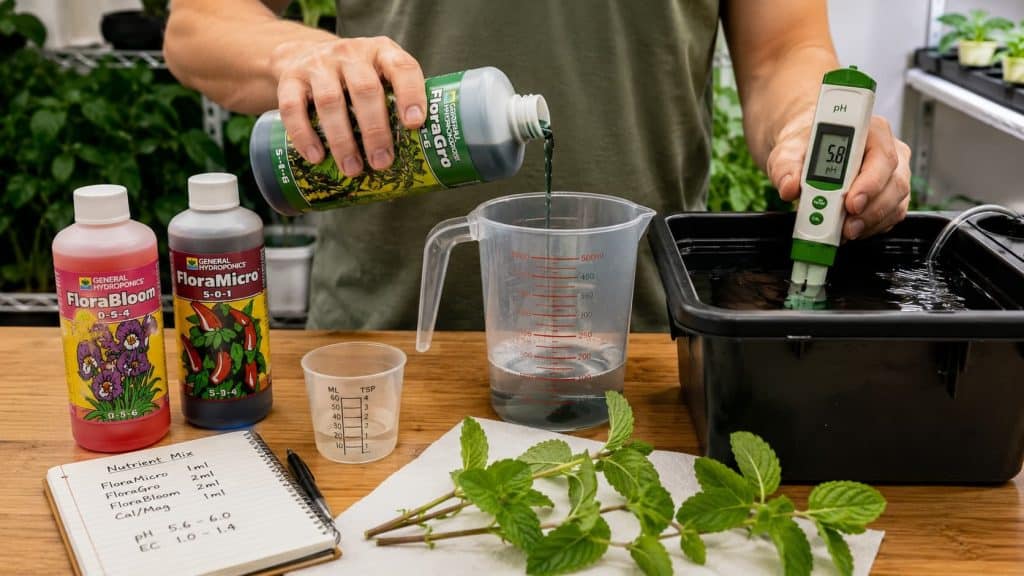
Use a mild nutrient solution with carefully controlled pH and low nutrient strength during early rooting. Choosing the correct dosage becomes easier once you understand basic items needed for hydroponic system components and how each part affects nutrient balance.
Fresh cuttings require less nutrition than mature plants.
Fresh cuttings require only a mild nutrient solution because they have not yet developed functional roots capable of absorbing nutrients efficiently. A nutrient solution of approximately 200 ppm (EC 0.4) is commonly used during early rooting.
What pH should hydroponic cuttings have?
Recommended target:
- pH 5.5–6.5
- Stable daily readings
This pH range helps maintain the availability of essential macro- and micronutrients in hydroponic nutrient solutions.
How strong should nutrients be?
For new cuttings:
- Low-strength solution
- Approximately 200 ppm
- Mild fertilizer new roots hydroponics approach
After rooting:
- Increase gradually
- Consider nutrient strength rooted cuttings adjustments
- Avoid sudden feeding increases
After roots emerge and active growth begins, nutrient strength can be gradually increased to approximately 300 ppm (EC 0.6) to support continued root and shoot development while minimizing osmotic stress.
What Environmental Conditions Produce Faster Roots?
Warm root zones, high humidity, and moderate light create the ideal rooting environment. These conditions are much easier to maintain when building an indoor hydroponic garden DIY setup that allows tighter environmental control.
Environmental consistency frequently separates successful hydroponic propagation from repeated failures.
What temperature works best?
| Parameter | Target |
| Root zone | 73–77°F (23–25°C) |
| Air temperature | 68–73°F (20–23°C) |
Maintaining a slightly warmer root zone than the surrounding air can encourage root development, although the ideal temperature depends on the plant species.
This is where bottom heat hydroponic cutting setups often provide an advantage.
How much humidity is needed?
During the first week:
Maintain 90–95% humidity
Use a hydroponic propagation dome if necessary
Reduce humidity gradually after rooting
Maintaining high humidity during the first 7–10 days after sticking cuttings helps reduce moisture loss until roots begin to develop.
How Much Light Do Hydroponic Cuttings Need?
Cuttings need gentle light initially and progressively higher light as roots develop.
Many beginners assume stronger light equals faster rooting. In practice, excessive intensity often increases stress and dehydration.
Can too much light slow rooting?
Yes.
Excessive light can:
Increase transpiration
Dry foliage
Delay rooting
Some growers use fluorescent light hydroponic cuttings setups because they provide moderate intensity and limited heat output.
How should light change over time?
Unrooted cuttings cannot process intense light because they lack the root structure to replace water lost through transpiration.
We position our propagation domes under low-intensity T5 fluorescents or dimmed LEDs, targeting a Photosynthetic Photon Flux Density (PPFD) of exactly 80 to 100 $\mu$mol/m²/s on a 14-to-18-hour daily photoperiod.
Once roots actively emerge, we gradually ramp up the intensity to 150 $\mu$mol/m²/s to trigger vegetative growth without scorching the foliage.
Commercial propagation guides provide benchmarks that many growers follow.
Why Do Hydroponic Cuttings Fail?
Most failures result from poor sanitation, low oxygen levels, excessive moisture, or unstable environmental conditions.
Failure usually stems from process errors rather than equipment limitations.
Is too much water a problem?
Yes.
Common consequences include:
- Rot
- Botrytis
- Oxygen deprivation
Several propagation studies suggest waterlogged conditions frequently cause greater losses than slight dryness.
What mistakes happen most often?
- Dirty tools
- Stagnant reservoirs
- Incorrect pH for hydroponic cuttings
- Weak airflow
- Infrequent water changes
- Ignoring hydroponic water temperature cuttings requirements
Bacterial populations can increase significantly in recirculating hydroponic systems, so regular water changes and sanitation are essential.
Maintaining clean, well-oxygenated water through regular reservoir maintenance and adequate aeration is generally more beneficial for healthy root development than relying on additional supplements alone.
Should You Use a Rooting Hormone?
Rooting hormone is optional but often improves rooting speed and consistency.
Rooting hormone hydroponics cuttings products are especially useful for difficult species.
They are commonly used for:
- Hardwood cuttings hydroponics
- Semi hardwood cuttings hydroponics
- Valuable ornamentals
- Slow-rooting species
Rooting hormones are available as gels, liquids, and powders.
In hydroponic propagation, gel formulations are often preferred because they adhere more effectively to the cut surface, allowing the hormone to remain in contact with the stem during the early stages of rooting.
Powder and liquid formulations can also be effective when applied correctly, although they may be more easily displaced in water-based systems.
When Should You Transplant Hydroponic Cuttings?
Move cuttings once roots are established but before they become excessively mature.
The timing of transplant rooted cuttings hydroponics projects can influence long-term growth.
How long does rooting take?
Typical schedule:
Day 1–3: Callus formation
Day 5–10: Root emergence
Day 10–21: Transplant readiness (varies by species)
Some species root sooner, while woody plants may require additional time.
What is the 1–2 inch root rule?
Many experienced growers transplant when roots are:
- 1–2 inches long
- White and healthy
- Well branched
In our propagation cycles, we strictly enforce the 1-to-2-inch root rule to prevent a phenomenon known as root hardening.
If you leave cuttings in a small propagation plug for too long, the young roots begin to wrap, become oxygen-starved, and lose their capacity to efficiently uptake nutrients.
Moving them the moment lateral branching appears ensures the root system immediately integrates into the main hydroponic system without experiencing structural transplant shock.
How Can You Improve Your Success Rate?
Focus on consistency, sanitation, and environmental control rather than expensive equipment.
Growers searching for the best hydroponics for cuttings often look for equipment upgrades first. In reality, process discipline produces larger gains.
What habits matter most?
- Sterilize tools
- Change water regularly
- Monitor pH daily
- Maintain airflow
- Keep reservoirs oxygenated
Does expensive equipment guarantee success?
No.
Many successful growers rely on:
- DIY hydroponic clone maker setups
- Rockwool cubes
- Basic air pumps
- Hydroponic cloning chambers
- Humidity domes
Some studies suggest hydro-style propagation methods can produce longer, healthier roots compared to traditional mist systems.
Data from ASHS Annual Conference demonstrates
“Cuttings in the sub-mist system produced measures of rooting superior to those in the other systems. They produced more than three times as many roots as cuttings in the overhead mist system, with roots more than six times the length. Root dry weights averaged 28 mg for cuttings in the sub-mist system, compared with only 3.5 mg among cuttings receiving overhead mist.” – ASHS Annual Conference
From our experience, consistency beats complexity almost every time.
Preparing Healthy Stem Cuttings for Hydroponic Propagation

Credits: Mefoo007
Before placing a cutting into a hydroponic cloning system, proper preparation helps improve rooting success. Select a healthy stem from a vigorous parent plant, then use clean, sharp scissors or pruning shears to make a fresh cut just below a leaf node. Remove the lower leaves so they will not sit in water, while leaving a few healthy leaves at the top to support photosynthesis. Careful handling at this stage reduces stress on the cutting and creates better conditions for strong, healthy root development.
FAQ
How do I improve the hydroponic cutting success rate?
You can improve the hydroponic cutting success rate by taking cuttings from healthy, disease-free plants and maintaining stable growing conditions. Keep humidity for hydroponic cuttings between 70% and 90%, provide 14 to 18 hours of light daily, and maintain water temperatures between 68°F and 75°F (20°C to 24°C). Consistent environmental conditions encourage faster rooting and stronger root development.
What is the best hydroponic rooting medium for cuttings?
When choosing your substrate, skip the cheap foam plugs and stick to premium, pre-conditioned Rockwool cubes. Through thousands of trials, we found Rockwool maintains the precise 4:1 water-to-oxygen ratio required to prevent root rot. To prepare them, submerge the cubes in a mild 200 ppm nutrient solution calibrated to a strict pH of 5.5 never raw tap water, which can shock the freshly exposed cambium layer of your cutting.
Why are my hydroponic cuttings not rooting?
If your cuttings are stalling without throwing roots, look closely at the stem base. A yellowing, translucent stem tip indicates localized suffocation due to poor water oxygenation or over-saturation. Conversely, if the foliage is crisping and dropping before a callus forms, your ambient vapor pressure deficit (VPD) is too high meaning your humidity dome is venting too fast, or your water temperature has spiked past 75°F (24°C), causing the water’s oxygen-carrying capacity to collapse. Making a hydroponic cutting node cut directly below a healthy leaf node also improves rooting potential. Poor sanitation and damaged stems can further slow root formation.
Can I use a hydroponic clone system for herbs and vegetables?
Absolutely. Clonal propagation is highly effective across a broad spectrum of crops. In our operations, we segment these into two primary categories: fast-striking soft-stemmed herbs (such as culinary basil and mint) and high-transpiration fruiting varieties (including indeterminate tomatoes and bell peppers). Both categories thrive in a dedicated cloning system, provided you match the ambient environment to their specific transpiration rates.
When should I transplant rooted hydroponic cuttings?
You should transplant rooted hydroponic cuttings when they have developed several healthy white roots that are at least 2 to 3 inches long. Strong root systems adapt more easily to a new hydroponic system or soil environment. During transplant rooted cuttings hydroponics procedures, handle roots carefully and gradually increase nutrient strength to minimize stress and support continued growth.
Growing From Cuttings in Hydroponics Made Simple
Getting cuttings to root can feel frustrating when growth stalls or roots take longer than expected. That’s normal. What matters most is giving your plants stable conditions from the start. Healthy cuttings, good oxygen levels, the right humidity, suitable temperatures, and balanced pH all help roots develop faster and more consistently.
The good news is that hydroponic propagation doesn’t have to be complicated. Whether you’re growing basil, tomatoes, mint, or flowering plants, sticking to the basics usually delivers the best results. Keep your setup clean, check conditions regularly, and move plants once roots are established. With a little practice, you’ll have a dependable way to grow more plants in less time.
References
- https://digitalcommons.library.umaine.edu/etd/2991/
- https://ashs.confex.com/ashs/2016/webprogram/Paper25093.html
Related Articles
- https://tophydroponicgarden.com/indoor-hydroponic-garden-diy/
- https://tophydroponicgarden.com/items-needed-for-hydroponic-system/
- https://tophydroponicgarden.com/hydroponic-systems/
Was this helpful?

I’m Barrie L., a passionate hydroponic gardening enthusiast dedicated to cultivating thriving, soil-less gardens. With a focus on all things hydroponic, I share my expertise on innovative growing techniques and sustainable practices through my blog, tophydroponicgarden.com. As a seasoned hydroponics specialist, my goal is to inspire and guide fellow gardeners in harnessing the power of water-based cultivation for bountiful and eco-friendly harvests. I’m also an author of the book “Hydroponics For Absolute Beginners: Your Step By Step Guide For How To Create An Hydroponics System At Home Without Soil, For Growing Vegetable, Fruit And Herbs.” which is sold on Amazon. Join me on a journey of redefining the way we cultivate plants, one nutrient-rich solution at a time. Happy growing!