

Hydroponic cucumbers often grow faster and yield more than soil-grown plants. Oklahoma State University research shows a pH of 5.5 to 6.0 is ideal for nutrient uptake.
To succeed indoors or in a greenhouse, you need stable roots, the right nutrients, and good vine training. Read on to find the best systems, understand common beginner pitfalls, and learn how to avoid them.
Quick Wins for Growing Hydroponic Cucumbers
- Manage your water and nutrients. Use a system like Dutch buckets that gives roots plenty of room. Keep the pH between 5.5 and 6.0, and raise the nutrient strength when fruit starts to form. Watch calcium and potassium levels closely during this stage.
- Control the environment. Pick self-pollinating cucumber varieties for indoor setups. Keep your water reservoir’s temperature steady to prevent root problems.
- Train the plants early. Get vines onto a trellis as soon as possible. This improves air flow, supports the heavy fruit, and makes everything easier to manage.
Why Are Cucumbers Ideal for Hydroponics?
Hydroponics and cucumbers are a perfect match. The plants grow quickly and show a direct response to the nutrients in the water.
While many vegetables thrive in hydroponic systems, cucumbers have a particular advantage. They grow quickly and produce fruit for a long time. Their big, greedy roots suck up water and nutrients fast. This makes feeding them in a water system pretty simple.
What Makes Cucumbers Different?
Several characteristics make growing cucumbers in hydroponics particularly attractive:
- Rapid vegetative growth
- High water consumption
- Continuous flowering potential
- Strong response to environmental control
- Excellent vertical growing capability
When I first transplanted a batch of Boston Pickling seedlings from their rockwool starter plugs into my active Dutch Bucket line, the explosive growth caught me completely off guard.
Because the roots don’t have to fight through dense soil to hunt for food, they transition to rapid vegetative growth almost overnight. In my greenhouse, I routinely measure a 2-to-3 inch explosion in vine length within the first 48 hours of immersion.
How Productive Can Hydroponic Cucumbers Become?
Commercial growers pick hydroponics for cucumbers for a simple reason. The roots get food all the time, right where they are. The plant doesn’t waste energy searching, it just absorbs what it needs.
The nutrient strength, or EC, is usually kept between 2.0 and 3.0 mS/cm, adjusted higher when fruiting begins. This precise control, featured in trade publications like Produce Grower, is key to the high yields in modern greenhouses.
A soilless system also sidesteps many common soil-borne diseases. Combined with uninterrupted water and food, this allows the vines to produce fruit continuously over a long season.
Best Hydroponic System for Cucumbers
Large-root-zone systems consistently outperform compact systems because cucumber roots expand aggressively.
According to The Korean Society for Bio-Environment Control
“Root-zone restriction has been identified as a factor that can negatively impact cucumber growth and fruit yield in hydroponic systems.” – The Korean Society for Bio-Environment Control
Many beginners underestimate cucumber root development. A small seedling’s roots grow fast. They can quickly fill up a small tank and choke the system.
Should Beginners Choose Dutch Buckets?
| System | Best For | Verdict |
| Dutch Bucket | Large vines | Recommended |
| DWC | Large reservoirs | Good option |
| NFT | Small crops | Usually avoid |
| Kratky | Experiments | Limited reliability |
Dutch bucket cucumbers remain the preferred option for many commercial and serious hobby growers. Individual buckets provide more root space, easier irrigation control, and greater system stability.
Deep Water Culture (DWC) can also grow great cucumbers. The key is using a reservoir large enough for their expansive roots and providing vigorous aeration to keep the roots oxygenated.
Why Do Small Hydroponic Systems Fail?
Several issues appear repeatedly in grower communities:
- Roots consume available space rapidly.
- Water demand increases dramatically during fruiting.
- Nutrient concentrations fluctuate more quickly.
- Reservoir temperatures become harder to stabilize.
If you try to run a heavy feeder like a cucumber in a standard 1-gallon countertop pod kit, you are setting yourself up for failure. In my early days, I tried running a space-saving bush variety in a compact reservoir; within four weeks, the root mass had literally choked out the water pump, and the plant drank the entire reservoir dry in less than 36 hours.
You need a minimum of 5 gallons of reservoir space per plant just to keep up with their daily water consumption once fruit sets.
Growing Conditions That Produce the Best Results
Stable environmental conditions outperform aggressive adjustments.
Hydroponic cucumber care is easier when you aim for consistency. It’s better to maintain a stable environment than to be constantly reacting to issues.
What Environmental Targets Should You Maintain?
| Parameter | Target Range |
| pH | 5.5–6.0 |
| Day Temperature | 75–85°F |
| Night Temperature | 65–70°F |
| EC (Vegetative) | 1.6–2.0 mS/cm |
| EC (Fruiting) | 2.2–2.7 mS/cm |
These targets support healthy cucumber nutrient uptake throughout multiple growth stages.
Why Does Consistency Beat Intensity?
Environmental stability supports:
- Better root function
- Improved nutrient absorption
- Higher fruit quality
- Lower stress levels
Oklahoma State University’s advice is straightforward: keep the pH and nutrient levels steady. Don’t make big, sudden changes.
Of course, every growing room differs slightly. That said, sudden swings in temperature or reservoir chemistry usually create more problems than they solve.
Starting Cucumber Seeds for Hydroponics

Start cucumber seeds in a moisture-retentive propagation medium and transplant once roots emerge.
Successful cucumber seed germination hydroponics begins before nutrients become a concern.
What Is the Simplest Germination Method?
- Place seeds into rockwool for cucumbers or starter plugs.
- Maintain temperatures around 75–80°F.
- Keep media consistently moist.
- Wait for roots to emerge.
- Transfer seedlings into the hydroponic cucumber setup.
Most cucumber seeds germinate within 2–3 days under warm conditions. Industry observations from Agrifarming report similar germination timelines.
When Should Seedlings Be Transplanted?
Look for:
- Visible root growth
- Two or more true leaves
- Healthy stem structure
- Consistent green coloration
If you move the seedlings too early, they’ll take longer to get going. Wait too long, and the roots will get tangled and stuck in their starter cubes.
How Should Nutrients Change During Growth?
Hydroponic cucumber nutrients should evolve alongside plant development.
The nutritional demands of a young vine differ substantially from those of a mature fruiting plant.
What Changes After Flowering Begins?
After the cucumber flowering stage begins:
- Nitrogen demand becomes relatively less dominant.
- Potassium demand rises.
- Calcium requirements remain important.
- Water consumption increases.
Hydroponic cucumber fertilizer programs should reflect these changing demands.
Why Is Potassium Called a Fruiting Driver?
Once those first bright yellow blossoms pop, your plant’s metabolic engine completely shifts gears. This is where you need to actively monitor your EC (Electrical Conductivity, which is just a digital measurement of how concentrated your nutrient solution is), raising it from a mild 1.6 up to a robust 2.5 mS/cm.
During this transition, potassium becomes your absolute primary driver for fruit development. If you don’t intentionally ramp up the potassium, the heavy load of growing cucumbers will aggressively strip the nutrient right out of the older, lower leaves to feed the fruit, leaving you with brittle, yellowing foliage at the base of your vine.”
When a plant is loaded with fruit, it can pull potassium away from the leaves, even if the overall nutrient level in the water looks fine. You might see yellowing leaves at the bottom while the fruit keeps growing.
The Importance of Calcium for Hydroponic Cucumbers
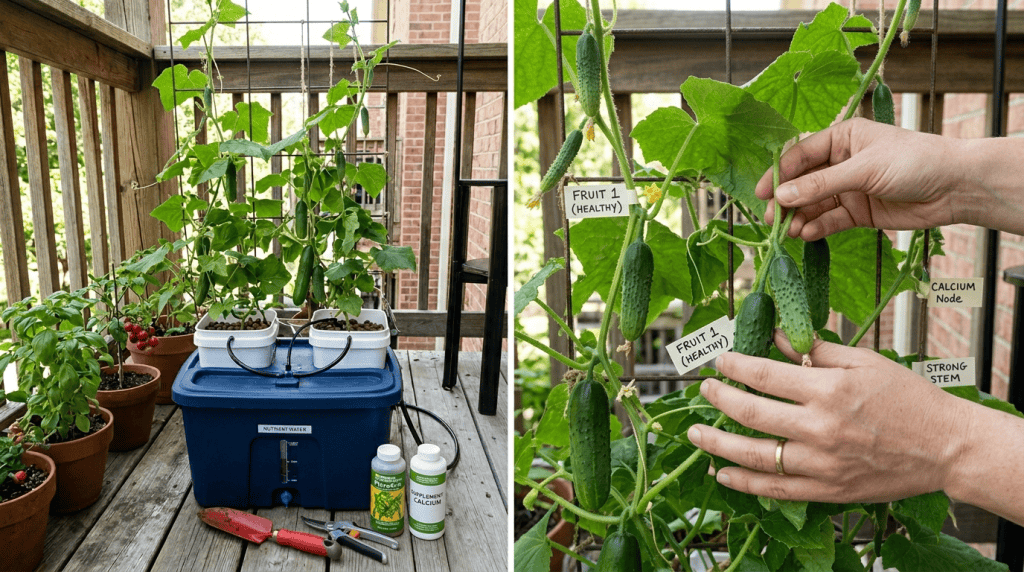
Calcium supports structural integrity and fruit quality throughout the crop cycle.
Unlike mobile nutrients, calcium must remain continuously available for healthy growth.
What Are the Signs of Calcium Deficiency?
Common symptoms include:
- Misshapen fruit
- Brittle leaf tissue
- Reduced growth vigor
- Poor fruit quality
Hydroponic cucumber troubleshooting frequently traces fruit disorders back to calcium management.
How Can Growers Prevent Calcium Problems?
Several strategies help:
- Maintain stable pH.
- Use balanced nutrient formulations.
- Supplement with Cal-Mag when necessary.
- Avoid severe moisture fluctuations.
In my own greenhouse, I’ve learned the hard way that calcium deficiencies will absolutely ruin a harvest. Because calcium is an immobile nutrient, meaning the plant can’t pull it from old leaves to feed new growth, it has to be constantly flowing through the water.
If my reservoir’s transpiration slows down due to high humidity, the fruit tips immediately develop blossom-end rot. Don’t wait for a corporate diagnostic sheet to tell you this: if your new leaf tips look hooked and withered, you need to supplement your reservoir with a high-quality Cal-Mag additive immediately.
Trellising and Pruning Hydroponic Cucumbers
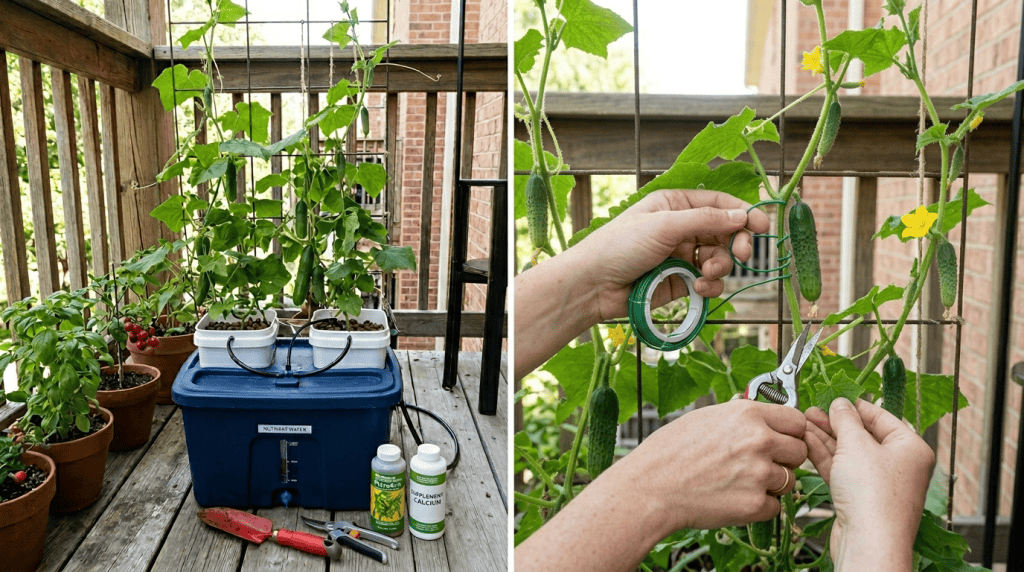
Vertical training improves airflow, harvest efficiency, and fruit quality.
Without trellising, cucumber vines quickly become unmanageable.
What Trellising Method Works Best?
When it comes to vertical training, I use the single-leader method on an overhead support wire. As the vine climbs, I manually wind the main stem around a heavy-duty nylon twine every few days.
The secret to massive yields is ruthlessly pinching off every single sucker (lateral shoot) and flower cluster for the first 4 to 5 leaf nodes. It feels wrong to rip off early flowers, but trust me: forcing the plant to build a robust, vertical trunk first pays off tenfold in fruit size later in the season.”
Trellising is especially important for greenhouse cucumbers. Using vertical space lets you grow a lot more plants in the same area.
Should You Use the Umbrella Method?
The umbrella method offers several advantages:
- Better height control
- Improved light penetration
- Easier harvest access
Most commercial greenhouse operations utilize some variation of vertical cucumber vine training.
Why Are Indoor Flowers Dropping Without Fruit?
Pollination problems or incorrect genetics often cause flower drop.
Many indoor growers spend months troubleshooting issues that stem from variety selection.
What Is the Difference Between Standard and Parthenocarpic Varieties?
| Type | Pollination Needed? |
| Standard | Yes |
| Parthenocarpic | No |
Why Do Indoor Growers Prefer Parthenocarpic Cucumbers?
Benefits include:
- Reliable fruit set
- No hand pollinating cucumbers
- Better greenhouse compatibility
- Consistent production
If there is one mistake that sinks indoor growers more than any other, it’s picking the wrong seed genetics. During my first indoor winter setup, I mistakenly planted a standard outdoor slicing variety and watched in frustration as dozens of female flowers shriveled and dropped off because there were no bees inside to pollinate them.
For indoor hydroponics, you must use parthenocarpic (self-pollinating) hybrids like ‘Bella’ or ‘Socrates.’ These varieties are specifically bred to set fruit without any pollination assistance whatsoever. These are bred specifically for the controlled conditions inside a greenhouse or grow room.
Preventing Bitter Cucumbers

Credits: MIgardener
Reduce plant stress through environmental and nutrient stability.
Bitter fruit remains one of the most common complaints among hydroponic cucumber growers.
What Causes Cucumbers to Become Bitter?
Several stressors contribute:
- Heat stress
- Water stress
- Nutrient imbalances
- Reservoir fluctuations
How Does Plant Stress Trigger Bitterness?
Stress increases production of cucurbitacin compounds that influence flavor.
The main reason cucumbers turn bitter is usually cucurbitacin. This is a compound that builds up when the plant is stressed. It’s a common topic in grower talks and online forums.
Maintaining stable reservoir temperatures often improves flavor consistency significantly.
Protecting Roots from Algae and Root Rot
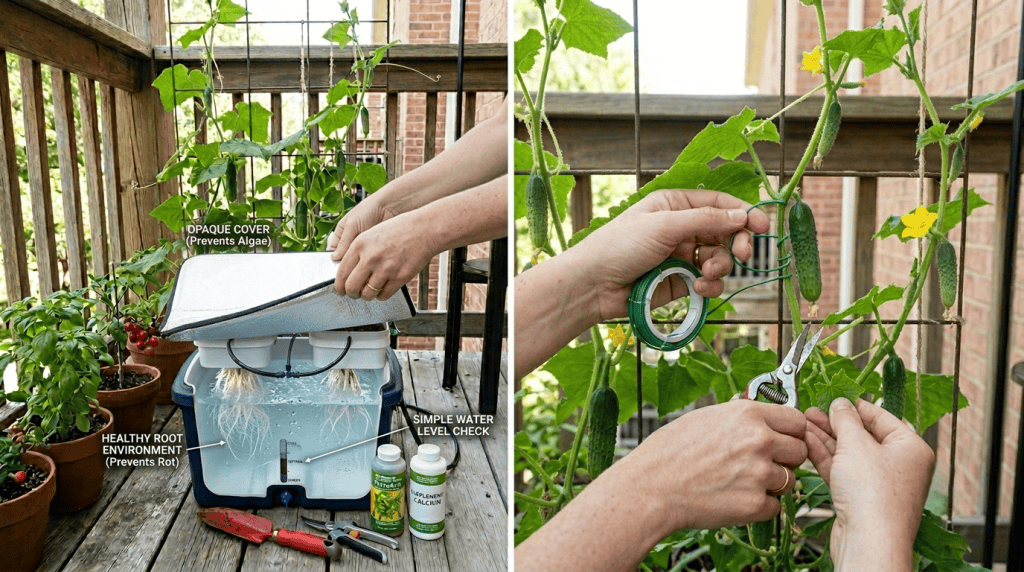
Keep water cool, oxygenated, and shielded from light.
Root health often determines the success or failure of hydroponic cucumber cultivation.
What Conditions Encourage Root Problems?
Several conditions increase risk:
- Warm reservoirs
- Light leaks
- Poor aeration
- Pathogens such as Pythium
If your water temperatures climb above 72°F, you are practically inviting Pythium (an aggressive water-borne fungus better known as root rot) into your system. This pathogen thrives in warm, low-oxygen water and can rot away up to 70% of your root system before you even realize there’s a problem.
To build a defense barrier for my roots, I use a two-pronged strategy: I wrap my clear reservoirs in black vinyl to eliminate light leaks, and I inject monosilicic acid (a highly bioavailable form of liquid silicon) into my nutrient mix. This silicon physically strengthens the root cell walls, making it incredibly difficult for root rot spores to pierce the tissue.
What Is Advanced Root Armor for Hydroponic Cucumbers?
Consider these protective measures:
- Use opaque reservoirs.
- Improve root aeration hydroponics.
- Maintain reservoir temperatures below 72°F.
- Consider monosilicic acid supplementation.
- Conduct regular root inspections.
For a high-yield cucumber setup, two factors are essential: strong root aeration and a growing medium that doesn’t hold too much water.
The 5-Gallon Delusion That Hurts Many Growers
Cucumbers outgrow undersized hydroponic systems much faster than most beginners expect.
Many viral videos present cucumber production as effortless. Real-world results often look different.
How Large Does the Root System Become?
Mature cucumber plants develop:
- Aggressive root networks
- High daily water consumption
- Significant nutrient demand
When growing cucumbers hydroponically on a large scale, you have to plan for massive root growth well before it becomes a problem.
What Reservoir Size Supports Long-Term Growth?
Common options include:
- Large DWC reservoirs
- Dutch bucket cucumbers
- Commercial recirculating systems
Growers regularly report dramatic water consumption increases during peak fruiting periods. Reservoir volume becomes increasingly important as yields rise.
How Can You Scale from a Hobby Plant to Continuous Harvests?
Focus on root volume, nutrient consistency, pruning, and genetics before expanding.
Scaling too quickly often creates management challenges that reduce overall productivity.
What Habits Separate Successful Growers?
Consistent performers typically:
- Inspect roots weekly.
- Monitor pH and EC regularly.
- Follow structured pruning schedules.
- Maintain environmental stability.
Commercial hydroponic greenhouse production relies heavily on routine monitoring rather than reactive management.
When Should You Expand Your System?
Expansion makes sense when:
- One crop cycle succeeds consistently.
- Nutrient management becomes predictable.
- Harvest quality remains stable.
According to Oregon State University
“Ongoing monitoring of root-zone conditions and nutrient status remains fundamental for long-term greenhouse success.” – Oregon State University
What Should You Remember Before Starting?
Hydroponic cucumbers reward planning, consistency, and proper system design more than shortcuts.
Which Factors Matter Most?
- Root space
- Stable pH
- Proper nutrition
- Trellising
- Variety selection
How Can Tophydroponicgarden Readers Improve Success Rates?
- Select the correct hydroponic cucumber system.
- Monitor plants consistently.
- Correct minor issues quickly.
- Prioritize root health.
FAQ
What hydroponic cucumber varieties work best for beginners?
Beginners often achieve the best results with parthenocarpic cucumbers because these plants produce fruit without requiring pollination. Many greenhouse cucumber hydroponics and indoor hydroponic cucumbers growers prefer these varieties because they set fruit reliably in controlled environments.
When choosing hydroponic cucumber varieties, select plants with strong disease resistance, compact growth habits, and consistent fruit production to simplify plant management.
How do I improve cucumber root development in hydroponics?
You can improve cucumber root development by maintaining water temperatures between 18°C and 22°C, supplying adequate oxygen, and preventing nutrient imbalances. Effective cucumber root zone management allows roots to absorb water and nutrients efficiently.
A suitable hydroponic growing medium also supports healthy root expansion. Regularly inspecting roots for discoloration, rot, or damage helps prevent growth problems before they affect production.
Can indoor hydroponic cucumbers produce fruit year-round?
Yes, indoor hydroponic cucumbers can produce fruit throughout the year when growing conditions remain stable. Plants require adequate light, consistent temperatures, and balanced hydroponic cucumber nutrients to sustain continuous growth.
Meeting cucumber light requirements with sufficient daily light exposure encourages flowering and fruit set. Proper hydroponic cucumber care also reduces plant stress and supports reliable harvests during every season.
How can I prevent common cucumber diseases in hydroponics?
You can prevent many diseases by maintaining good sanitation, proper airflow, and balanced humidity levels. Effective hydroponic pest control reduces plant stress and limits damage caused by insects that spread disease.
Consistent cucumber disease prevention practices include removing infected leaves, cleaning equipment, and monitoring plants regularly. These measures also help reduce the risk of powdery mildew management challenges in hydroponic systems.
What affects hydroponic cucumber production and harvest quality?
Hydroponic cucumber production depends on nutrient balance, light intensity, temperature, plant spacing, and irrigation management. Proper hydroponic nutrient management ensures plants receive the nutrients needed for vigorous growth and fruit development.
Monitoring cucumber harvest timing is equally important because overripe cucumbers often lose texture and market quality. Careful crop management helps growers produce high yield hydroponic cucumbers with consistent size and appearance.
Final Thoughts on Hydroponic Cucumbers
If your cucumber plants keep struggling, the problem often comes from unstable growing conditions. You need a system that keeps roots healthy and growth steady. Small mistakes can slow results.
Mastering hydroponic cucumbers doesn’t require over-engineering your system, it just requires giving those massive roots the space and environmental consistency they crave.
If you are tired of dealing with root rot or bitter fruit, I’ve put together a step-by-step blueprint of my personal Dutch Bucket layout over at Tophydroponicgarden. Grab the free plumbing schematic there, map out your grow space, and get those vines climbing.”
References
- https://koreascience.kr/article/CFKO199811922488604.pub?lang=ko
- https://horticulture.oregonstate.edu/
Related Articles
- https://tophydroponicgarden.com/how-to-grow-cucumbers-hydroponically/
- https://tophydroponicgarden.com/common-issues-in-hydroponic-cucumbers/
- https://tophydroponicgarden.com/what-happens-if-my-ec-is-too-high/
Was this helpful?

I’m Barrie L., a passionate hydroponic gardening enthusiast dedicated to cultivating thriving, soil-less gardens. With a focus on all things hydroponic, I share my expertise on innovative growing techniques and sustainable practices through my blog, tophydroponicgarden.com. As a seasoned hydroponics specialist, my goal is to inspire and guide fellow gardeners in harnessing the power of water-based cultivation for bountiful and eco-friendly harvests. I’m also an author of the book “Hydroponics For Absolute Beginners: Your Step By Step Guide For How To Create An Hydroponics System At Home Without Soil, For Growing Vegetable, Fruit And Herbs.” which is sold on Amazon. Join me on a journey of redefining the way we cultivate plants, one nutrient-rich solution at a time. Happy growing!