

If you wait until your strawberry leaves look sick, you’ve already lost the first battle. Spider mites are tiny sap-suckers that destroy your plants’ ability to photosynthesize, quietly robbing you of your fruit yield before you even spot a single web.
In my years of growing, I’ve learned that the only way to save your harvest is a proactive defense. Let’s break down exactly how to catch them early, protect your crop, and stop an outbreak in its tracks.
Quick Wins for Controlling Spider Mites on Strawberries
- Check the undersides of leaves every week.
- Use water sprays or insecticidal soap for early problems.
- Release predatory mites early and rotate any chemical treatments.
Spider Mites Are Harmful Pests That Can Severely Damage Strawberry Plants.
Spider mites are very small pests that suck the juices from strawberry leaves. This feeding weakens the plant and can hurt your harvest.
The two-spotted spider mite is a tiny enemy with a big appetite. These pests pierce the leaf cells with sharp mouthparts and drink the plant’s juices. This feeding steals vital nutrients from the strawberry plant.
Without these juices, the leaves cannot convert sunlight into energy. The plant grows weak, stops developing, and produces small, sour berries.
How do spider mites damage strawberry plants?
Spider mite feeding disrupts normal plant function.
- Pierce leaf cells and extract plant fluids.
- Cause strawberry leaf yellowing and bronzing.
- Reduce photosynthetic capacity.
- Lower fruit size and marketable yield.
If you don’t manage them, a bad spider mite problem can really cut your harvest and make the fruit worse. The damage usually shows up on the leaves before you even see the mites.
Why do infestations spread so fast?
Spider mites thrive during warm, dry periods.
One female spider mite can lay dozens of eggs. When it’s warmer than 80°F, they can go from egg to adult in just a week. This fast life cycle is why their numbers can get out of control so quickly in spring and summer.
Of course, environmental conditions matter. Dry conditions spider mites prefer are common in tunnels, greenhouses, and drought-stressed fields.
How to Spot Spider Mites on Strawberries
Inspect leaf undersides for mites, eggs, feeding damage, and webbing.
When I first started growing strawberries, I used to mistake early mite spotting for a simple magnesium or nitrogen deficiency. It’s a classic rookie mistake. Now, my mandatory weekly routine involves grabbing a 10x hand lens and flipping over leaves across different areas of the garden.
If you aren’t checking the dusty undersides right along the leaf veins, you aren’t actually scouting, and that’s exactly where the mites hide. Inspecting leaves with a hand lens often reveals mites and spider mite eggs on leaves clustered along veins.
What does a severe infestation look like?
Advanced infestations create obvious symptoms.
- Fine spider mite webbing on strawberries.
- Burnt-looking foliage.
- Severe strawberry leaf bronzing.
- Strawberry leaf curling.
- Reduced berry production.
Heavy infestations frequently cause strawberry plant decline and substantial strawberry foliage damage.
Spider Mites Should Be Treated as Soon as Early Signs of Infestation Appear
Treatment should begin when mite populations start increasing or reach economic thresholds.
Commercial growers often use treatment thresholds to guide decisions.
How do growers determine treatment thresholds?
| Infestation Level | Recommended Action |
| Low | Continue monitoring |
| Moderate | Use cultural and biological controls |
| High | Apply targeted treatments immediately |
According to Clemson University IPM Guide
“Managing twospotted spider mites in strawberry fields can be challenging, especially under dry conditions when populations tend to increase rapidly” – Clemson University IPM guide
Experts say you should take action when you find about 5 mites on a single leaflet, or when around a quarter of your leaflets show signs of damage. Note: Threshold increases to 15-20 mites/leaflet after fruiting begins.
Why is early treatment important?
Early intervention reduces long-term damage.
- Prevents population explosions.
- Limits strawberry plant stress from mites.
- Improves biological control success.
- Protects fruit production.
If you wait until you see webbing, it usually takes several rounds of treatment to get the mites back under control.
Water Sprays Can Reduce Spider Mite Populations on Strawberry Plants

Strong water sprays physically remove mites from plants.
Water remains one of the most overlooked forms of organic spider mite control.
What is the best way to use water sprays?
Follow a consistent process.
- Spray leaf undersides thoroughly.
- Focus on infestation hotspots.
- Daily water sprays work for early infestations; for severe cases, combine with other methods
- Continue monitoring populations.
A strong blast of water can knock a lot of the mites right off the plants. This works well and doesn’t hurt the good bugs.
When is water treatment most effective?
Water treatments work best under specific conditions.
- Early infestations.
- Small garden plantings.
- Raised beds.
- Before releasing biological controls.
Many gardeners find that spraying plants with water works very well, especially when they catch the mites early.
The Problem with Neem Oil
Neem oil may suppress active mites but often fails to eliminate eggs.
Many gardeners expect a single neem application to solve the problem. That rarely happens.
What mistakes reduce neem oil effectiveness?
Common errors include:
- Applying only once.
- Missing leaf undersides.
- Treating after heavy webbing develops.
- Failing to repeat applications.
Neem oil is most effective when applied before mites and eggs are present in large numbers; eggs may survive if application timing is delayed.
How can you improve neem oil results?
Use a complete management approach.
- Ensure full coverage.
- Repeat applications according to label instructions.
- Combine with scouting.
- Remove heavily infested foliage.
Let’s bust a popular internet myth: spraying neem oil once will not fix a spider mite outbreak. While neem suffocates active, adult mites on contact, it completely misses the eggs.
A week later, those eggs hatch, and you are right back at square one. When I use organic oils, I always pair them with heavy pruning, clipping away and burning the worst-hit leaves to physically remove the eggs before spraying the remaining foliage.
Using Insecticidal Soap

Insecticidal soaps control spider mites through direct contact.
Unlike systemic products, soaps must directly contact mites to work.
How should insecticidal soap be applied?
Coverage determines effectiveness.
- Spray upper leaf surfaces.
- Thoroughly coat undersides.
- Treat hotspot areas.
- Repeat during active outbreaks.
Apply insecticidal soap 2-3 times at 5-7 day intervals (maximum 3 applications) for better mite kill.
What should you avoid when using soaps?
Avoid practices that increase plant stress.
- Household dish detergents.
- Midday applications.
- Spraying drought-stressed plants.
Use a real insecticidal soap made for plants. A homemade mix with dish detergent can hurt your strawberry leaves.
Predatory Mites Offer the Best Long-Term Spider Mite Control
Predatory mites provide effective biological control and long-term suppression.
For sustainable management, biological control often delivers the most consistent results.
Which predatory mites are commonly used?
| Predator | Primary Role |
| Phytoseiulus persimilis | Active outbreak control |
| Neoseiulus californicus | Preventive control |
These species are among the most widely used beneficial mites for strawberries.
According to Springer
“Phytoseiulus persimilis recorded the highest reduction as 81.7% of T. urticae eggs,” and achieved an 84.9% reduction in mobile stages. The study also found that biological treatment with P. persimilis achieved the highest yield increase of 38.7–39.7% compared to untreated controls. – Springer
If you are skeptical about using bugs to fight bugs, the data speaks for itself. A prominent study published by Springer proved that releasing predatory mites (Phytoseiulus persimilis) wiped out over 81% of spider mite eggs and nearly 85% of active adults.
In real-world terms, that biological intervention translated to a massive 39% jump in total berry yield compared to patches left to fend for themselves. I’ve seen this exact boost in my own setups, beneficial insects simply out-work chemicals
When should predatory mites be released?
Timing matters.
- At first signs of hotspots.
- Before widespread webbing develops.
- After pesticide residues decline.
Release when 2+ mites/leaflet detected OR 25-35% leaflets infected; wait 4+ weeks after broad-spectrum insecticide before the spider mites get out of hand.
Some Insecticides Can Make Spider Mite Problems Worse
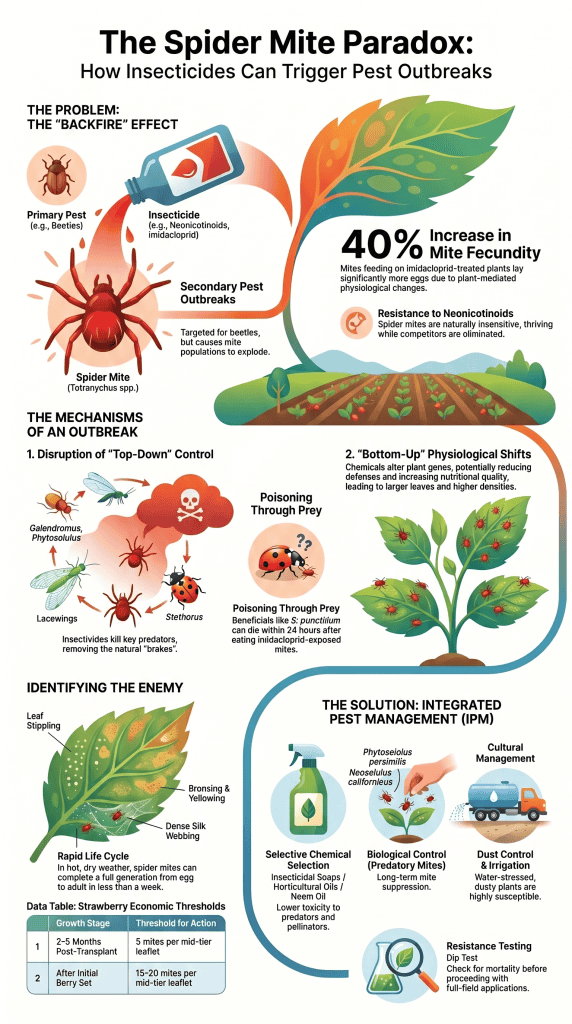
Broad-spectrum insecticides often eliminate beneficial predators.
Many growers unintentionally create larger mite outbreaks.
Which products commonly trigger mite flare-ups?
Several insecticide groups are associated with outbreaks.
- Pyrethroid insecticides.
- Broad-spectrum contact insecticides.
These products frequently kill natural enemies while leaving surviving mites free to reproduce.
How can growers avoid this problem?
Integrated approaches reduce flare-up risk.
- Preserve predators.
- Use selective products.
- Follow integrated pest management strawberries principles.
Sometimes, protecting your helpful bugs is more important than spraying another chemical.
Miticides May Be Needed for Severe Spider Mite Infestations
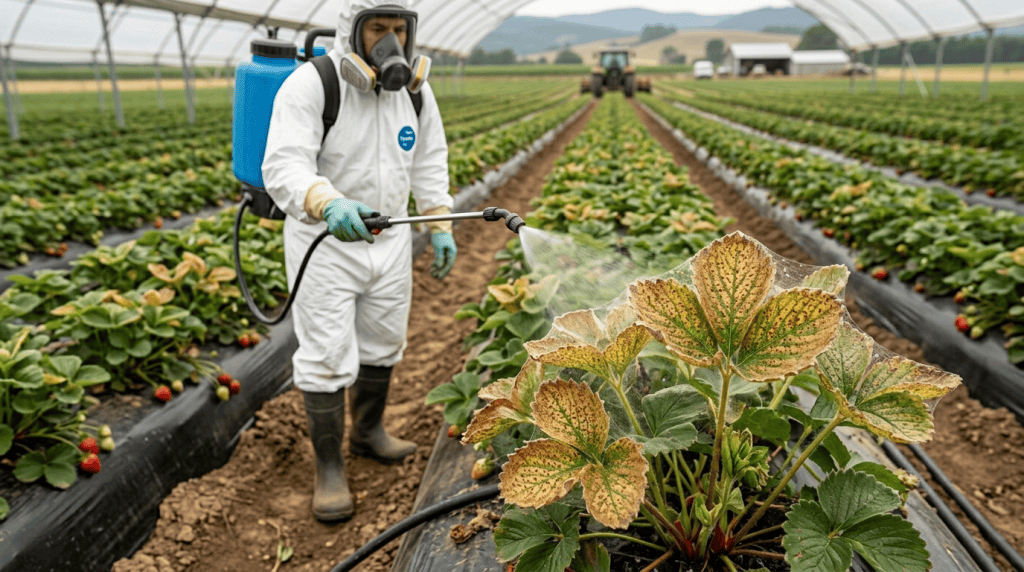
Commercial miticides are used when populations exceed treatment thresholds.
Severe infestations may require specialized products.
Which miticides are commonly recommended?
- Acramite
- Kanemite
- Horticultural oils
These products are commonly used in professional strawberry crop protection programs.
Why is rotating miticides important?
Resistance management remains essential.
- Reduces resistance development.
- Preserves effectiveness.
- Supports long-term control.
Using the same type of chemical over and over again makes the mites build resistance faster.
Proper Plant Care Helps Prevent Spider Mites From Returning

Credit: Epic Gardening
Prevention focuses on reducing favorable conditions and plant stress.
Long-term prevention costs less than repeated treatments.
How does fertilizer influence spider mite outbreaks?
Nutrition affects pest pressure.
- Excess nitrogen promotes rapid reproduction.
- Balanced fertility supports plant resilience.
- Healthy growth improves recovery from feeding damage.
Managing nutrients supports healthy strawberry plants and stronger defenses against pests.
Which cultural practices reduce infestations?
Several practices support spider mite prevention.
- Minimize dust.
- Maintain consistent irrigation.
- Use clean planting stock.
- Protect beneficial insects.
Good watering keeps your plants from getting stressed in hot, dry weather. Stressed plants are more likely to have mite problems.
Control Tips for Hydroponic Strawberries
Hydroponic growers should prioritize environmental management and early detection.
Hydroponic and greenhouse environments create unique challenges.
How can humidity and airflow help?
Environmental control influences pest pressure.
- Increase humidity during dry conditions.
- Improve airflow.
- Scout frequently.
Many greenhouse strawberry pests thrive when temperatures rise and humidity remains low.
Which hydroponic-friendly control methods work best?
Several methods fit controlled environments.
- Use 1% horticultural oil or insecticidal soap instead of alcohol (risk of plant damage)
- Predatory mites.
- Insecticidal soap.
- Routine scouting.
For hydroponic growers, checking your plants often is what really matters. It’s more important than any one treatment you might use later.
Integrated Pest Management Is the Best Way to Control Spider Mites
Integrated pest management provides the most reliable and sustainable control.
Combining multiple tactics consistently outperforms single-method approaches.
What should an integrated management plan include?
A complete strawberry integrated pest control program should include:
- Routine scouting.
- Early intervention.
- Biological controls.
- Selective treatments.
- Ongoing prevention.
How to Do It in Tophydroponicgarden
- Inspect strawberry plants weekly.
- Record mite populations and damage.
- Remove hotspots with water sprays.
- Introduce predatory mites early.
- Apply targeted treatments when necessary.
- Maintain nutrition, airflow, and moisture.
- Continue monitoring for reinfestation.
Spider Mite Management Comparison
| Strategy | Best Use | Key Benefit |
| Water spray | Early infestation | Immediate population reduction |
| Insecticidal soap | Moderate infestation | Direct contact control |
| Neem oil | Supplemental treatment | Helps suppress active mites |
| Predatory mites | Long-term management | Sustainable biological control |
| Miticides | Severe outbreaks | Rapid knockdown |
FAQ
How Do I Identify Spider Mite Damage on Strawberry Leaves Early?
Early damage starts as tiny white or yellow pinpricks on the upper side of the leaf, a symptom known as stippling. As the mites drain more fluid, the foliage loses its green gloss, fading into a sickly yellow before turning a distinct, burnt bronze color. If you see that bronzing, the leaves are essentially choking, and berry production will stall.
Inspect the undersides of leaves regularly because strawberry leaf undersides pests often hide there. Early spider mite detection allows you to treat infestations before serious strawberry foliage damage occurs.
Are Predatory Mites Effective for Strawberry Mite Infestation Control?
Yes, predatory mites for strawberries are one of the most effective biological control for spider mites methods. Species such as Phytoseiulus persimilis and Neoseiulus californicus actively feed on pest mites and can significantly reduce a strawberry mite infestation.
Many growers use these beneficial mites for strawberries as part of strawberry integrated pest control programs because they provide ongoing control without harming strawberry plants or beneficial insects.
Why Do Spider Mites Spread Faster During Hot, Dry Weather?
Spider mites reproduce much faster during hot, dry weather because these conditions shorten the spider mite life cycle and increase spider mite reproduction rates. Dry conditions spider mites prefer can also weaken plants and increase drought stress strawberries experience.
As a result, strawberry plant stress from mites becomes more severe, causing strawberry leaf curling, strawberry foliage bronzing, and reduced strawberry yield if the infestation remains unmanaged.
Can Spider Mites Become a Problem in Hydroponic Strawberries?
Yes, hydroponic strawberry spider mites can become a serious problem because protected growing environments often support rapid pest reproduction. Greenhouse strawberry pests frequently thrive in warm, stable conditions where natural predators are limited.
Regular strawberry crop scouting, strawberry pest monitoring, and strawberry pest identification help detect spider mite eggs on leaves, spider mite webbing on strawberries, and other strawberry pest infestation signs before plant damage becomes widespread.
What Helps Prevent Future Spider Mite Outbreaks in Strawberries?
Effective spider mite prevention requires a combination of good growing practices and regular monitoring. Integrated pest management strawberries programs often include controlling spider mites naturally, encouraging natural predators of spider mites, and using companion planting for pest control.
Consistent strawberry garden maintenance, proper strawberry plant health management, and routine strawberry crop protection measures help maintain healthy strawberry plants and reduce the risk of future infestations.
Keep Your Strawberry Plants Healthy With Consistent Action
Spider mites can spread fast, and the damage often shows up before you realize there’s a problem. That’s why regular checks matter. If you spot the signs early and respond quickly, it’s much easier to protect your plants and avoid losing healthy leaves or reducing your harvest.
The good news is that you don’t need a complicated plan. Stay consistent with inspections, pay attention to growing conditions, and use targeted treatments only when needed. Small steps taken at the right time can help keep spider mites under control and support stronger strawberry plants throughout the season.
References
- https://blogs.clemson.edu/ipm/tag/strawberries-ipm/#primary
- https://link.springer.com/article/10.1186/s43088-026-00741-2
Related Articles
- https://tophydroponicgarden.com/best-strawberry-varieties-for-hydroponics/
- https://tophydroponicgarden.com/top-3-pruning-scissors-for-hydroponics/
- https://tophydroponicgarden.com/how-to-grow-hydroponic-strawberries-at-home/
Was this helpful?

I’m Barrie L., a passionate hydroponic gardening enthusiast dedicated to cultivating thriving, soil-less gardens. With a focus on all things hydroponic, I share my expertise on innovative growing techniques and sustainable practices through my blog, tophydroponicgarden.com. As a seasoned hydroponics specialist, my goal is to inspire and guide fellow gardeners in harnessing the power of water-based cultivation for bountiful and eco-friendly harvests. I’m also an author of the book “Hydroponics For Absolute Beginners: Your Step By Step Guide For How To Create An Hydroponics System At Home Without Soil, For Growing Vegetable, Fruit And Herbs.” which is sold on Amazon. Join me on a journey of redefining the way we cultivate plants, one nutrient-rich solution at a time. Happy growing!