

Starting your first hydroponic project can feel overwhelming. There’s a lot to consider, space, budget, types of plants, and the hydroponic system itself.
It’s not just about setting up a grow system; it’s about picking one that fits your situation and goals. Whether you want to grow leafy greens with a simple wick system or try a deep water culture setup for more variety, understanding these factors helps.
You’ll also want to think about maintenance, equipment like grow lights, and your skill level. Read on to get a clear idea on how to choose your first hydroponic project that works for you.
Key Takeaways
- Assess your available space and light to pick a system size and location that suits you.
- Start with easy plants like leafy greens and herbs for quicker success.
- Choose a hydroponic system that matches your budget and maintenance comfort level.
Assess Your Space and Environment
When picking your first hydroponic project, space is a big deal. Think about how much room you have.
University of Minnesota Extension research shows that hydroponic gardening is space-efficient and takes less water than soil gardening, making wick systems or Kratky setups ideal here. [1]
Small spaces like apartments or kitchen counters are perfect for compact systems. Wick systems or Kratky setups fit well here. They don’t take much room and don’t need pumps or complicated parts.
If you have a spare corner or patio, medium setups like Deep Water Culture (DWC) work well. They need a bit more space but allow growing more plants.
Large spaces, like a garage or backyard, give you freedom to try drip systems or aeroponics. These can handle many plants but need more attention and equipment.
Also, decide if you’ll grow indoors or outdoors. Indoor gardens let you control temperature and humidity, and you can use grow lights when natural light is limited. Outdoor setups rely on sunlight but face weather changes.
Light availability matters. If you have good natural light, your plants get a boost. If not, invest in LED grow lights which use less energy and provide the right spectrum for photosynthesis.
Budget Planning and System Cost Analysis
Your budget shapes the project. Starting small helps you learn without spending too much.
- Wick system is the cheapest. It’s simple and great for small herbs and greens.
- Deep Water Culture (DWC) costs more but offers better control and plant variety.
- Aeroponics and drip systems are pricier and more complex but can produce higher yields.
Keep in mind the cost of extra items like grow lights, nutrient solutions, and growing media such as coconut coir or clay pebbles.
Buying starter kits can save time and sometimes money. They come with most parts you need, including reservoirs, pumps, and net pots.
Plant Selection Criteria for Beginner Hydroponics

For your first project, pick plants that are easy to grow and forgiving.
Leafy greens like lettuce and spinach grow fast and don’t need complex nutrient mixes. Herbs such as basil and oregano also do well and add flavor to your cooking.
Fruiting plants like tomatoes or peppers need more care and stable nutrient solutions. Save these for when you’re comfortable with basics.
Root vegetables aren’t ideal for beginners. They require special setups and growing media.
Fast growers give you quick results, which is encouraging. It also helps you learn how your system works without waiting months.
Hydroponic System Type Selection
There are many hydroponic systems. The key is to pick one that matches your skill level and goals.
Simple systems like the Wick system or Kratky method don’t use pumps or electricity. They’re perfect for beginners and small spaces.
Deep Water Culture (DWC) is the next step up. Roots sit in nutrient solution, and you use an air pump to keep oxygen flowing. It’s still manageable but needs more monitoring.
Nutrient Film Technique (NFT) circulates a thin layer of nutrient water over roots. It saves space but requires a reliable pump.
Drip systems drip nutrient solution directly to plants. They’re scalable and good for bigger setups but more complex.
Aeroponics mists roots with nutrients and oxygen. It’s efficient but complex and costly.
Starting simple helps you avoid frustration. You can always upgrade later.
Maintenance and Automation Requirements
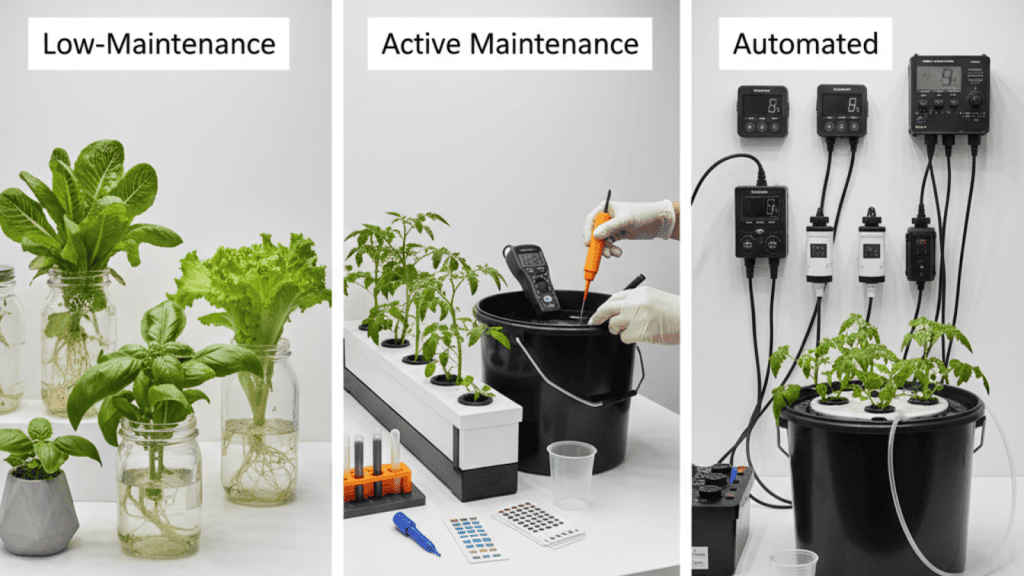
Maintenance varies by system. Wick and Kratky methods are low-maintenance. Check water levels and nutrient solution occasionally, and you’re mostly set.
DWC and NFT need regular checks of pH, nutrient concentration, and pump function. You’ll test pH and electrical conductivity often, using pH meters or strips.
Automation can help. Timers for pumps and lights reduce manual work. More advanced setups use sensors to monitor solution levels and adjust nutrients automatically.
Understanding hydroponic nutrients well helps you anticipate what your plants need and maintain healthy growth.
Manual systems teach you fundamentals well but require daily attention. Semi-automated setups strike a balance and suit busy beginners.
Materials and Tools for Hydroponics Setup
Growing media supports plants. Coconut coir holds moisture and is eco-friendly. Clay pebbles provide good aeration and drainage. Rockwool keeps moisture but needs careful handling.
You’ll need containers or reservoirs to hold nutrient solutions. Pumps and tubing circulate water in active systems. Net pots hold plants and growing media.
If growing indoors, invest in grow lights. Oklahoma State University research on LED grow lights shows their energy efficiency and optimal light spectrum benefits for plant production, making LEDs common for their advantages. Make sure your water source is clean. [2]
Make sure your water source is clean. Test and adjust pH to around 5.5–6.5 for most plants.
Learning Curve and Scalability Considerations
Hydroponics has a learning curve. Start simple and build skills gradually.
Choose systems that can expand if you want to grow more later. Modular systems let you add more plants or levels without rebuilding.
Keep notes or a journal on your setup. Track pH, nutrient changes, and plant growth to learn what works best.
Common Mistakes to Avoid in Your First Hydroponic Project
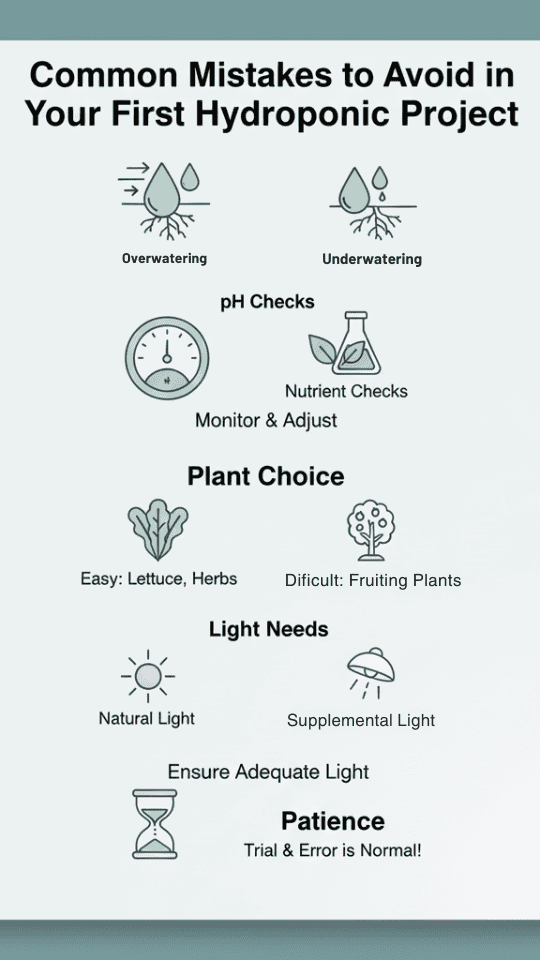
It’s easy to get overwhelmed. Common pitfalls include:
- Overwatering or underwatering plants. Even in hydroponics, water flow matters.
- Neglecting pH and nutrient checks, which can stunt growth.
- Picking plants too difficult for your system.
- Ignoring light needs, especially indoors.
Patience is key. Hydroponics requires some trial and error.
Understanding Nutrient Solutions and pH Management
One of the trickiest parts of your first hydroponic project is managing hydroponic nutrients and pH levels. Plants need the right balance of nutrients dissolved in water, and the pH affects how well they absorb these nutrients.
For beginners, start with pre-mixed nutrient solutions designed for leafy greens or herbs. Knowing how to make nutrient solution for hydroponics ensures you get the right concentrations and avoid common mistakes.
Regularly testing pH with a meter or strips is crucial. Most hydroponic plants prefer a pH between 5.5 and 6.5. If pH drifts too far outside this range, plants can’t absorb nutrients properly, and growth will suffer.
It’s wise to set a schedule for testing, maybe every few days. Adjust pH with simple solutions available at garden stores if needed.
Mastering this early will save you frustration and help your plants thrive.
Tips for Managing Light and Temperature in Your Hydroponic Setup
Credits: FoodForestClub
Light and temperature play big roles in your hydroponic success. Plants depend on light for photosynthesis and warmth for growth.
If you’re growing indoors, natural light might be limited. Using LED grow lights can make a big difference. They’re energy-efficient and offer the right light spectrum. Position lights about 12 to 18 inches above plants and keep them on for around 14 to 16 hours a day for leafy greens.
Temperature matters too. Most hydroponic plants grow best between 65 and 75 degrees Fahrenheit. Too cold or hot can slow growth or stress plants.
Keep your setup in a place where temperature stays steady, avoiding drafts or direct heat sources. A simple thermometer can help you monitor conditions.
Good light and stable temperature combine to support faster growth and healthier plants.
FAQ
How do I manage nutrient solutions in my hydroponic system?
Check your nutrient solution every few days with a pH meter. Most hydroponic plants like pH between 5.5-6.5. Change the solution in your water reservoir weekly. Commercial growers use fancy systems, but you can start simple. Mix hydroponic nutrients with clean water. Follow the package directions. Keep nutrient solutions cool and covered.
What’s the difference between nutrient film technique and other hydroponic systems?
Nutrient film technique uses thin water flow over plant roots. Deep water culture keeps roots in nutrient solution all the time. Both growing systems work well for leafy greens. Nutrient film technique uses less water but needs good water pumps. It’s perfect for herbs and vegetables with small roots. Deep water culture is easier for beginners.
Can I really grow plants without soil and get successful hydroponic results?
Yes! You can grow plants without soil using hydroponic systems. Plant roots get food directly from water solutions instead of dirt. Many hydroponic plants grow faster than soil plants. They get exactly what they need. Leafy greens, herbs and vegetables love hydroponic growing setups. Just keep good nutrient solutions and use grow lights for indoor hydroponics.
How do I set up a water reservoir and water pump for my hydroponic grow?
Your water reservoir holds nutrient solution that feeds hydroponic plant roots. Make it big enough for several days – about 1-2 gallons per plant. Connect your water pump to tubes that bring nutrient solution to plants. For drip systems, use a timer for water flow. The pump moves fresh nutrients around. Keep your reservoir covered and cool for healthy growing systems.
Conclusion
Growing your first hydroponic garden doesn’t need to be hard. Pick something small – maybe lettuce or basil in a basic water setup. You’ll need pots with holes, nutrients, and decent light. Keep an eye on the water’s pH and nutrient levels. That’s really all there’s to it. Once you get the hang of it, you can try fancier setups.
References
- https://extension.umn.edu/how/small-scale-hydroponics
- https://extension.okstate.edu/fact-sheets/led-grow-lights-for-plant-production.html
Related Articles
- https://tophydroponicgarden.com/understanding-hydroponic-nutrients/
- https://tophydroponicgarden.com/how-to-make-nutrient-solution-for-hydroponics/
- https://tophydroponicgarden.com/hydroponics-for-beginners/
Was this helpful?

I’m Barrie L., a passionate hydroponic gardening enthusiast dedicated to cultivating thriving, soil-less gardens. With a focus on all things hydroponic, I share my expertise on innovative growing techniques and sustainable practices through my blog, tophydroponicgarden.com. As a seasoned hydroponics specialist, my goal is to inspire and guide fellow gardeners in harnessing the power of water-based cultivation for bountiful and eco-friendly harvests. I’m also an author of the book “Hydroponics For Absolute Beginners: Your Step By Step Guide For How To Create An Hydroponics System At Home Without Soil, For Growing Vegetable, Fruit And Herbs.” which is sold on Amazon. Join me on a journey of redefining the way we cultivate plants, one nutrient-rich solution at a time. Happy growing!