

Choosing the best full-spectrum LED light starts with your plants, not the biggest wattage printed on a product page.
Crop type, canopy size, usable light intensity, coverage, and efficiency all matter more than one impressive number.
At Top Hydroponic Garden, we prefer looking at grow lights as part of the whole indoor setup rather than an isolated gadget.
That makes it much easier to separate useful specifications from marketing noise.
Here’s what actually deserves your attention before you buy.
A Quick Grow-Light Buying Snapshot
If you only remember three things while comparing lights, make them these:
- Match the fixture to your crop, growth stage, and actual canopy size.
- Compare PPFD distribution, PPF, and photon efficacy, not wattage alone.
- Factor in dimming, hanging space, heat, warranty, and running cost before choosing the cheapest option.
Once those basics are clear, most grow-light product pages become much easier to judge.
What Should You Check Before Looking at Grow-Light Brands?
There isn’t one full-spectrum LED that works best for every hydroponic garden.
A compact light may be more than enough for seedlings or leafy greens, while a mature tomato canopy can demand considerably more usable light. The first step is figuring out what the fixture actually needs to cover.
Write down your crop, current growth stage, canopy dimensions, available hanging height, and whether any natural sunlight reaches the plants.
If you’re still figuring out whether your setup needs artificial lighting in the first place, this guide on whether hydroponic systems need grow lights can help you work that out before choosing a fixture.
Also think a few months ahead. If you’re starting with lettuce but expect to grow peppers later, buying a dimmable fixture with some extra capacity may make more sense than replacing an undersized light later.
Which Grow-Light Specs Actually Matter?
You don’t need to understand every number on the box.
The useful specifications answer three basic things: how many plant-usable photons the fixture produces, how much light reaches the canopy, and how efficiently the fixture turns electricity into photons.
| Metric | What It Tells You | Why It Matters |
| PPF | Total photosynthetic photon output | Shows overall fixture output |
| PPFD | Photon density reaching the canopy | Helps judge usable intensity |
| PPE | Photon output per joule | Helps compare efficiency |
| DLI | Total light received per day | Connects intensity with lighting duration |
Kusuma, Pattison, and Bugbee explain that horticultural lighting is better evaluated through photon-based measurements than lumen-based ratings because lumens are weighted around human vision, not plant responses.
How Should You Read PPFD and a PAR Map?
PPFD shows how much photosynthetically useful light reaches a given area of the canopy.
Don’t stop at the highest number on the chart. A fixture may look powerful in the center while intensity drops sharply near the edges.
Check the entire PPFD map and the measurement height used by the manufacturer.
Hanging height matters too. Raising the fixture usually widens coverage but lowers intensity, while moving it closer increases intensity over a smaller area.
For buying purposes, even distribution across the usable canopy can matter just as much as a strong center reading.
What Do PPF and Photon Efficacy Tell You?
PPF describes the total photosynthetic photon output produced by the fixture.
Photon efficacy, usually expressed in μmol/J, tells you how much photon output is produced for each joule of electrical energy. That makes it useful when comparing fixtures with similar wattage.
A 200-watt light isn’t automatically equal to another 200-watt light. Driver losses, heat, optics, and overall fixture design can all affect performance.
According to Kusuma, Pattison, and Bugbee:
“Photons excite electrons and photobiology is thus driven by the number of photons, not energy or lumens.” – Kusuma, Pattison & Bugbee, Horticulture Research
Why Does DLI Matter After PPFD?
PPFD tells you about light intensity, while DLI tells you how much photosynthetically active light plants receive throughout the day.
That means intensity and photoperiod work together.
Research by Núñez Ocaña and colleagues describes DLI through the combination of PPFD and light duration. Their lettuce study also shows that similar daily light totals can come from different intensity and photoperiod combinations.
In practice, a stronger fixture doesn’t always need a longer schedule. A timer for grow lights and water pumps also makes it easier to keep that photoperiod consistent from day to day.
How Much Light Do You Actually Need for Your Grow Area?
Start by measuring the plant canopy rather than the entire room, rack, or grow tent.
Then compare the crop’s lighting needs with the manufacturer’s PPFD map at a realistic mounting height.
This is where advertised coverage can become misleading. A fixture may visibly illuminate a 3 × 3-foot area without providing equally useful intensity across every part of that space.
Think in terms of effective coverage, not just visible coverage.
| Crop Type | Relative Light Demand | What to Prioritize |
| Seedlings | Lower | Dimming and uniform coverage |
| Lettuce and leafy greens | Low to moderate | Consistent canopy intensity |
| Culinary herbs | Moderate | Adjustable output |
| Tomatoes and peppers | Higher | Strong output and broad coverage |
These are relative categories, not universal PPFD targets. Exact requirements vary by crop, cultivar, growth stage, photoperiod, and surrounding conditions.
For multi-level racks, treat every shelf as its own growing area rather than sizing one fixture for the entire rack.
Does “Full Spectrum” Tell You Enough About a Grow Light?

Not by itself.
A broad-spectrum horticultural LED may combine white light with different proportions of blue, red, and sometimes far-red wavelengths. That can make it useful across several plant stages.
Still, spectrum is only one piece of the puzzle.
Research on horticultural LEDs shows that spectral composition can influence plant morphology and development, while the response can vary among species and growing conditions.
So more colors on a marketing graphic don’t automatically mean better plant performance.
UV, far-red, and extra spectral channels may serve specific purposes, but they shouldn’t distract you from more basic questions: Does the fixture provide enough photons? Is the distribution usable? Is it efficient?
I’d choose a well-performing broad-spectrum fixture over one with a longer wavelength list but poor coverage data.
Which LED Fixture Design Fits Your Hydroponic Setup?
Physical design matters once the fixture actually has to fit above a reservoir, shelf, or grow tent.
Board-style LEDs work well over compact growing areas and are relatively straightforward to hang. Bar fixtures spread LEDs across a wider frame, while slim LED bars are often easier to fit into stacked shelves where vertical space is limited.
If you’re building inside an enclosed setup, this top hydroponic garden grow tent setup guide can help you plan light placement, clearance, and the surrounding equipment together.
Grow bulbs are convenient for a few plants but become harder to position evenly across a larger hydroponic garden.
| Fixture Type | Good Fit For | Coverage Style |
| LED panel | Compact canopies | Broad but concentrated |
| Bar fixture | Wider grow areas | More distributed |
| Slim LED bars | Shelves and racks | Narrow and linear |
| Grow bulb | One or a few plants | Localized |
Also check where the driver sits and how much clearance remains above the plants.
A light that technically fits but blocks reservoir access gets annoying very quickly.
Which LED Features Are Actually Worth Paying More For?
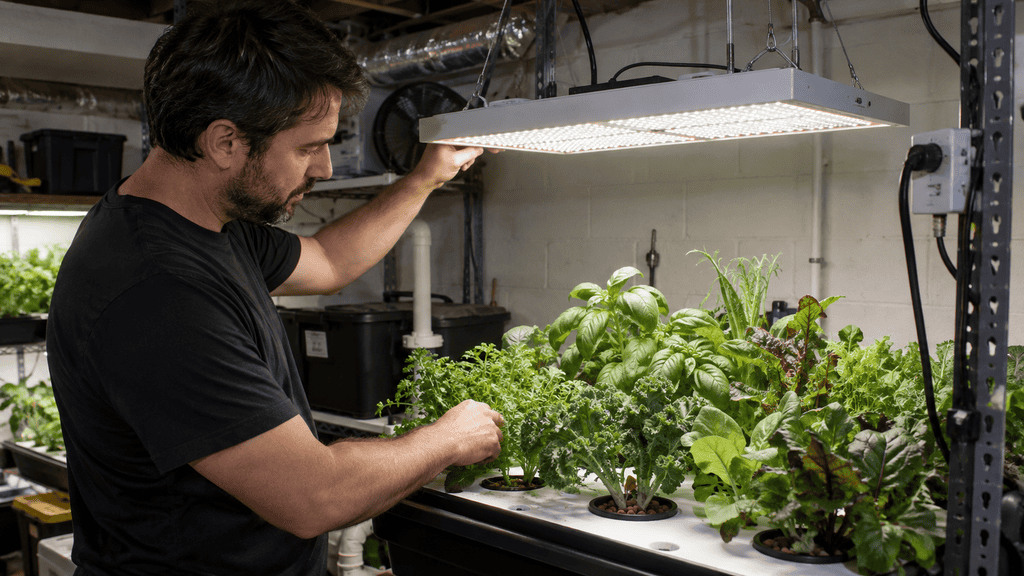
Dimming is one of the features I’d prioritize first.
It gives you room to adjust output as seedlings develop into larger plants instead of changing fixtures every time their lighting needs change.
Thermal design deserves attention too. LEDs still create heat, and that heat has to go somewhere. Look at heatsink design, driver placement, ventilation around the fixture, and whether a hot light will sit directly above a small enclosed canopy.
Other practical features include:
- Adjustable hanging hardware
- External or remotely mounted drivers
- Daisy-chain or controller compatibility
- Moisture-resistant construction where appropriate
- Clear warranty terms
- Accessible customer support
- Recognized electrical safety certification
Don’t judge the fixture only by the diode brand. A good diode can still be part of a poorly designed light if thermal management, power delivery, or distribution isn’t handled well.
Is the Cheapest Grow Light Really the Least Expensive?

Credits: Fast Gardening Michigan
Not always.
Purchase price is only one part of the cost. Actual power draw, efficiency, daily operating hours, the number of fixtures required, and local electricity rates all matter.
A simple starting calculation is:
Daily electricity use = fixture watts × operating hours ÷ 1,000
Lighting duration matters too because plants respond to the amount of light accumulated over the day, not wattage alone.
As noted by Núñez Ocaña and colleagues:
“PPFD and photoperiod together determine the daily light integral (DLI), which is highly correlated with biomass accumulation.” – Núñez Ocaña et al., Frontiers in Plant Science
A cheap fixture can still make sense for a small herb or lettuce setup. The problem is when low output means buying several units or replacing the light as the garden expands.
This comparison gives you a better picture than simply choosing whichever fixture has the lowest upfront price.
Which Grow-Light Claims Should Make You Cautious?
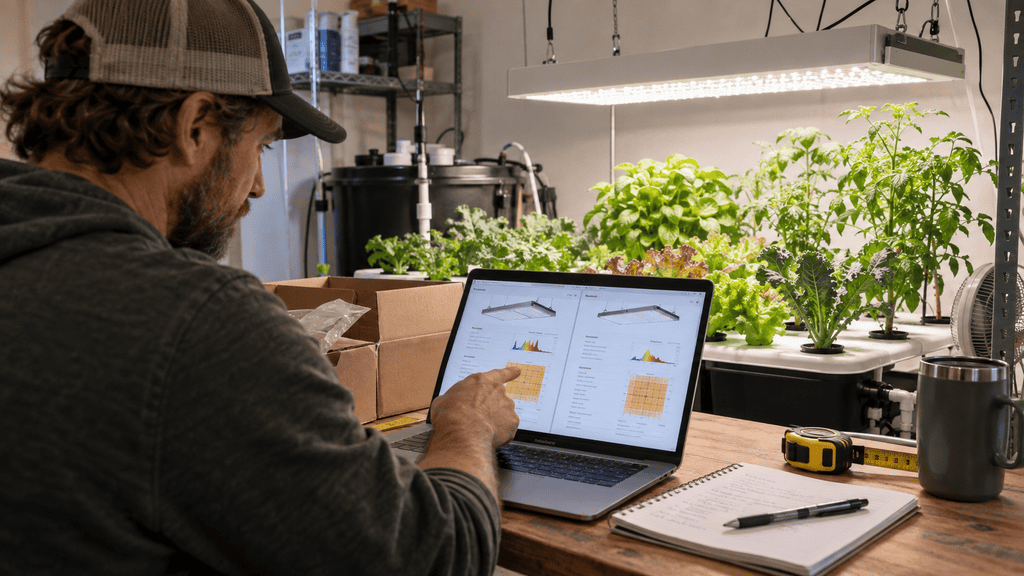
Grow-light listings sometimes mix useful specifications with numbers that are difficult to compare.
Start by checking actual wall power.
Names such as “1000W” or “2000W” don’t necessarily mean the fixture actually draws that amount of electricity. Product naming and equivalent-wattage claims can create unnecessary confusion.
I’d also look closer when you see:
- A huge PPFD number with no measurement height
- Only a center PPFD reading
- Coverage claims without a PPFD map
- Lumens used as the main plant-performance metric
- Spectrum graphics without useful output data
- Very large coverage claims from a small fixture
- UV or far-red marketed as an automatic yield increase
- Huge lifespan claims without meaningful warranty support
None of these automatically makes a fixture bad.
They simply mean you need more information before comparing it with another light.
What Checklist Should You Use Before Buying?
You can make the final comparison much faster by checking the lights in the same order every time.
- Identify the crop and growth stage.
- Measure the actual canopy.
- Determine an appropriate PPFD and DLI target from a credible horticultural source.
- Check the fixture’s PPFD map at a usable height.
- Compare center and edge readings.
- Check actual wattage, PPF, and PPE.
- Review the spectrum without treating “full spectrum” as a performance guarantee.
- Check dimming, cooling, moisture suitability, and hanging hardware.
- Compare warranty and manufacturer support.
- Estimate electricity cost and future expansion needs.
The best light doesn’t need to win every category.
It needs to fit your crop, physical setup, budget, and the amount of light you actually need.
FAQ
Can Any LED Light Be Used as a Grow Light?
Some ordinary LEDs can support low-demand plants if they provide enough usable light. The problem is that household bulbs rarely include reliable PPFD and coverage data, so they’re harder to size accurately.
Can Full-Spectrum LEDs Completely Replace Sunlight?
Yes, plants can be grown entirely under artificial lighting when the fixture provides suitable intensity, spectrum, photoperiod, and daily light amount. The “full spectrum” label alone doesn’t guarantee that.
Should LED Grow Lights Stay On 24 Hours a Day?
Not as a default. The right photoperiod depends on the crop, and some controlled-environment studies use extended or continuous lighting only under carefully managed intensity and DLI.
Can LED Grow Lights Burn Plants?
Yes. Excessive light intensity or heat can stress leaves even when the fixture uses LEDs. Dimming the fixture or increasing hanging distance can help when canopy intensity is too high.
How Long Do LED Grow Lights Usually Last?
A quality LED can remain usable for years, but output gradually declines and drivers or other components may fail first. Warranty length and documented performance are more useful than a huge lifespan number on the box.
Which Full-Spectrum LED Is Actually Worth Buying?
If you’re comparing full-spectrum LEDs and every spec sheet starts looking the same, focus on what your plants actually need.
Bigger numbers don’t automatically mean better results.
Match the light to your crop and canopy, then look at PPFD distribution, efficiency, heat, and running cost so you’re paying for usable light, not impressive specs.
If you’re still putting your indoor setup together, Top Hydroponic Garden can help you compare grow lights and related hydroponic equipment without overcomplicating the process.
Once the fixture fits your growing space and plant needs, the choice gets much easier.
References
- https://www.nature.com/articles/s41438-020-0283-7
- https://www.frontiersin.org/journals/plant-science/articles/10.3389/fpls.2026.1756524/full
Related Articles
- https://tophydroponicgarden.com/do-you-need-grow-lights-for-hydroponics/
- https://tophydroponicgarden.com/using-a-timer-for-lights-and-water-pumps/
- https://tophydroponicgarden.com/how-to-set-up-a-grow-tent-for-hydroponics/
Was this helpful?
I’m Barrie L., a passionate hydroponic gardening enthusiast dedicated to cultivating thriving, soil-less gardens. With a focus on all things hydroponic, I share my expertise on innovative growing techniques and sustainable practices through my blog, tophydroponicgarden.com. As a seasoned hydroponics specialist, my goal is to inspire and guide fellow gardeners in harnessing the power of water-based cultivation for bountiful and eco-friendly harvests. I’m also an author of the book “Hydroponics For Absolute Beginners: Your Step By Step Guide For How To Create An Hydroponics System At Home Without Soil, For Growing Vegetable, Fruit And Herbs.” which is sold on Amazon. Join me on a journey of redefining the way we cultivate plants, one nutrient-rich solution at a time. Happy growing!