

Hydroponic cucumbers need 12 to 18 inches between plants, while greenhouse rows usually need 4 to 6 feet between centers. Some setups allow about 6 to 9 square feet per plant, but floor space isn’t the only factor.
Roots need room to spread. Vines need support, and plants need good light and airflow. Trellis height matters, too. Get the spacing right early, and planning gets easier.
Keep reading on Tophydroponicgarden to size your cucumber growing area and plan your setup with confidence.
Quick Space Guide: Cucumber Growing Room
- Plant spacing: 12 to 18 inches apart.
- Row spacing: About 5 feet between rows.
- Growing space: Allow 6 to 9 sq. ft. per plant.
Horizontal Space Needed Per Cucumber Plant
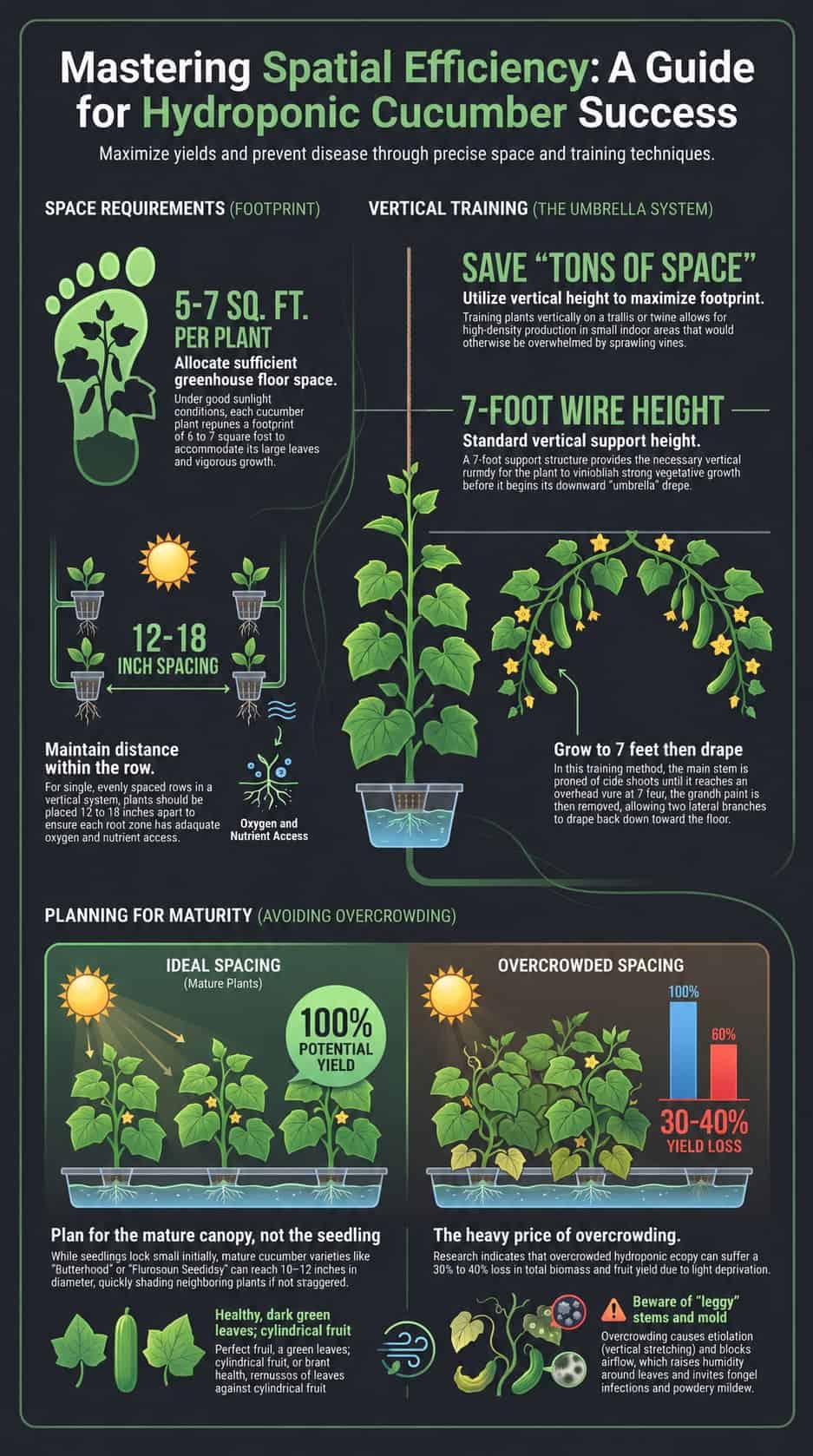
Allow 12 to 18 inches between cucumber plants when vines are trained vertically. Alaska Cooperative Extension recommends this range for vertically trellised greenhouse cucumbers.
Use 12-inch spacing for close vine training. Keep one main leader and remove side shoots. With 16 to 18 inches of plant spacing, leaves get more room. Airflow and plant care also get more room. That extra space can help in smaller grow rooms where humidity is harder to manage.
| Setup | Starting spacing | Main factor |
|---|---|---|
| Dense vertical training | 12 inches | Regular pruning |
| Standard greenhouse | 16 to 18 inches | More canopy room |
| Lower light | Wider spacing | Less light competition |
| Untrained vines | More space | Fast lateral growth |
Don’t treat minimum spacing as the target. Cucumber vines expand fast once flowering begins. For Tophydroponicgarden growers, match spacing to the footprint, lighting, and training routine.
Hydroponic Cucumber Row Spacing
A 5-foot row center gives growers a useful starting point for greenhouse planning. Auburn University uses 5-foot centers in its greenhouse cucumber production guidance. For growers planning different cucumber setups, the available space should also account for how the plants will be trained and managed.
Cucumber vines grow up. Their leaves can spread into nearby lanes. So row spacing needs to account for the mature canopy, not the small footprint of a young plant..
Leave room for:
- Mature canopy growth
- Harvest access
- Pruning and vine training
- Trellis access
- Nutrient lines and drainage
- Equipment movement
Single-row trellises can make harvest and pruning easier. Double rows can raise plant density. They need close canopy control.
Plan the growing area around the mature cucumber canopy. That approach gives you enough working space without wasting valuable floor area.
Floor Space Needed Per Hydroponic Cucumber
Commercial greenhouse systems may allow 6 to 9 square feet per cucumber plant, depending on the cultivar and cropping method. Oregon State University provides this range for greenhouse cucumber production.
Treat this as a planning guide, not a fixed minimum. Intensive training can reduce floor use, while home setups may need extra room for access and equipment.
Useful planning points:
- 2 × 2 feet: Highly managed trial plant
- 3 × 3 feet: One trained plant
- 5 × 5 feet: More canopy and access room
- Larger greenhouse: Row-based planning
A 3 × 3-foot area gives 9 square feet. Walls, walkways, reservoirs, and tools can cut the usable space. So the plant’s floor area is only part of the plan.
The canopy still needs light and airflow. Roots need oxygen, too. Growers also need enough room to prune, train, and harvest.
Plan floor space, root space, and vertical space together for a more practical cucumber growing area.
Vertical Space Requirements for Hydroponic Cucumbers

Vertical training lets cucumber vines use height instead of extra floor space. Alabama Cooperative Extension describes greenhouse trellises around 6 to 8 feet high, while some advanced systems extend beyond 12 feet.
Cucumbers grow fast. Without support, vines can spread into plants, lights, walkways, and walls. A trellis gives each vine a defined path and keeps the canopy easier to manage.
Common support options include:
- String systems
- Overhead wire
- Plant clips
- Trellis netting
Choose support based on the cultivar and growing method. Leave enough height for the mature vine, too. A short trellis can limit training options and make the upper canopy harder to manage.
Use vertical space well, and a cucumber setup can support strong vine growth without using excessive floor area.
Recommended Trellis Height for Hydroponic Cucumbers
A 6 to 8-foot trellis is a practical starting point for many home and greenhouse systems. Some high-wire systems can exceed 12 feet. This gives more room for vine training.
A useful cucumber trellis should include:
- Strong overhead support
- One position per plant
- Clearance above the mature canopy
- Space for lowering or retraining vines
- Easy access for harvesting
Trellis height matters when vines reach the top. If there’s no room left, growers may need to redirect vines sideways. That can increase canopy overlap and reduce the available growing space between plants.
Plan trellis height around the expected vine length and training method. More vertical room can also reduce pressure on the floor layout.
Training and Floor Space Management
Cucumber training changes the amount of floor space each plant needs. A single-leader system sends growth upward. Unpruned side shoots can make the canopy much wider.
Useful training practices include:
- Directing the main vine upward
- Removing unwanted lateral shoots
- Keeping each vine in its lane
- Matching density to available light
- Leaving access for harvesting
As noted by Penn State Extension
“Penn State Extension notes that trellising cucumbers in high tunnels encourages better airflow and disease prevention, with plants pruned to a single stem and trained to a single string for efficient space use.” – Penn State Extension
Commercial growers use training and pruning to control plant density. These steps also help control crop growth. Auburn Cooperative Extension notes that greenhouse cucumber density should match available light and production conditions.
A smaller grow room can still support healthy cucumber plants with proper training. The key is to use vertical space efficiently and keep the canopy from spreading into nearby plants or walkways. Train the vine upward, then manage the canopy.
Root Space Requirements for Hydroponic Cucumbers
Hydroponic cucumbers need a root zone with good oxygen, drainage, and nutrient access. University of Florida IFAS notes that cucumber roots can grow large in NFT systems. Large roots can make oxygen control harder.
Container size alone doesn’t determine root-zone quality. A small container can support strong growth under controlled conditions, but poor oxygen levels can quickly create problems.
Key priorities include:
- Adequate root support
- Good drainage
- Strong aeration
- Stable nutrient delivery
- Suitable solution temperature
Different systems need different root-zone planning:
- Dutch bucket: Media and drainage
- DWC: Aeration and solution volume
- NFT: Channel capacity and root mass
- Trough: Root development and water flow
As noted by Canadian Center of Science and Education
“Research published in the Journal of Agricultural Science found that a cooled nutrient solution at 22°C significantly improves dissolved oxygen levels in the root zone compared to warmer solutions, enhancing root respiration and nutrient uptake for healthier cucumber yields” – Canadian Center of Science and Education
Warm nutrient solution can hold less dissolved oxygen. This can stress the root zone. Plan the roots, water, aeration, and drainage as one system.
Hydroponic Cucumbers in NFT Channels
Hydroponic cucumbers can grow in NFT channels. Large roots can cause oxygen and flow issues. University of Florida IFAS notes that cucumber roots can become substantial in NFT systems, increasing the need for careful oxygen management. The same root-zone considerations matter when growing cucumbers in a DWC system, where oxygen availability is especially important.
NFT uses little growing media. It sends nutrient solution to the roots. That makes it appealing for compact setups. But cucumber roots can fill the channel as the plant matures.
| Benefits | Main concerns |
|---|---|
| Low media use | Large root growth |
| Direct nutrient delivery | High oxygen demand |
| Compact layout | Restricted water flow |
| Efficient floor use | Warm solution stress |
Keep an eye on:
- Channel dimensions
- Solution flow
- Root growth
- Oxygen levels
- Nutrient temperature
- Plant density
NFT can support cucumbers with proper design. But root management needs to stay part of the growing plan.
Cucumber Canopy Space at Maturity

Credits : Matt Garver the Hydroponics Guy
A mature cucumber canopy can spread past the container. This is more likely without vertical training. North Carolina State University notes that cucumber plants can reach roughly 3 to 8 feet wide when growth isn’t tightly controlled.
The main vine may grow up. Leaves and side shoots can spread out. So the usable canopy area can become much larger than the root footprint.
Good canopy management includes:
- Main-vine training
- Lateral-shoot control
- Selective leaf removal
- Trellis direction
Vertical training shifts more growth upward and can free valuable floor space. But the root footprint, plant footprint, and accessible growing area aren’t the same thing.
A 12-inch container spacing may look efficient at first. Once mature leaves overlap nearby plants or block access to fruit, that spacing can become harder to manage. Plan around the mature canopy, not the container.
Hydroponic Cucumber Spacing in Winter

Low winter light may need lower plant density. It does not call for tighter spacing. Alabama Cooperative Extension notes that greenhouse plant density may be reduced by 25% or more during winter to improve light reaching the crop.
Use the light level to set plant spacing. Do not base spacing on the season alone. Fewer plants can reduce competition under weak lighting.
- Strong summer light: Higher density
- Limited winter light: Lower density
- Weak grow lights: Fewer plants
- Uniform strong lighting: Controlled higher density
Growers should also check the canopy. Heavy leaf overlap can block light even in a bright room. So don’t change spacing based on season alone.
Check:
- Canopy overlap
- Light distribution
- Leaf shading
- Plant growth
A lower winter density can give each plant more access to available light. But the exact spacing still needs to match the lighting system and mature canopy.
Calculating Space for a Small Hydroponic Cucumber Setup

Plan around 6 to 9 square feet per cucumber plant for greenhouse-style production. Oregon State University provides this range as a useful planning benchmark.
For a small setup:
- 2 plants × 6 sq. ft. = 12 sq. ft.
- 4 plants × 6 sq. ft. = 24 sq. ft.
- 4 plants × 9 sq. ft. = 36 sq. ft.
- 6 plants × 9 sq. ft. = 54 sq. ft.
These figures describe planning space, not container or reservoir size. So usable floor area matters more than the room’s total footprint.
Account for:
- Trellis position
- Walkways
- Reservoirs
- Lighting
- Drainage
- Electrical equipment
- Pruning access
A 30-square-foot room may not provide 30 square feet for cucumber growth if equipment takes up part of the floor. Four plants may fit on paper, but heavy leaf overlap can make the setup harder to manage. Measure usable growing space, not empty floor space.
Effects of Overcrowded Hydroponic Cucumbers
Excessive cucumber plant density can limit light and airflow. It can also make pruning and harvesting harder. Alabama Cooperative Extension notes that higher plant density does not always produce higher yields. These conditions can contribute to some common issues in hydroponic cucumbers, especially when the canopy becomes difficult to manage.
Signs of an overcrowded canopy include:
- Heavy leaf overlap
- Shaded lower foliage
- Difficult pruning access
- High canopy humidity
- Strong light competition
Crowding often appears in the canopy before it becomes obvious on the floor. More plants don’t automatically mean more fruit.
If the canopy becomes too dense, growers can:
- Retrain vines vertically
- Remove selected lateral shoots
- Improve air circulation
- Reduce plant numbers
Adding more light may help with shading, but it won’t fix poor access or excessive canopy growth. Avoid aggressive pruning, too.
Cucumber leaves drive photosynthesis, so remove excess growth without stripping away productive foliage.
Choosing Hydroponic Cucumber Spacing
A practical starting point is 12 to 18 inches between vertically trained plants with about 5-foot row centers in greenhouse-style layouts. Adjust the final spacing to match light, cultivar, training, airflow, and root-zone design.
Use these guidelines:
- Maximum density: Tighter spacing, regular pruning
- Easy maintenance: Wider plant spacing
- Limited light: Fewer plants
- High humidity: More canopy separation
- Small grow room: Vertical training
- NFT system: Strong root oxygen management
No single cucumber spacing fits every hydroponic setup. Commercial systems can support tighter layouts with controlled lighting, temperature, humidity, irrigation, and training.
Home systems often have less room for error. Wider spacing can make pruning and harvesting easier. It also gives growers better access for disease checks and nutrient-system maintenance. Match plant density to the real growing conditions.
Hydroponic Cucumber Space Requirements
Hydroponic cucumbers generally need 12 to 18 inches between vertically trained plants, but the real space requirement extends beyond the container. Canopy growth, row access, trellis height, light, airflow, and root-zone conditions all affect plant density.
Useful planning benchmarks include:
- Plant spacing: 12 to 18 inches
- Row centers: About 5 feet
- Planning area: 6 to 9 sq. ft. per plant
- Training: Vertical support
These figures are starting points, not fixed rules. A cucumber may begin in a small net pot or bucket, but the mature canopy can spread far beyond it.
More plants also don’t guarantee a larger harvest. Crowding can limit light and make pruning or harvesting harder.
For Tophydroponicgarden growers, begin with a manageable plant density. Build strong trellis support, then increase density only if the lighting, airflow, and growing area can handle the mature canopy.
FAQ
What cucumber container size supports healthy root development?
Choose a container that gives the cucumber root zone enough room for healthy root development. The ideal cucumber container size depends on the cultivar and hydroponic grow system. A container that is too small can restrict root growth and make it harder to maintain stable moisture, oxygen, and nutrient conditions around the roots.
How does cucumber plant size affect indoor cucumber growing?
Cucumber plant size can vary depending on the cultivar and growing conditions. For indoor cucumber growing, plan for the plant’s mature size rather than its seedling size. Consider cucumber plant height, cucumber vine growth, leaf growth, and cucumber canopy space so each plant has enough room for training, airflow, light, and routine maintenance.
How much space do cucumber vines need around a trellis?
Cucumber vines need enough space to climb without becoming crowded by nearby plants. Cucumber vine spacing should allow easy training and access to the trellis during routine care. Proper cucumber trellis spacing also supports airflow and reduces excessive leaf crowding, which can block light and make cucumber canopy management more difficult.
How does cucumber plant density affect hydroponic cucumber yield?
Cucumber plant density affects competition for light, airflow, and available growing space. Planting too closely can increase cucumber plant competition and make canopy management more difficult. The appropriate density depends on the cultivar, growing conditions, training method, and available production space rather than one fixed spacing for every hydroponic cucumber system.
How can I save space when growing cucumbers vertically?
Space-saving cucumber growing uses vertical support to train vines upward instead of allowing them to spread across the floor. Vertical cucumber growing can make better use of available height and reduce the cucumber growing footprint. Plan the vertical trellis, vine support, canopy space, and access paths together to create an efficient cucumber growing setup.
Planning the Right Space for Cucumber Plants
If your hydroponic cucumbers feel cramped as they grow, the problem usually starts with planning around seedlings instead of mature plants. You need enough room for the canopy, roots, trellis, and access for routine care. Space matters.
Tophydroponicgarden can help you plan your growing setup with the full-grown cucumber plant in mind, so you’re not constantly fighting for room later. Give each plant enough space to grow and maintain airflow, then adjust your layout based on your trellis and growing system.
References
- https://extension.psu.nx.iwdfun.com/growing-cucumbers-in-high-tunnels
- https://www.academia.edu/49105581/Influence_of_Nutrient_Solution_Temperature_on_Its_Oxygen_Level_and_Growth_Yield_and_Quality_of_Hydroponic_Cucumber
Related Articles
- https://tophydroponicgarden.com/cucumbers/
- https://tophydroponicgarden.com/common-issues-in-hydroponic-cucumbers/
- https://tophydroponicgarden.com/growing-cucumbers-in-a-dwc-system/
Was this helpful?

I’m Barrie L., a passionate hydroponic gardening enthusiast dedicated to cultivating thriving, soil-less gardens. With a focus on all things hydroponic, I share my expertise on innovative growing techniques and sustainable practices through my blog, tophydroponicgarden.com. As a seasoned hydroponics specialist, my goal is to inspire and guide fellow gardeners in harnessing the power of water-based cultivation for bountiful and eco-friendly harvests. I’m also an author of the book “Hydroponics For Absolute Beginners: Your Step By Step Guide For How To Create An Hydroponics System At Home Without Soil, For Growing Vegetable, Fruit And Herbs.” which is sold on Amazon. Join me on a journey of redefining the way we cultivate plants, one nutrient-rich solution at a time. Happy growing!