
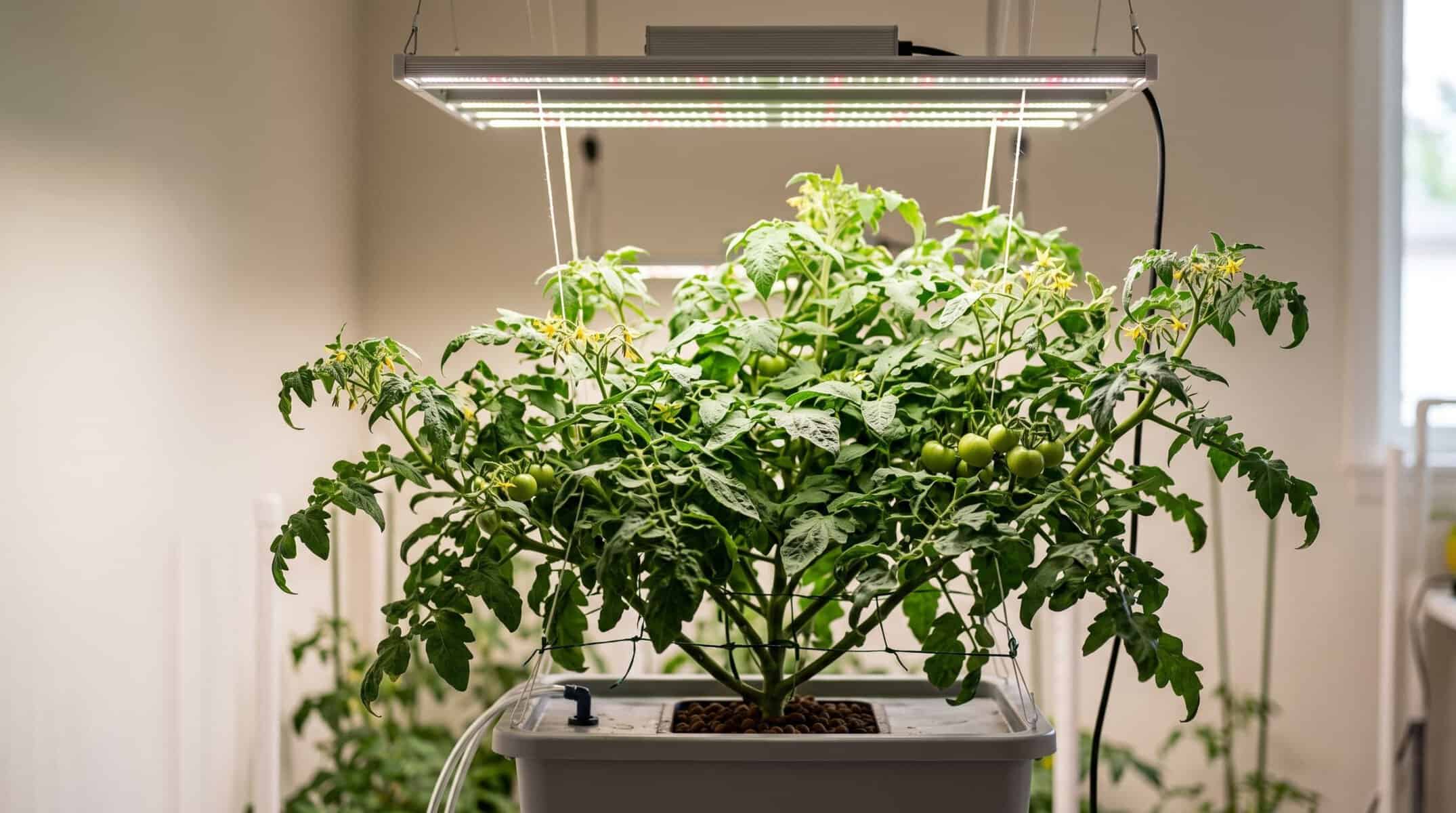
Hydroponic tomatoes need about 20-30 mol/m²/day of DLI for productive mature growth, with 25-30 mol/m²/day often used as a commercial target for high-wire tomatoes.
The exact light needed can change with plant age, light intensity, and available natural light. Understanding PPFD and DLI helps growers choose the right LED grow lights for tomatoes without wasting energy or putting plants under too much light. Keep reading with Tophydroponicgarden for practical tips on managing tomato light levels.
Better Lighting for Hydroponic Tomatoes
- Hydroponic tomatoes generally perform well at 20–30 mol/m²/day DLI, with mature fruiting plants often targeting the upper end of that range.
- A lighting schedule of around 16 hours on and 8 hours off is commonly used, while PPFD should be adjusted to the plant stage and growing environment.
- Even canopy coverage matters as much as peak intensity because uneven light can create weak growth, light stress, and inconsistent fruit production.
What Is the Right DLI for Hydroponic Tomatoes?
Mature hydroponic tomatoes generally perform best with 20–30 mol/m²/day of DLI, while commercial high-wire production often targets approximately 25–30 mol/m²/day.
Daily light integral (DLI) measures the total amount of photosynthetically useful light a plant receives over an entire day. It is more useful than looking at light hours alone because both intensity and duration affect the final amount of light.
According to Michigan State University Extension, high-wire fruiting crops such as tomatoes can require approximately 25–30 mol/m²/day for productive commercial production. Virginia Cooperative Extension gives a broader tomato range of approximately 20–30 mol/m²/day.
For growers, the practical targets are:
- 20–30 DLI: productive mature hydroponic tomatoes.
- 25–30 DLI: useful commercial high-wire target.
- Below 20 DLI: may limit productive growth and fruit development.
- 5–10 DLI: more appropriate as a general reference range for young seedlings.
DLI is therefore the main number to track when planning indoor tomato growing. A grower can reach the same DLI through different combinations of PPFD and photoperiod.
How Many Hours of Light Do Hydroponic Tomatoes Need?
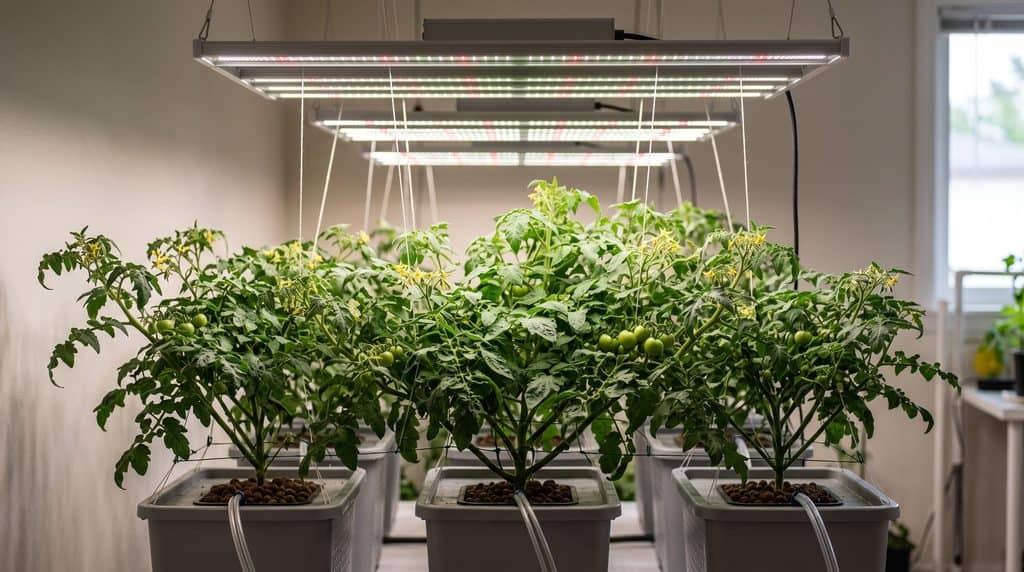
A 16-hour light and 8-hour dark schedule is a practical starting point for hydroponic tomatoes, as long as the light intensity is high enough to meet the desired DLI. This schedule gives plants a consistent daily light period while also allowing a regular dark period.
Tomatoes are high-light, day-neutral plants. So, growers don’t need to change the photoperiod to trigger flowering. The main focus should be on whether hydroponic systems need grow lights to provide enough total daily light for healthy growth and fruit production.
A 16/8 schedule is useful for many tomato grow light setups because it creates a predictable lighting period. It also makes DLI calculations easier for growers who want to track daily light levels.
But 16 hours of light doesn’t automatically mean the plants receive enough light. For example, 200 µmol/m²/s for 16 hours produces only 11.52 DLI. That’s well below the 20-30 DLI target for mature fruiting plants.
So, measure light intensity as well as duration. Both factors affect the total light plants receive each day.
What PPFD Should Tomato Plants Receive?
PPFD should be measured at the tomato canopy because it shows how much photosynthetically useful light reaches the leaves.
The supplied research gives 150-200 µmol/m²/s as a supplemental-lighting benchmark from Michigan State University Extension. But the DLI calculation suggests that mature tomatoes under heavy artificial lighting may need a higher average canopy PPFD.
- At 200 µmol/m²/s for 16 hours, DLI is about 11.52.
- At 300 µmol/m²/s for 16 hours, DLI is about 17.28.
- At 400 µmol/m²/s for 16 hours, DLI is about 23.04.
- At 500 µmol/m²/s for 16 hours, DLI is about 28.80.
- At 600 µmol/m²/s for 14 hours, DLI is about 30.24.
So PPFD and DLI need to be considered together. A grower using 400-500 µmol/m²/s for 16 hours can reach roughly 23-29 DLI, which falls within the commonly cited range for mature tomatoes.
Wattage alone can’t tell you how much light reaches the crop. A 400-watt LED grow light may deliver a different PPFD than another 400-watt fixture because efficiency, optics, mounting height, and coverage can vary.
How Much Light Do Tomato Seedlings Need?
Tomato seedlings need much less light than mature fruiting plants. So, growers shouldn’t expose young plants to the full 25-30 DLI commercial target right away. Young seedlings have lower light needs while their stems, leaves, and roots are still developing.
The research dossier identifies 5.04 mol/m²/day as a minimum developmental threshold for hydroponic tomato seedlings. Too little light can cause weak, stretched stems and delayed development. But excessive light at this stage isn’t the goal either.
A practical lighting progression is:
| Growth stage | General lighting approach |
| Seedling | Approximately 5–10 DLI reference range |
| Vegetative | Gradually increase light as the canopy develops |
| Flowering | Increase toward productive crop-level DLI |
| Fruiting | Approximately 20–30 DLI |
During the seedling stage, focus on healthy plant structure rather than maximum light exposure. As plants grow larger and begin producing flowers, their need for photosynthetic light rises.
So, increase light as the canopy develops. Don’t push young seedlings too hard too early. A gradual increase gives plants time to adjust to higher light levels as their growth and leaf area increase.
Why Does PPFD Matter More Than Grow Light Wattage?
PPFD matters more than wattage because PPFD measures the light reaching the plant, while wattage only measures electrical power consumed by the fixture.
A fixture can have high wattage but poor coverage or efficiency. Another LED fixture can consume less electricity while delivering more useful photons to the tomato canopy.
For grow lights for hydroponic tomatoes, growers should therefore look for manufacturer-provided PPFD maps rather than relying only on wattage claims.
The most useful measurements are:
- PPFD: instantaneous light intensity at the canopy.
- DLI: total daily light received by the crop.
- Wattage: electrical consumption.
- Coverage: the area receiving useful light.
- Uniformity: how evenly light reaches the canopy.
Michigan State University Extension also emphasizes measuring lighting performance across the growing area rather than treating fixture output as a single number.
For indoor tomato production, this approach makes light planning more predictable and can also reduce unnecessary tomato growth, light cost and energy consumption.
How Should You Measure PPFD for Hydroponic Tomatoes?
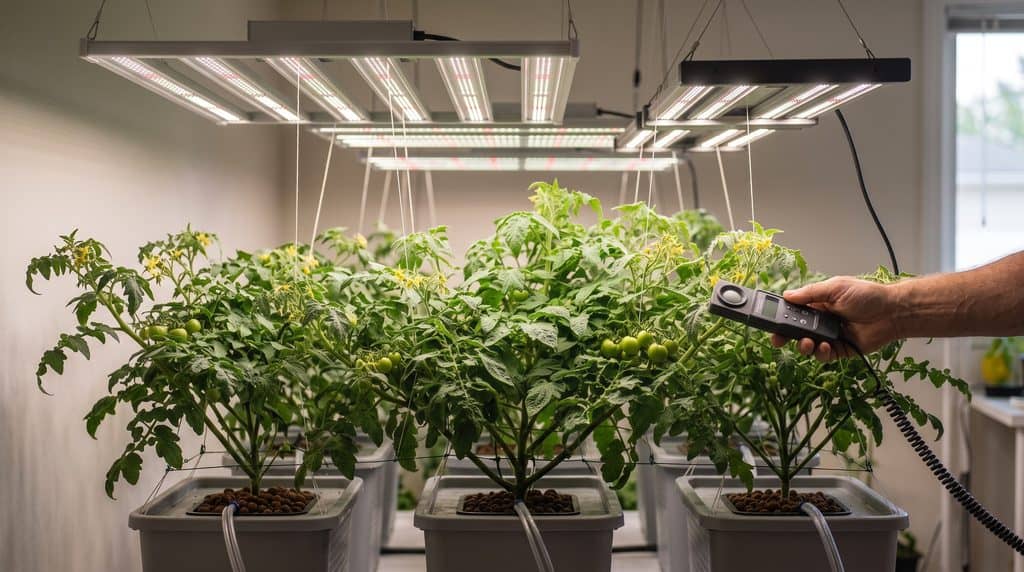
Measure PPFD at canopy height and take readings from several points. This shows whether the whole tomato canopy gets enough and even light.
A single reading under the center of a grow light can be misleading. Leaves near the edges may receive much less light, especially when the fixture has limited coverage.
For accurate tomato light measurement, use a PAR meter and check several areas across the growing space. Don’t rely on one spot.
- Measure the canopy center.
- Check the front, back, and edges.
- Compare high and low readings.
- Adjust light height or spacing.
- Recheck as plants grow taller.
Michigan State University Extension cites about 15-20% or less variation as a lighting uniformity target for greenhouse applications. Even light can help reduce strong center growth and weak edge growth.
So, measure across the full canopy, not only beneath the light. As tomatoes grow taller, their canopy position changes too, so readings should be repeated.
How Can You Improve Tomato Canopy Light Distribution?
Improve distribution by adjusting fixture height, spacing, and coverage rather than simply increasing the light’s maximum output.
Data from Frontiers in Plant Science demonstrates
“Low photosynthetic photon flux density (PPFD) at the lower leaves tends to limit plant growth.” – Frontiers in Plant Science
A wider fixture or multiple appropriately spaced LED grow lights can provide better coverage than one powerful fixture positioned directly above the center. The goal is a reasonably uniform canopy rather than the highest possible reading in one location.
What Are the Signs of Too Little or Too Much Light?
Low light commonly produces leggy tomato plants, while excessive light can cause bleaching, curling, scorching, or dry leaf edges.
Plant symptoms provide useful clues, but they do not prove that light is the only cause. Temperature, humidity, airflow, nutrient solution, EC, and pH can produce overlapping symptoms.
| Light condition | Common signs | First adjustment |
| Too little | Stretching, weak stems, slow development | Increase PPFD or reduce distance |
| Suitable | Compact growth, healthy green leaves | Maintain settings |
| Too much | Bleaching, curling, scorching | Reduce intensity or increase distance |
| Uneven | Strong center, weak edges | Improve coverage |
Michigan State University research on tomato transplants links insufficient light with weak, elongated growth. Low light can leave plants thin and stretched, especially during early growth.
Excessive light can cause a different set of problems when high light levels combine with heat. So, check the growing conditions before changing the light alone.
If symptoms appear, check light intensity first, then review temperature, humidity, airflow, and nutrient conditions. This helps avoid treating the wrong cause.
How Can You Reduce Tomato Light Stress?
Reduce light stress by lowering fixture intensity, increasing the distance from the canopy, or improving airflow and temperature control.
If leaves develop tomato light burn symptoms, check PPFD and canopy temperature before making a major change to the photoperiod. A lighting problem can also be an environmental problem.
Which Grow Light Spectrum Works for Hydroponic Tomatoes?
A full-spectrum LED is a practical choice for hydroponic tomatoes. Red and blue wavelengths can also affect plant structure and growth.
The supplied research identifies about 10-15% blue light as a useful addition to a red-dominant LED spectrum. Research from the University of Manitoba cited in the dossier links this balance with leaf development and less excessive stem elongation.
As highlighted by Frontiers in Plant Science
“Our data suggest that a full spectrum offers advantages over a simple red and blue emission spectrum in tomato plants.” – Frontiers in Plant Science
For most indoor growers, a quality full-spectrum fixture keeps the setup simple. It provides a broad range of wavelengths throughout the tomato growing cycle.
The basic approach is:
- Choose a horticultural full-spectrum LED.
- Check the PPFD map.
- Confirm good canopy coverage.
- Keep lighting consistent unless needed.
But spectrum isn’t a substitute for PPFD and DLI. A suitable light spectrum can’t make up for too little total light.
The right spectrum should support the light level your tomatoes receive each day. Check PPFD and DLI along with the spectrum to get a clearer picture of whether the plants have enough usable light.
How Can You Set Up Grow Lights for Hydroponic Tomatoes?
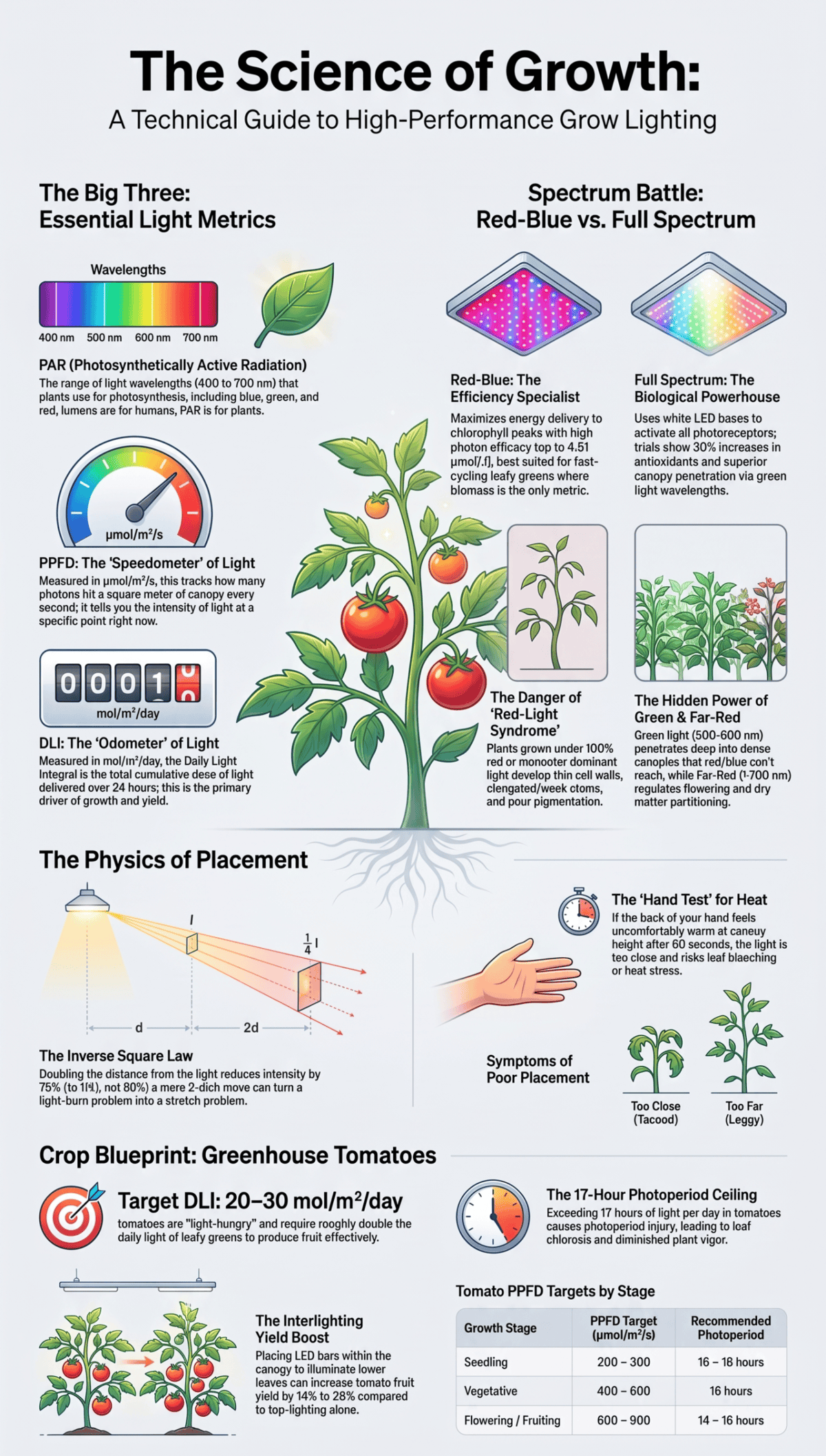
A practical lighting setup starts with the desired DLI. From there, determine the required PPFD, photoperiod, fixture coverage, and mounting height.
For mature tomato plants, 25-30 DLI is a useful commercial planning target. With a 16-hour photoperiod, an average canopy PPFD of about 434 µmol/m²/s is needed for 25 DLI, while 30 DLI requires about 521 µmol/m²/s. For a 20 DLI target, the required PPFD is about 347 µmol/m²/s.
So don’t choose the light distance based on a fixed number. The correct tomato grow light distance depends on the fixture. Use the manufacturer’s PPFD data, then measure the light at canopy height. That check matters.
A good tomato grow light setup should provide:
- Consistent PPFD across the canopy.
- About 16 hours of light.
- Adequate fixture coverage.
- Suitable full-spectrum LED output.
- A consistent dark period.
- Good airflow and temperature control.
Keep the same approach for DWC, NFT, ebb-and-flow, or drip hydroponic tomatoes. The lighting target is based on the amount of light reaching the plant canopy, not the type of hydroponic system.
That makes PPFD and DLI the useful numbers to check, rather than wattage or light distance alone.
What Is the Best Light Strategy for Hydroponic Tomatoes?

Credit: Hydro How-To
The most practical approach is to manage DLI first, PPFD second, and photoperiod third. Then, check how the plants respond and review the growing conditions.
Start with the growth stage. Seedlings need much less light than mature fruiting plants. As the canopy grows and flowering begins, gradually move toward the 20-30 DLI range.
Next, measure PPFD at canopy height. If the average is too low, adjust the light output, fixture height, or coverage. Don’t extend the light schedule automatically to make up for low PPFD.
Then check temperature, humidity, airflow, and the pH for tomatoes in hydroponics along with the tomato nutrient solution. Strong light increases photosynthetic demand, so these conditions need to support higher light levels.
There isn’t one PPFD level that fits every tomato cultivar or growing setup. The 20-30 DLI range is a useful planning guide, but actual settings should be adjusted based on measurements and plant response.
This approach helps growers avoid changing several light settings at once. Keep track of PPFD, DLI, and plant growth so each adjustment has a clear purpose.
FAQ
How can you tell if hydroponic tomato plants receive too much light?
Watch for tomato light burn symptoms, including bleached or pale leaves, crispy edges, curling, and damaged upper leaves. These tomato light stress signs can appear when light intensity becomes too high.
Measure PPFD for tomatoes at the canopy with a PAR meter. If readings are excessive, increase the tomato grow light distance or reduce light intensity gradually.
Does tomato pruning affect how much light reaches the plant?
Yes. Tomato pruning can improve light penetration into the canopy by removing older, crowded, or unnecessary leaves. However, excessive pruning can expose leaves and fruit to too much direct light.
Combine tomato pruning and light management with proper tomato plant spacing and trellising. This helps improve tomato canopy light distribution and maintain more uniform light throughout the plant.
How should you adjust hydroponic tomato lighting during winter?
Tomato light requirements can be harder to meet during winter because natural daylight may be shorter or weaker. Indoor tomato growing and greenhouse production may need supplemental lighting when sunlight is insufficient.
Measure light at the plant canopy before adding artificial lighting. Then adjust the tomato light duration per day according to the amount of natural light available.
How high should grow lights be above hydroponic tomato plants?
Tomato grow light height depends on light output, coverage area, and PPFD at the plant canopy. Do not rely on one fixed tomato grow light distance for every setup.
Measure light at canopy level and adjust the height gradually. Proper tomato light positioning should provide even coverage without creating intense hot spots on upper leaves or fruit.
Can light affect tomato yield in a hydroponic system?
Yes. Light directly supports tomato photosynthesis and can affect tomato yield when other growing conditions are suitable. Light also works with the tomato nutrient solution, EC, pH, root-zone oxygen, and overall plant health.
Maintaining consistent light helps hydroponic tomatoes use available resources efficiently. This is especially important during vegetative growth, flowering, and fruit production.
How Much Light Do Hydroponic Tomatoes Need?
Getting tomato lighting right can be frustrating when wattage and lighting hours don’t tell you what the leaves actually receive. A useful target is around 20-30 mol/m²/day of DLI, with 25-30 often used for mature commercial crops. That’s the number to watch.
Start with canopy-level PPFD, calculate DLI, then check how evenly the light reaches the plants before making small adjustments. For a 16-hour schedule, 400-500 µmol/m²/s can provide roughly 23-29 DLI. The right LED setup can help maintain productive growth without wasting energy. Tophydroponicgarden can help you put these lighting steps into practice.
References
- https://www.frontiersin.org/journals/plant-science/articles/10.3389/fpls.2016.00448/full
- https://www.frontiersin.org/journals/plant-science/articles/10.3389/fpls.2021.611236/full
Related Articles
- https://tophydroponicgarden.com/tomatoes/
- https://tophydroponicgarden.com/do-you-need-grow-lights-for-hydroponics/
- https://tophydroponicgarden.com/ideal-ph-for-tomatoes-in-hydroponics/
Was this helpful?

I’m Barrie L., a passionate hydroponic gardening enthusiast dedicated to cultivating thriving, soil-less gardens. With a focus on all things hydroponic, I share my expertise on innovative growing techniques and sustainable practices through my blog, tophydroponicgarden.com. As a seasoned hydroponics specialist, my goal is to inspire and guide fellow gardeners in harnessing the power of water-based cultivation for bountiful and eco-friendly harvests. I’m also an author of the book “Hydroponics For Absolute Beginners: Your Step By Step Guide For How To Create An Hydroponics System At Home Without Soil, For Growing Vegetable, Fruit And Herbs.” which is sold on Amazon. Join me on a journey of redefining the way we cultivate plants, one nutrient-rich solution at a time. Happy growing!