

You can expect a small hydroponic system to use about as much electricity as a standard desktop computer. That countertop herb garden you’ve been eyeing probably costs less than eight dollars a month to run. The power consumption isn’t some mysterious black box, it’s just simple math based on the equipment you choose and how you use it.
This guide will walk you through real numbers for different system sizes and show you exactly where the watts go. Keep reading to learn how to build an efficient system that doesn’t shock you when the utility bill arrives.
Key Takeaways
- Lighting is your biggest expense, but switching to LEDs cuts that cost dramatically.
- System size directly determines cost, with small setups being surprisingly affordable.
- Smart placement and equipment choices can slash your energy use by half or more.
The Real Cost of Running Your Lights

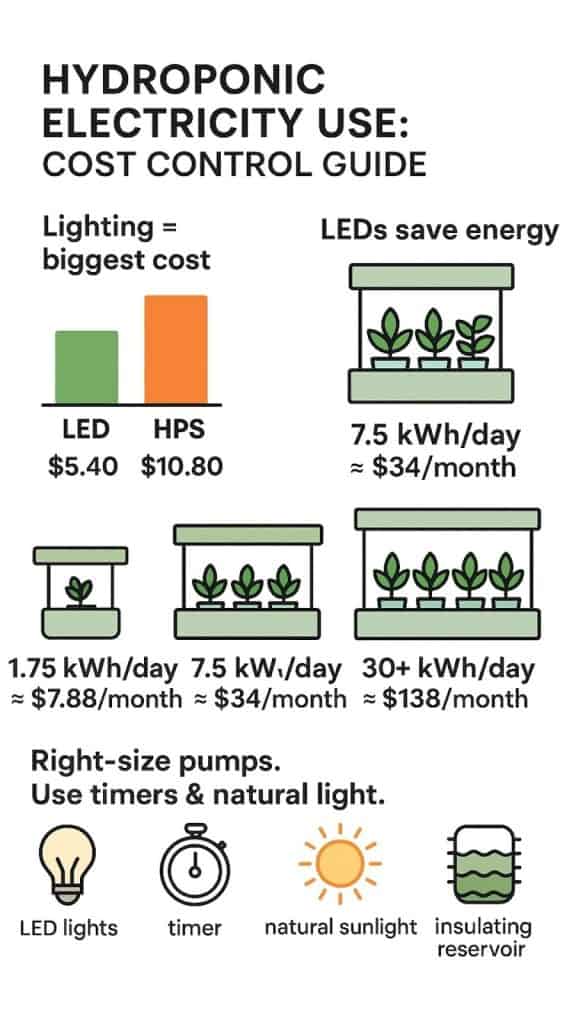
Grow lights are the heart of an indoor hydroponic system, and they’re also the biggest draw on your power. It’s not just about the wattage printed on the box. You have to consider how many hours a day they’re on. A 100-watt LED running for 12 hours consumes 1.2 kilowatt-hours (kWh). At the average U.S. rate of 15 cents per kWh, that’s 18 cents a day, or about $5.40 a month just for light.
Older lighting technology like High-Pressure Sodium (HPS) bulbs are real energy hogs. A 600W HPS system can easily use double the electricity of a modern LED setup providing the same light intensity. The initial investment in quality LEDs pays for itself over time on your electricity bill. They also produce less heat, which can reduce the need for cooling fans.
The type of plants you grow dictates your lighting schedule. Leafy greens like lettuce and spinach are happy with 12 to 14 hours of light. Fruiting plants like tomatoes and peppers demand 16 to 18 hours. That difference of a few hours each day adds up significantly over a month. Using a simple timer is a non-negotiable for controlling this cost.
To minimize lighting costs:
- Choose full-spectrum LED lights over HPS or fluorescent options.
- Use an automatic timer to ensure lights are only on when needed.
- Select plant varieties that require fewer hours of daily light.
The Steady Drip of Pumps and Climate Control
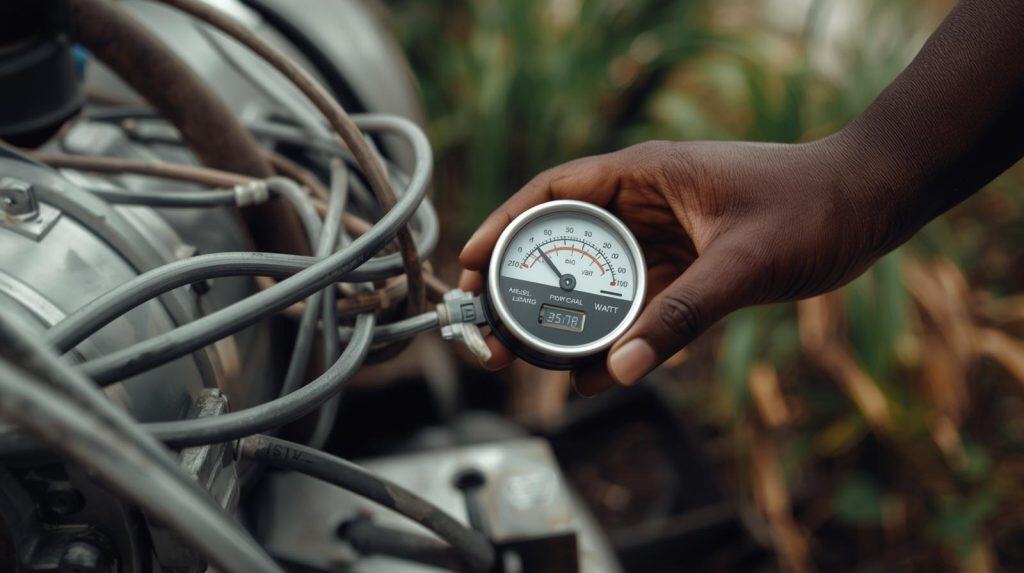
While lights get all the attention, the other components hum along in the background, steadily adding to your total. Water pumps and air pumps typically run 24 hours a day, seven days a week.
A small, efficient water pump might use only 15 watts. That seems tiny, but because it never turns off, it amounts to 360 watt-hours per day. Over a month, that’s 10.8 kWh, adding another $1.62 to your bill.
The key with pumps is to avoid overbuying. A massive pump meant for a large commercial system will guzzle electricity in a small home setup without providing any benefit. Match the pump’s gallons-per-hour (GPH) rating to the size of your reservoir.
Climate control is the wild card. If your garden is in a thermally stable space like a living room, you might not need any extra heating or cooling.
But a system in a cold garage will require a water heater. A 150-watt heater running for 8 hours a day adds 1.2 kWh daily. In a hot attic, a chiller might be necessary, and those can draw 400 watts or more.
These devices are often the second-largest energy users after lighting. Insulating your reservoir with a simple foam sleeve can drastically reduce how often these devices need to kick on.
Scaling Up: From Countertop to Garage Farm

Credit : Simple Greens Hydroponics
Your total electricity use is essentially the sum of all these parts, and it scales directly with the size of your ambition. A compact countertop system for herbs and microgreens is remarkably cheap to operate.
With one small LED light and a couple of small pumps, you’re looking at around 1.75 kWh per day. That translates to roughly 52.5 kWh per month, costing about $7.88. It’s an affordable way to have fresh flavors year-round.
Stepping up to a medium-sized system in a garage or spare room changes the equation. You might have a larger 300-watt LED light for tomatoes, a more powerful pump, multiple air stones, and even a small heater.
This setup can easily use 7.5 kWh daily. Your monthly consumption jumps to around 226 kWh, with a cost of approximately $34. This is still manageable, especially if the produce replaces grocery store purchases.
A large, dedicated home farm is a serious energy commitment. Think multiple high-power LED lights, several pumps, and active climate control for optimal growth. This scale of operation can consume over 30 kWh per day.
The monthly total nears 923 kWh, with an estimated cost of $138. While this is a significant expense, for a serious grower producing substantial amounts of food, the economics can still make sense compared to buying organic produce.
Making Your Hydroponic System More Efficient
You don’t have to choose between high electricity bills and a thriving garden. A few strategic choices can dramatically reduce your energy footprint. It starts with leveraging free resources. The sun is the most powerful grow light available, and it’s completely free.
Placing your system near a south-facing window can cut the required runtime of your artificial lights in half. Even a bright room can reduce the intensity needed from your LEDs.
Effective energy-saving strategies include:
- Harness Natural Light: Position systems in sunrooms or near large windows.
- Use Reflective Surfaces: Line walls with Mylar or white paint to bounce light.
- Right-Size Your Pump: Calculate your exact GPH needs to avoid an oversized, inefficient pump.
- Insulate Reservoirs: Use foam board or reflective insulation to stabilize water temperature.
Technology is your friend here. Smart controllers have become more accessible. These devices can monitor water temperature and only trigger a heater if it drops below a set point, preventing it from running unnecessarily.
Some can even integrate with smart plugs to give you real-time data on how much electricity each component is using. Knowledge is power, literally in this case, allowing you to identify and address energy-wasting elements.
FAQ
How can you check hydroponic electricity consumption in a small home setup?
You look at the watt rating of each device. You check how long it runs each day. You multiply it by your local electricity rate. This gives you a clear view of your hydroponic power usage. You can also use simple meters to track hydroponic energy usage per day so you see real numbers.
How much does LED grow light power affect your hydroponics electricity bills?
LED grow light power often makes up most of your hydroponics electricity bills. You check the lamp wattage and daily runtime. Many growers use LED hydroponic grow lights consumption data to pick efficient lights. You can compare it with hydroponics LED vs HPS energy to choose better options and lower hydroponic lighting electricity cost.
What hydroponic power consumption components use the most energy?
Lights, nutrient pumps, and fans use the most energy. Hydroponic nutrient pump power goes up in bigger systems. Hydroponic air circulation energy rises when your grow room gets warm. Hydroponic HVAC electricity can also increase in greenhouses. You track each device to understand which hydroponic system power consumption factor matters most.
How can you measure hydroponic system electricity usage easily?
You can use a hydroponic system electricity usage calculator. You enter the watt numbers for parts like hydroponic water pump energy, hydroponic pump electricity consumption per hour, and hydroponic lighting power consumption. This helps you do a quick hydroponic energy analysis. You compare the results with hydroponic energy consumption trends to plan savings.
How can you reduce hydroponics energy costs without replacing your system?
You set timers. You shorten hydroponics lighting duration and energy when your plants already get enough light. You review your hydroponic pump running cost and adjust the schedule. You follow simple hydroponic energy consumption reduction steps by turning off devices you do not need. You track progress with hydroponic energy monitoring.
Conclusion
Hydroponic electricity use is not a mystery. It’s a predictable calculation based on the tools you employ. The most important lesson is that you are in control. Starting with a small, efficient system allows you to learn and understand your energy needs without a major financial commitment.
The upfront cost of quality LED lights and properly sized pumps is an investment that pays dividends every month on your utility bill. Your hydroponic garden should be a source of fresh food, not financial stress. With thoughtful planning, you can ensure it stays that way.
References
- https://jurnal.unpad.ac.id/teknotan/article/view/56014
- https://arxiv.org/abs/2405.09643
Related Articles
- https://tophydroponicgarden.com/is-hydroponics-expensive-for-a-beginner/
- https://tophydroponicgarden.com/does-hydroponics-need-constant-water/
- https://tophydroponicgarden.com/does-hydroponics-need-running-water/
Was this helpful?

I’m Barrie L., a passionate hydroponic gardening enthusiast dedicated to cultivating thriving, soil-less gardens. With a focus on all things hydroponic, I share my expertise on innovative growing techniques and sustainable practices through my blog, tophydroponicgarden.com. As a seasoned hydroponics specialist, my goal is to inspire and guide fellow gardeners in harnessing the power of water-based cultivation for bountiful and eco-friendly harvests. I’m also an author of the book “Hydroponics For Absolute Beginners: Your Step By Step Guide For How To Create An Hydroponics System At Home Without Soil, For Growing Vegetable, Fruit And Herbs.” which is sold on Amazon. Join me on a journey of redefining the way we cultivate plants, one nutrient-rich solution at a time. Happy growing!