

Good ventilation has a bigger impact on indoor health than most people realize. Stale air can affect focus, comfort, and overall air quality, while poor airflow may lead to excess moisture and mold problems over time.
Many experts recommend keeping indoor CO2 levels low, especially in shared spaces. Whether it’s a home office, workshop, indoor garden, or residential property, understanding how ventilation works can help create a healthier indoor setup with better air quality and comfort.
Keep reading to see why ventilation deserves more attention than it usually gets.
Fresh Air Fast Facts
- Ventilation improves indoor air quality by removing stale air, reducing pollutants, and maintaining a healthier indoor environment.
- Proper airflow helps control humidity, prevent condensation, and lower the risk of mold growth.
- The right ventilation strategy balances fresh air, comfort, and energy efficiency, making indoor spaces healthier and more comfortable to use.
Why Is Ventilation So Important for Indoor Setups?
You know that stuffy, heavy feeling you get in a room after a few hours? That’s often poor ventilation at work. It’s not just about comfort, it’s about what’s in the air you’re breathing.
Every indoor space collects invisible contaminants. People breathe out carbon dioxide (CO2). Furniture, paints, and cleaning products give off gases called VOCs.
Dust, cooking, and just moving around kick up tiny particles. Without a way to swap that indoor air with fresh outdoor air, all those pollutants just build up.
Ventilation works by simple dilution.It brings in fresh air and pushes the old, contaminated air out, while maintaining consistent air circulation throughout the indoor environment. This process directly lowers your exposure to things like:
- Carbon Dioxide (CO2)
- Chemical vapors from products (VOCs)
- Fine dust and particles (PM2.5)
- Excess moisture that can lead to mold
- General odors and stale air
The Society of Occupational Medicine points to CO2 as a useful, easy-to-measure clue. In a shared space like an office, if CO2 levels stay below 800 parts per million, it generally means the ventilation is doing its job.
When that number climbs, it’s a sign the air isn’t being refreshed enough, and people inside can start to feel tired or find it hard to concentrate.
In short, good ventilation clears the air, literally. It takes the invisible buildup of everyday pollutants and flushes it out, making a space healthier and more comfortable to be in.
How Ventilation Supports Indoor Air Quality

Ventilation is basically your building’s lungs. It works by swapping out stale indoor air for fresh outdoor air, which directly controls what you’re breathing inside.
It’s a common misconception that outdoor air is dirtier. In many cases, the opposite is true. Indoor air can be two to five times, and in some cases, significantly more, polluted than outdoor air, depending on occupant density and chemical off-gassing, a fact that catches a lot of property managers off guard.
When ventilation is poor, you end up with a predictable set of problems: the room feels stuffy and smells linger, dust and other particles hang in the air longer, and overall freshness plummets.
Why everyone keeps talking about CO2
Carbon dioxide has become the go-to metric for judging if a ventilation system is actually working. Here’s the simple reason: we exhale it. In a closed room with people, the CO2 level is a direct proxy for how much “used” breath is accumulating. If the ventilation can’t keep up, that number climbs.
This isn’t just about comfort. A study from Masaryk University linked higher CO2 levels to measurable drops in cognitive function, specifically affecting memory and problem-solving skills. When CO2 gets too high, people report feeling tired, getting headaches, and struggling to focus.
As highlighted by Journal of Exposure Science & Environmental Epidemiology
“directionally consistent evidence that higher central and peak classroom carbon dioxide concentrations… are associated with lower cognitive test scores” and that “higher outdoor air ventilation appears to provide additional benefits by reducing indoor air exposure and supporting student performance.” – Journal of Exposure Science & Environmental Epidemiology
Most decent air quality monitors now use a technology called NDIR to measure CO2, as it’s far more accurate than cheap sensor alternatives.
What we’ve seen time and again is that when a building starts tracking CO2, they almost always find their ventilation isn’t performing as well as they assumed. It reveals problems that were invisible before.
What Happens When Ventilation Is Poor?

Source : wikiHow
When ventilation fails, it doesn’t happen all at once. It’s a slow creep. The air starts to feel heavy and stale. You might notice condensation building up on the windows in the morning, or a musty smell that just won’t go away.
Rooms can feel stuffy and too warm in some spots, too cold in others. For some people, allergy symptoms or sinus irritation get worse indoors.
These aren’t just minor annoyances. They’re classic signs of what’s often called Sick Building Syndrome. People in these spaces commonly report headaches, a persistent tiredness, itchy eyes, and trouble focusing on their work.
It’s not a stretch to say that what gets labeled as a “low productivity day” might actually be a bad air quality day.
The impact is measurable. One study analyzed chess players and found that when fine particulate matter (PM2.5) increased, the quality of their decisions dropped significantly. They made more mistakes. This underscores a direct link: the air we breathe affects how well we think.
Poor ventilation sets off a chain reaction. Trapped heat, excess moisture from breathing and cooking, and all the pollutants we generate indoors have nowhere to go.
This stagnant environment is exactly what mold needs to start growing on walls or in corners, turning an air quality issue into a much bigger property problem.
Why Humidity Management Depends on Ventilation
Managing indoor humidity isn’t just about comfort, it’s a battle against moisture, and ventilation is your primary weapon.
Every activity adds water to the air: people breathing, plants transpiring, cooking, showering, even running a dishwasher. Without a way to remove that moisture, the humidity level climbs.
This creates an ideal breeding ground. Research from building services courses suggests keeping indoor relative humidity between 30% and 70%, with a target around 50-60% for a balance humidity levels, comfort, and safety. Go higher, and you’re inviting trouble.
As noted by Journal of Thermal Analysis and Calorimetry
“in a long-term, windless, or long-term insufficiently ventilated indoor space, the negative impact on the human organism is primarily due to the adverse effects of high relative humidity, which, together with low surface temperatures on internal building structures, is the leading cause of mould formation and growth.” – Journal of Thermal Analysis and Calorimetry
How ventilation stops mold before it starts
Mold needs moisture to grow. The problem often begins with condensation. When warm, humid air touches a cooler surface, like a window pane, an exterior wall, or a cold water pipe, the water vapor turns to liquid. Do this repeatedly, and you get damp spots.
Those damp spots are where mold spores, which are always present in the air, finally find a home. From there, you can get mildew, peeling paint, rotting wood, and eventually, structural damage.
Ventilation tackles this at the source by removing the humid air before it can condense. A good system isn’t just about opening a window.
It’s a coordinated approach: it exchanges the moist indoor air with drier outdoor air, manages the overall humidity level, keeps air moving to prevent stagnant pockets, and uses exhaust fans in key moisture-generating areas like kitchens and bathrooms.
While ventilation can’t fix a leaking pipe or a flooded basement, it is the most effective daily defense for controlling the moisture that everyday life creates.
Natural Ventilation vs Mechanical Ventilation
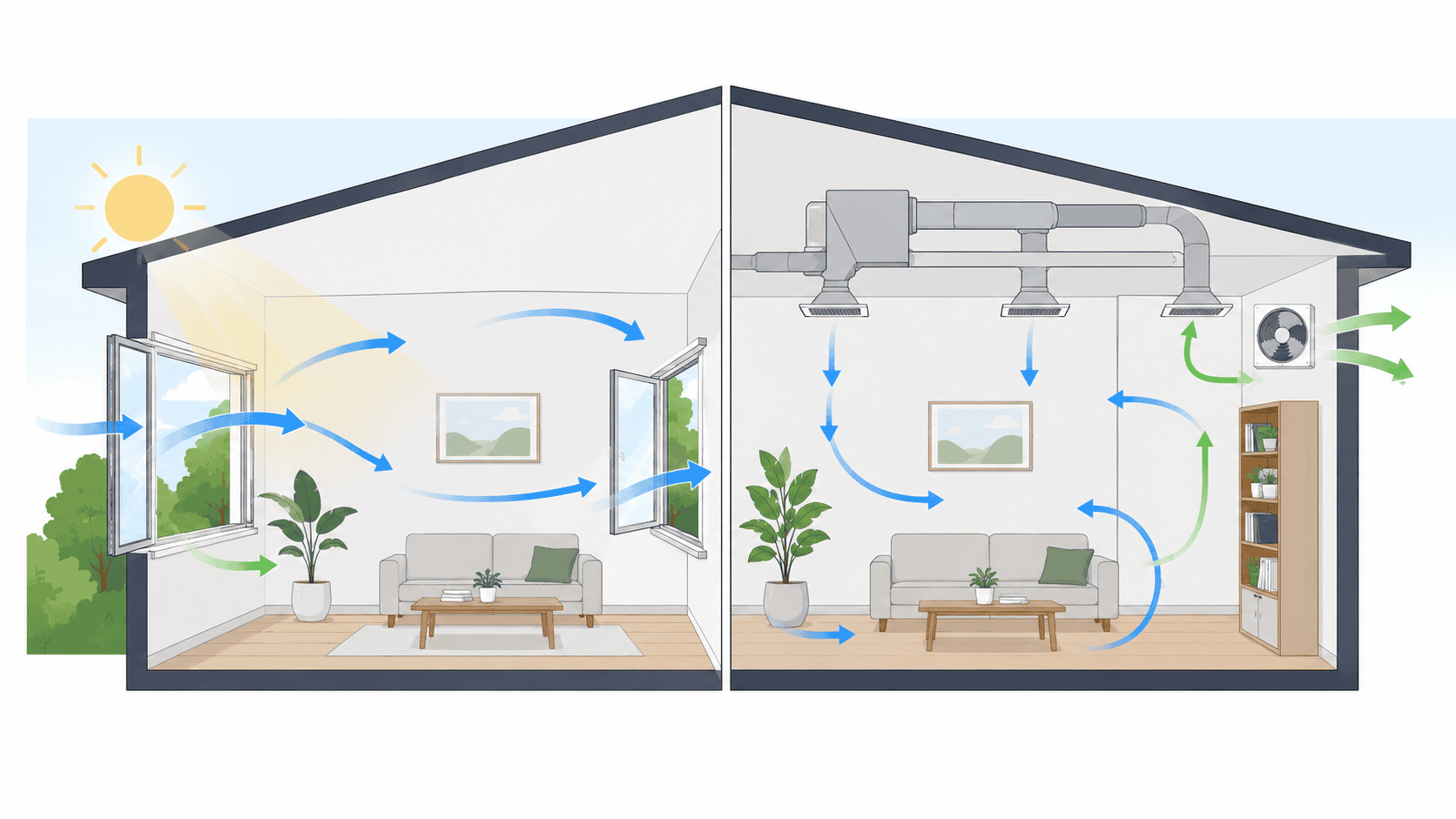
You have two main ways to get fresh air into a building: letting nature do it, or using machines to force it. Both work, but they’re very different in practice.
Natural Ventilation: Simple, but Unpredictable
This is the old-school method. It uses wind and temperature differences to pull air through a space. Think opening windows, designing rooms for cross-breezes, or using special vents and shafts that let warm air rise and escape.
The big appeal is its simplicity and near-zero energy cost. The major drawback is that you’re at the mercy of the weather. If it’s windless, bitterly cold, or the outdoor air is polluted, your ventilation basically stops working.
The amount of air moving is inconsistent, which makes it hard to reliably control humidity or pollutant levels.
Mechanical Ventilation: Controlled, but Complex
This is where fans and ductwork take over. Systems range from a simple bathroom extractor fan to a whole-house unit with heat recovery.
The core advantage is control. A mechanical system delivers a specific, measurable amount of fresh air every hour, no matter what’s happening outside.
It can filter incoming air, actively exhaust pollutants from source points like kitchens, and in advanced systems, even capture heat from the outgoing stale air to save energy.
While it’s more effective and predictable, it comes with upfront costs, energy use, and requires maintenance. You’re trading simplicity for reliability.
For many modern, airtight buildings, a mechanical system isn’t just an upgrade, it’s a necessity to make the indoor environment actually habitable.
Comparing Common Ventilation Strategies
Choosing a ventilation strategy is about matching the method to the building’s needs. A drafty old house and a sealed modern apartment require completely different solutions.
Here’s a quick breakdown of common approaches:
| Ventilation System | Main Benefit | Main Limitation |
| Natural ventilation | Very low energy use | Completely dependent on weather |
| Cross ventilation | Better air flow across a room | Needs specific window placement |
| Extractor fan systems | Great for removing moisture at the source | Can create negative pressure, pulling in drafts |
| Positive Input Ventilation (PIV) | Keeps air fresh and reduces condensation | Doesn’t actively extract pollutants |
| Mechanical Ventilation with Heat Recovery (MVHR) | Saves energy by recycling heat | More expensive to install |
| HVAC systems | Controls temperature, humidity, and air quality | Complex and costly to run |
The table shows the trade-offs. Simpler systems like opening a window or using an extractor fan are good for specific jobs, but they can cause new problems like drafts or pressure imbalances.
For newer, airtight buildings, a balanced system is usually necessary. Something like an MVHR unit provides a controlled, consistent air change while managing energy loss.
It handles the whole job, bringing fresh air in, pushing stale air out, and keeping the heat, instead of leaving you to patch together several limited solutions.
Understanding Air Exchange Rate and ACH
Air exchange rate is a core idea in ventilation. It answers a simple question: how many times does the entire volume of air in a room get swapped out in one hour? This is called Air Changes per Hour, or ACH.
Professionals calculate it by looking at the room’s size and the system’s power. They measure airflow in cubic feet per minute (CFM). The math starts with the room’s volume: its length, multiplied by its width, multiplied by its height.
Once you know how much air is in the space, you can figure out how much new air you need to pump in to hit your desired ACH target.
A higher ACH usually means pollutants are cleared out faster. But there’s a catch: in a modern, well-sealed building, constantly bringing in cold outdoor air and heating it (or cooling hot air in summer) uses a lot of energy.
This is the central tension in ventilation design today, balancing the need for healthy, fresh air with the cost and environmental impact of conditioning that air.
This is precisely why systems with heat recovery have become so important. They allow for that higher, healthier air exchange rate without the massive energy penalty.
Why Heat Recovery Ventilation Is Growing in Popularity
Heat recovery ventilation is getting popular because it solves a fundamental conflict: we need fresh air, but we don’t want to waste the energy we used to heat or cool our homes.
Traditional ventilation is a bit wasteful. In winter, you blow warm indoor air outside and suck in freezing air that you have to heat all over again. In summer, you exhaust cool air and pull in hot, humid air that needs cooling. Your energy bill pays for that exchange.
Systems like HRV (Heat Recovery Ventilation) and MVHR (Mechanical Ventilation with Heat Recovery) fix this. They use a heat exchanger, a core that lets the outgoing and incoming air streams pass each other without mixing.
In winter, the warmth from the stale air leaving is transferred to the cold fresh air coming in. In summer, the process can work in reverse, precooling the incoming hot air. You get the fresh air without the massive energy penalty.
The benefits stack up: consistent air quality, better control over humidity, lower heating and cooling costs, and a more stable indoor temperature.
It’s a direct response to modern building trends. New homes are built to be extremely airtight to save energy, but that also means pollutants and moisture get trapped inside. You can’t just rely on old-fashioned drafts.
A controlled, efficient mechanical system like this becomes essential, meeting both health codes and energy standards in one package.
Are Air Purifiers a Replacement for Ventilation?
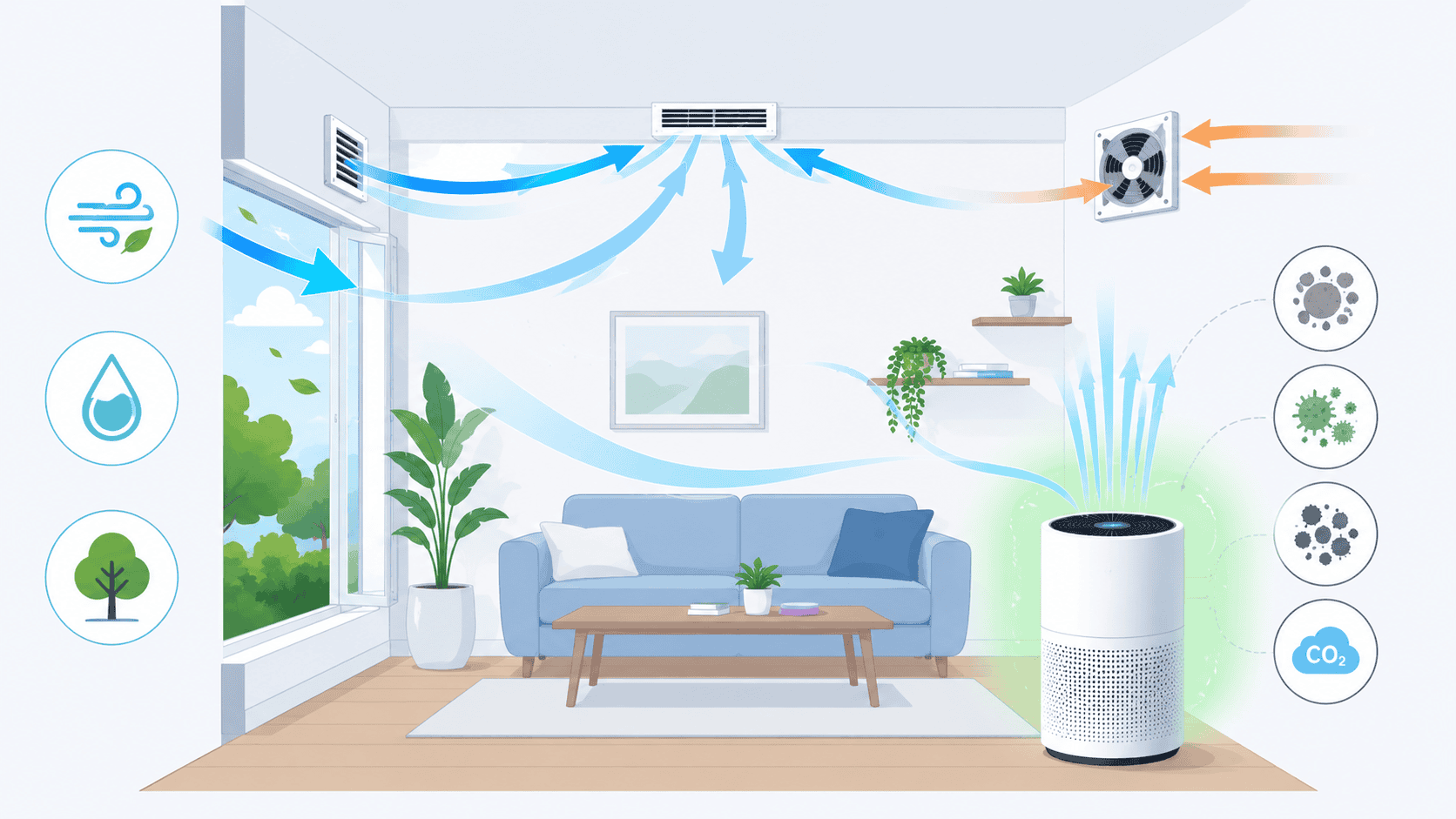
This is a crucial point that trips up a lot of people: an air purifier is not a substitute for ventilation. They do different jobs.
Think of it this way: ventilation is about exchange. It removes the stale air you’ve already breathed and brings in fresh outdoor air. An air purifier is about cleaning. It recirculates and filters the air that’s already in the room.
A HEPA filter is excellent at trapping dust, pollen, and other particles. But it can’t address the fundamental issue of a sealed room: the buildup of carbon dioxide from our breath.
This is why a space can feel cleaner with a purifier running but still feel stuffy, heavy, or cause headaches. The air might be particle-free, but it’s still the same old, exhaled air.
For a truly healthy indoor environment, you need both. Ventilation handles the air replacement and gas removal (like CO2), while a purifier can tackle specific pollutants that ventilation might bring in or that are generated indoors.
Using one without the other leaves a gap in your air quality strategy.
Should You Monitor Ventilation Performance?
You can’t manage what you don’t measure. Guessing about your ventilation is like trying to drive with a blindfold on, you might be moving, but you have no real control.
Monitoring gives you the dashboard. Key things to track are carbon dioxide (CO2), relative humidity, temperature, fine dust levels (PM2.5), and overall airflow. These numbers tell the real story. For example, An average adult adds approximately 60–90 grams of moisture to the air every hour…
A simple checklist for a healthy space looks like this:
- CO2: Keep it under 800 ppm.
- Humidity: Aim for 30% to 70%.
- Temperature: Consistent and comfortable.
- Air Movement: No stagnant corners.
- Maintenance: Filters clean, vents unblocked.
When you start monitoring, you stop guessing. You might discover that your office ventilation shuts off at 6 PM, letting CO2 spike overnight.
Or that the humidity in your basement is always at 80%, inviting mold. It turns ventilation from a vague concept into a concrete part of your building’s performance, showing you exactly where and when it’s failing.
FAQ
How Can I Tell if My Indoor Setup Has Poor Ventilation?
Poor ventilation usually causes noticeable changes in the room. Carbon dioxide levels can rise when fresh air is not entering the space fast enough, which may lead to drowsiness and reduced concentration. Other signs include lingering odors, condensation on windows, excessive humidity, and stale air. Using air quality sensors to monitor indoor air quality (IAQ) can help identify ventilation problems before they become more serious.
What Air Exchange Rate Should an Indoor Room Have?
The recommended air exchange rate depends on the room’s size, purpose, and occupancy level. Air changes per hour (ACH) measure how many times the air inside a room is replaced with fresh air. A higher ACH generally improves contaminant removal, air dilution, and air freshness. Calculating the required airflow rate in cubic feet per minute (CFM) helps ensure the ventilation system provides enough fresh air.
When Is Mechanical Ventilation Better Than Natural Ventilation?
Mechanical ventilation is often more effective when a building has high airtightness, limited window access, or inconsistent outdoor conditions. Natural ventilation relies on outdoor wind and temperature differences, which can change throughout the day. Mechanical ventilation provides a controlled airflow rate, improves moisture control, and maintains more consistent indoor air quality. It is also more reliable for managing indoor pollutants and maintaining thermal comfort.
How Do HRV and MVHR Systems Improve Energy Efficiency?
Heat recovery ventilation (HRV) and mechanical ventilation with heat recovery (MVHR) systems improve energy efficiency by transferring heat from outgoing stale air to incoming fresh air. This process reduces the amount of energy needed to heat or cool the indoor space. At the same time, these systems support continuous air replacement, humidity management, and contaminant removal, helping maintain a healthier and more comfortable indoor climate.
Can Air Filtration Replace Proper Ventilation?
Air filtration cannot fully replace proper ventilation because filters do not bring fresh air into a building. HEPA filters can capture particulate matter, including PM2.5, while some filtration systems reduce airborne contaminants. However, ventilation is still needed to remove carbon dioxide, control humidity, and reduce the concentration of volatile organic compounds (VOCs). Combining air filtration with effective air ventilation provides better indoor environmental quality (IEQ).
The Important Ventilation for Indoor Setups
Poor air movement can make a room feel uncomfortable fast. You notice the stuffy air, the extra moisture, and that heavy feeling that makes it harder to focus or relax. That’s the reality.
Without proper ventilation, problems like condensation and mold can start to build up, affecting both the space and the people using it.
The good news is that improving ventilation doesn’t have to be complicated. A system that consistently brings in fresh air can make a noticeable difference in how your indoor space feels every day.
It’s a simple step that helps protect your building while creating a healthier environment where people can feel more comfortable and productive.
References
- https://pubmed.ncbi.nlm.nih.gov/40204887/
- https://link.springer.com/article/10.1007/s10973-025-14625-7
- https://tophydroponicgarden.com/why-is-good-air-circulation-important/
- https://tophydroponicgarden.com/indoor-hydroponic-kits/
- https://tophydroponicgarden.com/what-is-the-ideal-humidity-for-a-grow-room/
Was this helpful?

I’m Barrie L., a passionate hydroponic gardening enthusiast dedicated to cultivating thriving, soil-less gardens. With a focus on all things hydroponic, I share my expertise on innovative growing techniques and sustainable practices through my blog, tophydroponicgarden.com. As a seasoned hydroponics specialist, my goal is to inspire and guide fellow gardeners in harnessing the power of water-based cultivation for bountiful and eco-friendly harvests. I’m also an author of the book “Hydroponics For Absolute Beginners: Your Step By Step Guide For How To Create An Hydroponics System At Home Without Soil, For Growing Vegetable, Fruit And Herbs.” which is sold on Amazon. Join me on a journey of redefining the way we cultivate plants, one nutrient-rich solution at a time. Happy growing!