

You can grow a lot of strawberries in a very small space using an NFT system, and it’s surprisingly efficient. In this setup, a thin film of nutrient-rich water runs along the bottom of narrow channels, just brushing the roots while the rest of the root zone stays in the air.
That mix of oxygen and steady nutrition is exactly what strawberries respond to, so they tend to grow faster and set more fruit than in most soil beds. If you’re ready for cleaner, more controlled harvests, keep reading to see how to build and run a setup that works.
Key Takeaways
- Day-neutral strawberry varieties like Albion are perfectly suited for NFT’s continuous flow, yielding fruit for months.
- Precise control of the nutrient solution’s pH and electrical conductivity is non-negotiable for healthy roots and sweet berries.
- A simple system built with a steady slope and reliable water pump prevents the most common NFT failure: root dry-out.
The Quiet Efficiency of Roots in a Stream
He noticed the roots before anything else. Not tucked away in soil, but exposed, trailing in a shallow stream of water, pale and thin like lace someone forgot to put away. That’s when it made sense. This wasn’t really gardening in the old way, it was more like running utilities.
The strawberry plants, their crowns snug in small net pots, were just tenants in a well-managed building. Their job was simple: make fruit. The NFT system’s job was to bring everything to those hanging roots, on time, every day. No wandering, no competing. Just quiet, steady taking in.
This is the calm kind of efficiency you see in nutrient film technique setups for strawberries. The basic idea is simple enough. Slightly sloped channels, often just PVC gutters, carry a thin layer of nutrient solution from a reservoir and pump, down toward a return line, which is exactly how a nutrient film system keeps roots fed without drowning them.
The roots rest in that moving film, pulling in nutrients while the thin flow keeps fresh oxygen moving around them (which roots love).
The whole thing loops back on itself, a recycling circuit of water and minerals. The angle of the slope matters a lot: usually around a one to two percent grade. Too steep and the solution rushes by before the roots can drink. Too flat and it gathers in puddles, pushing out oxygen and suffocating the roots. That thin line, between flow and film, is where the system really works.
For the gardener, the upsides are very real.
- Water use drops sharply, often by as much as 90 percent compared to growing in soil.
- Weeds basically disappear, since there’s no soil for them to claim.
- You can grow up instead of out, stacking channels to turn a plain balcony wall into a living strawberry rack.
- The harvest doesn’t stay stuck to one short summer window, it stretches out over time, especially if you pick good everbearing or day-neutral varieties.
Which Strawberries Thrive in the Constant Flow?

Not every strawberry is meant for this kind of life. The June-bearing types, the ones that throw all their energy into a single big harvest and then mostly rest, feel a bit out of place here. They’d give you their one big act, then just sit there, using water, light, and space without much return. For an NFT system, you want plants that behave more like steady workers than one-time performers: the day-neutral varieties.
They respond mostly to temperature instead of how long the day is. Keep them in the right climate band, and they’ll keep fruiting for half a year or more. For a hydroponic setup, that kind of consistency makes them almost the ideal tenant. [1]
A few names come up again and again among growers, and not by accident. Albion is at the top of many lists. Its berries are firm, nicely shaped, and recognized for strong sweetness that doesn’t fade. The plants also show decent resistance to common diseases, which is a big deal when your water lines connect every plant in the system. Trouble in one channel can spread fast.
Seascape is another dependable pick, known for high yields and a classic strawberry flavor that holds up when eaten fresh or used in desserts. If you’re working with tighter spaces or just want more compact growth, San Andreas is a good fit, producing shiny red fruit over a long, steady season.
Most people begin with bare-root runners. These are dormant plants, just a crown with some roots attached. They look tired and lifeless, almost like leftover plant debris. But once those roots reach that thin sheet of nutrient solution, they usually wake up in a hurry.
There’s also the option of tissue-culture plugs. They cost a bit more, since they’re produced under sterile lab conditions, but they come free from soil-borne diseases, which reduces risk in a closed system. The key moment is when you set the crown. Too deep and the crown stays wet, which invites rot.
Too high and it sits exposed, drying out before it can establish. You want the crown level with the top of your growing medium, whether that’s rockwool, clay pebbles, or another inert support, so the roots can reach down into the film while the growing point stays just high enough to breathe.
The Lifeblood: Water, Food, and Light

Credits: My Green Hydroponics New Zealend
The first thing to accept is that, in NFT, the nutrient solution isn’t just important, it’s everything. It’s the only source of nutrition the plants have. In soil, roots can lean on organic matter and minerals stored in the ground, a kind of savings account they can draw from.
In an NFT system, there’s no savings. No cushion. Whatever is dissolved in that thin stream of water is all the plant can use, which is why consistency matters more than volume. Managing it starts to feel less like traditional gardening and more like running a small lab. Two tools quickly become essential: a pH meter and an EC meter.
Strawberries are fussy about acidity. They want their environment slightly acidic, not too sharp, not too mellow. The best range for the solution’s pH sits between 5.5 and 6.2. Drift much outside that window and the plant starts losing access to certain nutrients, even if those nutrients are literally passing by the roots.
The result shows up in the leaves first, yellowing between veins, spots, odd discoloration patterns, long before the fruit quality drops. Keeping a small bottle of pH up and pH down on hand lets you nudge that range back into place with just a few drops.
Electrical Conductivity, or EC, is your snapshot of how much “food” is dissolved in the water. It measures the total dissolved salts, which in this case are your nutrients. For young plants, you keep things gentle, around 1.0 mS/cm. As they mature and start to flower and set fruit, you raise that level to somewhere between 1.5 and 2.0 mS/cm. It’s a bit like increasing calories and protein for an athlete as training gets harder.
But there’s a catch. In a recirculating system, water slowly evaporates, while the salts stay behind. That means EC can creep upward over time, turning the solution too strong and scorching delicate root tips. The usual fixes are simple: dilute with fresh water or swap out the reservoir entirely once a week to reset the balance.
Strawberry NFT Nutrient & Light Guidelines
| Growth Stage | pH Range | EC Level (mS/cm) | Light Duration | Notes |
| Newly planted runners | 5.5 – 6.0 | 0.8 – 1.0 | 12–14 hours | Gentle feeding helps roots establish |
| Vegetative growth | 5.6 – 6.2 | 1.2 – 1.5 | 14–16 hours | Focus on leaf and crown development |
| Flowering & fruiting | 5.5 – 6.2 | 1.5 – 2.0 | 14–16 hours | Higher EC supports fruit size and sweetness |
Light is the other half of the equation, especially indoors, where you’re responsible for every “day” the plants see. Strawberries want plenty of it, typically 12 to 16 hours of light daily. Full-spectrum LED fixtures are the go-to now, because they run cool, use less power, and can be tuned to favor certain wavelengths.
Strawberries tend to do especially well under fixtures with a generous amount of red light, which supports flowering and can help with flavor development. Intensity matters, too. You’re aiming for something that feels like a bright spring day, strong enough to cast clear shadows but not so harsh that it feels like midsummer desert glare.
Building Your Own Strawberry Stream
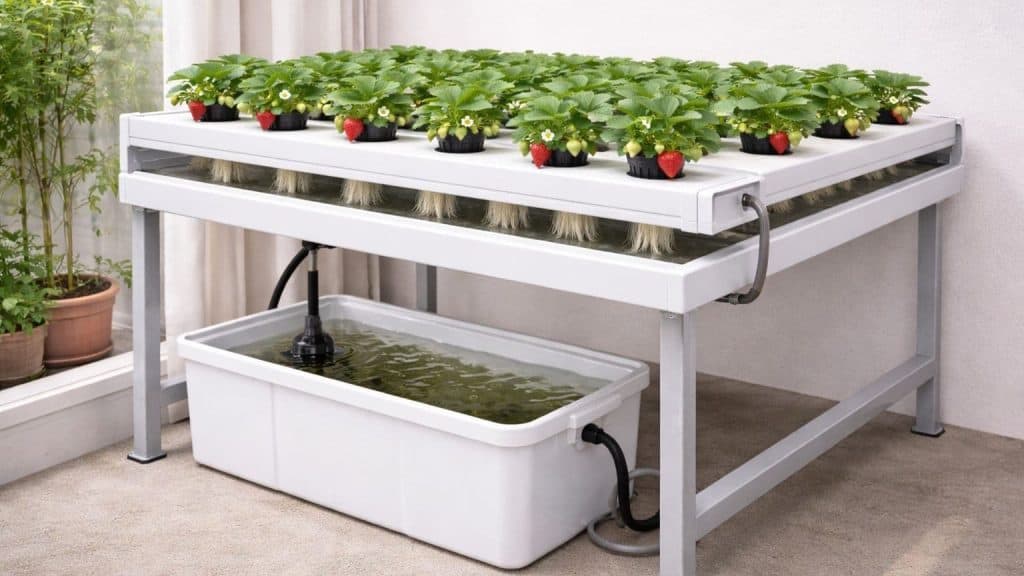
He probably didn’t realize it, but the first real decision happens before any water flows at all: do you buy a system, or build your own. Among different hydroponic techniques, NFT appeals to growers who value precision and repeatability over bulk volume. You can buy a pre-made NFT kit, sure, but putting one together by hand strips away the mystery. You start to see how every part serves the roots.
The channels come first. White PVC or black ABS gutters both work well. White has one clear advantage: it reflects more heat, keeping the root zone cooler, and it makes it easier to spot any algae building up. A 4-inch-wide channel is a common choice. It gives the roots enough space to spread without tangling into a solid mat too quickly.
The frame quietly decides whether your system thrives or fails. It has to be rigid and truly level along its length. Any soft spot or bow in the middle becomes a low point where water gathers, and pooled water in NFT usually means rotting roots. Sturdy lumber or aluminum strut both make dependable supports.
You also build your slope right into this frame. For a 10-foot channel, one end needs to sit about 1.2 to 2.4 inches higher than the other. That small difference is what creates the 1-2% grade that keeps the nutrient film thin and moving.
At the bottom of it all sits the mechanical heart: the reservoir and pump. A simple plastic tote is usually enough, as long as it holds a good volume of solution so the pump never runs dry between top-ups. The pump lives inside the reservoir. It doesn’t need a lot of power, reliability matters more than brute strength.
From the pump, a main feed line carries solution to each channel. At the far end of every channel, the film drains back into the reservoir, closing the loop and sending the water on its next trip past the roots.
Here’s the basic sequence.
- Cut your channels to length, and drill holes for net pots every 8 to 12 inches.
- Build the support frame, locking in a steady, gentle slope from one end to the other.
- Set up the reservoir and pump, and connect the feeder line to your channels.
- Drop net pots into the holes, add your chosen growing medium, and set in the plants.
- Fill the reservoir, mix in nutrients, adjust the pH, and start the pump.
- Watch for that thin, shimmering film of solution to slide along the bottom of each channel, just brushing the roots as it passes.
Keeping the Roots Happy and Healthy
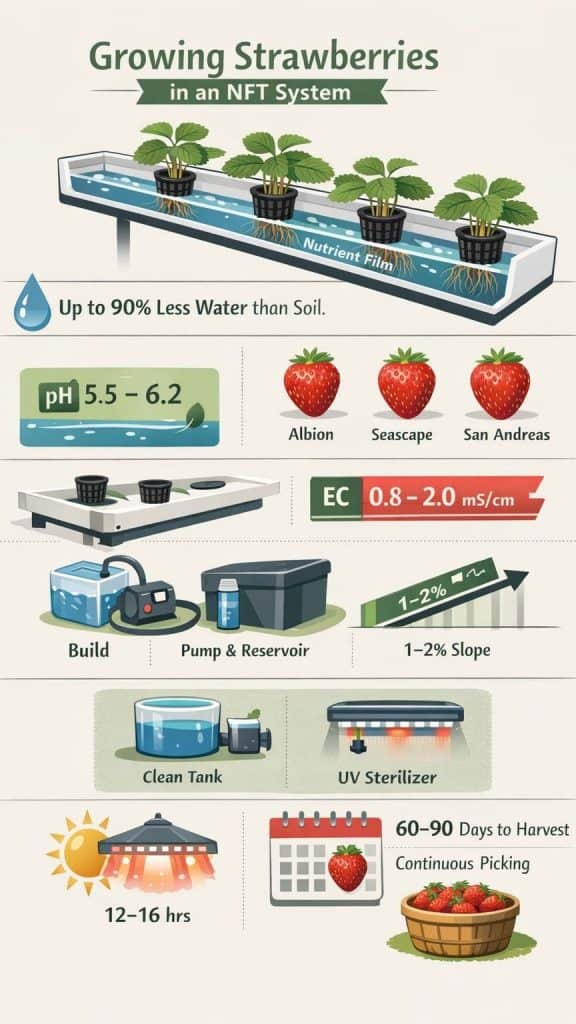
The first thing most people notice in NFT is also the most fragile part of it: the exposed roots. They’re hanging there, pale and delicate, and they don’t get any protection from soil. That makes them easy targets. The main threat is root rot, often driven by a waterborne pathogen called Pythium. It can turn bright white roots into a slimy brown tangle fast. You don’t really cure that once it gets going, so prevention becomes the whole game.
A clean reservoir is your first line of defense. Scrub it between cycles, don’t let old solution sit for weeks. Some growers add a small UV sterilizer on the return line. It’s a simple tube that bathes the passing water in ultraviolet light, which helps knock back algae, bacteria, and pathogens before they build up to dangerous levels.
Air movement is another quiet helper. The shallow film of solution leaves part of the root zone in contact with air, which is why the “film” in Nutrient Film Technique matters so much. Too deep a flow, and you lose that mix of water and oxygen that keeps roots strong.
There’s another kind of risk that arrives all at once: power failure. No electricity means no pump, which means no flow. On a warm day, exposed roots can start to dry and die in just a few hours. One simple backup is a battery-powered air pump in the reservoir, like the models used for fish tanks.
It won’t move the solution through the channels, but it will keep oxygen bubbling into the water, buying you some time. A small uninterruptible power supply (UPS) dedicated to the pump is even better. If the grid flickers, your flow keeps going long enough for you to fix the problem or shut things down on your own terms.
Indoor growing does reduce some outdoor pressure, but pests still find a way to sneak in. Spider mites are fond of warm, dry air around grow lights, spinning tiny webs and speckling leaves. Aphids can appear suddenly on tender growth. The best tool here is calm, regular observation.
Turn leaves over with your fingers. Look closely at the new growth at the top of each plant. At the first sign of trouble, you can respond gently: beneficial insects like ladybugs or lacewings, and yellow sticky cards for flying pests such as fungus gnats. The goal isn’t a sterile room, it’s a balanced space where any problem stays small.
From Flowers to Fruit, Again and Again
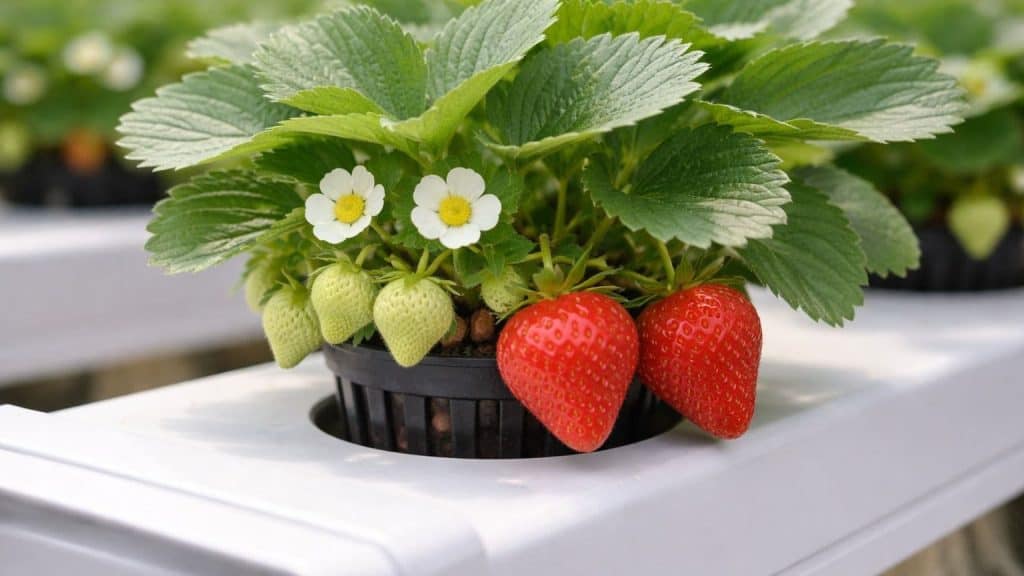
The reward doesn’t arrive all at once, it arrives in handfuls. With day-neutral strawberries in a well-tuned NFT system, you’re not waiting for one big crop. You’re harvesting in waves, a few berries at a time, again and again. After planting bare-root runners, the first ripe fruit usually shows up somewhere between 60 and 90 days. [2]
You start to recognize the right moment to pick: the berry is fully red, even near the cap, the seeds sit slightly recessed into the flesh, and the fruit releases from the stem with a soft twist instead of a tug.
One quiet piece of the puzzle, especially indoors, is pollination. Outside, wind and bees handle it without asking you. Inside, the flowers still open, but nothing moves the pollen unless you step in. The process is simple.
When the white petals are spread wide, take a small, soft paintbrush and gently swirl it around the center of each bloom. Do this daily as new flowers open. The brush carries pollen from the stamens to the pistil, helping each flower develop into a full, evenly shaped berry instead of a misshapen one.
Maintenance quickly settles into a weekly rhythm. Check pH and EC at least once a week, and adjust as needed. Top up the reservoir with fresh water to replace what’s lost to evaporation and plant use. About every two weeks, a full reservoir change is worth considering. It clears out built-up salts and leftover nutrients that the plants didn’t take up, which helps keep your solution balanced and predictable.
Pruning folds into that same routine. As you harvest, remove old or yellowing leaves so they don’t harbor pests or disease. Pinch off runners as they appear. In NFT, you’re not trying to create a patch that spreads; you’re running a focused fruit factory. Every runner you remove is energy redirected from making new plants to filling out the next cluster of berries already on the way.
FAQ
How do I set strawberry pH and EC levels in an NFT system?
In strawberry NFT hydroponics, pH and EC must stay within specific ranges to support nutrient uptake. Hydroponic strawberry cultivation performs best at a pH of 5.5 to 6.2, with strawberry EC levels adjusted by growth stage. Use pH monitoring NFT tools and strawberry EC monitoring daily. Make small corrections to the hydroponic nutrient solution to protect roots and avoid nutrient stress.
What NFT system setup details most affect strawberry root oxygenation?
Strawberry root oxygenation depends on precise NFT system setup. NFT channel design, correct channel slope NFT, and a steady nutrient film flow rate keep roots moist while allowing air exposure. The nutrient film technique strawberries require shallow flow, not pooling. Continuous nutrient recirculation prevents oxygen depletion, supports strawberry root health, and reduces the risk of root rot in recirculating hydroponic systems.
Which strawberry varieties perform best in nutrient film technique systems?
Strawberry varieties for NFT should flower consistently and tolerate constant moisture. Day-neutral strawberry varieties and everbearing strawberries hydroponic systems perform reliably in nutrient film technique strawberries. These varieties handle bare-root strawberries NFT planting well and simplify strawberry runner management. Selecting proven genetics improves strawberry yield optimization, fruit uniformity, and long-term system stability in soil-less strawberry farming.
How can I prevent pests and diseases in hydroponic strawberry systems?
Strawberry hydroponic pests and strawberry hydroponic diseases spread quickly in shared water systems. Effective strawberry disease prevention starts with clean NFT channels, routine strawberry system maintenance, and proper strawberry humidity control. Strong airflow and stable temperatures limit fungal growth. Regular inspection of leaves and roots supports early intervention and protects overall hydroponic crop management performance.
What affects strawberry harvest timing and yield in NFT growing?
Strawberry harvest timing is influenced by light intensity, temperature stability, and nutrient balance. Hydroponic strawberry lighting, including LED grow lights strawberries, drives flowering and fruit size. Strawberry temperature control and complete strawberry macro-nutrients and micro-nutrients support steady production. Accurate strawberry growth monitoring systems help maximize strawberry harvest yield and maintain consistent strawberry quality control.
Your Strawberry System, Simplified
Growing strawberries in an NFT system starts with an image of roots floating in a shallow stream. It is less about planting and more about creating the right environment: water flow, nutrients, light, and air. Early on, you focus on details like channel slope, reservoir mix, pH, EC, and lighting. Once balanced, care becomes simple and calm.
Starting small helps you learn plant signals, water use, and nutrient drift. You watch flowers bloom, hand-pollinate them, and see fruit develop. Harvesting the first berry makes the system feel real, rewarding, and ready to scale.
References
- https://help.mygardyn.com/en/articles/1786241
- https://www.mdpi.com/2624-7402/4/1/7
Related Article
- https://tophydroponicgarden.com/nutrient-film-technique/
- https://tophydroponicgarden.com/what-is-a-nutrient-film-technique-system/
- https://tophydroponicgarden.com/what-are-the-different-hydroponic-techniques-a-simple-guide/
Was this helpful?

I’m Barrie L., a passionate hydroponic gardening enthusiast dedicated to cultivating thriving, soil-less gardens. With a focus on all things hydroponic, I share my expertise on innovative growing techniques and sustainable practices through my blog, tophydroponicgarden.com. As a seasoned hydroponics specialist, my goal is to inspire and guide fellow gardeners in harnessing the power of water-based cultivation for bountiful and eco-friendly harvests. I’m also an author of the book “Hydroponics For Absolute Beginners: Your Step By Step Guide For How To Create An Hydroponics System At Home Without Soil, For Growing Vegetable, Fruit And Herbs.” which is sold on Amazon. Join me on a journey of redefining the way we cultivate plants, one nutrient-rich solution at a time. Happy growing!