
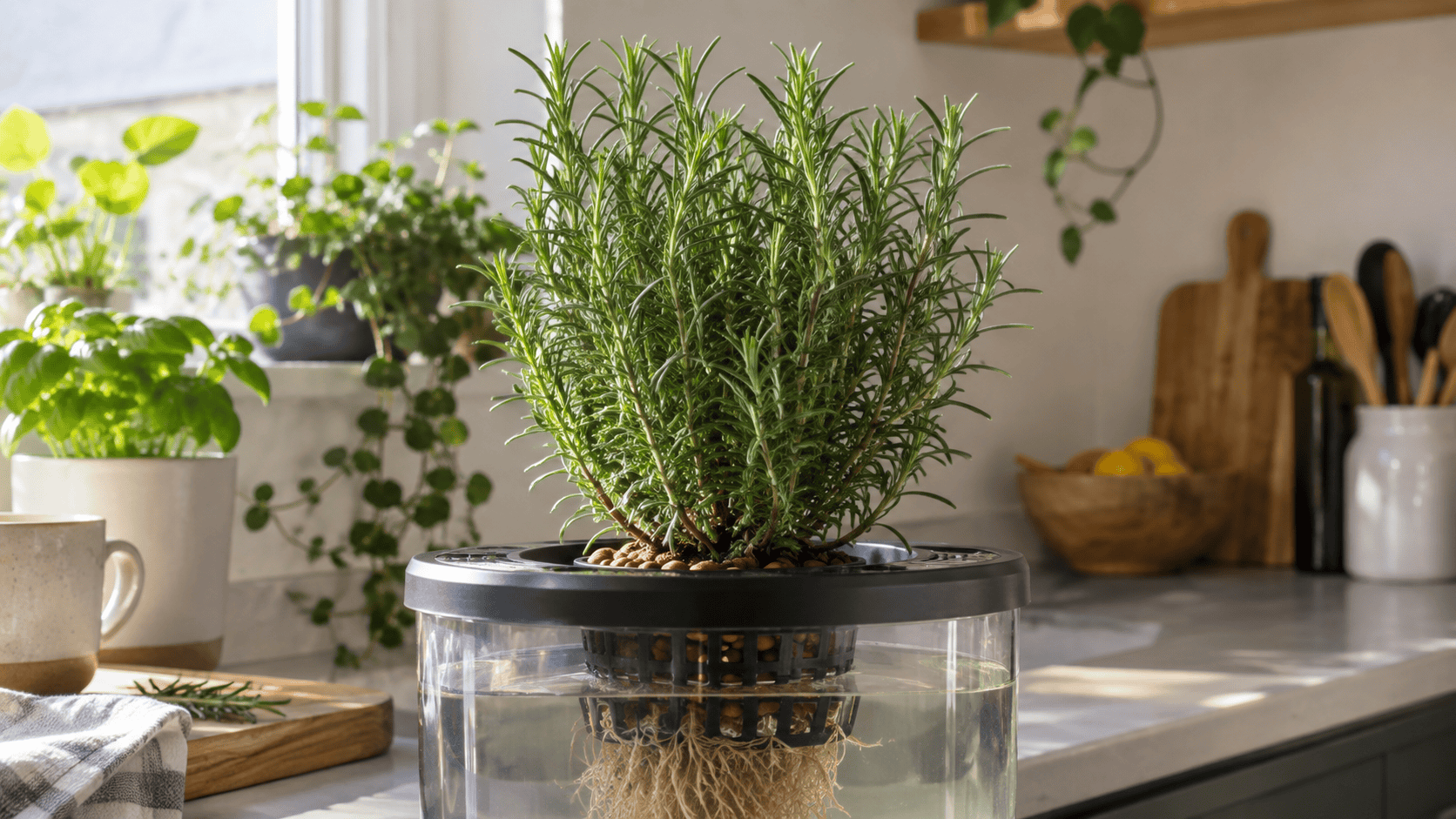
Growing rosemary in a hydroponic system works, but rosemary needs a little more care around the roots than basil or lettuce. Warm, stagnant nutrient solution and overly aggressive feeding can quickly make an otherwise healthy plant struggle.
At Top Hydroponic Garden, we’d rather match the setup to how rosemary actually grows. That means good aeration, moderate nutrients, enough light, and a reservoir you can monitor easily.
Once those basics are in place, rosemary can become a long-term hydroponic herb instead of a frustrating experiment.
Keep reading to see what works and where growers usually go wrong.
Rosemary Hydroponic at Glance
You don’t need a complicated routine to grow rosemary hydroponically. Most of the setup comes down to three things:
- Give the roots plenty of oxygen. Aerated DWC or a well-run NFT system gives rosemary a more forgiving root zone.
- Start gently. A rooted cutting and moderate nutrient strength are easier to manage than seedlings pushed with strong feeding.
- Keep the reservoir stable. Watch pH, EC, temperature, cleanliness, and water level instead of adjusting something every day.
Rosemary grows slower than many common hydroponic herbs, so there’s rarely a reason to rush it.
Can Rosemary Actually Grow in a Hydroponic System?
Yes. Rosemary can grow hydroponically, produce new stems, and support repeated harvests. The important part is remembering that it isn’t naturally a soft, fast-growing leafy crop.
Rosemary grows as a woody Mediterranean shrub and normally favors bright conditions and excellent drainage.
Nebraska Extension notes that:
“The biggest threat to rosemary’s winter survival is wet, poorly drained winter soil, leading to root rot.” – Nebraska Extension
Hydroponics obviously removes soil from the equation, but the underlying lesson still matters: rosemary doesn’t respond well to a poorly managed wet root environment.
For hydroponic growers, that means paying particular attention to:
- root-zone oxygen,
- nutrient solution temperature,
- water level,
- root cleanliness,
- and enough space as the plant matures.
Why Doesn’t Rosemary Behave Like Lettuce or Basil?
Rosemary develops woody stems and grows at a slower pace than lettuce, basil, or mint.
That affects how you manage it hydroponically. You’re usually keeping one rosemary plant much longer, so small reservoir problems have more time to build up.
It also doesn’t need to be pushed with high nutrient strength just because growth looks slow.
Instead, focus on steady new shoots, firm roots, and compact foliage. A healthy rosemary plant may look less dramatic from week to week than basil, but that slower pace is normal rather than a sign that the system needs more fertilizer.
What Should You Expect From Hydroponic Rosemary?
Think long-term herb, not quick crop.
A rooted cutting needs time to establish before regular harvesting begins. Once settled, it can keep producing usable stems if you prune moderately and maintain the root zone.
Realistic expectations include:
- slower early growth than basil,
- gradual woody stem development,
- small repeat harvests rather than huge cuts,
- increasing root space needs,
- and regular pruning to control size.
If a rosemary cutting looks healthy but isn’t doubling in size every few weeks, that alone isn’t a problem. Give it time to establish before changing the nutrient strength.
Which Hydroponic System Works Best for Rosemary?
The best system for rosemary is one that gives the roots reliable access to both nutrients and oxygen.
Aerated DWC and NFT are strong choices. DWC keeps the roots in nutrient solution while an air pump supplies oxygen. NFT moves a shallow film of solution through the root zone, leaving much of the roots exposed to air.
Kratky can work too, but it leaves less room for mistakes involving water level, reservoir heat, or the developing air gap.
Research into soilless rosemary propagation also supports paying attention to oxygen around the root zone. In a 2025 study comparing mist, float, and aeroponic propagation systems, researchers actively managed aeration in the experimental setups.
| System | Difficulty | Root Rot Risk | Rosemary Fit | Beginner-Friendly |
| DWC | Low to moderate | Low if well aerated | Very good | Yes |
| NFT | Moderate | Low with reliable flow | Very good | Fairly |
| Kratky | Simple equipment | Moderate | Possible | Less forgiving |
Why Do DWC and NFT Work Well for Rosemary?
DWC and NFT approach oxygen differently, but both avoid relying on a completely stagnant root environment.
With DWC:
- an air stone continuously aerates the reservoir,
- roots have constant access to nutrients,
- and water chemistry is easy to measure.
With NFT:
- nutrient solution keeps moving,
- part of the root mass stays exposed to air,
- and excess water doesn’t need to surround every root constantly.
Neither system is maintenance-free. A failed air pump, blocked channel, warm reservoir, or dirty tubing can still cause root problems, so regular checks still matter.
Is the Kratky Method a Bad Fit for Rosemary?
Not necessarily. It’s simply less forgiving.
Kratky relies on the nutrient level dropping naturally so an air gap forms between the net pot and solution. Upper roots adapt to that oxygen-rich space while lower roots continue reaching the nutrients.
Problems often start when growers:
- refill the reservoir too high,
- repeatedly submerge established air roots,
- let a small container overheat,
- or allow the solution to sit for too long without monitoring it.
If you’re deciding between passive and aerated growing, the Kratky vs. DWC guide from Top Hydroponic Garden breaks down how both root environments work.
Should You Start Rosemary From Cuttings or Seeds?
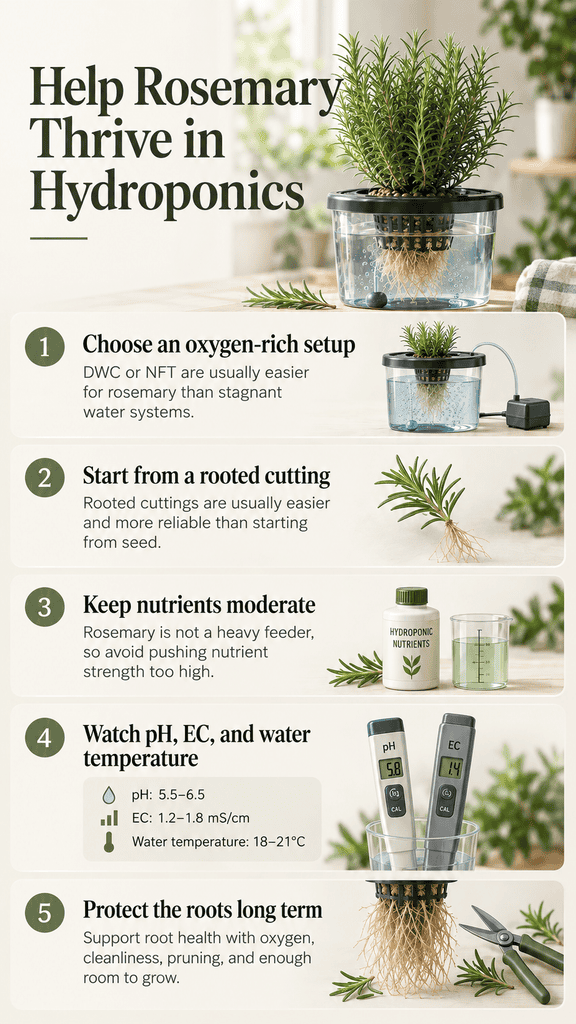
For most home hydroponic setups, starting with a cutting is the more practical route.
Seeds add a slow germination and seedling stage before you even reach the hydroponic setup. A cutting lets you start with healthy stem tissue from an established rosemary plant and focus directly on developing roots.
Cuttings also make sense when you want predictable growth from a plant you already like.
Look for:
- healthy new or semi-soft growth,
- a non-flowering stem,
- no visible pest damage,
- several healthy leaf nodes,
- and a stem that isn’t heavily woody yet.
Once roots begin forming, don’t rush the cutting into a large reservoir. A small but established root network handles the transition better than one tiny new root.
How Should You Root a Cutting Before Moving It?
Take a healthy stem several inches long and make a clean cut below a node.
Then:
- Remove leaves from the lower portion of the stem.
- Place the cutting in a clean propagation medium or suitable rooting setup.
- Keep the rooting area moist without soaking the entire stem.
- Provide bright but gentle light while roots develop.
- Wait for several fresh roots before transplanting.
Handle those new roots carefully when moving the cutting. At this stage, physical damage or suddenly exposing a barely rooted stem to strong nutrients can set the plant back more than waiting another few days.
What Conditions Does Hydroponic Rosemary Need?
Rosemary doesn’t need perfect numbers every hour, but it does benefit from a fairly steady environment.
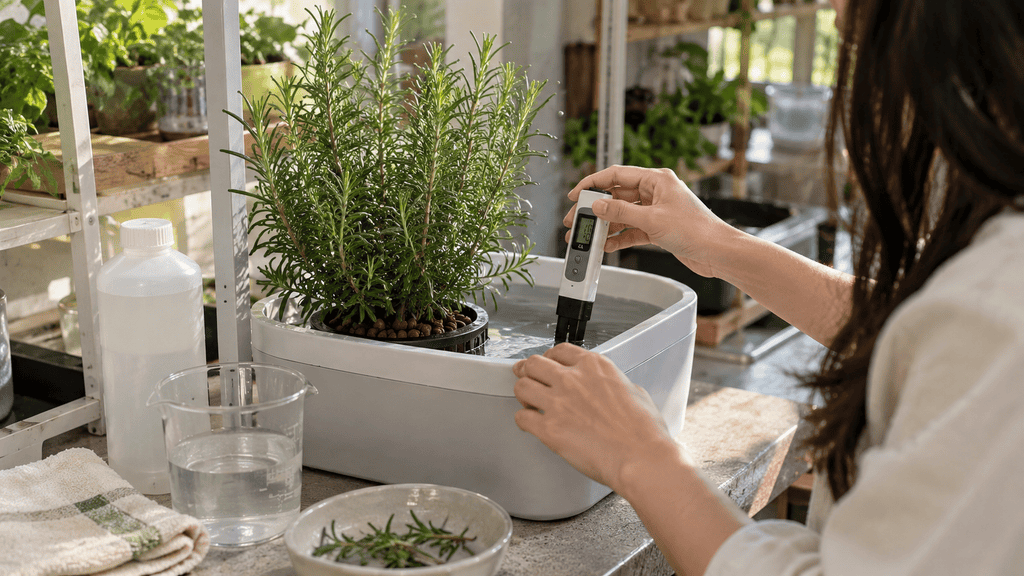
A useful starting range is pH 5.5 to 6.5 and roughly 1.2 to 1.8 mS/cm EC, with young plants starting near the lower end.
According to Lykokanellos, G., et al.,
“The system was supplemented with an aeration module driven by a submersible pump to prevent stagnation and anoxia.” – Lykokanellos et al, 2025
For a home grower, the takeaway isn’t to copy a research setup exactly. It’s to keep the root environment stable and well oxygenated.
Check these parameters as a group rather than obsessing over one reading:
| Parameter | Practical Target | Watch For |
| pH | 5.5–6.5 | Repeated rapid drift |
| EC | 1.2–1.8 mS/cm | Start lower for young plants |
| Water temperature | Around 18–21°C | Prolonged warm solution |
| Indoor light | Around 12–16 hours | Stretching or weak growth |
| Full solution change | Roughly every 7–14 days | Adjust to reservoir behavior |
What pH and EC Range Works for Rosemary?
Keep the nutrient solution around pH 5.5 to 6.5, with roughly 5.8 to 6.2 being an easy working zone.
For EC, 1.2 to 1.8 mS/cm is a practical general range.
A newly rooted cutting should begin toward the lower end. Increase nutrient strength gradually as the plant develops.
Pay attention to the direction of the EC reading too:
- EC rising as water drops: the plant may be using water faster than nutrients.
- EC falling steadily: nutrients may be getting depleted faster.
- EC staying fairly stable: your current feeding strength may already be close to what the plant needs.
How Much Light and What Temperature Does Rosemary Need?
Rosemary prefers strong light if you want compact, aromatic growth.
Indoors, around 12 to 16 hours of grow light is a reasonable starting point, although light intensity matters too. Long hours under a weak lamp won’t necessarily replace stronger light.
For the reservoir:
- aim for roughly 18 to 21°C when practical,
- keep it out of direct light,
- check heat from nearby grow lights and pumps,
- and monitor actual water temperature before assuming cooling equipment is necessary.
Weak light often creates stretched growth. Excess reservoir heat creates a different problem by making the root environment harder to manage.
How Should You Feed Hydroponic Rosemary?
Rosemary needs complete nutrition, but it doesn’t need aggressive feeding to grow well.
Use a complete hydroponic nutrient designed for edible crops and let EC guide how strong the solution should be. Start lighter with young plants and increase gradually as the canopy and root system develop.
Avoid treating slow growth as an automatic nutrient deficiency.
Before increasing fertilizer, check:
- light intensity,
- root condition,
- water temperature,
- pH stability,
- current EC,
- and whether the reservoir has become crowded.
A rosemary plant with weak roots won’t suddenly recover because you raised the nutrient concentration.
The useful habit here is simple: watch EC and water level together. They tell you far more about what is happening in the reservoir than a fixed weekly feeding dose.
How Often Should You Change the Nutrient Solution?
For a small home system, a complete nutrient change every 7 to 14 days is a sensible starting point.
Between changes:
- check the remaining water level,
- measure EC before adding nutrients,
- check pH after adjustments,
- top off according to what the readings show,
- and reset the reservoir when repeated corrections become messy.
The Top Hydroponic Garden reservoir top-off guide explains why topping up water and replacing nutrients aren’t always the same job.
Tap water can work too. Check its starting EC and water quality first instead of assuming that tap, distilled, or filtered water is automatically best.
How Do You Prevent Root Rot in Hydroponic Rosemary?
Root rot is one of the bigger risks with hydroponic rosemary, which makes prevention much easier than trying to rescue a badly affected plant later.
Keep the root environment oxygenated, reasonably cool, and clean. Block light from entering the reservoir and remove dead root or plant material before it sits in the solution.
Root color alone isn’t a reliable diagnosis. Some nutrients naturally stain roots.
Instead, check a combination of:
- texture,
- smell,
- fresh root-tip growth,
- water uptake,
- and how the foliage is responding.
A plant that suddenly wilts despite having water, develops soft roots, and produces an unpleasant reservoir smell needs a root-zone check before anything else.
Don’t immediately increase nutrients. Start with aeration, temperature, cleanliness, and water level.
What Early Root Rot Signs Should You Check?
Check the roots regularly for several symptoms appearing together:
- sour or swampy odor,
- slimy root surfaces,
- soft brown root tips,
- sudden wilting despite available water,
- stalled new growth,
- and roots losing their normal firmness.
Brown or beige color on its own doesn’t prove root rot. Nutrient staining can change root color without damaging the tissue.
Fresh, firm root tips are a much better sign.
If the roots still feel healthy but the foliage looks wrong, investigate pH, EC, light, or nutrient balance before assuming a disease problem.
Which Habits Actually Reduce Root Rot Risk?
Good root care is mostly routine maintenance.
Focus on:
- reliable aeration in DWC,
- steady flow in NFT,
- keeping the crown above the wet root zone,
- blocking light from the reservoir,
- removing decaying root material,
- controlling excessive heat,
- and cleaning reusable equipment between crops.
Don’t stop at the reservoir if buildup appears elsewhere. Pumps, tubing, fittings, and net pots are part of the same water path.
The Top Hydroponic Garden cleaning guide covers those hidden areas without turning routine maintenance into a complicated sterilization process.
How Do You Maintain Rosemary Long Term?

Credits: JimmyB Harvests
Once the rosemary is established, maintenance becomes less about getting it to survive and more about keeping the plant proportional to the system.
Regular harvesting helps control the canopy while encouraging new branching. The root system also keeps expanding, so don’t judge system size by how well it fitted the original cutting.
Watch for signs that the plant is outgrowing its setup:
- roots filling most of the reservoir,
- stems repeatedly reaching the grow light,
- neighboring plants being shaded,
- water disappearing much faster than before,
- or heavy pruning becoming necessary just to keep rosemary inside the unit.
At that point, increasing nutrients isn’t the answer. The plant may simply need more space or a fresh cutting to restart a smaller rosemary plant.
How Should You Prune Hydroponic Rosemary?
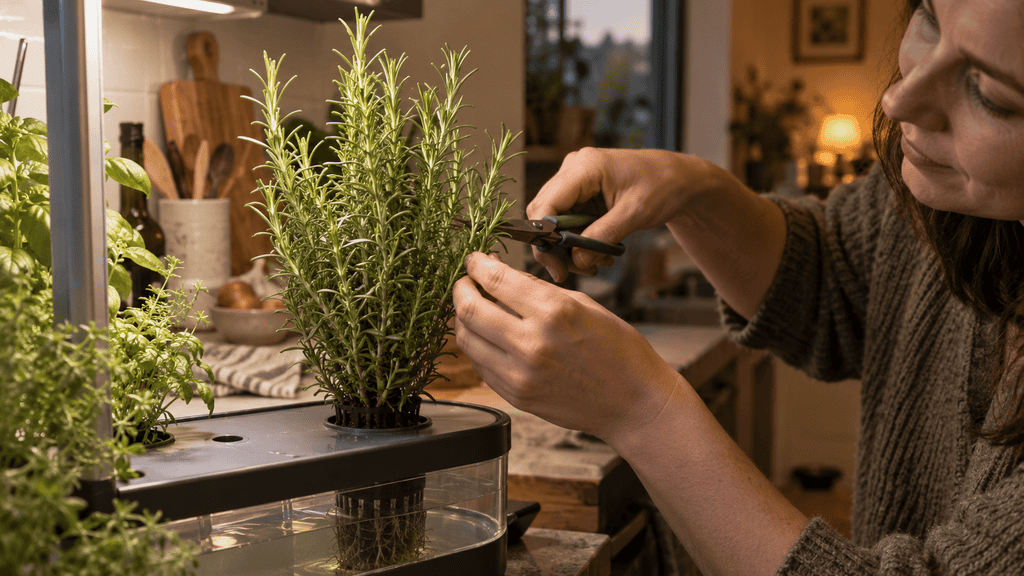
Harvest smaller amounts regularly instead of waiting until the plant becomes oversized.
A simple approach works well:
- cut younger leafy stems,
- trim just above active growth,
- rotate harvest areas,
- remove damaged material,
- thin a few crowded inward-facing shoots,
- and leave plenty of foliage behind.
Avoid repeatedly cutting far back into old bare wood.
Regular light pruning keeps rosemary easier to fit under an indoor grow light and supports a bushier shape without shocking the plant with one large harvest.
For kitchen use, younger leafy stems are also much easier to harvest than waiting for the plant to become heavily woody.
What Mistakes Should You Avoid?
Most rosemary failures come from several small mistakes rather than one dramatic problem.
Common ones include:
- choosing stagnant water just because the system looks simple,
- keeping the crown permanently wet,
- raising EC whenever growth slows,
- ignoring reservoir heat,
- refilling Kratky above its established air gap,
- leaving dead roots in the system,
- assuming all tap water behaves the same,
- and keeping a mature plant in a tiny reservoir.
The pattern is pretty consistent: rosemary gets harder when growers keep trying to make it grow faster.
Stable conditions usually work better than constant corrections.
FAQ
Can Rosemary Grow in a Countertop Hydroponic Kit?
Yes, especially while the plant is still small. As rosemary matures, root space, canopy size, and light height can become limiting.
Does Hydroponic Rosemary Taste as Strong as Soil-Grown Rosemary?
It can. Flavor and aroma depend more on cultivar, light, plant maturity, nutrition, and harvest timing than on soil versus hydroponics alone.
How Big Can Hydroponic Rosemary Get?
Rosemary naturally grows as a shrub, so it can eventually outgrow a compact hydroponic unit. Regular pruning helps, but a larger system may be needed over time.
Can You Move Rosemary Between Hydroponics and Soil?
Yes. Moving hydroponic rosemary into well-draining soil is usually easier than transferring an established soil plant directly into hydroponics.
Is Hydroponically Grown Rosemary Safe to Eat?
Yes, as long as you use nutrients suitable for edible crops and keep the system clean. Rinse harvested rosemary before using it in the kitchen
What Makes Hydroponic Rosemary Work Long Term?
Rosemary can grow well hydroponically when the roots get enough oxygen, nutrients stay moderate, and pH, EC, light, and water conditions remain stable.
Start with a healthy cutting, keep an eye on the root zone, and avoid pushing slow growth with extra nutrients.
For more practical tips on hydroponic systems, reservoir care, and growing herbs successfully, explore Top Hydroponic Garden and find the guides that fit your setup.
References
- https://lancaster.unl.edu/rosemary-herb-all-seasons/
- https://www.mdpi.com/3406954
Related Articles
- https://tophydroponicgarden.com/kratky-method-vs-dwc-for-beginners/
- https://tophydroponicgarden.com/how-to-top-off-your-hydroponic-reservoir/
- https://tophydroponicgarden.com/how-to-clean-a-hydroponic-herb-system/
Was this helpful?

I’m Barrie L., a passionate hydroponic gardening enthusiast dedicated to cultivating thriving, soil-less gardens. With a focus on all things hydroponic, I share my expertise on innovative growing techniques and sustainable practices through my blog, tophydroponicgarden.com. As a seasoned hydroponics specialist, my goal is to inspire and guide fellow gardeners in harnessing the power of water-based cultivation for bountiful and eco-friendly harvests. I’m also an author of the book “Hydroponics For Absolute Beginners: Your Step By Step Guide For How To Create An Hydroponics System At Home Without Soil, For Growing Vegetable, Fruit And Herbs.” which is sold on Amazon. Join me on a journey of redefining the way we cultivate plants, one nutrient-rich solution at a time. Happy growing!