

From seedling to harvest, learn how to grow hydroponic cucumbers in deep water culture. Master the art of DWC cucumbers with this practical guide.
Growing cucumbers in deep water culture (DWC) means managing oxygen levels, nutrients, temperature, and vine training from the start. Research shows yields can hit 24.4 kg per square meter with tight control. This guide covers the setup, common mistakes, and the techniques that make DWC a productive system.
What You’ll Learn: DWC Cucumber Growing Essentials
This guide covers the key steps to grow cucumbers in a DWC system from start to finish.
- Nutrients and water. Know the right EC and pH numbers to keep your plants fed. Keep water cool (18–21°C) so roots get enough oxygen.
- Roots and air. Use a strong air pump and a 10-gallon reservoir to prevent root rot and keep roots healthy and white.
- Vines and fixes. Train vines upward on a trellis and pinch side shoots. Learn how to spot and solve common problems like yellow leaves, small fruit, and mildew.
How Does A DWC System Support Cucumber Growth?
Transitioning cucumbers from soil to a Deep Water Culture (DWC) system completely fundamentally changes how the plant feeds.
Instead of forcing the root system to expend energy mining through a soil matrix for moisture and elements.
The roots stay suspended in oxygenated nutrient water, allowing continuous access to water and dissolved minerals without needing soil. The engine behind this acceleration is high-volume dissolved oxygen.
The quality of that water also affects nutrient uptake. Starting with clean water helps prevent unwanted minerals, chlorine, or contaminants from interfering with nutrient balance and root health.
Maintaining strong dissolved oxygen levels helps prevent anaerobic conditions and supports active root growth.
By utilizing powerful commercial air pumps and micro-pore air stones, we saturate the water with oxygen, preventing root suffocation and driving the rapid cellular respiration needed to fuel heavy fruit production.
Because cucumbers aggressively produce massive fan leaves, extensive vine networks, and heavy fruit clusters simultaneously, they demand a heavy-duty layout.
A small reservoir increases the chance of rapid EC changes and oxygen fluctuations as cucumber roots expand.
What Equipment Do You Need For Growing Cucumbers in DWC?
Cucumbers aren’t challenging because they are delicate; they are challenging because their sheer growth velocity demands heavy-duty infrastructure.
When assembling your system, skip the cheap aquarium kits.
Cucumbers grow aggressively, so reliable equipment helps maintain stable conditions during the growing cycle, especially when growing cucumbers hydroponically in fast-growing systems.
| Component | Minimum Hobbyist Spec | Expert / Commercial Target | Real-World Operational Impact |
| Reservoir | 5-Gallon Bucket | 10 to 14-Gallon Tote | Helps reduce EC swings caused by rapid water uptake during active growth. |
| Aeration | 40 GPH Diaphragm Pump | 150+ GPH Commercial Linear Pump | Creates strong water movement and increases oxygen exchange through continuous aeration. |
| Support | Standard Plant Clips | Overhead Drop-Line Trellis | Dictates single-leader canopy control to prevent powdery mildew outbreaks. |
| Monitoring | Litmus pH Paper Strips | Temperature-Compensated Digital Wands | Vital for identifying minor drifts before they trigger full nutrient lockout. |
When you run cucumbers in DWC, a 5-gallon bucket is the bare minimum, but I highly recommend a 10-gallon reservoir. Cucumbers are incredibly thirsty plants; during peak fruiting, a mature cucumber vine may use large amounts of water, especially under strong lighting and warm conditions.
In a small reservoir, this rapid water drawdown causes the remaining nutrient concentration to spike violently. As water evaporates and is absorbed, the electrical conductivity (EC) climbs, which can easily trigger fertilizer burn or root shock before your next scheduled top-off.
A larger body of water acts as a thermal and chemical buffer, keeping your EC steady and giving you a vital safety margin.
Why Do Cucumber Roots Need Oxygen?

Roots need oxygen just like the rest of the plant needs light and water. Roots use oxygen for Roots need oxygen just like the rest of the plant needs light and water. Roots use oxygen for respiration, which supports nutrient uptake and healthy root growth.
In soil, roots get air from tiny spaces between soil particles. In DWC, there is no soil. The oxygen has to come from your air pump.
If oxygen levels become too low, the plant may show signs of stress.
Watch for:
- Brown roots
- Soft or slimy roots
- Slow growth
- Drooping leaves
Healthy cucumber roots are usually white or cream colored. Dark, slimy roots usually indicate stress from low oxygen, high temperatures, or pathogens. They should smell fresh, not sour.
Research from Agronomy shows:
“The cucumber root system is very sensitive to hypoxia. So, good aeration in the rhizosphere should be kept to ensure root growth and development, and the uptake of mineral soil nutrients such as nitrogen, phosphorus, and potassium.” – Agronomy
Keep the water clean. Keep the air moving.
The air pump is one of the most important parts of the whole setup. If it stops for too long, the roots can struggle quickly.
What pH And Nutrients Do Cucumbers Need?

Credits: urbanhouseandgarden
Before adding nutrients, check your starting water quality. High mineral content, chlorine, or unstable water conditions can affect nutrient availability and EC readings.
Cucumbers need the right nutrient balance at each growth stage. Nitrogen supports leaf growth, potassium supports fruit development, and calcium helps maintain fruit quality.
When the plant is young, it focuses on leaves and stems. Later, it needs more nutrients for flowers and fruit.
| Growth stage | EC target |
| Vegetative growth | 1.6 to 2.0 EC |
| Fruiting stage | 2.0 to 2.5 EC (up to 2.8 for heavy-feeding varieties) Adjust gradually based on plant response, variety, and environmental conditions. |
Important targets:
- pH between 5.5 and 6.0. This range helps cucumbers absorb essential nutrients efficiently.
- Water temperature around 18 to 21°C. Check reservoir temperature regularly because warm water holds less dissolved oxygen.
- Water quality: Use clean water with stable mineral content. Check source water TDS before mixing nutrients because high starting levels can affect final EC readings.
- Higher potassium during fruiting
Insights from ScienceDirect indicate
“At molecular level, potassium-permeable transmembrane transport systems have been divided into five primary gene families: voltage-gated K+ channels, non-voltage-gated (tandem-pore) K+ (TPK) channels, high-affinity K+ transporters of the HAK type, high-affinity K+ transporters of the HKT type, and cation-proton antiporters (CPAs).” – ScienceDirect
Enough calcium for healthy fruit
Potassium becomes especially important once cucumbers start producing fruit. Calcium also matters because poor calcium levels can affect fruit quality.
A simple feeding plan:
- Early growth uses a balanced nutrient mix
- Flowering needs more potassium
- Fruit production needs close EC checks
- Do not change everything at once.
Many problems happen because growers adjust nutrients too aggressively. The plant needs time to respond. adjust nutrients too aggressively. The plant needs time to respond.
How Do You Choose Cucumber Varieties For DWC?

Picking the right variety makes growing easier.
Indoor growing environments lack natural pollinators, so selecting the right cucumber variety is essential. Parthenocarpic cultivars are the standard choice, as they produce fruit without any need for pollination.
For vertical growing systems with limited space, Iznik is often chosen for compact vertical systems because of its smaller growth habit and productive fruiting.
It yields heavy clusters of fruit while maintaining a compact growth habit. For growers who prefer a traditional, thick-skinned slicing cucumber, ‘Socrates’ is a highly recommended option.
Its primary advantage is a strong, built-in resistance to common diseases, providing a more reliable harvest.
When choosing a specific type, different varieties excel for different purposes. For a heavy, thick-skinned slicing cucumber, ‘Socrates’ is a reliable choice known for its strong disease resistance.
For a crisp, thin-skinned cocktail cucumber, ‘Iznik’ performs well, producing high yields even in tight vertical spaces.
For growers focused on premium flavor, ‘Diva’ offers a bitter-free profile and adapts well to intense LED lighting. This makes it useful for indoor growers who want consistent quality under controlled lighting.
A good variety will not fix every problem, but it gives you a better starting point.
How Should You Train Cucumber Vines?
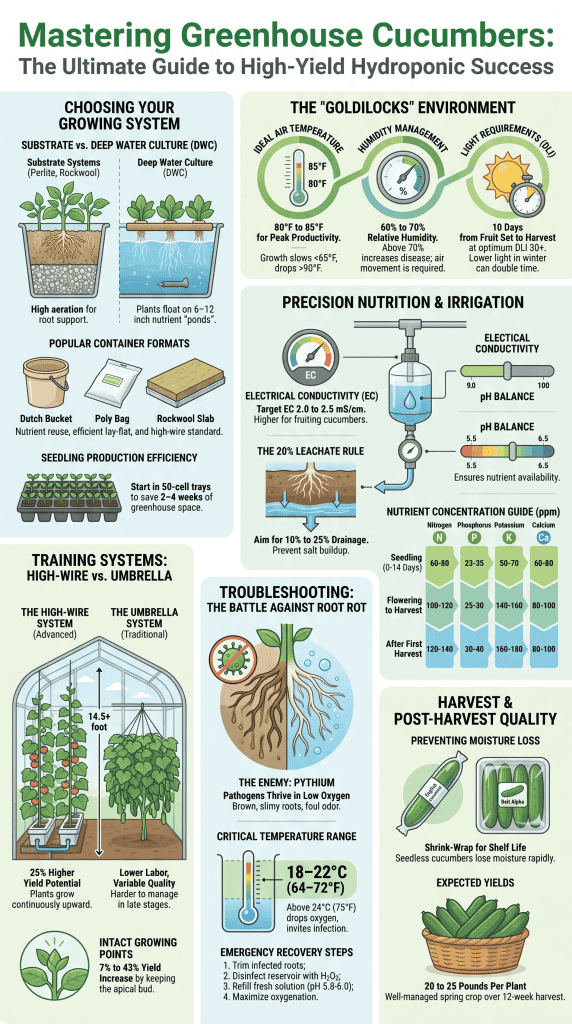
Cucumber plants grow upward naturally when given support.
Without a trellis, vines can spread across everything. Leaves block light, airflow drops, and harvesting becomes harder, so a DIY cucumber trellis helps keep vines upright and easier to manage.
Vigorous vegetative growth can overwhelm a growth space without immediate and deliberate management of the canopy. A standard method is to install a vertical drop-line above each plant.
The main stem is then secured to this line every few inches using strong vine clips. Start training early before the vine becomes heavy and difficult to reposition.
Canopy management requires consistent, hands-on work. The older, yellowing fan leaves at the bottom of the plant, typically the first 18 inches, should be removed. Removing these leaves improves airflow and reduces humid areas where fungal problems can develop.
This isn’t just for tidiness; it’s essential for securing good airflow at the base of the plants. Simultaneously, non-essential side shoots must be pinched back.
This practice directs all the plant’s energy into a single, primary leader stem, which is where fruit development will be concentrated. A healthy vine still needs room.
Train the main vine to a single leader line, pinching off lateral side-shoots after their first fruit joint to preserve energy
Why Do Small DWC Containers Fail?
Cucumbers require a minimum reservoir volume of 5 gallons per plant, though 10 gallons is ideal to buffer daily water drawdowns. Small containers can create problems because cucumbers use a lot of water and nutrients.
| Problem | Result |
| Small reservoir | Faster EC changes |
| Crowded roots | Less oxygen |
| Too many plants | More competition |
A five gallon bucket can grow a cucumber plant, especially for home growers. But one plant per bucket is usually easier to manage. It simplifies nutrient tracking, root inspection, and prevents plants from competing for oxygen and space, reducing many common cucumber issues as plants mature.
A deep water culture reservoir functions as a closed biological system. Without soil to act as a buffer, chemical changes happen rapidly. This demands meticulous maintenance habits from the grower.
A strict “one plant per bucket” rule is widely advocated. This prevents competing root systems from tangling and choking each other out for space. More importantly, it allows for precise monitoring. You can track the water depletion rate for each plant individually.
It’s easier to maintain peak levels of dissolved oxygen in a single-plant reservoir. This isolation also acts as a critical barrier, preventing a localized root disease from spreading and wiping out an entire crop.
How Can You Prevent Heat Problems?
Managing your water temperature is critical because hot water holds significantly less dissolved oxygen, which creates a breeding ground for root rot.
Dark reservoirs absorb more heat from grow lights and the surrounding environment. High-intensity grow lights can also increase leaf temperature and water evaporation, so proper light distance and ventilation help maintain stable growing conditions.
The solution implemented at the facility involves wrapping the reservoirs in reflective insulation or Mylar covers.
Keeping your water strictly between 18°C and 21°C is a small mechanical adjustment, but it makes an immediate difference in preventing root suffocation and keeping your root zones pristine.
Keep the water around 18 to 21°C when possible.
How Do You Fix Common Cucumber DWC Problems?
Most issues come from a few areas. Nutrients, oxygen, temperature, or airflow.
| Symptom | Possible cause |
| Small fruit | Low potassium |
| Yellow leaves | Nutrient imbalance |
| Weak growth | Low oxygen |
| Powdery mildew | Poor airflow |
Common fixes:
- Check pH
- Check EC
- Inspect roots
- Improve airflow
- Adjust nutrients slowly
Powdery mildew often appears when the leaves stay too wet and air movement is poor.
Cucumber leaves curling can happen because of heat stress, nutrient issues, or unstable conditions.
Do not chase one symptom. Look at the whole system. Check multiple factors together, including pH, EC, root condition, temperature, airflow, and lighting.
What Harvest Can You Expect From DWC Cucumbers?
A healthy DWC system can produce a good cucumber harvest when the basics are handled properly.
Yield depends on plant variety, lighting intensity and duration, nutrient balance, root oxygen levels, and vine support. Strong lighting helps cucumbers produce more energy for flowering and fruit development.
Some controlled hydroponic cucumber studies have recorded around 24.4 kg per square meter.
Commercial systems can produce more with advanced equipment and careful management. Higher yields usually come from optimized lighting, climate control, plant spacing, and nutrient management.
| Factor | Effect |
| Oxygen | Helps root activity |
| EC control | Supports fruit growth |
| Trellis | Saves space |
Keep notes.
Record pH, EC, water use, and harvest numbers. Over time, those records help you understand what your plants need.
How Can TopHydroponicGarden Help With Cucumber DWC Growing?
A highly productive cucumber harvest depends on balancing three critical factors: root oxygenation, stable nutrient levels, and precise vine management. For new growers, finding this balance can feel like chasing a moving target.
TopHydroponicGarden helps growers organize setup decisions, nutrient planning, and system improvements through practical hydroponic resources.
Determining the correct system spacing, especially for plumbing, is a critical step that can make or break an early harvest. Many growers turn to baseline calculator tools to remove the guesswork.
Resources like the specific water-to-canopy depletion checklists from TopHydroponicGarden provide a structured approach. Using these matrices helps growers correctly size their initial plumbing lines from the start.
This proactive planning is key to avoiding the chokepoints and flow restrictions that commonly sabotage first-year yields.
Benefits of Growing Hydroponic Cucumbers
Hydroponic cucumbers are a smart option if faster growth and cleaner harvests matter. But they don’t grow in soil.
Instead, the roots sit in a nutrient-rich water solution. That gives the plants direct access to water and nutrients, so they can put more energy into growing. Pretty efficient.
There are other benefits too:
- Faster growth
- Fewer soil-borne diseases
- Cleaner harvests
- Better use of space
Still, the system needs regular attention. Check the nutrient solution, water level, light, temperature, and vine support. Miss one of those, and growth can slow down.
Hydroponic cucumbers can be a good fit for home gardeners or commercial growers. With the right setup, they produce fresh, high-quality cucumbers without relying on traditional soil.
FAQ
What nutrients do cucumbers need in a DWC system?
Cucumbers need balanced hydroponic cucumber nutrients to support strong roots, healthy vines, flowering, and fruit production. A proper cucumber nutrient solution should contain essential elements such as nitrogen, phosphorus, potassium, calcium, and magnesium.
Monitoring nutrient strength, cucumber EC level, and water quality helps plants absorb nutrients effectively. Starting water should be free from excessive chlorine and unwanted mineral buildup, as these can affect nutrient balance and root performance.
How do I start growing cucumbers in a DWC system at home?
To successfully transition your first homegrown cucumber seedling into an active DWC bucket, ensure the roots are gently rinsed completely free of starting soil or rockwool debris before nesting them into the clay pebbles.
Start with a lower EC during transplant recovery, then increase gradually as roots and leaves develop. Set your initial nutrient solution to a mild vegetative EC of 1.2 to 1.4 dS/m, keep your grow lights exactly 18 to 24 inches away to prevent early leaf scorch, and run your aeration pump 24/7 without interruption to prevent transplant shock.
How do I diagnose and halt an early-stage Pythium (root rot) outbreak?
If your cucumber roots drop their fresh scent, turn light tan, or display a slimy texture, you are dealing with early-stage root rot, typically caused by water temperatures crossing 22°C.
Immediately flush your reservoir with a clean water rinse, drop your water temps back down to a strict 18°C to 21°C range, increase your air stone output, and inoculate the fresh nutrient solution with a beneficial bacterial strain like Bacillus amyloliquefaciens to outcompete the pathogen.
Do cucumber plants need support when grown in DWC?
Vertical trellis systems are commonly preferred because they save space and improve airflow. A heavy-duty overhead line is installed, and the cucumber’s main stem is clipped to a vertical cord running down from it.
The key to this system is aggressive pruning. Every lateral side-shoot is pinched back after it develops its first fruit node. This forces the plant to grow as a single, vertical leader. The result is an open, airy canopy that discourages powdery mildew and makes inspecting and harvesting the daily crop a straightforward task.
How can I increase cucumber yield in a DWC system?
To increase cucumber yield, provide proper care during each cucumber growth stage. A consistent cucumber feeding schedule, sufficient LED lighting with the right intensity and daily light duration, balanced nutrients, and proper pruning all support stronger plants.
Good pollination methods and healthy roots also improve cucumber fruit production and help achieve better harvest results in a deep water culture cucumber growing system.
Final Tips for Better DWC Cucumber Growing
Growing cucumbers in a DWC system can feel difficult when the basics are not managed well. You need steady aeration, balanced nutrients, and proper support for healthy growth. Small checks can make a big difference.
TopHydroponicGarden can help simplify your DWC growing setup with solutions that support your next harvest cycle. It’s a practical option when you want to improve your system and grow with more confidence.
References
- https://www.mdpi.com/2073-4395/13/2/369
- https://www.sciencedirect.com/science/article/pii/S2666154325000705
Related Articles
- https://tophydroponicgarden.com/how-to-grow-cucumbers-hydroponically/
- https://tophydroponicgarden.com/how-to-build-a-diy-cucumber-trellis/
- https://tophydroponicgarden.com/common-issues-in-hydroponic-cucumbers/
Was this helpful?

I’m Barrie L., a passionate hydroponic gardening enthusiast dedicated to cultivating thriving, soil-less gardens. With a focus on all things hydroponic, I share my expertise on innovative growing techniques and sustainable practices through my blog, tophydroponicgarden.com. As a seasoned hydroponics specialist, my goal is to inspire and guide fellow gardeners in harnessing the power of water-based cultivation for bountiful and eco-friendly harvests. I’m also an author of the book “Hydroponics For Absolute Beginners: Your Step By Step Guide For How To Create An Hydroponics System At Home Without Soil, For Growing Vegetable, Fruit And Herbs.” which is sold on Amazon. Join me on a journey of redefining the way we cultivate plants, one nutrient-rich solution at a time. Happy growing!