
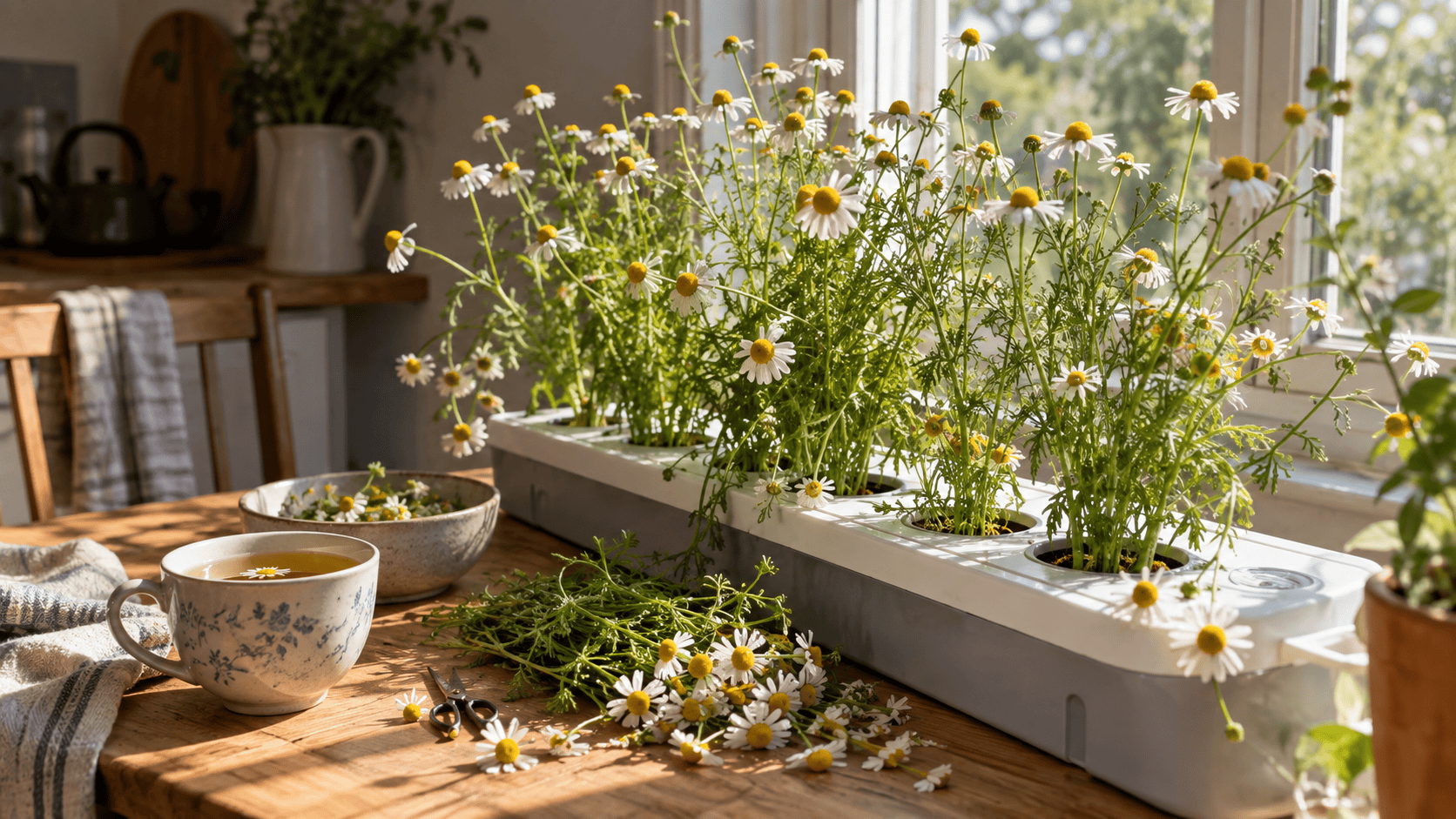
Growing chamomile hydroponically for tea is easier once you focus on the flowers, not just leafy growth.
Light, nutrient strength, root health, and harvest timing all play a part in getting healthy blooms worth brewing.
Top Hydroponic Garden keeps the process practical for home growers without turning every step into a complicated formula.
From starting tiny German chamomile seeds to drying the finished flowers, this guide covers the full process.
Keep reading to see what matters at each stage and how to avoid common mistakes that can affect flowering and harvest quality.
Chamomile at a Glance
You do not need a complicated flowering setup, but a few decisions make the whole grow easier.
- Choose German chamomile if tea is the main goal.
- Surface-sow the tiny seeds because they need light to germinate.
- Increase nutrient strength gradually after transplanting instead of starting strong.
- Harvest mature flower heads, then dry them fully before storage.
That is the basic path. The details below explain where growers usually get stuck and what actually deserves attention.
Can You Really Grow Chamomile Hydroponically for Tea?
Yes.
German chamomile can be grown hydroponically through flowering, and controlled research has already done it in aerated deep-water culture under LEDs.
In that trial, plants were started from seed, moved into the hydroponic system after developing two sets of true leaves, and grown until flowering.
The important part for a home grower is not copying the lab setup exactly.
It is understanding what the study proves: chamomile can complete the seed-to-flower cycle without soil when the root zone stays oxygenated and the plant receives enough light and balanced nutrition.
That makes chamomile a little different from fast hydroponic herbs.
A large leafy plant is not the finish line.
You are waiting for healthy flower heads, so lighting, plant spacing, feeding, airflow, and harvest timing matter more than simply keeping the foliage green.
Is German or Roman Chamomile Better for Tea?
German chamomile, Matricaria chamomilla, is the easier fit for this guide.
It grows upright as an annual and is commonly used for chamomile tea. Roman chamomile, Chamaemelum nobile, is a creeping perennial with a different growth habit.
Wisconsin Extension notes that Roman chamomile is used less often for tea because it tastes more bitter.
Check the botanical name before buying seed.
A packet that only says “chamomile” can leave you with a plant that behaves differently from the upright German chamomile described here.
Which Hydroponic System Works Well for Chamomile?
Chamomile does not need a special flower-only hydroponic system.
What matters more is steady root-zone oxygen, a stable nutrient solution, enough space above the reservoir, and easy access when flowers start opening.
DWC is a strong home option because it keeps the setup simple and is directly supported by the 2025 chamomile study, where roots stayed submerged in an aerated nutrient solution.
Ebb and flow can also work if you prefer periodically wetted media, while drip systems make sense when you want more physical support around the root zone.
NFT is possible, but a branching flowering herb can become awkward if the channels and plant supports are small.
| System | Main Advantage | Main Challenge | Small Tea Garden |
| DWC | Simple, actively aerated root zone | Requires an air pump | Very practical |
| Ebb and flow | Good moisture and air balance | More timing and plumbing | Practical |
| Drip/substrate | Strong plant support | Emitters need checking | Practical |
| NFT | Efficient circulation | Mature plants need support | More situational |
If you are still choosing the basic layout, Top Hydroponic Garden’s DIY Hydroponic System for Herbs is a useful companion because it compares simple home setups without forcing every herb into one method.
How Do You Start Chamomile Seeds for Hydroponics?
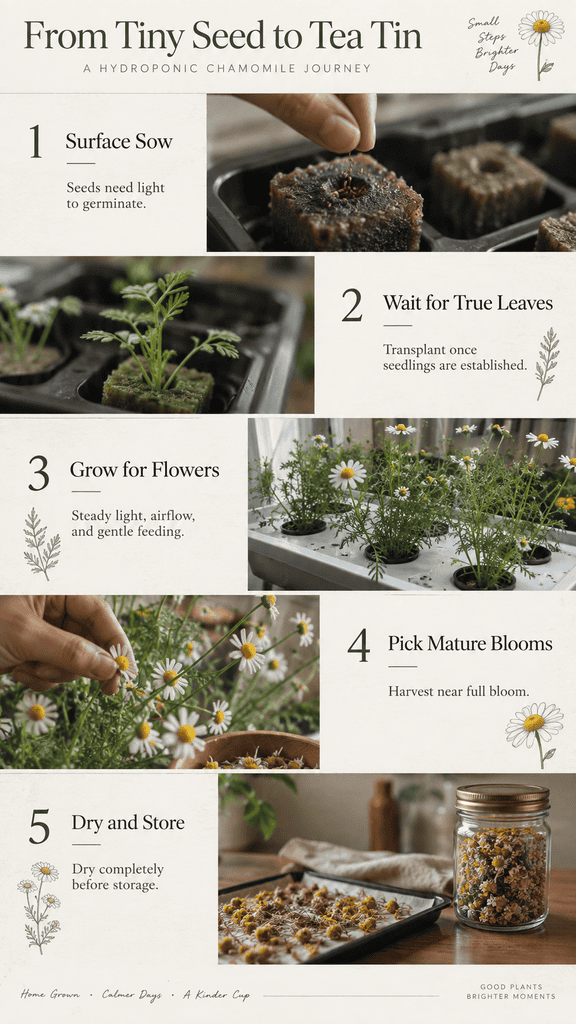
Seed starting is one place where chamomile deserves different treatment from larger herbs.
The seeds are tiny and need light for germination, so burying them deeply can work against you.
Wisconsin Extension recommends surface sowing and reports that germination can happen within about a week under warm conditions.
For hydroponics, use a clean, pre-moistened propagation plug or another fine seed-starting medium that can hold moisture without swallowing the seed.
Keep the surface damp but not flooded.
The goal is steady contact with moisture while the seed still receives light.
Do not rush nutrients at this stage.
Germination and early root development matter more than feeding strength.
Once seedlings have true leaves and a stable root system, they can move into the main hydroponic setup and begin receiving a mild nutrient solution.
How Should You Sow the Tiny Seeds?
Place a few seeds on the surface of a pre-moistened plug, then press them gently so they make contact with the medium.
Avoid covering them with a thick layer of rockwool fibers, coco, or another material.
According to University of Wisconsin-Madison Extension:
“The seeds need light to germinate, so surface sow and press into the soil.” – University of Wisconsin-Madison Extension
A gentle mist or bottom watering helps prevent the seeds from washing away. For more context on plugs and root-zone support, see Top Hydroponic Garden’s Best Grow Medium for Hydroponic Herbs Compared.
When Are Seedlings Ready for the Hydroponic System?
Use plant development instead of counting days.
In the 2025 hydroponic trial, chamomile seedlings were moved into the vertical system when they had two sets of true leaves.
That happened about three weeks after sowing under the study’s controlled conditions.
For a home setup, two sets of true leaves are a better checkpoint than “day 21.”
Look for a seedling that holds itself upright, has established roots, and is no longer relying only on its first seed leaves.
Move it gently, then start with a mild nutrient solution.
What Growing Conditions Help Hydroponic Chamomile Flower?
Flowering is where the grow becomes more than ordinary herb maintenance.
Chamomile needs enough usable light to support both plant growth and bloom development, while steady airflow helps keep dense foliage and flower heads from sitting in humid pockets.
Root conditions still matter too.
A plant struggling with low oxygen or unstable nutrition will not suddenly become productive just because the light stays on longer.
Think of the environment as a group of connected conditions: light duration, light intensity, temperature, airflow, root oxygen, and nutrient strength.
You do not need laboratory precision, but you do need consistency.
The 2025 study gives a helpful controlled-environment example.
Chamomile was grown under LEDs, with air circulated through the canopy and the roots continuously submerged in an oxygenated nutrient solution.
Those details are useful reference points, not a recipe every home grower must copy.
How Much Light Does Hydroponic Chamomile Need?
In the HortScience trial, chamomile received a daily light integral of about 17 mol·m⁻²·d⁻¹ under LEDs and a 16-hour photoperiod.
The researchers treated chamomile as a long-day flowering species.
As noted by Maynard et al.:
“The photoperiod was set to 16 hours for both species to induce flowering in the chamomile.” – Maynard et al., HortScience
Home growers do not need that exact DLI. A better takeaway is to provide consistent usable light and good canopy coverage.
Top Hydroponic Garden’s Full-Spectrum LED Grow Light guide explains the grow-light numbers that actually matter.
What Temperature and Airflow Does Chamomile Prefer?
The same controlled trial used 24°C days and 20°C nights, with air actively moved through the canopy.
Those values describe the experiment, not universal home targets.
For a small grow, avoid persistent heat and stagnant, humid air around developing flowers.
A gentle fan can improve circulation without blasting the plant.
Also separate canopy temperature from reservoir temperature when troubleshooting.
Warm room air and warm nutrient solution can create different problems, so check both instead of assuming one thermometer tells the whole story.
What pH and EC Should Hydroponic Chamomile Use?
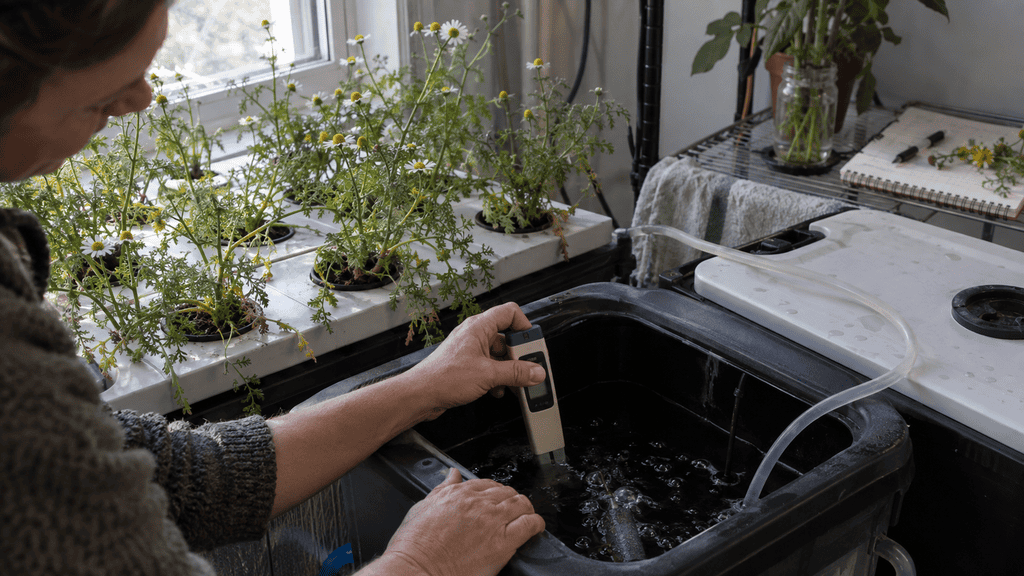
Direct hydroponic research gives a useful starting reference.
In the 2025 DWC trial, researchers maintained the nutrient solution at pH 6.0 to 6.5. EC was not set immediately at full strength.
It was gradually increased from about 0.75 to 1.5 dS/m over four weeks because the seedlings had not been fertilized before entering the hydroponic system.
Those numbers are helpful, but they are not proof that every cultivar, reservoir, fertilizer, or home grow should be locked to the same readings.
Use them as an evidence-based reference while watching the plant and the reservoir together.
A stable trend matters more than constantly chasing a decimal.
Check pH and EC regularly, especially after top-offs, warm days, or rapid water use.
If readings start moving unusually fast, look at reservoir volume, roots, temperature, and plant uptake before making a large correction.
Why Should You Increase Nutrient Strength Gradually?
A new transplant does not need the same nutrient concentration as an established flowering plant. Starting lighter gives the roots time to adjust before demand increases.
The study’s gradual EC rise is useful because it shows a controlled transition rather than an instant jump to full strength.
At home, watch new leaves, roots, water use, and EC movement as feeding increases. More fertilizer does not automatically mean more flowers.
Wisconsin Extension also notes that German chamomile does not need much fertilizer, another reason to avoid aggressive feeding without a clear need.
How Do You Maintain Chamomile Until It Flowers?
Once the plant is established, maintenance should become routine rather than reactive.
Check the reservoir level, pH, EC, root appearance, new growth, canopy spacing, airflow, and developing buds.
You do not need to change something every time a reading moves slightly.
It is more useful to notice the direction of change over several checks.
For example, if EC keeps rising while the water level drops, the plant may be taking up proportionally more water than nutrients. If pH suddenly becomes harder to hold, inspect the reservoir and roots before adding repeated corrections.
Keep the canopy open enough that light and air can reach through it.
Chamomile branches as it matures, and an overcrowded plant becomes harder to inspect and harvest.
The goal is a stable plant that moves naturally toward flowering, not a reservoir that looks perfect on paper every hour.
How Can You Encourage More Flowers, Not Just Leaves?
Do not judge success by leaf volume alone.
With chamomile, the useful harvest is the flower head, so a very leafy plant with little bloom is a sign to review the growing conditions.
Start with light.
Make sure the plant gets enough usable intensity and a consistent long-day schedule.
Then look at feeding. Avoid increasing EC simply because the plant appears healthy.
There is also no need to reach immediately for a “bloom booster.”
A balanced nutrient program, steady root conditions, suitable light, and enough maturity are a more defensible starting point than unsupported phosphorus-heavy recipes.
When Should You Harvest Chamomile for Tea?

Credits: Green Our Planet
For home tea, harvest timing should follow the flower rather than a fixed number of days.
Wisconsin Extension recommends picking German chamomile near full bloom for best quality and snipping the flower head from the stem.
The flowers can be used fresh or dried.
That advice is more useful for tea than copying the harvest timing from the 2025 hydroponic study.
The researchers collected unopened chamomile inflorescences because their goal was chemical analysis of apigenin, not deciding when homegrown tea tastes best.
Start checking plants often once flowering begins.
Chamomile does not open every bud on the same day, so the harvest naturally happens in small rounds.
Pick mature flowers while leaving younger buds to continue developing.
This gives you cleaner material and avoids stripping the plant before the next wave of blooms is ready.
What Should You Harvest, and When?
Pick the flower heads rather than cutting long sections of stem and foliage.
A ready flower should look fresh and well developed, with white petals opened around a clear yellow center.
Avoid waiting until petals are browning, falling, or the head looks tired.
Snip or pinch close to the flower head so the drying tray contains mostly the part you actually want for tea.
That saves sorting later and reduces the amount of bitter-tasting foliage mixed into the batch.
Can You Harvest the Same Plant More Than Once?
Yes.
German chamomile is an annual, but individual plants can keep opening new flowers during the same blooming period.
The 2025 paper also notes that field-grown chamomile is frequently harvested multiple times because flowers develop at different stages.
That means you do not need to wait for the whole canopy to look identical.
Harvest mature flower heads, leave unopened buds alone, and check again as they develop.
Repeated small harvests are usually more practical than one large cut, especially for a few homegrown tea plants.
How Do You Dry and Store Hydroponic Chamomile for Tea?
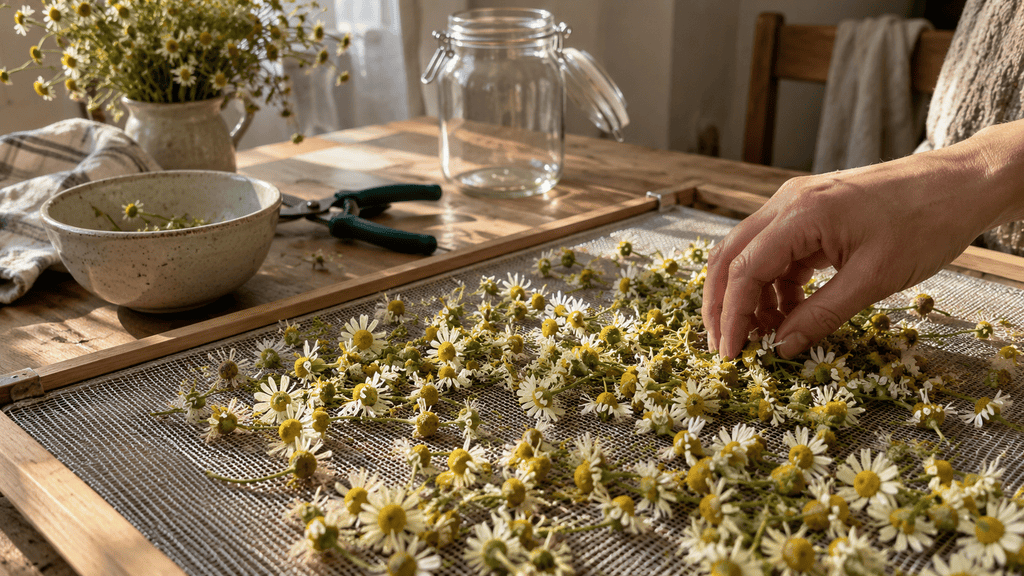
Fresh chamomile flowers can be used for tea, but drying is what makes a larger harvest practical to store.
Start by inspecting the flowers and removing damaged material, insects, or excessive stems.
Then spread the flower heads in a thin layer instead of piling them together.
Air-drying works in a warm, dry place with good ventilation.
A dehydrator is another option when you want more control, but there is no need for harsh heat.
Drying speed changes with humidity, flower size, airflow, and equipment, so a rigid hour count is less useful than checking the flowers themselves.
Do not seal the batch while it still feels soft or damp.
Trapped moisture can undo the work of a clean harvest very quickly.
Let dehydrated flowers cool before storage, then check them again before closing the container.
How Should Dried Chamomile Be Stored?
Keep completely dried flowers in a clean, airtight container away from strong light, heat, and humidity.
A cupboard is usually more useful than an exposed shelf beside a sunny window.
After sealing the first batch, check it again for condensation, softness, clumping, or a musty smell.
Those signs suggest that moisture may still be present.
Avoid repeatedly opening one large jar if you harvest a lot.
Smaller containers can reduce unnecessary exposure each time you make tea.
The main goal is simple: keep dried flowers dry, clean, and protected until you are ready to use them.
What Can Go Wrong With Hydroponic Chamomile?
Most chamomile problems are easier to solve when you start with the growing conditions instead of guessing one nutrient deficiency from one leaf.
Poor germination often points back to buried seed or inconsistent surface moisture.
Stretchy seedlings usually deserve a lighting check before extra fertilizer.
A big plant with few flowers should send you back to light duration, usable intensity, maturity, and feeding.
Root problems deserve quick attention because chamomile may spend a long time in the system before harvest.
Check aeration, reservoir temperature, cleanliness, and stagnant water if roots deteriorate.
Wisconsin Extension also lists aphids as one of the few notable pests of German chamomile.
Use the table as a starting check, not an automatic diagnosis.
Several problems can produce similar symptoms, especially once reservoir conditions begin drifting.
| Problem | Check First | Practical Response |
| Poor germination | Seed depth and moisture | Surface-sow and keep evenly moist |
| Stretchy seedlings | Light intensity | Improve light before feeding more |
| Few flowers | Light, maturity, excess feeding | Stabilize conditions |
| Rising EC | Water use and top-offs | Recheck solution balance |
| Unhealthy roots | Oxygen, heat, cleanliness | Correct root-zone conditions |
| Aphids | Leaves and flower clusters | Isolate and use edible-crop-safe controls |
How Do You Keep Chamomile Clean Enough for Tea?
Because the flowers will eventually go into a drink, harvest cleanliness deserves attention before flowering starts. Use clean water, clean tools, and a reservoir setup that does not splash nutrient solution or algae onto flower heads.
Inspect blooms as you pick them, especially around the yellow centers where tiny insects can be easy to miss.
Be cautious with pesticides, insecticidal soaps, oils, foliar fertilizers, and homemade sprays as harvest approaches. “Natural” does not automatically mean suitable for flowers that will be brewed. Follow the product label, crop restrictions, and any pre-harvest interval instead of improvising.
Use clean hands and trays during harvest, and move the flowers into drying conditions rather than leaving them piled together.
If a bloom shows mold, decay, or obvious contamination, discard it. Hydroponics gives you more control over the root zone, but it does not make post-harvest hygiene automatic.
FAQ
Can chamomile grow in a Kratky system?
It can, but its longer seed-to-flower cycle makes root-zone stability important. DWC gives you more direct control over oxygen, while Kratky needs enough reservoir volume and a stable air gap.
Can you make tea from fresh hydroponic chamomile flowers?
Yes. Chamomile flowers can be used fresh or dried, although the flavor may differ.
Does German chamomile grow back after harvest?
It is an annual, but the same plant can keep opening new flowers during one blooming period.
Can chamomile share a reservoir with other herbs?
Yes, when the other crops tolerate similar pH, nutrient strength, temperature, and root conditions. Crops with similar growth stages are simply easier to manage together.
Why does homegrown chamomile tea taste grassy or bitter?
Check for excess stem or foliage, flower maturity, and whether you used fresh or dried blooms. Roman chamomile is also more bitter than German chamomile.
From Hydroponic Flowers to a Tea-Ready Harvest
Growing chamomile hydroponically for tea comes down to getting a few important stages right. Start with German chamomile, surface-sow the seeds, introduce nutrients gradually, and give the plants enough light and airflow to support healthy flowering.
Once blooms appear, focus on harvesting mature flower heads, drying them completely, and storing them away from heat and moisture. There’s no need to chase one “perfect” pH, EC, or lighting number if the plants are responding well.
For more straightforward guides on hydroponic herbs, lighting, nutrients, and reservoir care, explore Top Hydroponic Garden and keep building a setup that works for your plants.
References
- https://hort.extension.wisc.edu/articles/chamomile-matricaria-chamomilla/
- https://journals.ashs.org/view/journals/hortsci/60/1/article-p17.xml
Related Articles
- https://tophydroponicgarden.com/diy-hydroponic-system-for-herbs/
- https://tophydroponicgarden.com/best-grow-medium-for-hydroponic-herbs/
- https://tophydroponicgarden.com/how-to-choose-the-best-full-spectrum-led-light/
Was this helpful?

I’m Barrie L., a passionate hydroponic gardening enthusiast dedicated to cultivating thriving, soil-less gardens. With a focus on all things hydroponic, I share my expertise on innovative growing techniques and sustainable practices through my blog, tophydroponicgarden.com. As a seasoned hydroponics specialist, my goal is to inspire and guide fellow gardeners in harnessing the power of water-based cultivation for bountiful and eco-friendly harvests. I’m also an author of the book “Hydroponics For Absolute Beginners: Your Step By Step Guide For How To Create An Hydroponics System At Home Without Soil, For Growing Vegetable, Fruit And Herbs.” which is sold on Amazon. Join me on a journey of redefining the way we cultivate plants, one nutrient-rich solution at a time. Happy growing!