

Hydroponic bok choy can be ready to harvest in as little as 30–45 days while using far less water than traditional soil growing. And it doesn’t take a massive setup to get good results. With the right nutrients, steady temperatures, and a bit of attention to daily conditions, bok choy grows fast and stays crisp.
But small mistakes can lead to bolting, browning leaves, or stalled growth. Keep reading for the exact setup, nutrient targets, and fixes that help produce healthy, reliable harvests.
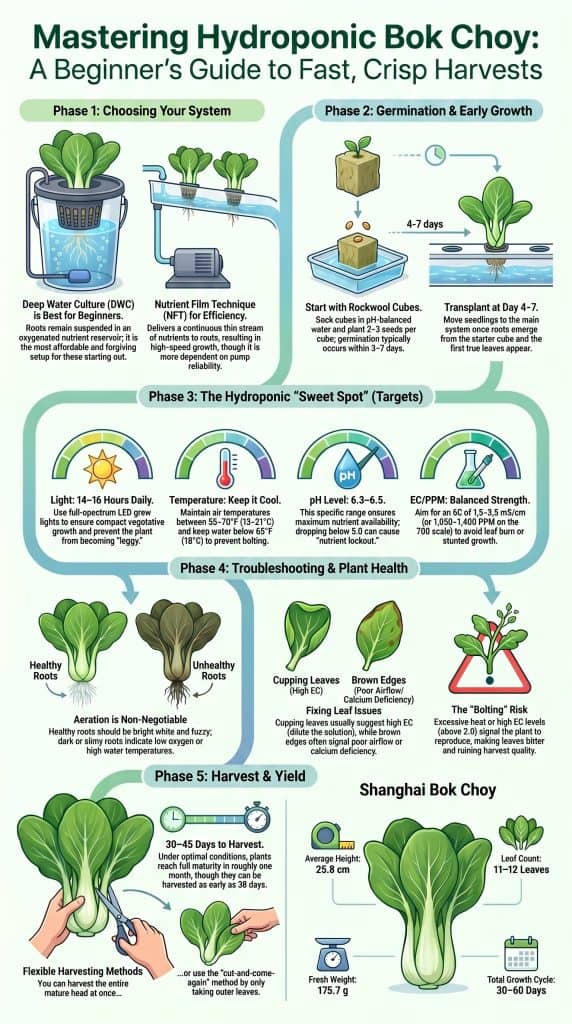
Hydroponic Bok Choy Fast Facts
Before building your hydroponic setup, focus on key success factors such as system choice, nutrient balance, and environmental control to ensure fast growth, healthy plants, and high-quality bok choy harvests.
- The best hydroponic systems for growing bok choy successfully.
- Ideal nutrient, pH, EC, temperature, and lighting targets.
- Common mistakes that reduce yield and how to fix them.
This brief overview highlights the key factors that support faster growth, healthy development, and high-quality, crisp harvests of hydroponic bok choy.
Important Things to Know Before Growing Hydroponic Bok Choy
Bok choy is one of the easiest leafy greens for hydroponic beginners because it matures quickly and adapts well to multiple hydroponic systems.
Hydroponic bok choy is a fast-growing crop with a short production cycle. Most varieties germinate in 3–7 days and reach harvest in 30–45 days under favorable conditions. That rapid turnover makes it attractive for growers who want consistent harvests throughout the year.
Popular varieties include Shanghai bok choy, dwarf bok choy, traditional white-stemmed cultivars, and red-leaf selections. Compact varieties often perform particularly well in indoor systems where space is limited.
Growers frequently choose hydroponic bok choy because it offers:
- Fast crop turnover
- Compact growth habits
- Reliable indoor production
- Reduced soil-borne disease pressure
Whenever beginners ask me what crop they should start with to test their plumbing and lighting, I always point them to dwarf bok choy.
Because it bounces back rapidly from minor chemical imbalances and hits harvest size in just over a month, it gives you a quick, highly forgiving feedback loop to build your confidence before you tackle finicky fruiting crops.
The Best Bok Choy Varieties for Hydroponic Growing
Shanghai bok choy and dwarf varieties generally adapt exceptionally well to indoor hydroponic systems because of their compact size and rapid growth. These cultivars produce tender leaves and mature quickly.
Bok Choy Is One of the Best Crops for Hydroponic Beginners
The crop tolerates a range of hydroponic methods, responds quickly to nutrient adjustments, and reaches harvest faster than many leafy greens. Mistakes become easier to identify and correct within a short growing cycle.
The Best Hydroponic Systems for Growing Bok Choy
Most home growers succeed with Deep Water Culture because it combines simplicity with strong root development.
Bok choy performs well in several hydroponic systems. The best choice depends on your budget, experience level, and available space.
| System | Pros | Cons | Best For |
| DWC | Simple affordable | Requires aertion | Beginners |
| NFT | Efficient nutrient delivery | Pump-dependent | Intermediate growers |
| Drip | Flexible Scaling | More components | Large setups |
NFT systems are commonly used in research because they deliver nutrients continuously to plant roots, resulting in consistent leafy green production. Bok choy grown in an NFT system reached 25.8 cm in height, produced 11–12 leaves, and had a fresh weight of 175.7 g under optimal conditions.
Deep Water Culture Is the Simplest Hydroponic Option
Yes. A bok choy DWC system is often the simplest entry point. Roots remain suspended in an oxygenated nutrient reservoir, reducing the number of moving parts.
NFT and DWC Systems Offer Different Growth Advantages
A properly tuned bok choy NFT system can promote rapid nutrient uptake and uniform growth. However, NFT depends heavily on pumps and uninterrupted nutrient flow, making it slightly less forgiving than DWC.
Successful Bok Choy Seed Germination Methods

Consistent moisture and moderate temperatures help seeds sprout within one week.
The most common approach for bok choy rockwool hydroponics begins with seed germination in starter cubes.
- Soak rockwool cubes in pH-balanced water.
- Insert 2–3 hydroponic bok choy seeds per cube.
- Maintain moisture without oversaturation.
- Provide gentle light after sprouting.
- Thin to the strongest seedling.
Rockwool remains one of the most widely used hydroponic germination media because it retains moisture while maintaining airflow around developing roots.
The Best Growing Media for Hydroponic Bok Choy
Several options perform well:
- Rockwool cubes
- Planting sponges
- Coco coir
- Clay pebbles
- Oasis cubes
The Right Time to Transplant Bok Choy Seedlings
Transplant when roots emerge from the starter cube and seedlings develop their first true leaves, typically between days 4 and 7.
Ideal Temperature and Lighting Conditions for Bok Choy
Cool temperatures and consistent lighting produce compact, flavorful plants while reducing the risk of bolting.
Environmental control has a major influence on hydroponic bok choy success.
- Air temperature: 55–70°F (13–21°C) Water temperature: ≤65°F (18°C)
- Lighting duration: 14–16 hours daily of full-spectrum light to ensure rapid, compact vegetative growth.
- Seedling intensity: 100–150 µmol/m²/s
- Mature plants: 150–200 µmol/m²/s
Research on automated vertical farming systems shows that bok choy grows well vegetatively when given a photoperiod of 16 hours of light followed by 8 hours of darkness.
Data from Sharma, V., et al. demonstrates
“A study on hydroponic bok choy found that a moderate temperature regime of 21–23°C and 70–75% relative humidity, combined with 150 ppm nitrogen, consistently delivered superior outcomes, including enhanced vegetative growth and a higher yield of 370 g plant⁻¹” – Journal of Agribusiness and Community Empowerment
Indoor growers commonly use full-spectrum LED grow lights to minimize heat while maintaining consistent light quality.
High Temperature Can Trigger Bolting in Bok Choy
High EC levels above 2.0 can also stress bok choy plants, causing them to bolt faster and develop a more bitter taste.
Excessive heat signals the plant to enter its reproductive stage. Once bolting begins, leaf quality declines and bitterness increases.
How many hours of light does bok choy need?
Most growers achieve strong results with 14–16 hours of daily light exposure when growing bok choy hydroponically. This extended photoperiod supports steady vegetative growth, encourages larger leaves, and helps plants develop compact, healthy heads.
Full-spectrum LED grow lights are commonly used indoors because they provide consistent light intensity while producing less heat. Maintaining a proper light schedule is also important to prevent slow growth, weak stems, and stress that can lead to early bolting.
Optimal Nutrient Levels for Healthy Bok Choy Growth
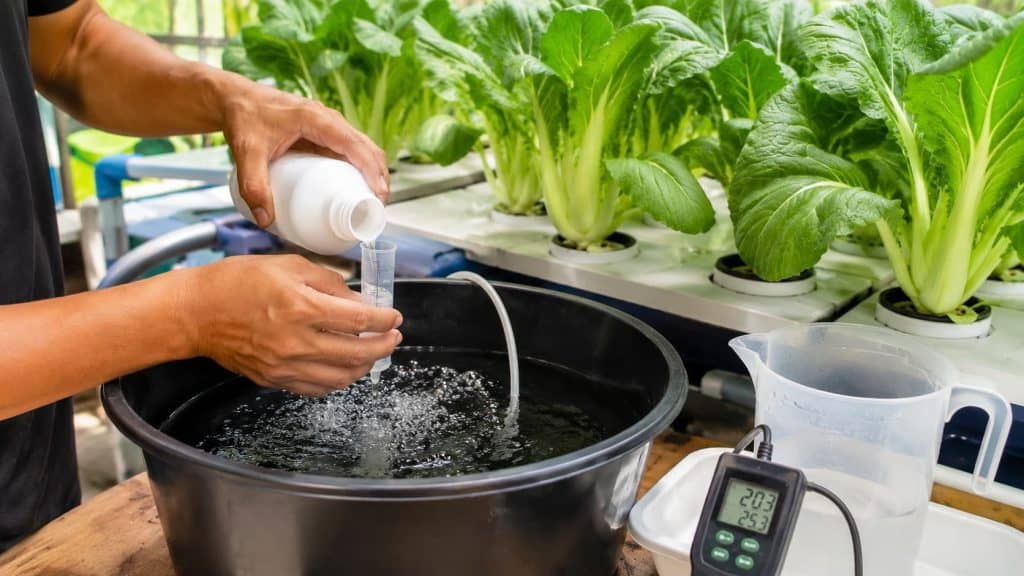
Balanced nutrient strength consistently outperforms both weak and overly concentrated solutions.
Proper nutrient management is essential when growing bok choy hydroponics.
| Matric | Target Range |
| pH | 6.3–6.5 (optimal) |
| EC | 1.5-2.5 mS/cm |
| PPM | 750–1,000 (500 scale) or 1,050–1,400 (700 scale) |
Avoid exceeding these limits to prevent leaf burn.
A balanced nutrient concentration is important for hydroponic bok choy. Many growers achieve strong results around 1,400 ppm, while excessively high concentrations may reduce yield and increase plant stress.
The primary nutrients supporting leafy development include nitrogen, potassium, calcium, magnesium, and phosphorus. Maintaining balanced nutrient levels helps prevent deficiencies and supports healthy leaf growth.
As noted by Luckardi, S., et al.
“balanced TDS and pH conditions enhanced leaf formation and biomass accumulation, while imbalances caused nutrient stress and growth inhibition” – ASEAN Journal of Science and Engineering
Many growers rely on bok choy AB mix nutrients because they simplify nutrient balancing and reduce mixing errors.
Excess Fertilizer Can Reduce Bok Choy Growth
High nutrient concentrations increase osmotic pressure, making water uptake more difficult. Excessive EC frequently leads to stunted growth and leaf stress.
Essential Nutrients for Strong Leaf Development
Nitrogen plays a primary role in promoting vigorous leaf growth by supporting chlorophyll production and overall photosynthesis, which directly drives larger and faster leaf expansion. When nitrogen is available in adequate amounts, plants develop lush, green foliage with improved energy capture.
Meanwhile, calcium is essential for building strong cell walls and maintaining structural integrity throughout the plant. It helps stabilize growing tissues and is especially important in fast-growing leafy crops, where deficiencies can lead to weak growth and tip burn. Together, these nutrients create a balance between rapid growth and physical strength.
Managing pH and EC Throughout the Growing Cycle
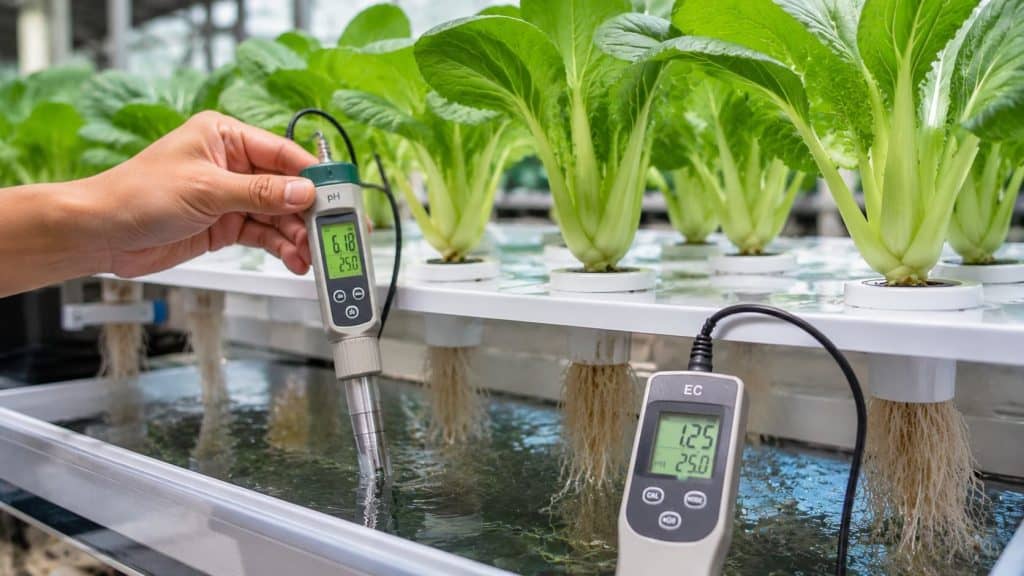
Small daily adjustments help maintain nutrient availability and prevent deficiencies.
Successful growers often:
- Check pH daily
- Monitor EC using a TDS meter
- Calibrate meters regularly
- Refresh nutrient solutions every 2–3 weeks
- Flush systems periodically
Low pH Can Cause Nutrient Lockout Problems
Nutrient lockout can occur, limiting the availability of calcium, magnesium, and other essential elements. This becomes especially important when managing crops that perform best under a lower pH range.
How often should you refresh the nutrient reservoir?
Most hydroponic bok choy growers replace nutrient solutions every two to three weeks to maintain stable nutrient availability and prevent imbalances. Over time, plants absorb different amounts of minerals, causing nutrient ratios, EC levels, and pH to shift.
Refreshing the reservoir helps maintain consistent growing conditions, reduces salt buildup, and ensures roots continue receiving the nutrients needed for healthy leaf development. For best results, growers should also monitor water levels, pH, and EC regularly between reservoir changes and make small adjustments when needed.
Aeration Supports Healthy Roots and Faster Growth
Oxygen-rich roots absorb nutrients more effectively and remain healthier throughout the growing cycle.
Many hydroponic bok choy failures begin below the surface.
Research and grower observations consistently show improved biomass production in oxygenated nutrient solutions. Healthy roots typically appear:
- Bright white
- Thick
- Slightly fuzzy
In a bok choy DWC system, air stones and pumps maintain dissolved oxygen levels that support rapid growth.
Healthy Roots Show Strong Oxygen Availability
Healthy roots are typically bright white or creamy in color, firm to the touch, and actively branching as they grow through the medium or nutrient solution. This indicates strong oxygen uptake and efficient nutrient absorption. In hydroponic systems, healthy roots should look clean and “fuzzy” due to fine root hairs, which increase surface area for water and mineral uptake.
They should not appear brown, mushy, or translucent, as those are common signs of root rot or poor oxygenation. A healthy root system also has no foul smell and remains free from slimy buildup, which often indicates bacterial or fungal issues. Overall, strong roots signal that the plant is well-supported and capable of sustaining vigorous leaf and stem growth above the surface.
Root Slime Develops from Poor Oxygen and Water Conditions
Root slime commonly develops when oxygen levels decline, water temperatures rise, or organic matter accumulates in the reservoir.
“White, fuzzy roots usually indicate strong oxygen availability.”
Common Causes of Bok Choy Leaf Problems
Environmental stress, nutrient imbalance, and poor airflow are the most common causes.
Even experienced growers occasionally encounter problems.
Several common issues can occur during hydroponic bok choy cultivation. Leaf cupping is usually caused by high EC levels and can be corrected by diluting the nutrient solution. Brown leaf edges are often linked to calcium uptake problems or poor airflow, and improving ventilation can help resolve this issue.
Slow growth typically indicates insufficient nutrient strength, so checking and adjusting EC levels is important. Root discoloration is commonly caused by low oxygen levels in the nutrient solution, which can be improved by increasing aeration.
Community discussions among Masterblend users frequently point to airflow limitations as a contributor to calcium-related leaf disorders.
Of course, nutrient concentration is only part of the equation. A plant may have adequate calcium in solution but still struggle to move it into developing leaves if airflow is poor.
Poor Airflow Can Reduce Calcium Movement
Yes. Limited transpiration often reduces calcium movement within the plant, leading to browning and distorted growth.
Flushing the System Prevents Nutrient Imbalances
You should flush a hydroponic system when nutrient balance can no longer be corrected through normal adjustments. One clear signal is unstable EC levels when electrical conductivity keeps rising or fluctuating even after topping up water or adjusting nutrients. This often indicates that salts are building up faster than the system can stabilize them.
Another sign is visible salt accumulation, such as crusty deposits on the reservoir, growing media, or root zone. This buildup can interfere with nutrient uptake and create uneven feeding conditions. You should also consider flushing when plants show persistent nutrient imbalances like ongoing tip burn, chlorosis, or stunted growth even after you’ve already corrected the nutrient formula.
A full flush resets the system by removing excess salts and resetting the nutrient environment, allowing you to restart with a clean, balanced solution that restores stable uptake conditions for the plants.
The Best Time to Harvest Hydroponic Bok Choy
Most hydroponic bok choy reaches harvest between 30 and 60 days after planting.
Optimal environmental conditions frequently shorten production timelines.
Many growers harvest:
- Entire mature heads
- Outer leaves only
- Cut-and-come-again harvests
Hydroponic bok choy commonly reaches harvest size within 28–45 days under favorable conditions.
Harvesting Options for Hydroponic Bok Choy
Whole-head harvesting is often the preferred method for many leafy crops because it allows you to capture the maximum yield in a single cycle. By harvesting the entire plant at once, you ensure uniform maturity, consistent texture, and optimal weight per head, especially for crops like bok choy, lettuce, or cabbage.
However, whether you should harvest the entire plant depends on your production goals and crop type. If you need continuous production, some systems allow partial harvesting or “cut-and-come-again” methods, where outer leaves are removed while the inner growth continues. This can extend the harvest window but may result in slightly smaller individual yields per cut.
In contrast, whole-head harvesting is more efficient for commercial or batch production because it simplifies timing, reduces labor complexity, and prepares the system quickly for the next planting cycle.
Bok Choy Can Regrow After Selective Harvesting
Yes, bok choy can regrow after harvesting, especially when you use a selective or “cut-and-come-again” method. Instead of removing the whole plant, you harvest the outer leaves while leaving the central growing point intact. This allows the plant to continue photosynthesizing and producing new leaves.
With proper conditions stable nutrients, good light, and consistent water quality the plant can produce several additional harvests over time. However, regrowth is usually smaller and slower compared to the first harvest, and overall plant vigor may gradually decline after multiple cuts.
Expected Yield from Hydroponic Bok Choy Systems
Well-managed systems produce consistent harvests with predictable quality and strong yields.
Hydroponics can help make use of limited space and support community empowerment in urban agriculture.
Under well-managed conditions, hydroponic bok choy can produce consistent results. Plants often reach a fresh weight of around 175 grams per plant, with approximately 11 to 12 leaves and a height of about 25.8 cm.
These results depend heavily on maintaining stable nutrient levels, proper oxygenation, and consistent environmental conditions such as temperature and lighting. The biggest factors affecting yield include nutrient management, temperature control, oxygenation, and lighting consistency.
Production Capacity of a Hydroponic Bok Choy System
Production depends on spacing, variety, and environmental conditions, though even compact systems can support multiple harvest cycles each month.
Factors That Influence Bok Choy Yield
The biggest factors affecting hydroponic yield are those that directly control nutrient uptake and plant metabolism. Stable pH ensures nutrients stay available and can be properly absorbed by the roots, preventing hidden deficiencies. Proper EC (electrical conductivity) keeps nutrient concentration in the optimal range so plants receive enough minerals without being overloaded or stressed.
Adequate oxygen in the root zone is equally important because it supports healthy respiration and prevents root diseases that can reduce growth. Consistent temperatures help maintain steady metabolic activity, avoiding slowdowns or stress that can reduce leaf size and overall biomass. When these four factors are well balanced, plants grow more efficiently and produce higher, more uniform harvests.
Hydroponic Bok Choy Is Worth Growing at Home
For gardeners seeking rapid harvests, clean produce, and year-round production, hydroponic bok choy delivers exceptional value relative to the effort involved.
Benefits include:
- Faster growth cycles
- Reduced water consumption
- Fewer soil-borne diseases
- Efficient use of indoor space
Before every grow cycle, review this checklist:
- Maintain pH between 6.3–6.5
- Keep water cool
- Provide 14–16 hours of light
- Maintain strong aeration
- Monitor EC consistently
Who benefits most from hydroponic bok choy?
Apartment gardeners, indoor growers, educators, and hobbyists seeking dependable harvests often achieve excellent results with bok choy, making it one of the most practical choices for beginners exploring hydroponic gardening.
Key Factors to Optimize for Better Bok Choy Growth
Start with pH stability and aeration, because they control how effectively everything else works. If pH is off, plants can’t properly absorb nutrients even if the solution is perfectly mixed, leading to hidden deficiencies and poor growth.
At the same time, good aeration ensures the root zone has enough oxygen, which supports healthy respiration and prevents root stress or rot. Once pH is stable and oxygen levels are sufficient, nutrient adjustments (like EC fine-tuning or adding specific elements) become much more effective and predictable.
Growing Bok Choy Hydroponically at Home

Credits: HomeGrown Passion
The video from HomeGrown Passion explains how to grow bok choy using a hydroponic system, showing the basic process from planting to harvesting. It highlights how bok choy can thrive without soil when provided with the right nutrients, water conditions, and growing environment.
The video also demonstrates simple hydroponic care techniques that help produce healthy leaves, faster growth, and a fresh harvest at home.
FAQ
How do I choose the best setup for growing bok choy hydroponics at home?
The ideal setup depends on your space and experience. A Deep Water Culture (DWC) system keeps the roots submerged in an oxygenated reservoir, making it highly forgiving for beginners. A bok choy NFT system continuously delivers a thin nutrient flow to the roots and uses less water. Both systems can support healthy growth when managed correctly.
What growing medium works best for hydroponic bok choy seeds?
Rockwool cubes are ideal for germination because they hold moisture while allowing roots to breathe. Once roots emerge, you can drop the cubes directly into your net cups without shocking the plant. After seedlings develop, hydroponic bok choy clay pebbles can provide additional support and airflow around the roots. The growing medium should hold moisture while allowing adequate oxygen to reach the root zone.
Can bok choy grow well indoors without natural sunlight?
Yes, bok choy indoor hydroponics can produce healthy harvests without natural sunlight when proper lighting is provided. Hydroponic bok choy light requirements typically range from 12 to 16 hours per day. Many growers use bok choy grow lights hydroponics systems with full-spectrum lighting. Stable temperatures and adequate airflow also contribute to strong growth and leaf development indoors.
Why are my bok choy leaves turning yellow in hydroponics?
Bok choy yellowing leaves hydroponics problems are often caused by incorrect nutrient levels, unsuitable pH, or poor root oxygenation. Check the hydroponic bok choy pH level regularly and keep hydroponic bok choy nutrients within the recommended range. Roots should remain white and healthy. Monitoring nutrient concentration and water conditions helps prevent many common hydroponic bok choy problems.
How can I improve hydroponic bok choy yield and harvest quality?
To improve hydroponic bok choy yield, maintain consistent nutrient levels, proper spacing, and healthy root conditions throughout the growing cycle. Follow a daily bok choy hydroponics routine by checking water levels, pH, and plant health. A weekly bok choy hydroponics routine should include inspecting roots, refreshing nutrient solution when needed, and removing damaged leaves to support vigorous growth.
Get More From Every Bok Choy Harvest
Stalled growth or warped leaves indicate environmental stress. Because hydroponic systems lack the buffering capacity of soil, plants respond almost instantly when you correct the balance Focus on keeping pH stable between 5.5 and 7.0, with many growers aiming for 6.3 to 6.5, while checking EC regularly and maintaining steady airflow.
These simple habits make it easier to grow healthy plants and achieve reliable harvests throughout the year. Consistency matters more than constant adjustments.
References
- https://journal.agrimetassociation.org/index.php/jam/article/view/3297
- https://ejournal.upi.edu/index.php/AJSE/article/view/89992/0
Related Articles
- https://tophydroponicgarden.com/leafy-greens/
- https://tophydroponicgarden.com/what-plants-prefer-a-lower-ph-level/
- https://tophydroponicgarden.com/best-plants-for-beginners-in-hydroponics/
Was this helpful?
I’m Barrie L., a passionate hydroponic gardening enthusiast dedicated to cultivating thriving, soil-less gardens. With a focus on all things hydroponic, I share my expertise on innovative growing techniques and sustainable practices through my blog, tophydroponicgarden.com. As a seasoned hydroponics specialist, my goal is to inspire and guide fellow gardeners in harnessing the power of water-based cultivation for bountiful and eco-friendly harvests. I’m also an author of the book “Hydroponics For Absolute Beginners: Your Step By Step Guide For How To Create An Hydroponics System At Home Without Soil, For Growing Vegetable, Fruit And Herbs.” which is sold on Amazon. Join me on a journey of redefining the way we cultivate plants, one nutrient-rich solution at a time. Happy growing!