

Shallow water culture can work well for arugula when the root zone stays cool, oxygenated, and stable. Keep checking water levels, EC, roots, and plant growth as the crop develops. Tophydroponicgarden can also be used as a reference when reviewing these basic growing practices and adjusting the system to suit your setup.
Arugula Growing Quick Wins
- Keep roots cool and oxygenated: Maintain steady aeration, monitor water temperature, and keep the plant crown above the nutrient solution to support healthy roots.
- Manage nutrients and water consistently: Start seedlings with a lower EC, increase nutrient strength gradually, and monitor pH, EC, and water levels because shallow reservoirs can change quickly.
- Control growth conditions and harvest timing: Provide enough light, airflow, and plant spacing, then harvest young leaves before heat or maturity causes bolting and stronger flavor.
What is shallow water culture for arugula?
Shallow water culture is a low-depth hydroponic system that keeps arugula roots in nutrient solution while the plant crown stays above the water.
The setup is similar to deep water culture, where plants sit in a raft or net cup above the nutrient solution. The main difference is the smaller amount of water and the shallower root zone.
Use food-grade materials for the reservoir and raft to help keep unwanted chemicals out of the nutrient solution. HDPE #2 or PP #5 trays paired with high-density EVA foam rafts are suitable options. Avoid cheap vinyl tubing and storage bins that aren’t made for food use, as some soft plastics can break down under strong grow lights and may affect water quality.
The raft holds the plants above the water while the roots reach into the nutrient solution.
Arugula is a good fit for this system because it grows quickly. Under suitable conditions, it can go from seed to harvest in about 3 to 5 weeks, though the exact time can vary with temperature, light, and nutrient levels.
- Use a shallow reservoir.
- Keep the crown above water.
- Keep the roots well oxygenated.
But shallow water has less room for changes in water conditions. Temperature, water level, and nutrient strength can shift faster. So check them often and make small adjustments when needed.
What water depth should you use for shallow water culture?

In a 3-inch shallow tray, keeping the nutrient solution at about 2.5 inches leaves a 0.5-inch air gap below the net cup. This gives the roots access to air while keeping the plant crown above the water. It can also help lower the risk of damping off.
For most shallow water culture arugula setups, start with 2-3 inches of nutrient solution in a 3-inch tray and maintain an air gap below the raft or net cup. Traditional deep water culture (DWC) often uses about 6 to 8 inches of nutrient solution, so shallow water culture uses a different setup rather than being the same system with less water.
Set the raft or net cups so young roots can reach the nutrient solution while the base of the stem stays mostly dry. As the roots grow, they can extend deeper into the water without leaving the crown sitting in moisture.
Shallow reservoirs can also heat up or change nutrient strength faster than larger DWC reservoirs. So keep an eye on water temperature and nutrient levels.
Keep the nutrient solution high enough for developing roots to reach it, but maintain the plant crown above the water. In a shallow tray, check the level daily because evaporation and plant uptake can quickly reduce root contact. If it drops too far, the roots may lose contact with the solution. This matters even more when arugula is growing quickly.
What pH and EC should arugula receive?
Arugula usually grows well in a slightly acidic nutrient solution. A good starting pH range for water culture is about 5.5 to 6.2. EC shows how much dissolved material is in the nutrient solution. It gives you a general idea of nutrient strength, but it can’t tell you which nutrients are present.
Use a weaker nutrient mix for young seedlings, then increase the strength as the plants grow.
Seedlings can start around 0.8 to 1.0 mS/cm with a suitable leafy-green fertilizer. As arugula matures, increase EC gradually toward about 1.5–1.8 mS/cm when plant growth and water quality support it. Use the lower end if plants show stress or your source water already has a high EC.
Also, check the EC of your source water before adding nutrients. Otherwise, the starting reading can be misleading.
Research from University of Arkansas shows
“Instead of using a general leafy-green nutrient mix, match the nutrient balance to arugula’s needs. In the tests, standard formulas caused salt buildup and quick EC spikes within about a week. Adjusting the N-K ratio during reservoir top-ups helped reduce nutrient stress as the leaves entered the later stage of growth.” – University of Arkansas.
There isn’t one EC level that’s right for every arugula setup. Research on NFT systems has found good results around 1.5 to 1.8 dS/m, but your plants may need a different range. Check the plants and adjust the solution as they grow.
How should EC change between seedlings and mature plants?
Raise EC slowly as arugula grows. Don’t give newly sprouted plants a full-strength nutrient mix right away. Young roots need less nutrition, while larger plants take up more water and nutrients as they produce leaves.
A sudden increase in EC can put extra stress on young roots. Start with a weaker solution, then increase it as the plants become established.
Keep an eye on both EC and water level. If the water level drops while EC rises, the plants may be using more water than nutrients. If EC drops fast, they may be taking up nutrients faster than water. Either way, check the plants before making a large change.
The goal isn’t the highest EC reading. It’s a steady nutrient solution that matches the plant’s stage of growth.
How can you keep shallow nutrient water oxygenated?
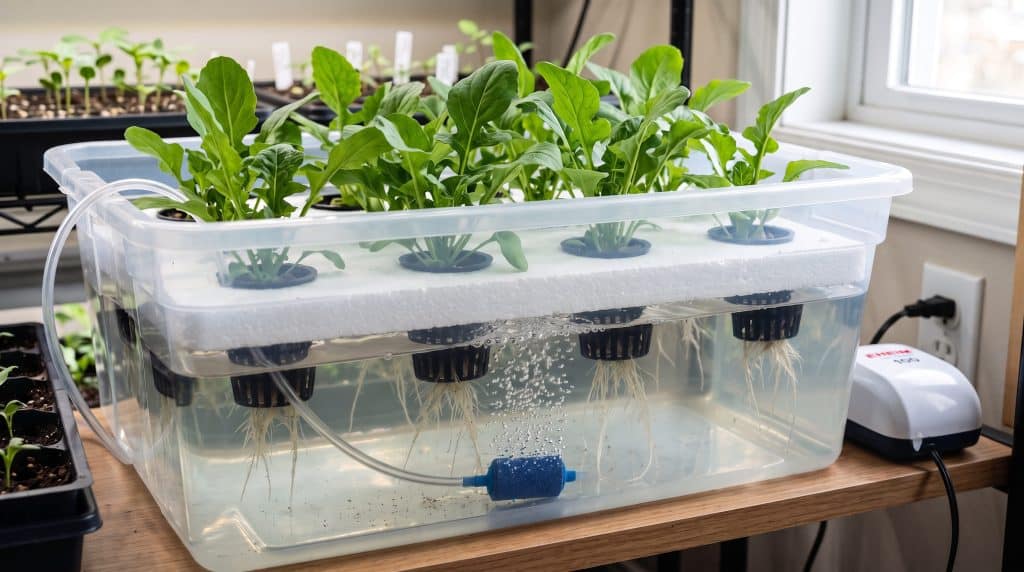
Arugula roots need oxygen while they sit in nutrient solution, so steady aeration is important in shallow water culture.
Choose an air pump that can continuously supply enough air for the reservoir volume and diffuser size. For a small 2–5 gallon tray, a compact aquarium air pump with a suitable air stone is usually enough. Keep the pump running as much as possible. Place the air stone where it can spread oxygen through the root zone, not only in one spot.
Research from Scilit shows
“Research on optimizing dissolved oxygen for arugula has found that higher levels can provide a significant boost to yield. One study demonstrated that maintaining DO enrichment above 15 mg·L⁻¹ benefited arugula biomass, improving it by 63% to 191% compared to standard aeration methods” – Scilit
Warm water holds less oxygen, so oxygen levels can become a bigger concern as the water temperature rises. A dissolved oxygen level of about 7 to 10 ppm is often linked with good hydroponic growth, while levels near 4 ppm are considered a lower limit in some growing guidance.
Check the air system often. Make sure the tubing isn’t bent and the diffuser isn’t blocked. Also look at the roots. Dark color, slime, or weak growth can point to poor oxygen levels.
A shallow tray can lose oxygen quickly if the pump stops, especially in warm conditions. So keep the aeration system reliable and check it regularly.
Why does water temperature matter so much for arugula?
Arugula is a cool-season crop, so it generally does better when the root zone stays cool and steady. Cooler water can also hold more dissolved oxygen, which helps roots growing in nutrient solution. As water gets warmer, it holds less oxygen. That can put more stress on the roots, especially in a shallow reservoir. So water temperature deserves regular attention.
Keep the reservoir away from grow lights or other heat sources. Good room airflow can help, too. Reflective insulation may also reduce heat buildup around the tray. A water temperature of about 65 to 70°F is a useful starting range, but it isn’t a strict limit. Different arugula varieties and growing setups may respond differently.
How does heat contribute to bolting and bitter flavor?
Once the plant begins to flower, the leaves may become stronger and more bitter. That can be a problem if you want mild, tender baby arugula.
Arugula gets its sharp flavor from glucosinolates, and heat or high EC can make the bite stronger. To keep baby arugula mild and tender, keep the growing area around 65°F to 68°F and avoid letting EC rise too high. Harvest around Day 24, before the center stem starts to stretch and the plant moves toward flowering.
Keep the growing area cool and avoid extra heat from grow lights. Harvest the leaves while they’re still young, before the plants become too mature.But heat isn’t the only cause of bitter leaves. High EC, low water levels, the arugula variety, and late harvesting can also affect flavor. Look at the whole growing setup first.
How should you start arugula seeds for shallow water culture?
Start arugula seeds in a clean hydroponic starter plug. Keep the plug moist while the seeds germinate, then move the seedlings once their roots are developed enough to reach the nutrient solution.
A simple process works:
- Sow the seeds in a starter plug.
- Keep the plug evenly moist.
- Thin seedlings if they grow too close.
- Give seedlings enough light.
- Move them into net cups or raft openings.
- Let the roots reach the nutrient solution.
Don’t keep the whole plug underwater. The growing medium should stay moist, while the roots get access to oxygenated nutrient solution. This helps the seedlings adjust to the water-based system without keeping the stem and crown too wet.
How should you manage light and spacing?
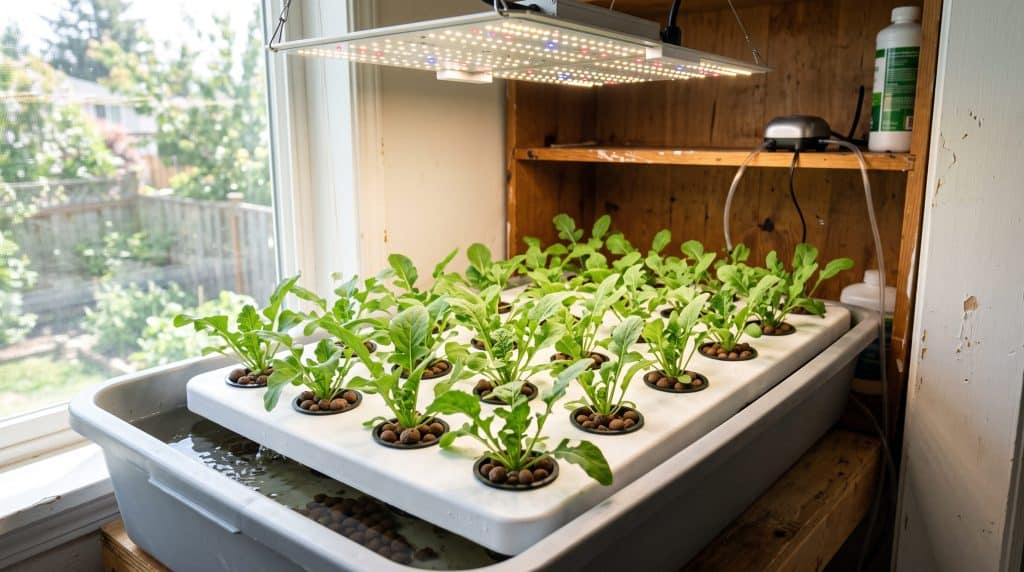
Good lighting and enough space help arugula grow strong, usable leaves instead of thin growth from crowded plants.
A grow light can run for about 12 to 14 hours each day. For arugula, aim for moderate light intensity at the canopy rather than judging light only by fixture distance. A PPFD target of about 150–250 µmol/m²/s is a useful starting range for leafy growth. Different LED lights can give off very different amounts of light, even at the same distance.
Keep the light spread across the whole plant canopy. Watch for long, weak stems, pale leaves, or heat building up around the plants. Give each plant enough room for air to move between the leaves. Crowded plants can trap moisture and make it harder to spot problems early.
How much space should each arugula plant receive?
The right spacing depends on how large you want the arugula to grow before harvest. Baby arugula can grow closer together because the leaves are harvested while they’re still small. Larger plants need more room for their leaves to spread and for air to move around them.
For baby arugula, start with about 4–6 inches between plants. For larger leaves, use about 6-8 inches to give the canopy more room and improve airflow. The arugula variety, raft size, and harvest plan all matter. Give plants enough room to grow without crowding the leaves.
When should you harvest hydroponic arugula?

Credits: Small Space Growing
Younger leaves usually have a milder flavor, while waiting too long can lead to stronger taste and tougher leaves.
Arugula can often be ready in about 3 to 4 weeks after transplanting, depending on the growing conditions. Treat that time as a guide, not a fixed harvest date. Heat, plant size, and the type of arugula can all change the timing.
For baby arugula, pick the leaves once they’re large enough to use. If you want larger leaves, let the plants grow longer, but watch for heat and signs of flowering.
For cut-and-come-again harvesting, snip the larger outer leaves with clean shears, leaving about 1 inch above the raft. Keep the center growing point untouched so the plant can send out new leaves. A healthy plant may give 2 to 3 harvests, with about 5 days between cuts, before the leaves lose quality and a new batch is needed.
Don’t let the whole crop sit too long before harvest. Picking at different times can keep the plants productive while giving you fresh leaves at the size you prefer.
Can arugula produce multiple harvests?
Yes, arugula can produce more than one harvest if you leave the main growing point intact. Pick the larger outer leaves first and give the plant time to grow new ones. How many times you can harvest depends on plant health and growing conditions.
Don’t assume every plant will give the same number of harvests. Heat, bolting, and plant stress can slow regrowth. For a steady supply, sow new batches of arugula at regular intervals. This can be more reliable than depending on every plant to regrow several times.
How can you prevent Pythium and root rot?
Good root health starts with clean equipment, cool nutrient solution, and steady oxygen. Arugula roots can suffer when they sit in warm, stagnant water with too little oxygen.
Shallow water culture doesn’t remove the risk of root rot. Its smaller water volume can change temperature and nutrient strength faster, so regular checks matter.
If the roots turn tan or become slimy, it can be a sign of early root disease, such as Pythium. When water temperatures rise above 72°F, increase aeration with two 4-inch ceramic air stones and a suitable air pump.
A product containing Bacillus amyloliquefaciens may also help support root health by competing with harmful microbes, without relying on harsh chemicals.
A broken pump, loose tube, or blocked air stone can cut oxygen to the roots quickly. Don’t wait for the roots to get worse before checking the system.
Why does hydroponic arugula become bitter or overly peppery?
Hydroponic arugula can develop a stronger, more peppery taste when plants get too hot, grow too old, or face nutrient stress.
Arugula gets its sharp flavor from natural compounds called glucosinolates. Heat and plant age can affect how strong that flavor becomes. So don’t change the fertilizer right away every time the leaves taste bitter.
Check the growing conditions first:
- Check the root-zone and air temperature.
- Check the EC against the fertilizer label.
- Look for signs of flowering.
- Check whether the plants are overmature.
- Check the water level and roots.
Harvesting younger leaves can also give you a milder flavor. For many growers, that’s a better approach than changing nutrient levels to control taste.
Is high EC always responsible for bitterness?
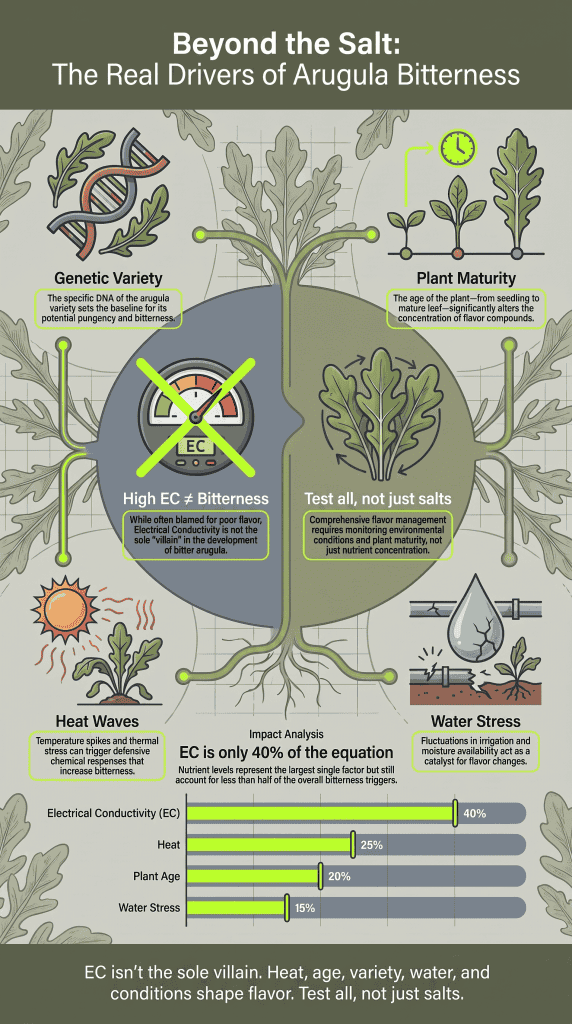
Some growers link EC levels above 1.4 mS/cm with harsher flavor, but that isn’t a rule for every system. Research has shown that nutrient strength can affect arugula quality, yet those results came from a specific NFT setup. Shallow water culture can behave differently.
Check the full growing setup before changing the nutrient strength.
How can you troubleshoot yellowing, tipburn, and slow growth?
Don’t change the fertilizer right away when arugula starts to look unhealthy. Check the root zone, EC, pH, water temperature, and lighting first. One problem can sometimes look like another.
| Symptom | First checks | What to do |
| Yellow leaves | pH, EC, roots | Check nutrient uptake and root health |
| Brown leaf edges | Oxygen, calcium, airflow | Check aeration and root function |
| Slimy or brown roots | Temperature, oxygen, sanitation | Fix root-zone conditions quickly |
| Leggy growth | Light strength and distance | Adjust the light |
| Bitter leaves | Heat, EC, plant age | Cool the system and harvest sooner |
| Early flowering | Heat and light schedule | Reduce heat and check lighting |
Brown leaf edges can have several causes. Low calcium availability, weak roots, heat, and changes in water use can all play a part. So adding more calcium may not fix the problem if the roots aren’t taking up nutrients properly.
Yellow leaves don’t always mean the plants need more fertilizer, either. If the roots are damaged, the plant may struggle to use nutrients that are already in the water.
Check the whole system before making a big change. That’s usually a better place to start.
What should you monitor every day in shallow water culture?
A quick daily check can catch problems before they affect the whole crop. Focus on the water level, aeration, temperature, roots, and plant growth. Check pH and EC on a regular schedule, too.
For many hydroponic systems, checking pH and EC two to three times a week is enough. But a small shallow water reservoir can change faster, so you may need to check them more often.
A daily check can include:
- Check the water level.
- Make sure the air pump runs.
- Check the water temperature.
- Look at the roots.
- Check leaves for damage.
- Look for crowded plants.
- Watch for early flowering.
- Check pH and EC as planned.
Keep a simple record of your readings. Over time, it can show changes that are easy to miss from one day to the next. You might spot rising EC, warmer water, or another issue before the plants show clear signs of stress.
Don’t rely on memory. A few notes each day can make troubleshooting much easier.
Is shallow water culture the right system for arugula?
Shallow water culture can be a good choice for arugula if you want a compact raft system and can keep the roots well oxygenated. You’ll also need to watch water temperature, level, and nutrient strength.
The best system depends on how much control and equipment you want to manage, along with the deep water culture benefits you may want from a larger reservoir.
| System | Best fit | Main advantage | Main concern |
| Shallow water culture | Small leafy-green setups | Simple raft design | Water conditions can change fast |
| DWC | Larger raft systems | More water provides better buffering | Uses more water and equipment |
| NFT | Continuous-flow systems | Steady nutrient flow | Pumps and channels need attention |
| Kratky | Passive setups | No running air pump | Less control over oxygen and water levels |
Arugula can grow well in water-based hydroponic systems. Shallow water culture makes sense when space is limited and you can keep the reservoir aerated.
DWC may be a better fit if you want more water volume and more stable conditions. NFT can work if you’re comfortable managing pumps and constant water flow. Kratky is another option if you want a passive setup.
The main issue with shallow water culture isn’t the arugula. It’s a small reservoir. Water can heat up, nutrient strength can shift, or aeration can stop working faster than in a larger system. So keep a close eye on the setup.
How can you build a reliable shallow water culture system?
For a small home setup, use a shallow reservoir that holds roughly 2–5 gallons of nutrient solution, depending on the number of plants and tray size, a stable raft or net-cup support, mixed nutrients, steady aeration, good lighting, and regular checks.
Build the system with mature plants in mind, not only young seedlings. Leave enough room for the roots and leaves to expand while keeping the plant crown above the nutrient solution. A similar approach applies when building deep water culture hydroponics, although DWC uses a deeper nutrient solution
A basic setup includes:
- A shallow food-safe reservoir.
- A floating raft or support board.
- Net cups and starter plugs.
- Hydroponic fertilizer for leafy greens.
- A calibrated pH meter.
- An EC meter.
- An air pump and air stone.
- Suitable grow lights.
- Good room ventilation.
Keep light out of the reservoir when possible. This helps limit algae growth. Clean the equipment between crops, and check the air pump and tubing often.
Don’t focus on one perfect number. Arugula growth depends on several conditions working together, including pH, EC, temperature, oxygen, light, root growth, and harvest timing. Keep those conditions steady, and the system will be much easier to manage.
FAQ
Can shallow water culture arugula produce good yields in a small growing space?
Yes, shallow water culture arugula can produce good yields even in limited growing spaces. Proper arugula plant spacing gives each plant enough room to develop healthy leaves without excessive competition.
Baby arugula hydroponics can provide an earlier harvest because young leaves are ready sooner. Light, temperature, nutrient management, and harvest timing also affect overall yield.
What water temperature helps prevent problems with hydroponic arugula roots?
Cool water generally supports healthier hydroponic arugula roots because cooler water can hold more dissolved oxygen. Warm water can reduce oxygen availability and increase stress on the root zone.
Monitoring arugula water temperature and dissolved oxygen can help maintain suitable conditions. Stable water temperatures are particularly important during hot weather and in enclosed growing areas.
How can growers reduce bolting in shallow water hydroponics?
Arugula bolting prevention depends mainly on controlling heat and reducing plant stress. High temperatures can cause arugula to flower earlier than desired. Consistent moisture, suitable light, adequate spacing, and balanced nutrition can help maintain vegetative growth.
Growing arugula during cooler conditions is also useful because arugula is naturally suited to cool-season production.
How does harvest timing affect peppery arugula flavor and leaf quality?
Harvest timing can significantly affect arugula leaf quality and flavor. Younger leaves usually have a milder flavor, while mature leaves often develop a stronger, more peppery arugula flavor. Harvesting at the desired leaf size helps maintain consistent quality.
Cut and come again arugula can also provide multiple harvests when plants remain healthy after each cutting.
What causes slow arugula root growth in a shallow nutrient solution?
Slow arugula root growth can result from low dissolved oxygen, unsuitable water temperature, poor water quality, or an unbalanced nutrient solution. The arugula root zone requires adequate oxygen and stable conditions for healthy development.
Nutrient problems can also limit root development and nutrient uptake. Regularly checking the roots, water conditions, and plant growth can help identify these problems early.
Final Growing Strategy for Shallow Water Culture Arugula
Growing arugula in shallow water culture is fairly simple, but the small reservoir needs regular attention. Keep the roots cool and well oxygenated, use moderate nutrients, and give plants enough light and airflow. The key is consistency.
For an easier setup, Tophydroponicgarden can be a helpful starting point for choosing suitable hydroponic equipment. Keep plant crowns above the water, adjust nutrients as plants mature, and monitor pH, EC, temperature, and water levels often. Small changes can happen quickly, so steady conditions matter most for healthy growth and timely harvests.
References
- https://scholarworks.uark.edu/hortpub/4/#main#1
- https://www.scilit.com/publications/5bd4cdc3af2a5a4615dbec34e630bdfc
Related Articles
- https://tophydroponicgarden.com/pros-and-cons-of-deep-water-culture-system/
- https://tophydroponicgarden.com/deep-water-culture-benefits/
- https://tophydroponicgarden.com/deep-water-culture-hydroponics-diy/
Was this helpful?
I’m Barrie L., a passionate hydroponic gardening enthusiast dedicated to cultivating thriving, soil-less gardens. With a focus on all things hydroponic, I share my expertise on innovative growing techniques and sustainable practices through my blog, tophydroponicgarden.com. As a seasoned hydroponics specialist, my goal is to inspire and guide fellow gardeners in harnessing the power of water-based cultivation for bountiful and eco-friendly harvests. I’m also an author of the book “Hydroponics For Absolute Beginners: Your Step By Step Guide For How To Create An Hydroponics System At Home Without Soil, For Growing Vegetable, Fruit And Herbs.” which is sold on Amazon. Join me on a journey of redefining the way we cultivate plants, one nutrient-rich solution at a time. Happy growing!