
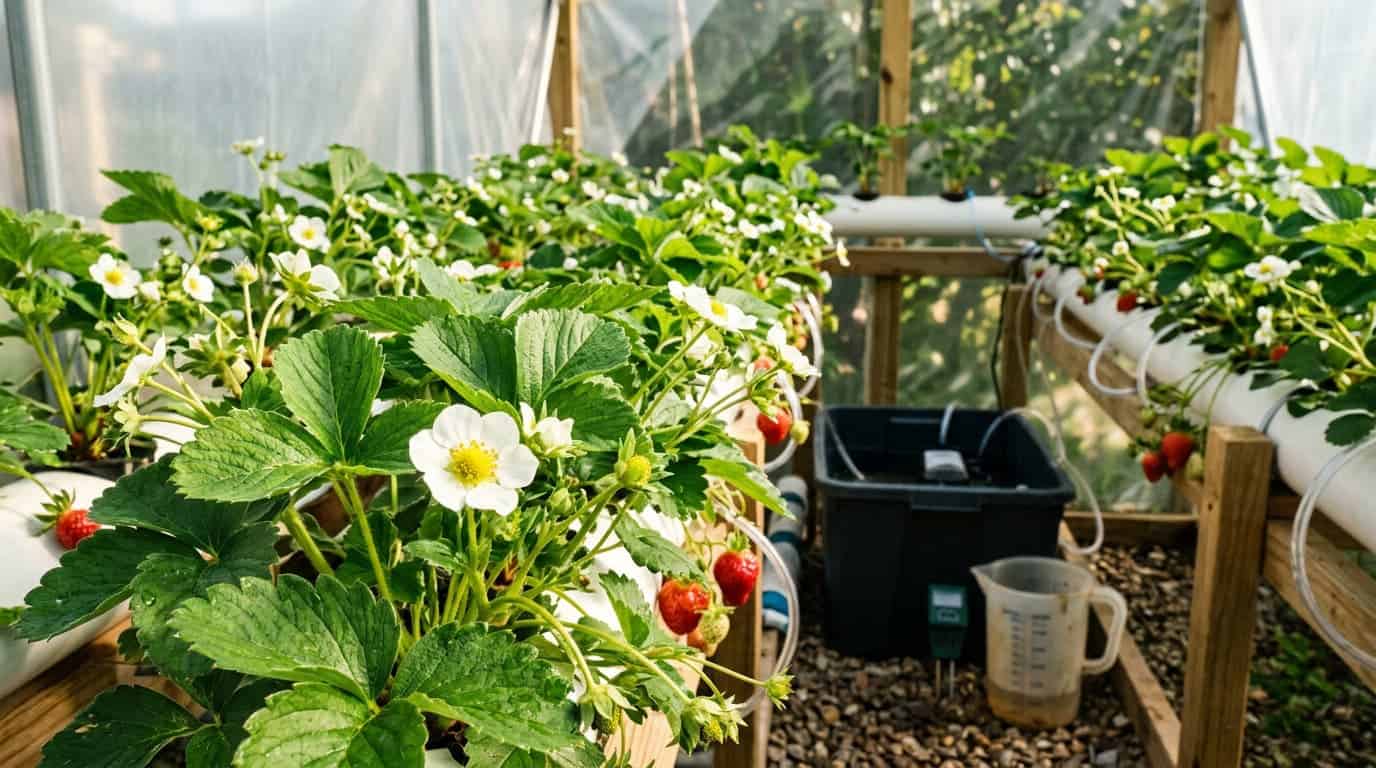
Flowering strawberries need balanced nutrition to support healthy blooms, successful pollination, and steady fruit growth. A practical nutrient schedule adjusts nitrogen, phosphorus, potassium, calcium, and magnesium as plants move from flowering to harvest.
The right feeding routine also depends on growing conditions, water quality, and the production system. This guide explains how to manage nutrients, monitor plant health, and avoid common feeding mistakes for stronger strawberry plants.
Strawberry Bloom Brief: What Really Matters
- Use a balanced nutrient formula with moderate nitrogen and adequate potassium during flowering and fruit development.
- For hydroponic strawberries, start with an EC of approximately 1.4–1.8 mS/cm and a pH of 5.8–6.2, then adjust based on plant response.
- Monitor nutrient levels, leaf growth, and fruit quality instead of following a fixed feeding schedule without checking the plants.
Why Does Strawberry Nutrition Change During Flowering?
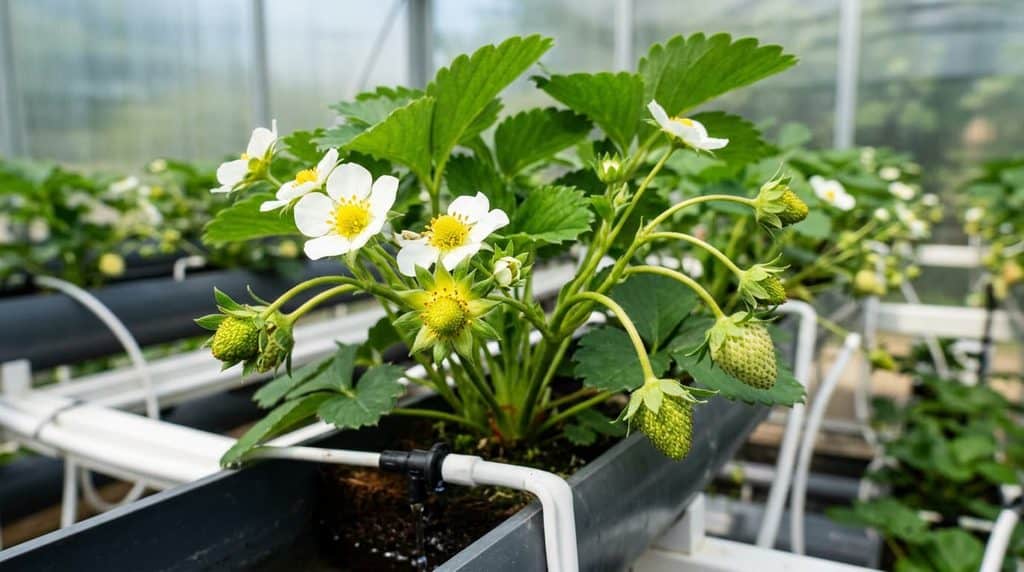
Strawberry plants need a different nutrient balance during flowering because they begin directing more energy toward flower development and fruit production. Their nutrient needs change as they move from vegetative growth to reproduction.
Before flowering, strawberries use nitrogen to develop leaves, stems, and roots. These structures help plants capture light and absorb water. However, excessive nitrogen during flowering can encourage leafy growth at the expense of flowers and fruit.
Phosphorus supports energy transfer and root activity, while potassium helps regulate water movement and supports fruit development. Calcium contributes to cell structure, and magnesium helps plants produce chlorophyll for photosynthesis.
A good flowering nutrient schedule should maintain a balance between these nutrients. It should not completely remove nitrogen or overload plants with potassium.
Watch for these changes during flowering:
- New leaves continue growing, but excessive leaf production can signal too much nitrogen.
- Flowers need steady nutrition and consistent water supply.
- Developing berries need potassium, calcium, and other nutrients.
- Healthy roots help plants absorb nutrients throughout the production cycle.
The goal is to support reproductive growth without weakening the leaves, roots, or overall plant structure.
What NPK Ratio Is Best for Flowering Strawberries?
Flowering strawberries generally benefit from a nutrient formula with moderate nitrogen and relatively higher phosphorus and potassium. The ideal ratio depends on the growing system, plant condition, and nutrient concentration.
NPK represents nitrogen, phosphorus, and potassium. Each nutrient has a different function. Nitrogen supports foliage, phosphorus supports energy transfer and root development, and potassium helps regulate water movement and fruit development.
A formula with excessive nitrogen can produce large leaves and dense foliage. This may reduce the balance between vegetative growth and fruit production. On the other hand, insufficient nitrogen can cause pale leaves and weak plant growth.
As reported by Preciado-Rangel et al. in Plants (2020);
“K and N are the nutrients with the highest influence on yield and fruit quality.” – Preciado-Rangel et al., Plants (2020)
This finding highlights why nitrogen and potassium need to remain balanced during flowering and fruit production. Increasing nitrogen alone may improve plant growth, but potassium also plays an important role in fruit quality.
The following ratios are examples of nutrient proportions that growers may consider when selecting a flowering formula.
| NPK ratio | Example formulation | Main purpose |
| 1:1.5:3 | 4-6-12 | Higher potassium support |
| 1:2:3 | 8-12-24 | Flowering and fruit development |
| 1:1:2 | 5-10-20 | Balanced fruit production |
These ratios are starting points, not universal prescriptions. Always check the full nutrient label because two products with similar NPK ratios may contain different amounts of calcium, magnesium, and micronutrients.
Nitrogen should remain available throughout flowering. The aim is to prevent excessive foliage while maintaining enough healthy leaves to support photosynthesis.
What Is the Best Nutrient Schedule for Flowering Strawberries?
A useful strawberry nutrient schedule adjusts feeding as flowers appear, berries develop, and harvesting begins.
Growers should monitor plant response before increasing nutrient strength. If you are growing strawberries hydroponically, learn how deep water culture can support strawberry growth and what to consider when managing this system.
A fixed feeding routine may not work equally well in every growing environment. Temperature, humidity, water quality, container size, and growing media all affect nutrient uptake.
The following schedule provides a practical starting point for hydroponic and container-grown strawberries.
| Growth stage | Feeding approach | Main objective |
| First visible flowers | Maintain balanced nutrients | Support flowering |
| Two weeks after flowering begins | Maintain potassium and calcium availability | Support fruit setting |
| Early fruit development | Monitor EC and maintain consistent feeding | Support berry growth |
| Continued flowering | Adjust nutrients based on plant response | Support new flowers and developing fruit |
| Harvest period | Maintain stable nutrition and water supply | Support fruit quality |
During the first visible flowers, avoid making sudden changes to the nutrient solution. Plants need consistent conditions while flowers develop.
As berries begin forming, monitor potassium and calcium availability. These nutrients support fruit development and healthy plant tissue.
During continued flowering, plants may carry flowers and developing berries at the same time. This means nutrient management should support both stages rather than focusing on flowering alone.
A slight adjustment may be necessary when plants show signs of nutrient imbalance. However, changing several nutrient levels at once makes it difficult to identify the cause of a problem.
What EC and PPM Levels Should Flowering Strawberries Have?
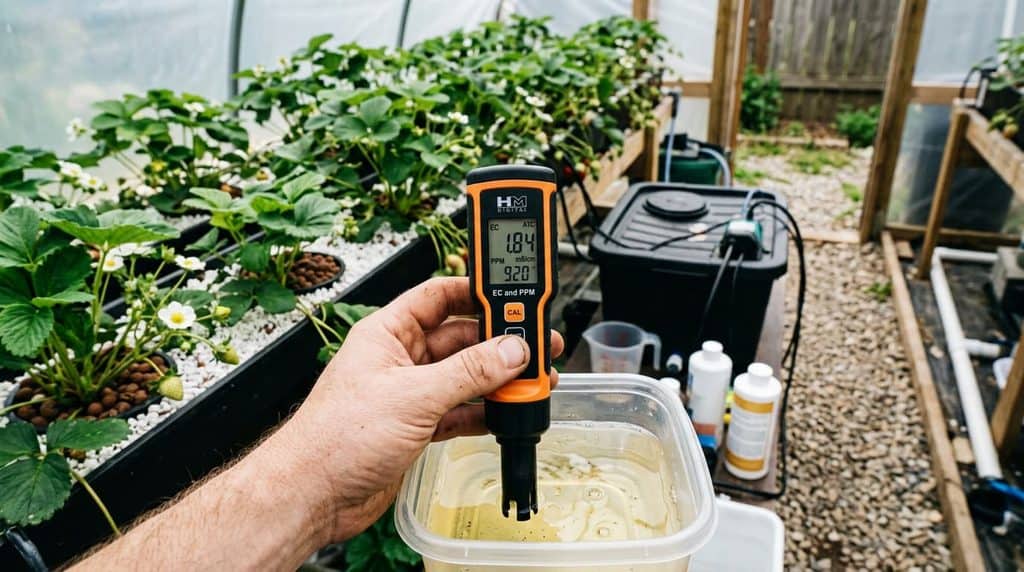
Electrical conductivity, or EC, measures the total concentration of dissolved salts in a nutrient solution. It helps growers monitor nutrient strength and avoid feeding plants with an overly concentrated mixture.
For hydroponic strawberries, an EC range of approximately 1.4–1.8 mS/cm can serve as an initial reference during flowering. Some growing conditions may require a lower or higher concentration.
PPM meters estimate dissolved solids from EC readings. Their displayed values depend on the conversion scale used by the meter. If you need help preparing the right mixture for your plants, follow this hydroponic strawberry nutrient solution recipe for a closer look at nutrient preparation.
For example, an EC reading of 1.4–1.8 mS/cm may appear as approximately 700–900 PPM on a 500 scale. A 700 scale meter will display a different number for the same solution.
Growers should use these measurements consistently:
- Check the nutrient solution before adding more fertilizer.
- Measure EC after mixing the nutrient solution.
- Monitor the drainage solution in container systems.
- Avoid sudden increases in nutrient concentration.
- Check water quality when EC rises unexpectedly.
A high EC reading can indicate excessive dissolved salts. This can make water absorption more difficult and cause leaf edge damage or poor growth.
That said, a low EC reading does not automatically mean plants need more fertilizer. Root health, pH, temperature, and irrigation frequency also affect nutrient uptake.
How Much Potassium, Calcium, and Magnesium Do Strawberries Need?

Potassium, calcium, and magnesium support different plant functions during flowering and fruit development. Their availability should remain balanced throughout the growing cycle.
Potassium helps regulate water movement and supports fruit development. A shortage may contribute to weak growth, poor fruit development, and leaf edge discoloration.
Calcium supports cell walls and growing tissues. It is especially relevant to developing leaves, roots, and fruit. However, calcium does not move easily through plants, so consistent water movement is necessary for effective delivery.
Magnesium forms part of chlorophyll, which plants use to capture light for photosynthesis. A deficiency may cause yellowing between leaf veins, particularly on older leaves.
As reported by Nazarideljou et al. in Acta Agriculturae Scandinavica, Section B: Soil & Plant Science (2019);
“We recommend growers to maintain an appropriate K⁺:Ca²⁺ ratio in the nutrient solution, as this affects growth parameters, productivity and strawberry quality.” – Nazarideljou et al., Acta Agriculturae Scandinavica (2019)
This research demonstrates that potassium and calcium should not be managed independently. Their balance can influence strawberry growth, productivity, and fruit quality.
The following ranges can serve as general reference points for nutrient solution planning:
- Potassium: approximately 200–250 ppm.
- Calcium: approximately 150–200 ppm.
- Magnesium: approximately 40–60 ppm.
These are not mandatory targets for every strawberry variety or production system. Water composition and the base fertilizer also affect the final nutrient balance.
Excessive potassium can interfere with calcium and magnesium uptake. Similarly, adding too much calcium without checking the existing nutrient solution can create an imbalance.
The best approach is to evaluate the complete nutrient formula rather than increasing one element based on a single leaf symptom.
Does Boron Help Strawberry Flowers Develop Properly?
Boron supports flower development, pollen function, and successful fertilization in strawberries. Although plants need only small amounts, both deficiency and excess can cause problems.
During flowering, healthy pollen development helps flowers produce well-shaped berries. Poor boron availability may interfere with this process and contribute to irregular fruit development.
However, deformed berries do not always indicate boron deficiency. Incomplete pollination, temperature stress, and inconsistent water supply can produce similar symptoms.
Boron has a narrow range between adequate and excessive concentrations. Adding extra boron without checking the nutrient formula can damage plants.
Growers should use a complete fertilizer that provides suitable micronutrients. Avoid adding concentrated boron products simply because flowers or berries appear unusual.
Consistent environmental conditions and healthy flowers are just as important as micronutrient availability.
How Does pH Affect Nutrient Absorption in Strawberries?
The pH of a nutrient solution affects how easily strawberry roots absorb essential minerals. A suitable pH helps keep nutrients available for healthy growth.
For hydroponic strawberries, a starting pH range of 5.8–6.2 is commonly used. Growing media and water composition can influence the ideal range.
When pH becomes too high, some micronutrients, including iron, may become less available. Plants can then show yellowing between the veins of young leaves.
When pH becomes too low, other nutrients may become excessively available or cause root stress.
A practical pH management routine includes:
- Measure pH after preparing the nutrient solution.
- Check pH regularly during active flowering.
- Adjust gradually rather than making sudden corrections.
- Recheck the solution after adding pH adjustment products.
- Monitor plant symptoms alongside meter readings.
Stable pH management helps prevent nutrient lockout. However, growers should also check root condition and water quality before assuming that every growth problem comes from pH.
How Can You Prevent Salt Buildup in Strawberry Growing Media?
Salt buildup occurs when dissolved fertilizer minerals accumulate faster than water can remove them. This problem can reduce root function and make nutrient absorption more difficult.
Container-grown strawberries can be especially sensitive when irrigation does not produce enough drainage. Nutrient salts may remain around the roots and gradually increase the concentration in the growing media.
Signs of possible salt buildup include:
- Brown or dry leaf edges.
- Slower leaf development.
- Poor flowering performance.
- Weak root growth.
- High EC readings in drainage water.
Prevention starts with consistent irrigation and regular EC monitoring. Growers should also check whether containers drain freely and whether the growing media remains suitable for root development.
If EC becomes excessively high, a controlled flush with suitable water may help remove accumulated salts. The amount of water needed depends on the growing media, container size, and drainage conditions.
Avoid flushing plants automatically. Excessive flushing can remove nutrients and create waterlogging if drainage is poor.
Do Flowering Strawberries Need Cal-Mag Supplements?

Credits: ZipGrow
Cal-Mag supplements can help when strawberries receive insufficient calcium or magnesium, but they are not necessary in every growing system.
Many complete nutrient formulas already contain both minerals. Adding another supplement without checking the existing solution can create an imbalance.
Calcium deficiency may appear as damaged young leaves or poor development in growing tissues. Magnesium deficiency often appears as yellowing between the veins of older leaves.
However, similar symptoms can result from root damage, unsuitable pH, excessive EC, or irregular irrigation.
Before adding Cal-Mag, check:
- The calcium and magnesium content of the base fertilizer.
- The mineral content of the source water.
- The current nutrient solution EC.
- The pH of the root zone.
- The condition of the roots and growing media.
If a deficiency is confirmed, make a measured adjustment. Adding more fertilizer than necessary can increase salt concentration and make nutrient uptake less reliable.
Does the Nutrient Schedule Differ for June-Bearing and Everbearing Strawberries?
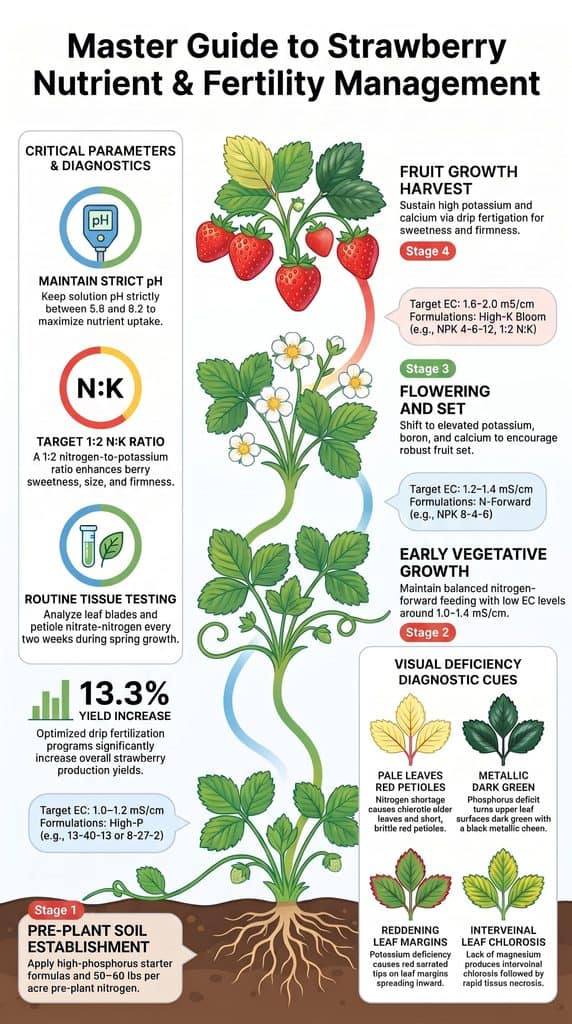
June-bearing and everbearing strawberries may need different feeding approaches because they produce fruit on different schedules.
June-bearing varieties generally produce one main crop during a concentrated harvest period. Their feeding routine should support plant establishment, flowering, and the main fruiting cycle.
Everbearing and day-neutral varieties can produce flowers and fruit over a longer period. Their nutrient supply must support repeated flowering and ongoing berry development.
The difference affects how growers monitor plants:
June-bearing strawberries
- Support healthy vegetative growth before flowering.
- Maintain balanced nutrition during the main flowering period.
- Avoid excessive nitrogen during fruit development.
- Maintain plant health after harvest.
Everbearing and day-neutral strawberries
- Maintain consistent nutrition during repeated flowering cycles.
- Monitor EC more frequently when plants carry flowers and fruit together.
- Adjust feeding based on leaf growth and berry development.
- Avoid sudden nutrient changes between harvests.
Neither type should receive excessive fertilizer simply because it produces more flowers. Plant condition and growing conditions should guide nutrient adjustments.
Should You Use Leaf Testing to Adjust Strawberry Nutrients?
Leaf testing can help growers identify nutrient imbalances before they cause more visible problems. It provides information about the minerals absorbed by the plant.
Leaf color alone cannot confirm every deficiency. Several nutrient problems produce similar symptoms, while environmental stress can also affect leaf appearance.
For more reliable monitoring, growers can compare leaf condition with nutrient solution measurements and plant growth.
Useful observations include:
- Leaf color and size.
- New leaf development.
- Flower production.
- Fruit size and shape.
- Root condition.
- EC and pH readings.
Take leaf samples consistently from similar parts of the plants. Mixing young, old, damaged, and healthy leaves can make comparisons less useful.
Testing becomes more helpful when growers repeat it at consistent intervals. A single result provides a snapshot, while repeated measurements show whether nutrient management is improving.
Can Foliar Fertilizer Improve Strawberry Flowering?
Foliar fertilizer supplies nutrients through the leaves rather than through the roots. It may help address certain nutrient problems, but it should not replace a balanced root-zone feeding program.
Foliar applications can be useful when a suitable nutrient is needed quickly or when root absorption is temporarily limited. However, their effectiveness depends on the nutrient, product formulation, application rate, and environmental conditions.
Overapplication can damage leaves and flowers. Spraying during strong sunlight or high temperatures can also increase the chance of leaf injury.
Growers considering foliar fertilizer should follow these precautions:
- Use products designed for foliar application.
- Follow the recommended dilution rate.
- Avoid spraying open flowers unnecessarily.
- Apply during cooler parts of the day.
- Test the product on a small number of plants first.
Foliar feeding should address a specific need. It should not become a routine substitute for checking the nutrient solution, pH, and root health.
How Can You Prevent Flower and Fruit Problems During Feeding?
Healthy strawberry flowers and berries depend on balanced nutrition, consistent watering, and suitable growing conditions. Nutrient problems are only one possible cause of poor fruit development. If your plants produce undersized berries, explore why hydroponic strawberries grow small to understand the other factors that may affect fruit size.
A plant may receive adequate fertilizer but still produce deformed berries because pollination is incomplete. Similarly, leaf damage may result from excessive salts rather than a shortage of a particular nutrient.
Use visible symptoms as a reason to investigate, not as automatic proof of a deficiency.
| Plant symptom | Possible cause | What to check |
| Excessive leaf growth | Too much nitrogen | Fertilizer balance |
| Small berries | Poor pollination or nutrient imbalance | Flower condition and feeding |
| Deformed berries | Incomplete pollination or possible boron deficiency | Pollination and nutrient levels |
| Leaf tipburn | Calcium delivery problems or root stress | Irrigation and root health |
| Gray mold | High humidity and poor airflow | Plant spacing and ventilation |
Environmental management matters during flowering. Excess humidity and poor airflow can encourage fungal problems, while irregular watering can stress roots and developing fruit.
A consistent routine makes it easier to identify the real cause of a problem. Change one factor at a time whenever possible, then observe how the plants respond.
FAQ
What nutrients do strawberries need during flowering?
Flowering strawberries need balanced nitrogen, phosphorus, and potassium, along with calcium, magnesium, and essential micronutrients. Nitrogen supports healthy leaves, phosphorus helps with energy transfer, and potassium supports water regulation and fruit development. Calcium and magnesium also contribute to healthy plant tissues and photosynthesis.
What is the ideal EC for flowering strawberries?
For hydroponic strawberries, an EC of approximately 1.4–1.8 mS/cm can serve as a starting point during flowering. However, the ideal concentration depends on water quality, growing conditions, and plant response. Monitor EC regularly to avoid excessive salt concentration or insufficient nutrient availability.
How often should you feed flowering strawberries?
Flowering strawberries need consistent nutrient availability throughout flowering and fruit development. Rather than following a rigid feeding frequency, monitor the nutrient solution, EC, pH, and plant condition. Adjust the feeding routine gradually as flowers appear, berries develop, and harvesting begins.
Can too much nitrogen affect strawberry fruit production?
Yes. Excessive nitrogen can encourage leafy growth at the expense of balanced flower and fruit development. However, strawberries still need nitrogen to maintain healthy leaves for photosynthesis. The goal is to provide enough nitrogen without promoting excessive foliage during flowering.
Why do strawberry flowers produce small or deformed berries?
Small or deformed strawberries can result from incomplete pollination, nutrient imbalances, temperature stress, or inconsistent watering. Boron deficiency may also interfere with pollen function and fertilization. Check flower condition, nutrient availability, and growing conditions before assuming that a single nutrient deficiency is responsible.
From Strawberry Blossoms to a Better Harvest
Great strawberries start with more than just watering and waiting. The right nutrient balance, consistent monitoring, and timely adjustments help flowers develop into healthy, flavorful fruit. Keep an eye on your plants, respond to their changing needs, and let their growth guide your feeding routine.
Ready to grow better strawberries? Visit TopHydroponicGarden for more practical hydroponic gardening tips and growing inspiration!
References
- https://doi.org/10.3390/plants9040441
- https://doi.org/10.1080/09064710.2018.1506500
Related Articles
https://tophydroponicgarden.com/what-are-the-benefits-of-hydroponic-strawberries/
https://tophydroponicgarden.com/how-to-grow-hydroponic-strawberries-at-home/
https://tophydroponicgarden.com/what-plants-are-not-suitable-for-dwc-growing/
Was this helpful?

I’m Barrie L., a passionate hydroponic gardening enthusiast dedicated to cultivating thriving, soil-less gardens. With a focus on all things hydroponic, I share my expertise on innovative growing techniques and sustainable practices through my blog, tophydroponicgarden.com. As a seasoned hydroponics specialist, my goal is to inspire and guide fellow gardeners in harnessing the power of water-based cultivation for bountiful and eco-friendly harvests. I’m also an author of the book “Hydroponics For Absolute Beginners: Your Step By Step Guide For How To Create An Hydroponics System At Home Without Soil, For Growing Vegetable, Fruit And Herbs.” which is sold on Amazon. Join me on a journey of redefining the way we cultivate plants, one nutrient-rich solution at a time. Happy growing!