

Forget shopping for the perfect kit. Your real starting points are the space you have, the money you can spend, and the time you’re willing to give. A small herb garden for your kitchen needs a totally different setup than a serious effort to grow vegetables.
Hydroponics is efficient, it can use 90% less water than soil, which is why NASA studies it. But that efficiency depends on a fragile balance. Every piece, from the lights to the water pump to the nutrient mix, has to work. If one fails, the system fails.
This guide cuts through the hype. We’ll cover the practical choices that lead to a stable, productive garden. Keep reading to build a system that fits your actual life.
Hydroponic Setup Essentials at a Glance
- Space, crop type, and budget define the most suitable hydroponic system
- Water quality, pH level management, and oxygenation directly affect plant survival
- Simpler systems reduce failure risk and improve long-term consistency
Space Availability and Location Impact on Hydroponic Setup
Space and environment decide if you go for compact indoor setups or larger outdoor hydroponics bathed in natural sunlight.
Indoor farms let you control temperature, humidity, and light perfectly, but that comes at the cost of higher energy bills. Smaller systems like nutrient film technique or deep water culture work well in apartments or cramped spaces, especially for growers setting up their first hydroponic system in limited indoor areas.
Outdoor hydroponics saves on electricity thanks to sunlight but opens the door to pests, unpredictable weather, and unstable water temps. Urban farming has seen significant growth in recent years, driven largely by the need to maximize limited space through methods like hydroponics.
How much space you have also shapes your system’s design. Vertical farming, stacking plants up instead of spreading out, boosts yields per square meter in places where every inch counts.
Key layout considerations include:
- Build compact bucket systems if you are growing in a closet or grow tent.
- Stack vertical PVC towers to maximize your yield in narrow spaces.
- Install wide ebb-and-flow trays if you have an open garage or greenhouse.
- Space your plants out evenly to maintain airflow and prevent powdery mildew.
Space decisions affect everything from system scalability to water circulation efficiency. A mismatch between space and system design often leads to overcrowding or wasted resources.
Deciding between indoors and outdoors
Your location sets the rules. Indoors, you control everything: light, temperature, and climate. It’s perfect for year-round herbs, but you pay for it with your electricity bill to power the lamps and fans.
Outside, you get free sun and natural airflow, which is great for tomatoes or peppers. But you’re vulnerable to weather, pests, and temperature swings.
Your available space dictates the design. Small areas need vertical or wall-mounted systems to save floor space. If you have a garage or yard, you can use wider trays and a larger water tank for less frequent maintenance. Choose the environment you can actually manage.
Budget Considerations and Running Costs

Hydroponic systems come in all shapes and prices, from simple, low-cost designs to high-tech setups that need ongoing spending.
Expect to spend between $30 and $50 for a DIY Deep Water Culture bucket, which covers the air pump, net pots, and starter nutrients, making it a practical option for growers trying to start hydroponics on a budget without investing in complex equipment.
If you want a 4-tube PVC system with entry-level LED grow lights, budget around $250 to $400. High-end automated systems easily break the $1,000 mark, and you’ll need to factor in about $50 to $100 annually just for replacement sensors.
Electricity is a big part of the bills. Energy costs, particularly from grow lights and climate control equipment, account for a substantial portion of indoor farming expenses. LED grow lights help cut down on power, but they still run constantly.
Other upfront costs include pumps for water and air, plus filtration gear. Better tubing and connectors prevent leaks but also push the price up.
Core cost components include:
- Equipment: pumps, reservoirs, grow trays
- Monitoring tools: pH meters, EC sensors
- Recurring nutrients and water supply
- Energy usage from lighting and automation
Budget planning also affects system durability and material quality. Cheap plastic may not meet plastic food safety standards, impacting long-term use.
The cost of starting up and keeping it running
Your initial spend depends on complexity. A simple wick system costs little, just a bucket and some nutrients. An active system with pumps and timers costs more upfront.
Then come the regular bills. Electricity for lights and pumps is the main one. You’ll constantly buy nutrients and pH adjusters. Systems that move water all the time, like NFT or aeroponics, wear out parts faster. Pumps fail, tubes clog, sprayers get blocked. The cheaper your initial gear, the more often you’ll be replacing it. Factor in these recurring costs from the start.
Plant Type Compatibility with Hydroponic Systems
Different crops need different hydroponic systems depending on their roots, how fast they grow, and what nutrients they need.
Leafy greens are among the most commonly grown hydroponic crops worldwide due to their shallow roots and rapid growth cycles. These plants have shallow roots and do well in deep water culture or nutrient film technique systems.
Crops that bear fruit, like tomatoes, need more support, bigger water reservoirs, and careful nutrient control. Drip irrigation or ebb and flow systems are better suited to handle those needs.
| Crop Type | Recommended System | Reason |
| Leafy greens | Nutrient film technique, DWC | Small roots, fast growth |
| Fruiting plants | Drip irrigation, ebb and flow | High nutrient demand |
| Root crops | Aggregate-based systems | Structural support needed |
Plant type also affects oxygenation of roots and water usage efficiency. Larger plants consume more oxygen and nutrients, increasing system complexity.
Matching your system to your crop
What you plan to grow dictates the kind of hardware you’ll need. Leafy greens and herbs, think lettuce, spinach, or basil, are the most forgiving. They have shallow roots, grow fast, and do well in simple setups like a deep water culture bucket or a basic nutrient film channel. The key for these plants is keeping water quality steady.
Fruiting and vining plants are another story. Tomatoes, cucumbers, and peppers get bigger, need solid support like trellises, and demand more care. Their roots spread out deeper, so they need larger trays and a carefully balanced nutrient mix for both growing leaves and making fruit. Picking these crops means you’re signing up for a tougher, more hands-on system.
What You’ll Need to Keep It Running

Source: Hoocho
The upkeep varies a lot. Passive systems are pretty hands-off. But if you’re running an active system, you’ll be checking things constantly to stop it from breaking down.
Something simple, like a wick system or a basic DWC tub, just needs you to top up the water and check the pH sometimes. They don’t mind if things aren’t perfect.
Aeroponics requires misting roots at exact intervals, and I learned this the hard way. Last summer, a cheap timer switch failed on my aeroponic tower while I was at work. Within four hours, my entire basil crop had completely dried out and died. If you run aeroponics, you absolutely need a reliable pump and a backup power plan.
Your Maintenance Checklist
Your time will be spent on a few core tasks: checking the water’s nutrient strength (EC) and pH, keeping the temperature stable, and ensuring the nutrient mix is correct.
A regular routine includes testing pH and EC, cleaning reservoirs to prevent algae, verifying water is circulating well, and inspecting all pumps and tubing.
You can automate monitoring with smart IoT systems, but this introduces new risks. A single sensor failure or power outage can disrupt the entire operation.
Matching Your Time to the System
Choose a system based on your available time. Simple setups like deep water culture or wick systems have few parts and need only occasional water top-ups, ideal for limited schedules.
Complex systems, such as aeroponics, are packed with pumps and sensors requiring daily monitoring, calibration, and troubleshooting. They offer faster growth and higher yields, but only if you commit to the rigorous, technical maintenance they demand. Your daily schedule is the deciding factor.
Experience Level and Learning Curve
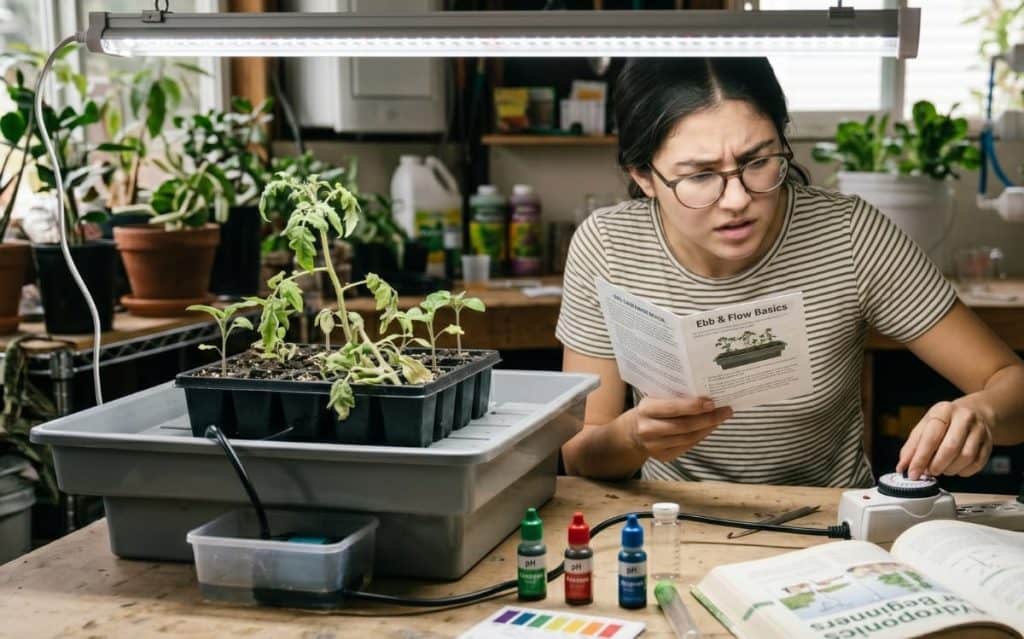
What you know determines what you can grow. Beginners should stick with simple systems. They’re designed to be forgiving.
Deep water culture is the classic starting point. The big tub of water acts like a safety net, if you add a little too much nutrient, it doesn’t immediately shock the plants. Starting with straightforward methods like deep water culture provides a safety net that significantly reduces the likelihood of early failure for beginners.
Once you’ve got the basics down, an ebb and flow system is a logical step up. You’re adding pumps and timers to the mix, which means more control but also more things that can go wrong.
True expert setups, like aeroponics or automated drip lines, are a different game. They run on data from sensors and monitors. Keeping everything working isn’t just about gardening; it’s about understanding the machinery and the science behind it.
Skill progression typically includes:
- Learning nutrient solution balance
- Understanding root health management
- Managing environmental variables
- Integrating automation and sensors
Experience also impacts decision-making in system scalability and crop rotation planning. More advanced users optimize harvest cycle management for continuous production.
Starting simple or going advanced
Where you begin should match your confidence and goals. Beginner-friendly systems are about getting your hands wet without drowning. A simple deep water culture bucket or a lettuce raft kit has few parts to assemble. The focus is on learning the fundamentals: mixing nutrients, watching roots, and keeping plants alive. Mistakes are easier to spot and fix.
Advanced systems are for when you’ve mastered the basics and want to push for maximum efficiency or yield. Think multi-zone setups with automated dosing, environmental controllers, or high-pressure aeroponics.
They demand you understand the science behind the growth, managing precise electrical conductivity, pH, and oxygen levels at the root zone. It’s a commitment to constant data and fine-tuning.
Water Quality Control and Temperature Stability
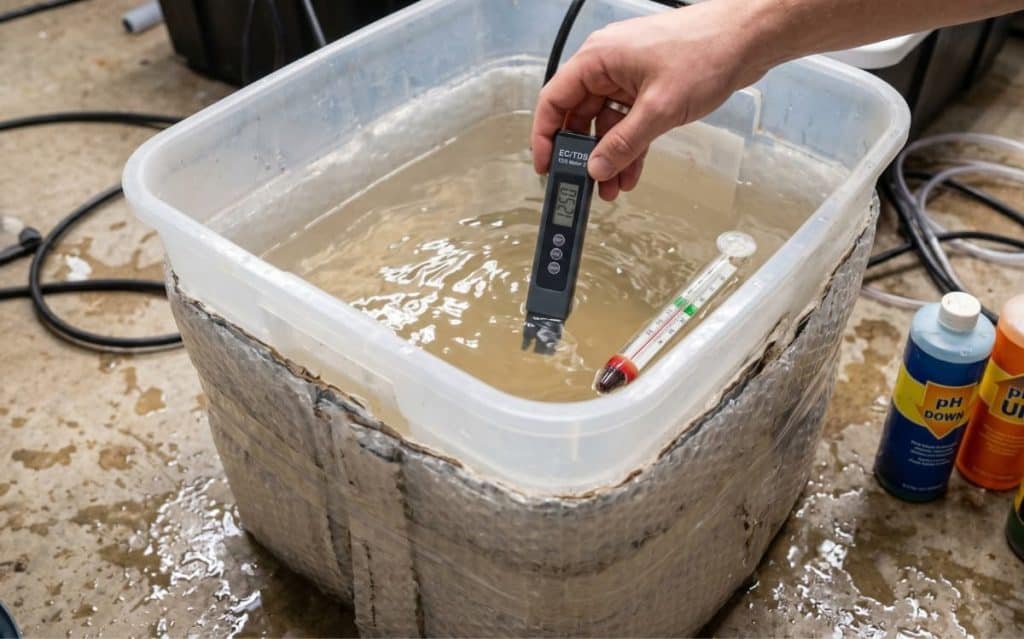
Your plants’ roots rely entirely on your water quality. If you manage your pH and keep the water cool, your plants will absorb nutrients easily and grow a healthy root system .
Hydroponic systems require a pH range of 5.5 to 6.5 for optimal nutrient absorption. Plant science indicates that an imbalanced pH can block nutrient uptake (a condition known as nutrient lockout), even when sufficient nutrients are present in the water.
Data from the Journal of Elementology (Poland) demonstrates
“The higher the pH of the solution, the lower the P uptake (42% lower at pH 7.5 and 50% at pH 8.5 compared to the control pH 5.5).”
Water temperature also affects oxygenation of roots. Research shows water above 20°C (68°F) reduces dissolved oxygen levels, increasing the risk of root rot in deep water culture systems, which is why many growers prefer setups considered the most water efficient system for maintaining stable circulation and oxygen levels.
Key water management elements include:
- Electrical conductivity monitoring for nutrient concentration
- Filtration systems for removing contaminants
- Stable reservoir size to prevent fluctuations
- Backup power options to maintain circulation
Maintaining water quality improves disease resistance and supports faster growth rate factors across all hydroponic system types.
The chemistry you can’t ignore
Two invisible factors make or break a hydroponic garden: what’s in the water, and how much air is in it.
The pH level of your nutrient solution is a strict gatekeeper. If it’s too high or too low, your plants literally can’t eat. They’ll show signs of starvation, yellow leaves, stunted growth, even with food right in front of them. You need a reliable meter and you must check it often, adjusting with acids or bases to keep it in the ideal range, usually between 5.5 and 6.5 for most crops.
Then there’s water temperature. Warm water holds less dissolved oxygen, and oxygen-starved roots are weak roots. They become susceptible to rot and disease. Cooler water, ideally between 65-70°F (18-21°C), keeps oxygen levels high.
As highlighted by PlantTalk Colorado
“Low oxygen levels in the nutrient solution favor disease… Maintain a proper root zone temperature (68-72°F is optimum).”
This promotes vigorous root growth, which is the foundation for everything else. In many systems, this means using a water chiller or placing reservoirs in a cool, shaded spot.
Common Mistakes in Choosing a Hydroponic Setup
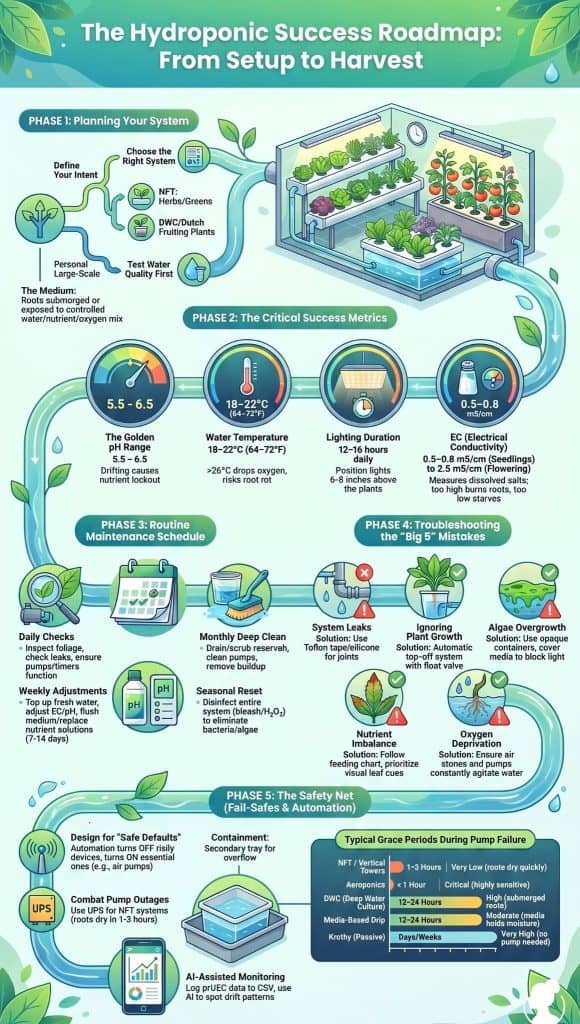
Avoiding poor equipment choices and unrealistic expectations prevents early system failure and crop loss.
Many beginners invest in low-cost monitoring tools that provide inaccurate readings. Inconsistent pH measurement leads to nutrient imbalance and poor plant growth.
Improper planning also causes issues. Overestimating space or ignoring drainage system design can lead to leaks and water damage.
Common pitfalls include:
- Using low-quality sensors and pumps
- Ignoring maintenance requirements
- Choosing overly complex systems too early
- Poor algae prevention strategies
Many beginners encounter early failures, often due to preventable setup mistakes like poor planning or buying unreliable equipment.
Common mistakes with gear and planning
Skipping on quality for critical tools often backfires. A cheap pH meter that drifts out of calibration will give you false readings, leading to nutrient lockout. A flimsy water pump might work for a week, then burn out and flood your roots. Reliable equipment isn’t a luxury; it’s what keeps your plants alive and your system from failing at 2 a.m.
Rushing the setup is another major pitfall. Not measuring your space leads to a cramped, unworkable jungle of tubes. Forgetting to plan for reservoir access makes nutrient changes a messy chore. Overlooking a slight slope in your grow tray can leave one end dry.
These small design errors create constant leaks, clogs, and headaches, turning maintenance from a quick check into a daily repair job.
Build a Hydroponic Setup You Can Actually Manage
Picking the wrong hydroponic system usually shows up fast, uneven growth, wasted nutrients, and constant fixes that eat up your time. A setup that looks advanced on paper can become frustrating when it doesn’t match your space or the crops you want to grow. Consistency matters more.
A simpler system that stays stable will usually give you better results over time. If you’re ready to build a setup that fits your goals without making maintenance harder, start with options that are easy to scale and adjust as you learn more. That approach helps you grow with confidence instead of dealing with avoidable setbacks.
FAQs
How does water quality control affect hydroponic system performance?
Water quality control directly affects nutrient uptake efficiency, root health management, and overall plant growth. Poor water conditions can create algae prevention problems, unstable pH level management, and nutrient deficiencies that slow plant development. Many growers use filtration systems and digital sensors to monitor water conditions consistently. Regular checks on water temperature stability also help prevent root stress and improve performance across different hydroponic system types.
Which hydroponic setup works best for limited indoor space?
Small indoor farming setup areas usually benefit from compact and efficient hydroponic system types. Nutrient film technique, wick system hydroponics, and drip irrigation hydroponics work well because they require less space and support vertical farming potential. Growers should also consider space availability, lighting requirements, and LED grow lights before choosing a system. Portable designs with low noise level of equipment are often more comfortable for apartments and smaller indoor environments.
Why is oxygenation important in deep water culture systems?
Deep water culture systems require strong oxygenation of roots because plant roots remain submerged in water throughout the growing cycle. Poor air pump selection or weak water circulation efficiency can reduce nutrient uptake efficiency and increase the risk of root disease. Growers often improve system performance by maintaining proper reservoir size, stable temperature control, and accurate electrical conductivity monitoring. Consistent oxygen levels support faster growth and healthier plant development over time.
What should beginners know before choosing outdoor hydroponics?
Outdoor hydroponics systems depend heavily on climate suitability, seasonal adjustments, and environmental conditions. Natural sunlight exposure can reduce energy consumption, but changing weather may affect nutrient solution balance and humidity regulation. Beginners should also plan for leak prevention, drainage system design, and pest control methods before installation. Durable materials, high-quality tubing and fittings quality, and manageable maintenance requirements help outdoor systems operate more efficiently throughout different growing seasons.
How can automation improve hydroponic crop management?
Automation options can improve crop yield optimization by reducing manual work and maintaining stable growing conditions. Smart hydroponics systems often combine timer systems, monitoring tools, IoT integration, and data tracking to manage water pump capacity and nutrient solution balance automatically. Automated systems also help growers handle system scalability, crop rotation planning, and harvest cycle management more efficiently. These features make large hydroponic system types easier to monitor and maintain consistently.
Related articles:
- https://tophydroponicgarden.com/first-hydroponic-system/
- https://tophydroponicgarden.com/how-to-start-hydroponics-on-a-budget/
- https://tophydroponicgarden.com/what-is-the-most-water-efficient-system/
Reference
- https://jsite.uwm.edu.pl/en/article/view/3372/#content
- https://planttalk.colostate.edu/topics/houseplants/1735-hydroponics-root-zone/
Was this helpful?
