
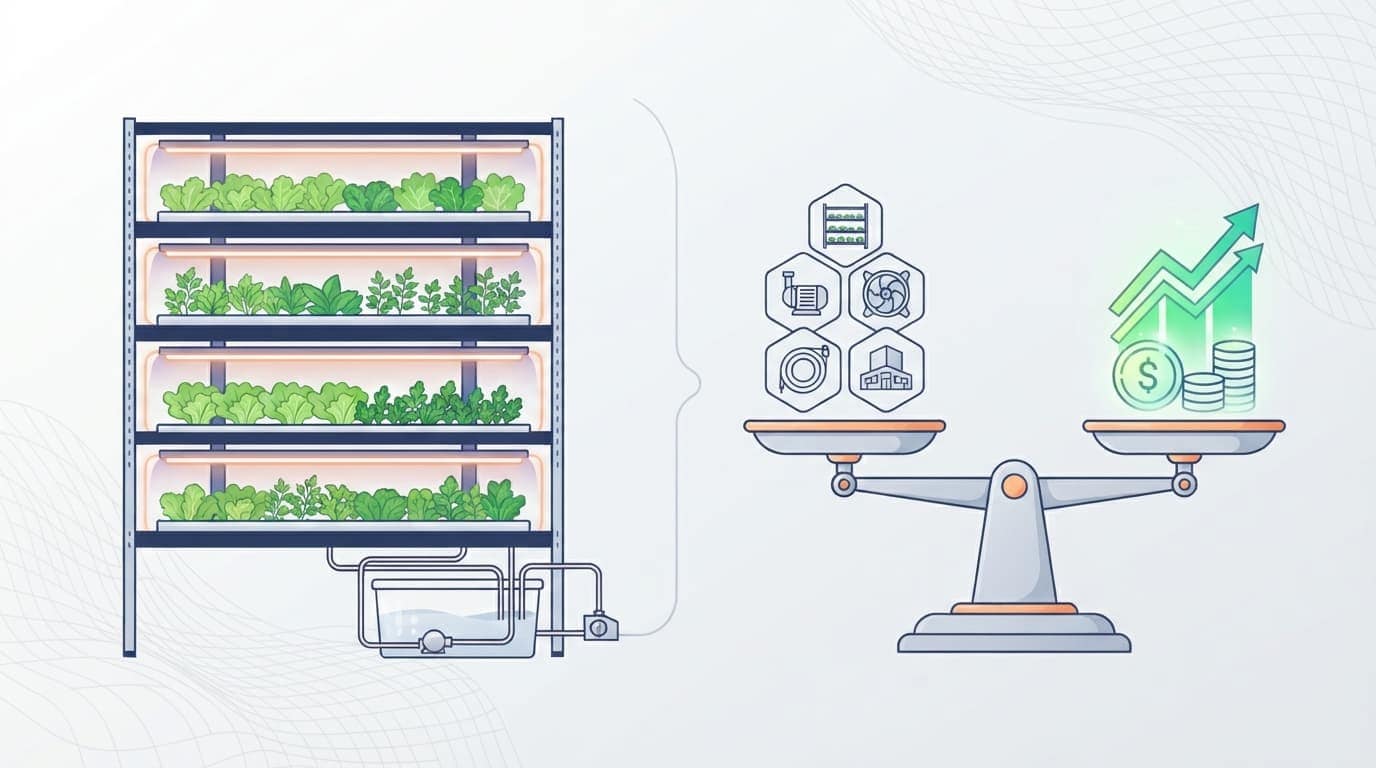
The cheapest hydroponic setup upfront may not stay the cheapest over time. Electricity, maintenance, labor, replacement parts, and crop prices can all affect what you really spend and earn. So look beyond the first price tag because it is critical for long-term survival.
A setup’s long-term cost depends on its size, design, crops, and daily upkeep. That’s worth checking before you commit. Keep reading to see how Tophydroponicgarden breaks down the real cost of running a hydroponic system.
Hydroponic Cost Quick Wins
- Calculate total ownership cost: Include startup equipment, electricity, nutrients, water, labor, maintenance, and replacement costs.
- Track real operating efficiency: Compare cost per kilogram, energy use per kilogram, and recurring costs across crop cycles.
- Automate only when it pays: Choose automation when its labor, energy, or crop-loss savings can outweigh its equipment and maintenance costs.
What Should You Include in a Long-Term Hydroponic Cost Analysis?
To really understand what a hydroponic system costs, look at capital costs, operating costs, replacement costs, and revenue together over the same timeframe. Your first equipment is CapEx: reservoirs, pumps, lights and infrastructure. OpEx is what keeps things running – electricity, water, nutrients, labor.
Maintenance and replacement costs are important, too, because pumps, tubing and lighting do wear out and need attention. For accounting analysis, also track depreciation separately from cash expenses. For investment decisions, track replacement timing and residual equipment value as well.
Ongoing costs can make up a large part of expenses, so a cheaper setup might end up being more expensive to maintain in the long run.
| Cost category | What to measure |
| CapEx | Reservoirs, pumps, lights, infrastructure |
| OpEx | Electricity, nutrients, water, labor |
| Maintenance | Pumps, tubing, meters, lighting |
| Replacement | Failed or degraded components |
| Revenue | Yield, crop cycles, selling price |
How Does Initial Cost Differ Between Hydroponic Systems?
Adding infrastructure, automation, lighting or climate control generally increases initial capital costs, although the amount varies by system design and scale. A basic passive system requires very few parts, while automated DWC, NFT and drip systems add pumps, sensors, timers and more plumbing.
Turn it into a commercial production line, and costs balloon further for building, electrical work, backup equipment, and labor. That’s why comparing a DIY setup to a commercial operation isn’t fair without adjusting for size and output. A home grower’s LED fixture and reservoir look nothing like a full-scale operation’s expenses.
| System factor | Lower initial cost | Higher initial cost |
| Growing method | Basic passive systems | Recirculating systems |
| Lighting | Natural light | Controlled LED lighting |
| Monitoring | Manual checks | Automated monitoring |
| Climate control | Minimal | Integrated control |
| Infrastructure | Small-scale | Commercial-scale |
Which Hydroponic Costs Continue After Installation?
Electricity, nutrients, water, labor, maintenance and replacement parts are recurring cost categories documented in hydroponic economic studies. Grow lights, pumps, and climate control equipment can add up fast, so it’s worth tracking energy use separately instead of lumping it into one utility bill.
Nutrients need regular monitoring and adjustment, and water costs depend on local prices plus how much gets lost to evaporation or flushing. A system can look cheap month to month but produce weak yields, while another costs more yet delivers far more in saleable crops.
A practical monthly tracking sheet can include:
- Electricity costs
- Nutrient costs
- Water costs
- Replacement parts
- Maintenance expenses
- Labor or maintenance time
- Cleaning and calibration
Why Can Electricity Change the Long-Term Cost Equation?
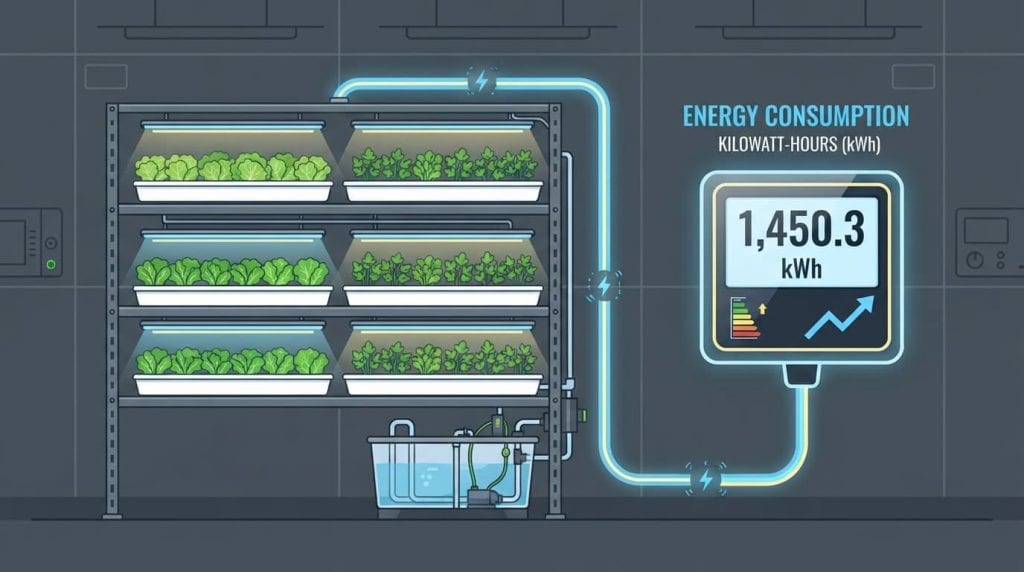
Lighting and environmental equipment run continuously throughout the growing cycle, and the electricity bill is often one of the largest long-term costs in indoor hydroponics. Grow lights can be one of the largest energy expenses in indoor hydroponics, while ventilation, heating and cooling can also contribute substantially.
The numbers can change depending on room size, fixture efficiency, crop type, and local electricity rates, so it’s a smart idea to track energy costs separately instead of rolling them into one bill. An efficient LED setup may cost more upfront but can reduce electricity costs over its operating life, depending on electricity rates, operating hours and equipment cost.
So don’t judge by wattage alone. For example, an indoor system might track:
- LED grow light cost
- Water pump cost
- Air pump cost
- Ventilation electricity
- Heating or cooling electricity
- Monitoring and automation electricity
How Much Does Labor Matter in Long-Term Hydroponic Costs?
Labor can be a major operating cost in hydroponic production, although its share varies with scale, crop and automation. With a manual system, you may need to check water levels, nutrients, pH, pumps, and plant health regularly. Automation moves more of that to monitoring and troubleshooting.
Massachusetts Institute of Technology (2024) found that
“Labor takes up approximately 50% of predicted operating costs, but may be reduced through automated systems.” (Massachusetts Institute of Technology, 2024)
However, automation isn’t a ‘set and forget’ solution. Sensors still need calibration, and pumps still need checking. Also, alerts still need responding to. So it makes more sense to consider the cost of automation based on the labor it actually saves, rather than thinking of automation as a guarantee of savings.
| Manual workflow | Automated workflow |
| Manual water checks | Automated monitoring |
| Manual adjustments | Alerts or controllers |
| Frequent routine checks | Scheduled inspection |
| Manual records | Digital tracking |
Can Automation Lower Total Ownership Costs?
Automation can reduce your total cost of ownership if it can eliminate enough labor and operating losses to cover the cost of sensors, controllers and calibration. It can reduce repetitive tasks in nutrient and pH monitoring, irrigation scheduling, environmental monitoring and pump or lighting control.
However, automation doesn’t come free. Sensors, timers, and dosing equipment create their own ongoing costs, and a small setup that only saves an hour or two a week may not need expensive hardware.
As production grows, automation may become more attractive when its labor savings and reduced operating losses outweigh its equipment, calibration and maintenance costs.
How Do Maintenance and Replacement Costs Affect the Final Bill?

Credits: Hydroponic wold
Maintenance and replacement costs can seriously change the long-term price of running a hydroponic system, since pumps, tubing, timers, meters, filters, and lights all wear out eventually. Installation cost is just the starting point, a cheap pump that needs frequent replacing can actually cost more over five years than a pricier, more durable one.
Maintenance also has hidden costs beyond the repair itself: a failed pump can interrupt irrigation, and a faulty timer can throw off an entire growing cycle. Those ripple effects deserve a spot in any serious cost breakdown, not just the repair bill itself.
| Component | Cost factor to track | Long-term question |
| Pump | Purchase and replacement cost | How often is replacement required? |
| Tubing | Material and labor | Does the system require frequent replacement? |
| pH/EC meter | Equipment and calibration | How often must it be calibrated or replaced? |
| Grow lights | Energy and service life | Does efficiency decline over time? |
| Filters | Replacement frequency | How much recurring maintenance is required? |
How Can Water Savings Affect Long-Term Costs?
Recirculating hydroponic systems can reduce fresh-water demand by returning unused solution to the system, although water is still lost through crop uptake, evaporation and maintenance. However, actual savings will depend on local water rates, system design, and the consumption of electricity and nutrients.
Where water is expensive or scarce, savings matter a lot more; where it’s cheap, electricity and labor tend to dominate the budget instead. And a system that barely uses any water can still be costly overall if lighting, climate control, and maintenance needs are high.
Data from Regmi, Abishkar, et al. (2024)
“Hydroponic production systems offer higher resource use efficiency, such as water and fertilizer, compared to traditional agriculture systems. Notably, water usage can be reduced by more than 90% and fertilizer by 60% depending upon the system and crop.” (Regmi, Abishkar, et al., 2024)
Water efficiency should be measured alongside:
- Fresh-water consumption.
- Nutrient consumption.
- Electricity consumption.
- Excess water or unwanted water.
- Agricultural production.
Does Higher Yield Offset Higher Hydroponic Costs?
Higher yield helps your bottom line only if the additional revenue it generates exceeds the additional capital and operating costs to generate it. A well-designed system can increase saleable output per square metre, but the gain depends on crop performance, system design and operating conditions.
However, that only pays off if there’s actual market demand, extra lettuce or herbs are only worth something if you can sell them at a good price. That’s why it helps to look at revenue per cycle instead of yield alone.
Revenue per cycle = Saleable yield × Selling price
Annual revenue then depends on how many productive cycles your system fits into a year, which is why crop turnover matters just as much as raw yield in any long-term cost comparison.
How Does Selling Price Change Long-Term System Economics?
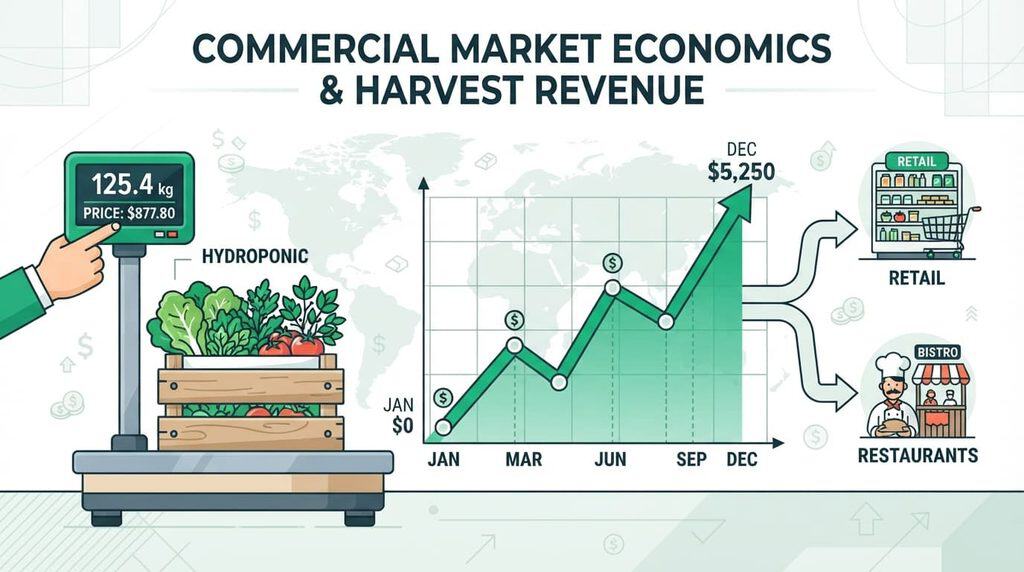
Selling prices can strongly affect hydroponic profitability because higher production costs require sufficient revenue to recover those costs. Where you sell is important too. Restaurants, supermarkets, specialty stores, and direct-to-consumer channels all come with different prices, volumes, and distribution costs.
It’s not just growing something hydroponically that guarantees a premium price; market prices depend on product quality, buyer demand, distribution costs and local market conditions. What really matters is whether your selling price still holds up after labor, electricity, nutrients, maintenance, and distribution costs are all subtracted.
| Economic factor | Effect on long-term analysis |
| Yield | Determines saleable output |
| Crop cycles | Determines annual production |
| Product quality | Can influence market access |
| Selling price | Determines gross revenue |
| Distribution cost | Reduces realized revenue |
| Market demand | Determines how much output can be sold |
How Should You Calculate the Long-Term Cost of Each System?
A real long-term hydroponic cost calculation pulls together your starting equipment costs, ongoing expenses, replacement parts, savings, and revenue over the same time period for every system you compare.
For a simple ownership-cost comparison, calculate initial CapEx + cumulative OpEx + replacement costs − measurable savings. For profitability, also account for revenue, financing, discounting, residual value and the analysis period.
For accounting-based analysis, include depreciation separately from cash expenses. For investment analysis, also account for replacement timing and residual equipment value. This approach also separates cost from profitability, a pricier system can still come out ahead financially if it produces more saleable crops or sells at a higher price than a cheaper alternative.
Which Hydroponic Cost Metrics Should You Track Over Time?
The most useful hydroponic cost metrics directly relate spending to production so you know if your system is getting more or less efficient as it gets older. Tracking energy cost per kilogram alongside labor, nutrients, water, and maintenance gives you a clearer picture than looking at any single expense alone.
Monthly or crop cycle checks of these figures build up a useful record over time. If the energy cost per kilogram is rising, it might be due to inefficient lighting or climate control. If the maintenance costs are rising, it might be because the pumps or sensors are worn out.
| Metric | Unit | What it reveals |
| Cost per crop | $/crop | Production expense |
| Cost per kilogram | $/kg | Unit economics |
| Energy intensity | kWh/kg | Electricity efficiency |
| Labor | Hours/cycle | Staffing burden |
| Water use | L/kg | Resource efficiency |
| Replacement cost | $/year | Equipment burden |
| Yield | kg/m² | Space productivity |
| Revenue | $/cycle | Sales performance |
| Gross margin | % | Revenue after direct costs |
How Does System Scale Change Long-Term Hydroponic Costs?
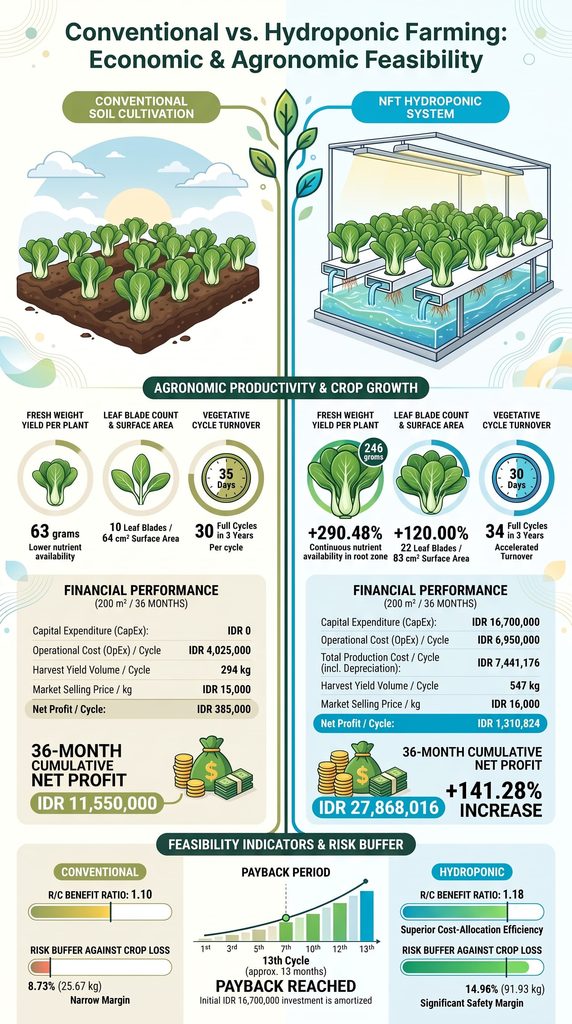
Hydroponic economics can be seriously affected by scale. Larger operations distribute fixed costs such as climate control or bulk lighting across more plants, which tends to reduce the cost per kilogram harvested. However, growing up also means more equipment and utility needs: more pumps, more grow lights, more ventilation and more electricity.
Labor often increases as production expands, but the rate can vary because automation, workflow and crop type affect labor requirements. That’s why growers moving from a small home setup to commercial-scale shouldn’t just multiply their small numbers. Efficiency, infrastructure needs, and staffing patterns can change, so the numbers need to be recalculated.
Does Larger Scale Reduce the Cost Per Unit?
Larger hydroponic systems can lower costs per kilogram or per growing area if the infrastructure, labor and automation are used well. For growers who start hydroponics on a budget, controlling the initial scale can help limit infrastructure spending while the production model is tested.
A larger operation can spread fixed costs across more output and potentially lower cost per kilogram, but extra energy, labor, and infrastructure costs can quickly offset those gains.
The real measure of success is cost per kilogram. It gives a more honest comparison across systems of different sizes than total spending alone.
When Can Scaling Increase Total Costs?
Scaling up can also raise total costs if producing more also means proportionally more electricity, climate control, labor, infrastructure or replacement equipment. Bigger controlled environments usually need more lighting, ventilation, cooling, pumps, and backup equipment, which raises both the initial and continuing costs.
This is why scale needs to be planned in stages, rather than assumed to deliver automatic savings. A bigger system can pay off nicely if there’s reliable demand for the extra output, but without enough buyers, that extra production capacity just becomes extra expense.
| Scale factor | Potential financial effect |
| More growing area | Higher output and infrastructure cost |
| More automation | Higher CapEx with potential labor savings |
| Larger climate-controlled area | Higher utility and construction costs |
| Greater production volume | More revenue potential and distribution expense |
How Do Crop Cycles Affect Long-Term Hydroponic Economics?
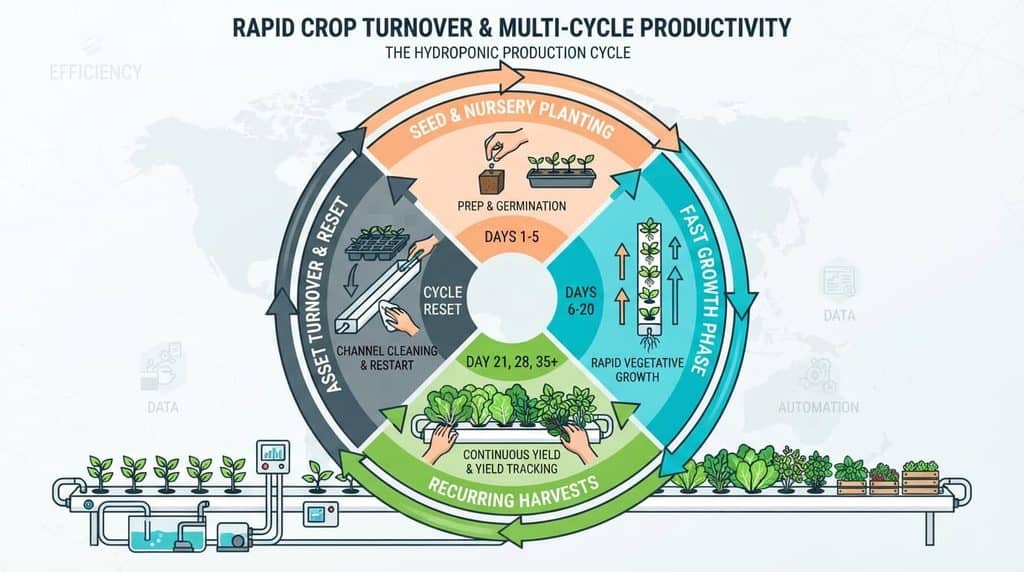
Crop-cycle speed makes a big difference in long-term hydroponic economics. Faster turnover can allow the same infrastructure to support more harvests per year when crop biology and system scheduling permit it. That turns your fixed infrastructure into a more productive asset, since the same footprint generates revenue more often.
Faster cycles can spread fixed costs over more output, but each additional cycle also creates costs for labor, nutrients, planting, cleaning and harvesting. This method works well for crops that have naturally shorter growing periods like leafy greens and herbs, rather than slow fruiting plants.
So selecting the right crops can increase your returns without even increasing your space.
Can Faster Crop Cycles Improve Revenue?
If you have enough market demand for the increased output, shorter crop cycles will increase your annual output and make better use of your fixed hydroponic infrastructure. More cycles mean your reservoirs, lighting and climate control systems can earn money more often, strengthening the link between what you spend and what you produce each year.
The basic math is simple: Annual Production = Saleable Yield Per Cycle × Number of Production Cycles. A system that produces less per harvest can still rack up strong annual output if it turns over crops quickly. While a big single harvest doesn’t help much if turnover is slow.
What Costs Rise When Production Turns Over More Often?
Higher crop turnover also means more nutrient use, labor, cleaning, packaging, planting, and harvesting. Every extra cycle brings its own round of production activities. Running costs like nutrients, water, electricity and labor should be multiplied by the number of actual cycles you run, not a flat yearly number.
Faster cycles can boost your bottom line, but only if the extra revenue is worth the extra work and costs that come with it. Faster production doesn’t automatically mean financial success in and of itself. It only helps when the numbers actually add up.
| Crop-cycle factor | Cost implication |
| More planting cycles | Higher seed or seedling expense |
| More harvests | Higher labor requirement |
| More nutrient cycles | Higher nutrient consumption |
| More cleaning periods | Higher labor and water use |
| More equipment use | Potentially higher maintenance |
| More sales opportunities | Potentially higher annual revenue |
FAQ
What is the most important cost to consider in a hydroponic system?
The most important cost is the total ownership cost, not just the upfront equipment price. Electricity, nutrients, water, labor, maintenance, replacement parts, and other recurring expenses can significantly change the system’s cost over time.
Is a more expensive hydroponic system cheaper in the long run?
It can be, but a higher purchase price does not automatically mean lower long-term costs. A more expensive system may reduce labor, improve production, or use resources more efficiently. The key is whether those savings and additional revenue outweigh the higher initial investment and ongoing maintenance costs.
How does electricity affect hydroponic system costs?
Electricity can become a major recurring expense, especially when a system relies on grow lights, pumps, ventilation, or climate control. Comparing energy use across systems helps show whether a higher-efficiency setup can reduce operating costs over its useful life.
Can higher crop yields make a hydroponic system more profitable?
Yes, but higher yield alone does not guarantee better profitability. Annual production depends on both saleable yield per cycle and the number of production cycles. Faster turnover can increase annual output, but each additional cycle can also increase nutrient, labor, cleaning, water, and packaging costs.
How should you compare two hydroponic systems before choosing one?
Compare their full ownership costs and productive output over the same period. Include upfront equipment, electricity, nutrients, water, labor, maintenance, replacement costs, crop yield, production cycles, and expected selling prices. This gives a more realistic comparison than looking at purchase price alone.
What Does a Long-Term Hydroponic Cost Comparison Reveal?
The real cost of a hydroponic system isn’t clear from the purchase price alone. Over time, electricity, labor, maintenance, water, nutrients, replacement parts, yield, and selling prices can change the financial picture. That’s why comparing systems only by upfront CapEx can give you the wrong idea. The full ownership cycle matters more.
A better approach is to look at how each system performs year after year under its actual operating conditions. Automation may reduce labor, while higher yields can spread fixed costs across more production.
If you’re planning or upgrading a setup, Tophydroponicgarden can be a practical place to explore equipment options while keeping the bigger long-term costs in mind.
References
- https://terrascope2024.mit.edu/?page_id=314#1
- https://agris.fao.org/search/en/records/682f2adbd0cf3796e6212fa8#1
Related Articles
- https://tophydroponicgarden.com/how-much-does-it-cost-to-run-a-hydroponic-system
- https://tophydroponicgarden.com/what-are-the-hidden-costs-of-hydroponic-systems/
- https://tophydroponicgarden.com/how-to-start-hydroponics-on-a-budget/
Was this helpful?

I’m Barrie L., a passionate hydroponic gardening enthusiast dedicated to cultivating thriving, soil-less gardens. With a focus on all things hydroponic, I share my expertise on innovative growing techniques and sustainable practices through my blog, tophydroponicgarden.com. As a seasoned hydroponics specialist, my goal is to inspire and guide fellow gardeners in harnessing the power of water-based cultivation for bountiful and eco-friendly harvests. I’m also an author of the book “Hydroponics For Absolute Beginners: Your Step By Step Guide For How To Create An Hydroponics System At Home Without Soil, For Growing Vegetable, Fruit And Herbs.” which is sold on Amazon. Join me on a journey of redefining the way we cultivate plants, one nutrient-rich solution at a time. Happy growing!