
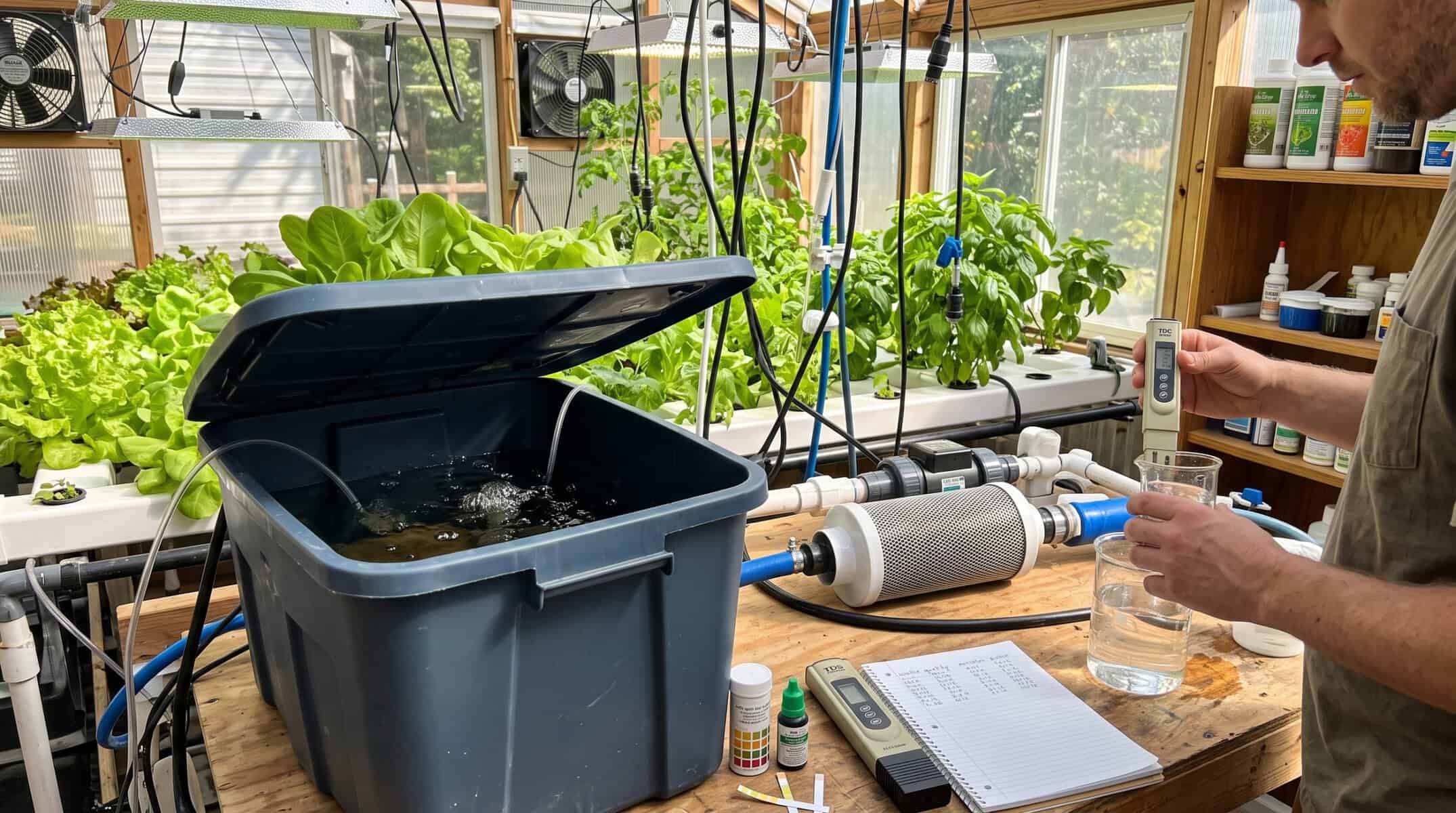
Water quality is an important part of hydroponic gardening because plants receive water and nutrients directly through their root systems. Unlike soil, hydroponic systems provide much less buffering around the roots, so the characteristics of the water you start with can affect the nutrient solution.
This leads to a common question among hydroponic growers: do you need a carbon filter for hydroponics?
The short answer is not necessarily. A carbon filter can be useful when your source water contains chlorine, certain organic compounds, or other substances that activated carbon is designed to reduce. However, it does not remove every dissolved mineral or solve every water-quality problem.
The best approach is to understand your source water first. Once you know its pH, EC, mineral content, and disinfectant levels, you can determine whether carbon filtration is actually necessary.
UNDERSTANDING CARBON FILTERS FOR HYDROPONICS
A carbon filter uses activated carbon to adsorb certain substances as water passes through the filter.
- Understand What Carbon Removes. Learn which contaminants activated carbon can reduce and which dissolved substances usually require another treatment method.
- Check Your Source Water. Test your tap or well water before deciding whether filtration is necessary.
- Choose the Right Treatment. Determine whether a carbon filter is sufficient or whether another option, such as reverse osmosis, better matches your water-quality problem.
What Is a Carbon Filter?
A carbon filter contains activated carbon, a porous material with a large surface area that can adsorb certain substances from water.
As water passes through the carbon, some compounds attach to the carbon surface. This makes activated carbon useful for reducing particular contaminants, odors, and tastes.
The Minnesota Department of Health explains that granular activated carbon can be used to treat certain chemicals in water, including chlorine.
“GAC filters also can be used to remove chemicals that give objectionable odors or tastes to water such as hydrogen sulfide … or chlorine.” — Minnesota Department of Health
Carbon filtration is therefore useful for specific water-treatment purposes. However, it should not be considered a universal purification method.
Do You Need a Carbon Filter for Hydroponics?
You may need a carbon filter if your source water contains chlorine or other contaminants that activated carbon can effectively reduce.
You may not need one if your source water already has suitable chemistry for your hydroponic plants and does not contain problematic levels of contaminants that carbon filtration can address.
Before buying a filter, test your source water.
Important measurements can include:
- EC or TDS
- pH
- Alkalinity
- Chlorine
- Chloramine
- Calcium
- Magnesium
- Sodium
- Other contaminants when relevant
Understanding what type of water to use for hydroponics can also help you decide whether your current water source needs treatment before you invest in additional filtration equipment.
Why Would Hydroponic Growers Use a Carbon Filter?
Carbon filtration can be useful for specific water-quality concerns.
One of the most common reasons is chlorine reduction.
Municipal water systems may use chlorine or chloramine as disinfectants. For hydroponic growers, the relevance of these compounds depends on the water source, concentration, hydroponic system, and whether beneficial microorganisms are being used.
Activated carbon can also reduce certain organic compounds and substances responsible for unpleasant tastes or odors.
However, a carbon filter is not designed to remove every dissolved substance in water.
The purpose of using one should therefore be based on an identified water-quality need rather than simply assuming that filtered water is always better.
How Does an Activated Carbon Filter Work?
Activated carbon works primarily through adsorption.
Adsorption occurs when substances attach to the surface of the carbon.
Activated carbon contains many pores, giving it a large surface area where certain compounds can be retained.
The effectiveness of filtration depends on factors such as:
- Type of activated carbon
- Amount of carbon
- Water flow rate
- Contact time
- Contaminant concentration
- Water chemistry
- Filter condition
This means that two carbon filters can have different performance even when they appear similar.
What Does a Carbon Filter Remove From Hydroponic Water?
Carbon filtration can reduce certain contaminants, but its capabilities are limited.
| Water Component | Carbon Filter |
| Chlorine | Can reduce |
| Some organic compounds | Can reduce |
| Some odors | Can reduce |
| Hydrogen sulfide | Can reduce under suitable conditions |
| Calcium | Generally not removed |
| Magnesium | Generally not removed |
| Nitrate | Generally not removed |
| Most dissolved salts | Not removed |
| High EC from minerals | Not effectively reduced |
| Heavy metals | Depends on filter/media |
| Chloramine | Depends on filter type and conditions |
The exact performance depends on the carbon media, filter design, flow rate, and contaminant.
Research from the University of Georgia Cooperative Extension explains that activated carbon filtration can address several types of contaminants, including residual chlorine and certain organic compounds.
“Activated carbon filtration is effective against unpleasant tastes, odors (hydrogen sulfide), residual chlorine, some metals like mercury, many organic compounds” — University of Georgia Cooperative Extension
However, this does not mean that activated carbon removes all dissolved substances. Mineral ions such as calcium, magnesium, and other salts generally require different treatment methods.
Carbon Filters and Chlorine
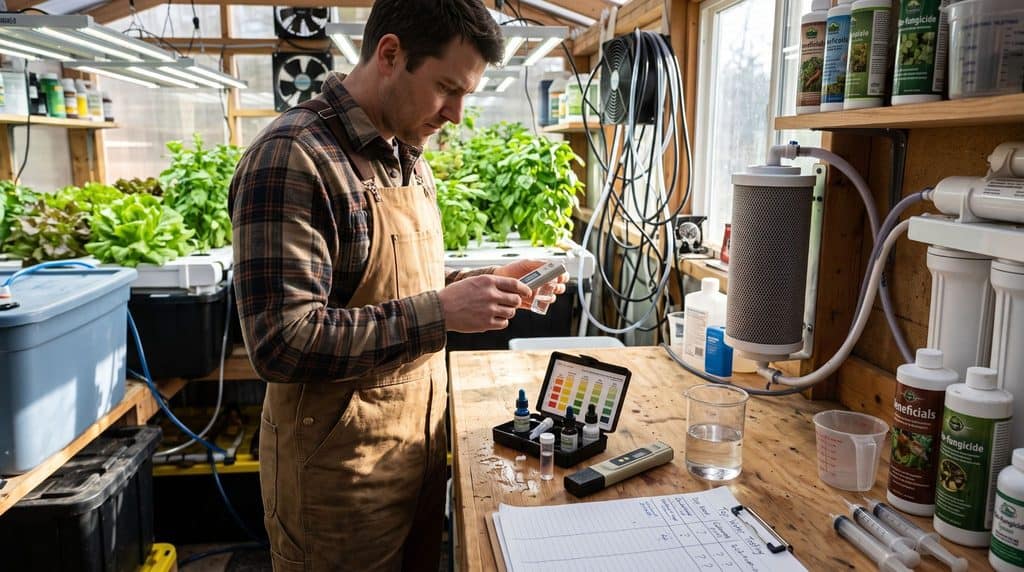
Chlorine is one of the main reasons a hydroponic grower may consider using a carbon filter.
Activated carbon can reduce free chlorine in water.
This can be particularly relevant when preparing water for hydroponic systems that contain beneficial microorganisms.
However, the important question is not simply whether chlorine is present.
The more useful question is:
Does the chlorine concentration in your source water justify treatment for your particular hydroponic system?
Testing your water can help answer that question.
Carbon Filters and Chloramine
Chloramine is different from free chlorine.
It is a more stable disinfectant, so methods that may work for free chlorine do not necessarily work equally well for chloramine.
This matters because some growers assume that every carbon filter removes chloramine.
That is not necessarily the case.
If your municipal water supply uses chloramine, check whether the specific carbon filter is rated for chloramine reduction.
Filter performance can depend on carbon type, contact time, flow rate, and other water conditions.
Carbon Filter vs Reverse Osmosis
A carbon filter and a reverse osmosis system perform different functions.
Carbon filtration primarily uses adsorption to target specific substances.
Reverse osmosis uses a semipermeable membrane to reduce a much broader range of dissolved substances.
| Feature | Carbon Filter | Reverse Osmosis |
| Chlorine | Can reduce | Usually requires carbon prefiltration |
| Some organic compounds | Can reduce | Can reduce many |
| Dissolved minerals | Limited | Significant removal |
| Calcium and magnesium | Generally not | Yes |
| Sodium | Generally not | Yes |
| Nitrate | Generally not | Yes |
| EC reduction | Limited | Significant |
| Water waste | Generally low | Produces reject water |
| Cost | Usually lower | Usually higher |
| Main advantage | Targeted filtration | Broad dissolved-contaminant reduction |
If your only concern is chlorine, a full RO system may be unnecessary.
If your source water has high EC or excessive dissolved minerals, carbon filtration may not address the underlying problem.
When Is a Carbon Filter Enough?
A carbon filter may be sufficient when:
- Your source water has otherwise suitable EC.
- Mineral concentrations are acceptable.
- Chlorine is your primary concern.
- You want to reduce certain organic compounds.
- You do not need extensive demineralization.
- The filter is correctly sized for the water flow.
In this situation, carbon filtration can be a relatively simple way to treat the source water before mixing nutrients.
When Is a Carbon Filter Not Enough?
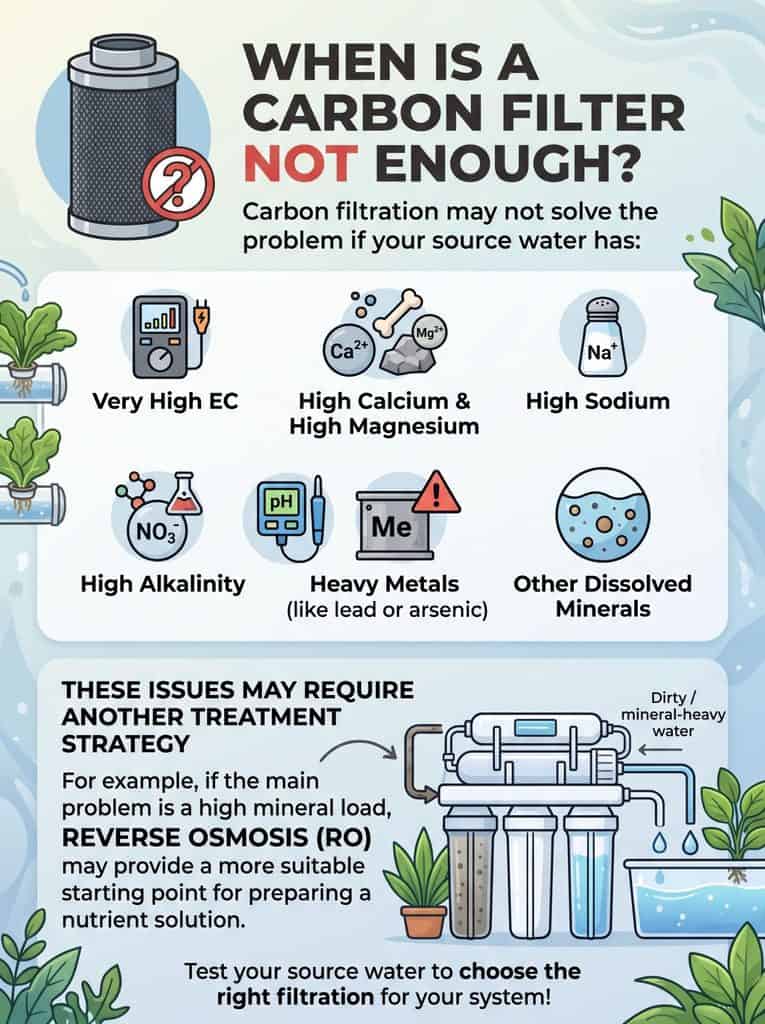
Carbon filtration may not solve the problem if your source water has:
- Very high EC
- High calcium
- High magnesium
- High sodium
- High nitrate
- High alkalinity
- Significant heavy-metal contamination
- Other dissolved mineral problems
These issues may require another treatment strategy.
For example, if the main problem is a high mineral load, reverse osmosis may provide a more suitable starting point for preparing a nutrient solution.
Does a Carbon Filter Lower EC?
Usually, no.
This is an important distinction between carbon filtration and reverse osmosis.
EC measures the conductivity associated with dissolved ions in water.
Activated carbon is not designed to remove most of the mineral ions responsible for EC.
Therefore, if your source water has high EC because of calcium, magnesium, sodium, or other dissolved salts, a carbon filter is unlikely to solve the problem.
If you are unsure what your water contains, start by testing your source water for hydroponics before selecting a filtration method.
Does a Carbon Filter Remove Hard Water Minerals?
Generally, no.
Hard water commonly contains elevated levels of calcium and magnesium.
Activated carbon primarily targets substances through adsorption rather than removing dissolved mineral ions through a broad demineralization process.
If hard water is affecting your nutrient solution, you may need a different treatment method.
This is why it is important to distinguish between filtered water and demineralized or purified water.
Carbon Filter vs Filtered Tap Water
Not every water filter is an activated carbon filter.
A sediment filter, for example, primarily targets suspended particles.
An activated carbon filter is designed for different types of substances.
Therefore, the word “filter” alone does not tell you what the system can remove.
If you are considering using tap water, understanding whether filtered tap water is suitable for hydroponics can help you determine whether additional water treatment is actually necessary.
How to Choose a Carbon Filter for Hydroponics
If testing shows that carbon filtration is appropriate, consider several factors.
1. Identify the Contaminant
Know what you are trying to remove.
If chlorine is the concern, choose a filter specifically rated for chlorine reduction.
If chloramine is the concern, verify that the filter is designed for chloramine reduction.
2. Check the Flow Rate
Water needs sufficient contact time with the carbon for adsorption to occur effectively.
If water moves through the filter too quickly, performance may be reduced.
Check the manufacturer’s recommended flow rate.
3. Check Filter Capacity
Carbon filters have a finite adsorption capacity.
Once the carbon becomes exhausted, its ability to remove contaminants decreases.
4. Consider the Water Volume
A small home hydroponic system may use much less water than a commercial operation.
Choose a filter based on your actual water consumption and the manufacturer’s capacity rating.
5. Follow Replacement Instructions
Carbon filters need periodic replacement.
Do not assume that a cartridge will continue performing indefinitely.
Follow the manufacturer’s recommendations for replacement and maintenance.
How to Use a Carbon Filter for Hydroponics
Using a carbon filter is generally straightforward.
Step 1: Test Your Source Water
Measure the water before filtration.
Record:
- EC/TDS
- pH
- Alkalinity
- Chlorine
- Chloramine when relevant
This gives you a baseline.
Step 2: Install the Filter Correctly
Follow the manufacturer’s installation instructions.
Pay attention to:
- Water direction
- Flow rate
- Connections
- Filter orientation
- Required flushing
Step 3: Flush a New Filter
Many carbon filters require initial flushing before use.
Follow the product instructions to remove carbon dust and prepare the filter.
Step 4: Test the Filtered Water
Do not assume the filter is working simply because water is flowing through it.
If chlorine reduction is your objective, test the treated water when appropriate.
Step 5: Monitor Filter Usage
Keep track of how much water passes through the filter.
Replace the cartridge according to its rated capacity or the manufacturer’s recommended schedule.
Should You Filter Water Before Adding Hydroponic Nutrients?
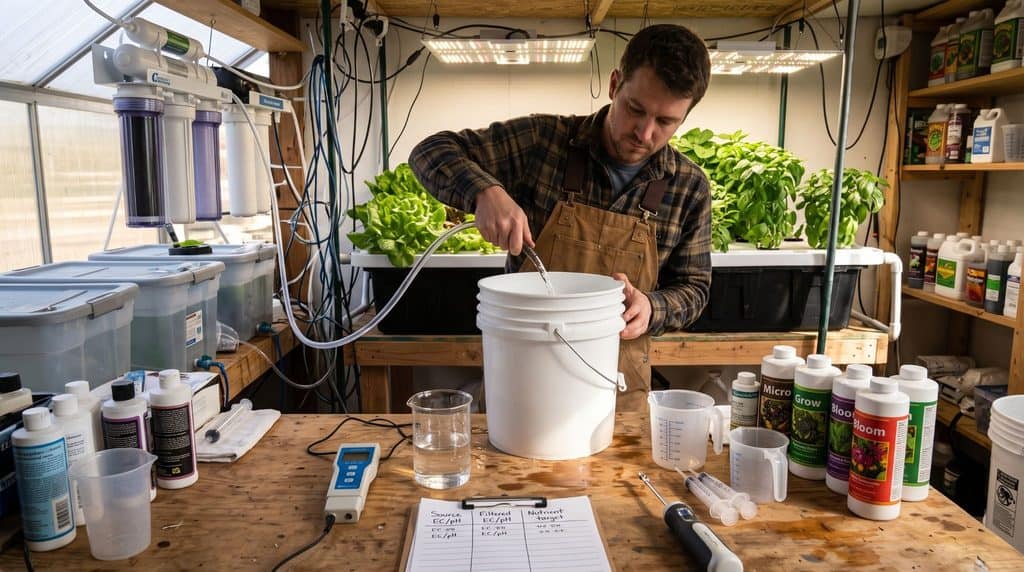
Yes, if filtration is necessary for your source water.
A practical sequence is:
Source water → filtration/treatment → testing → nutrient mixing → final pH adjustment
This makes it easier to understand what the filtration system changes before nutrients are introduced.
If you add nutrients before filtering, the filter is no longer treating simple source water. It is being exposed to a solution containing fertilizer salts and other dissolved substances.
Should You Use a Carbon Filter With RO?
Sometimes.
Carbon and RO can serve different functions.
Carbon filtration is commonly used as a pretreatment stage in RO systems because chlorine can damage certain RO membranes.
For hydroponics, the combination can provide:
- Carbon filtration for chlorine and certain organic compounds
- RO filtration for a much broader range of dissolved substances
However, an RO system is not automatically necessary for every grower.
If your source water is already suitable, adding multiple treatment stages may provide little practical benefit.
Can Carbon Filters Remove All Contaminants?
No.
This is one of the most common misconceptions about carbon filtration.
Carbon filters can reduce certain substances, but they do not remove every mineral, salt, chemical, or microorganism.
The effectiveness depends on the specific contaminant and the characteristics of the carbon filter.
Therefore, water that has passed through a carbon filter should not automatically be considered “pure.”
Do You Need a Carbon Filter for Different Hydroponic Systems?
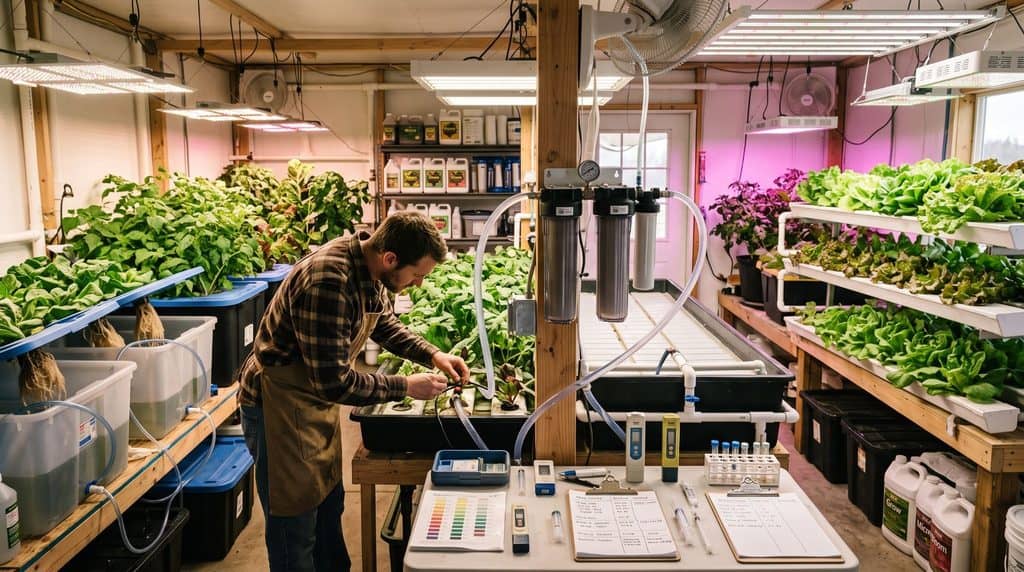
Deep Water Culture
DWC systems can use carbon-filtered source water when chlorine or another target contaminant is a concern.
Because roots remain exposed to nutrient solution for extended periods, maintaining suitable water conditions is important.
Nutrient Film Technique
NFT systems continuously circulate nutrient solution.
Source-water problems can therefore circulate throughout the system, making source-water testing particularly useful.
Ebb and Flow
Ebb-and-flow systems periodically move nutrient solution through the root zone.
Filtered source water can be used when appropriate, but filtration does not replace proper nutrient management.
Drip Hydroponics
Drip systems may be sensitive to mineral buildup because dissolved minerals can accumulate around emitters and irrigation components.
If your source water contains high mineral levels, carbon filtration alone may not address the problem.
How to Know If You Actually Need a Carbon Filter
Use this simple decision process:
Step 1: Test your source water.
Step 2: Determine whether chlorine or chloramine is present.
Step 3: Check EC/TDS and alkalinity.
Step 4: Identify whether your main problem is disinfectants, dissolved minerals, or another contaminant.
Step 5: Choose the treatment that matches the problem.
If chlorine is the main concern and the rest of the water chemistry is suitable, a carbon filter may be enough.
If the problem is high EC or excessive dissolved minerals, consider whether RO or another treatment is more appropriate.
If your source water is already suitable for your crop and nutrient program, you may not need filtration at all.
Common Mistakes When Using Carbon Filters in Hydroponics
1. Buying a Filter Without Testing the Water
You may spend money treating a problem your water does not actually have.
2. Assuming Carbon Removes Minerals
Carbon filtration does not generally solve high-EC or hard-water problems.
3. Confusing Chlorine With Chloramine
These disinfectants behave differently, and a filter that works for chlorine may not perform equally well against chloramine.
4. Ignoring Filter Capacity
An exhausted carbon filter cannot be expected to perform like a new one.
5. Using an Excessively High Flow Rate
Water that moves too quickly may not receive sufficient contact with the carbon.
6. Assuming Filtered Water Is Automatically Better
The goal is not simply to remove as many substances as possible.
Hydroponic plants need water with a suitable mineral profile for the nutrient program.
Frequently Asked Questions About Carbon Filters for Hydroponics
1. Do you need a carbon filter for hydroponics?
Not necessarily. A carbon filter is most useful when your source water contains chlorine or another substance that activated carbon can effectively reduce. Test your water before deciding.
2. Does a carbon filter remove chlorine from hydroponic water?
Yes, activated carbon can reduce free chlorine. The effectiveness depends on the filter design, carbon type, flow rate, and condition.
3. Does a carbon filter remove chloramine?
Some activated carbon systems can reduce chloramine, but performance varies. If your water uses chloramine, choose a filter specifically rated for chloramine reduction.
4. Does a carbon filter lower EC?
Generally, no. Activated carbon does not remove most dissolved mineral ions responsible for EC, so high-EC water may require another treatment such as RO.
5. Is RO better than a carbon filter for hydroponics?
Neither is universally better. Carbon filtration is useful for specific contaminants such as chlorine, while RO provides much broader removal of dissolved substances. The appropriate choice depends on your source-water chemistry.
When You DO Need a Carbon Filter
So, do you need a carbon filter for hydroponics?
Not automatically.
A carbon filter makes the most sense when you have identified a specific water-quality issue that activated carbon can address, particularly chlorine or certain organic compounds.
If your source water already has suitable EC, mineral levels, alkalinity, and disinfectant levels for your hydroponic system, additional filtration may not be necessary.
On the other hand, if chlorine is present and you want to reduce it before preparing your nutrient solution, activated carbon can be a practical option.
The important thing is to match the treatment to the problem.
Test first. Filter second.
A carbon filter should not be expected to remove every dissolved mineral or solve high-EC water. If your primary issue is excessive calcium, magnesium, sodium, nitrate, or overall dissolved solids, you may need a different treatment strategy.
By understanding what activated carbon can and cannot remove, you can avoid unnecessary equipment and build a water-treatment approach that actually fits your hydroponic system.
REFERENCES
- https://www.health.state.mn.us/communities/environment/hazardous/topics/gac.html
- https://extension.uga.edu/publications/detail.html?number=B939&title=water-quality-and-common-treatments-for-private-drinking-water-systems
RELATED ARTICLES
- https://tophydroponicgarden.com/how-to-properly-test-your-source-water
- https://tophydroponicgarden.com/can-you-use-filtered-tap-water-hydroponics/
- https://tophydroponicgarden.com/what-type-of-water-to-use-for-hydroponics/
Was this helpful?
