
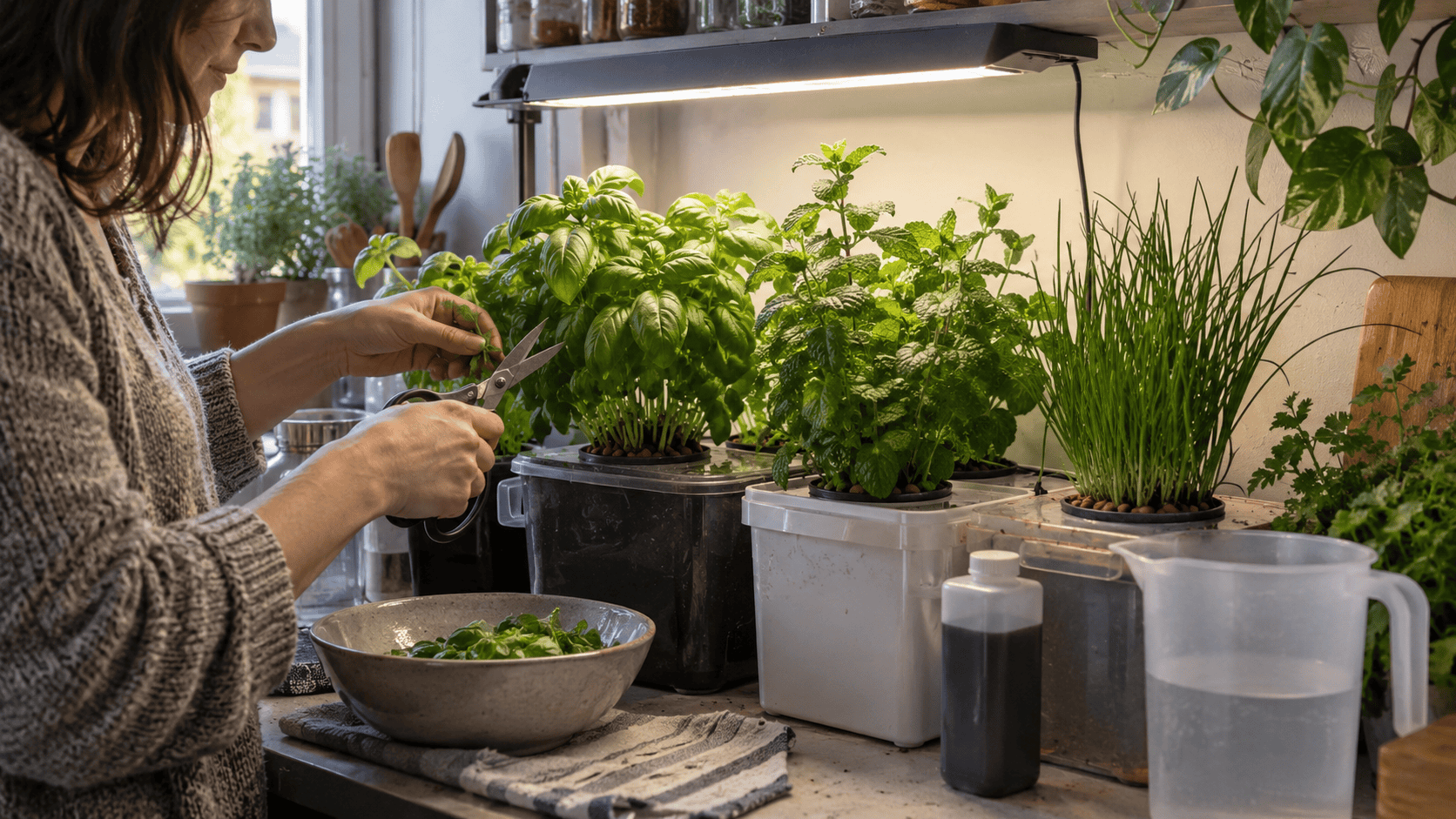
A DIY hydroponic system for herbs can be surprisingly simple.
You don’t need complicated pipes or a large indoor setup. A container, hydroponic nutrients, plant support, and enough light can already get you started.
The best setup depends on your space, budget, and how much maintenance you’re comfortable with.
That’s also the approach you’ll find across Top Hydroponic Garden: start with what you actually need, then upgrade only when it makes sense.
Keep reading to compare the easiest methods, build your own system, and learn how to keep your herbs growing well at home.
Before You Start Building
You don’t need to decide between ten different hydroponic systems before growing your first basil plant. Get these basics right first:
- Choose the method around your space and maintenance level. A passive jar and an aerated bucket solve the same basic problem in different ways.
- Start with forgiving herbs. Basil, mint, and chives are easier first projects than slower woody herbs.
- Keep light away from the nutrient reservoir. Light plus nutrient-rich water is a very convenient setup for algae.
- Build small enough to monitor easily. One or two plants can teach you more than an oversized system you don’t want to maintain.
Once those choices are clear, the actual build gets much easier.
What Is a DIY Hydroponic System for Herbs?
A DIY hydroponic herb garden grows plants without conventional soil.
Instead, the roots receive water and dissolved nutrients directly, while materials such as clay pebbles or coco coir may simply help support the plant.
According to Oklahoma State University:
“It is a method of crop production in which plants are grown without soil.” – Dunn & Singh, Oklahoma State University
That basic idea can take many forms at home.
You might use one opaque container with a net cup, or build a larger setup with an air pump and several planting sites.
Herbs are especially practical because many stay compact, tolerate regular harvesting, and fit easily on shelves, balconies, or small indoor growing areas.
The important thing is that DIY hydroponics doesn’t refer to one fixed design. You can choose a system based on your space, budget, and how much maintenance you want.
Which DIY Hydroponic Method Should You Choose?
Don’t buy pumps, tubing, or buckets first and decide what you’re building afterward.
Start with four questions: How many herbs do you want? How much space do you have? Are you okay using electricity? And how often do you realistically want to check the system?
There isn’t one best method for everyone.
| Method | Equipment | Maintenance | Best Fit |
| Kratky | Very low | Low | One or a few herbs |
| Wick system | Very low | Low | Compact, low-demand herbs |
| DWC | Moderate | Moderate | Faster growth and larger herbs |
| Simple drip | Higher | Moderate | Multiple plants and future expansion |
That gives you a much better starting point than choosing whatever setup looks coolest online.
Is the Kratky Method Good for a Simple Build?
Kratky is useful when you want very little equipment.
There’s no air pump constantly bubbling the reservoir and no water pump circulating solution. The plant sits above a nutrient reservoir while its roots gradually occupy both the solution and the moist air space that develops as the water level falls.
That simplicity makes Kratky attractive for individual basil, mint, or other compact herbs.
The tradeoff is that water level matters. You can’t treat a mature Kratky container exactly like DWC and automatically refill it to the top every time the level drops.
Is a Wick System Easier?
A wick system is another low-tech option.
Instead of putting most of the roots directly into a large nutrient reservoir, absorbent material pulls solution upward toward the growing medium. There’s no powered aeration and very little plumbing.
It works nicely for smaller herbs with modest water demand, especially when the goal is experimentation rather than maximum growth speed.
The weakness is also its simplicity. A small wick can only move so much moisture, so larger or thirstier plants may eventually demand more than the system can supply.
When Does Deep Water Culture Make More Sense?
Deep Water Culture, or DWC, is worth considering when you don’t mind adding an air pump.
The roots extend into the nutrient solution while an air stone supplies aeration. Compared with passive systems, that gives you more control over root-zone oxygen but also adds equipment that needs to keep working.
DWC can be a good middle ground for a home grower who wants something more active than a jar without building complicated plumbing.
It also scales nicely from one bucket to a larger tote with several planting sites.
Should Beginners Build a Drip System?
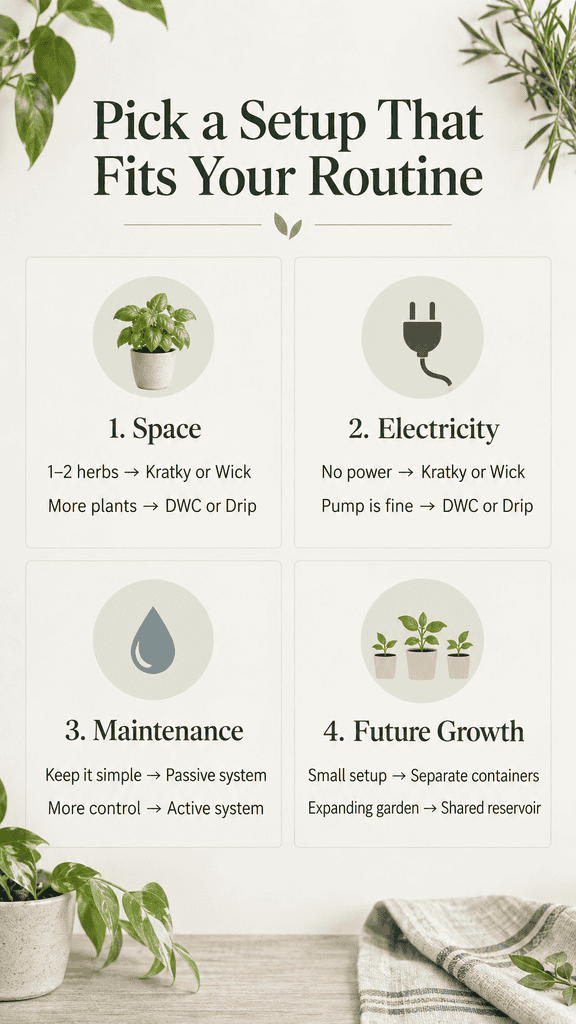
You can, but it usually isn’t the first method I’d suggest for one or two herbs.
A basic drip setup uses a pump, tubing, and emitters to deliver nutrient solution around each root zone. That becomes more useful when you have several plants or want to expand later.
For a tiny herb garden, all those extra connections can create maintenance you simply don’t need.
Once you’re managing multiple plants, though, drip irrigation starts making more sense because nutrient delivery can be distributed from a shared reservoir.
What Do You Need for a DIY Hydroponic Herb Garden?
The shopping list changes slightly with the method, but the core pieces stay fairly simple.
You’ll usually need:
- A reservoir or container
- Net cups or another plant holder
- Suitable growing medium
- Complete hydroponic nutrients
- Herb seeds, cuttings, or seedlings
- Water
- Basic pH testing supplies
- Something opaque to block reservoir light
Depending on your system, you may also need an air pump, air stone, wick material, tubing, water pump, timer, or grow light.
Don’t buy every hydroponic accessory at once. Start with whatever directly supports water, nutrients, roots, and light.
As noted by Al Meselmani:
“The function of a hydroponics nutrient solution is to supply the plant roots with water, oxygen, and essential mineral elements in soluble form.” – Moaed Ali Al Meselmani, IntechOpen
If you’re unsure about the medium, this guide to choosing the best growing medium for hydroponic herbs goes deeper into matching media with different systems.
Can You Use Recycled Containers?
Yes, and this is where DIY builds can stay genuinely inexpensive.
Food-safe buckets, suitable storage tubs, bottles, and jars can all be repurposed if they’re structurally sound and thoroughly cleaned. Avoid containers that previously held chemicals or unknown substances.
The container also needs enough root space for the mature herb, not just the seedling sitting in it today.
One more thing matters more than aesthetics: opacity. If sunlight or a grow light shines straight through the reservoir wall, algae gets a much easier start.
Do You Need a Grow Light?
A sunny location may provide enough usable light for some herbs, while an indoor shelf several feet from a window may look bright to you but still be disappointing for plants.
If natural light isn’t enough, artificial lighting gives you more control over intensity and photoperiod.
Don’t choose a fixture by wattage alone.
Crop type, canopy size, coverage, hanging height, and light distribution all matter.
If your DIY garden will live indoors, Top Hydroponic Garden has a separate guide on choosing a full-spectrum LED grow light so you can compare lighting without turning this build into a grow-light article.
Which Herbs Work Best in a DIY Hydroponic System?
Basil is probably the easiest place to start, but it isn’t the only option.
Mint grows enthusiastically, chives stay compact, and parsley works well if you’re willing to wait a little longer. Cilantro and dill are also possible, although heat and vertical space become more important.
| Herb | Beginner Level | Space | DIY Note |
| Basil | Easy | Medium | Fast growth and frequent harvests |
| Mint | Easy | Medium | Vigorous roots and shoots |
| Chives | Easy | Small | Great for compact containers |
| Parsley | Moderate | Medium | Slower to establish |
| Cilantro | Moderate | Medium | More sensitive to heat |
| Dill | Moderate | Taller | Needs overhead room |
If you want more crop ideas before planting, Top Hydroponic Garden has a broader guide to the best herbs to grow in a hydroponic garden.
Should You Grow Every Herb in the Same Reservoir?
I wouldn’t mix plants only because they all happen to be herbs.
A fast basil plant can become wide enough to shade smaller chives. Dill may stretch upward while parsley is still establishing. Mint can produce a surprisingly aggressive root mass.
Shared reservoirs also mean every plant receives the same nutrient solution.
For a first multi-plant build, choose herbs with reasonably similar growth habits, sizes, and environmental needs. You don’t need perfect matches, but avoiding extreme differences makes spacing, lighting, pruning, and nutrient management much easier.
Which Herbs Are Harder for Beginners?
Rosemary, thyme, and oregano aren’t impossible hydroponic crops.
They’re simply less forgiving as first projects than basil or chives.
Many woody herbs establish more slowly, and their growth habits don’t always suit a tiny reservoir packed with faster leafy herbs.
That can actually be useful later. Once you understand water level, lighting, nutrients, and root health from an easier crop, experimenting with slower herbs becomes much less frustrating.
For the first build, quick feedback is helpful. A fast-growing herb tells you sooner whether your setup is working.
How Do You Build a DIY Hydroponic System for Herbs?
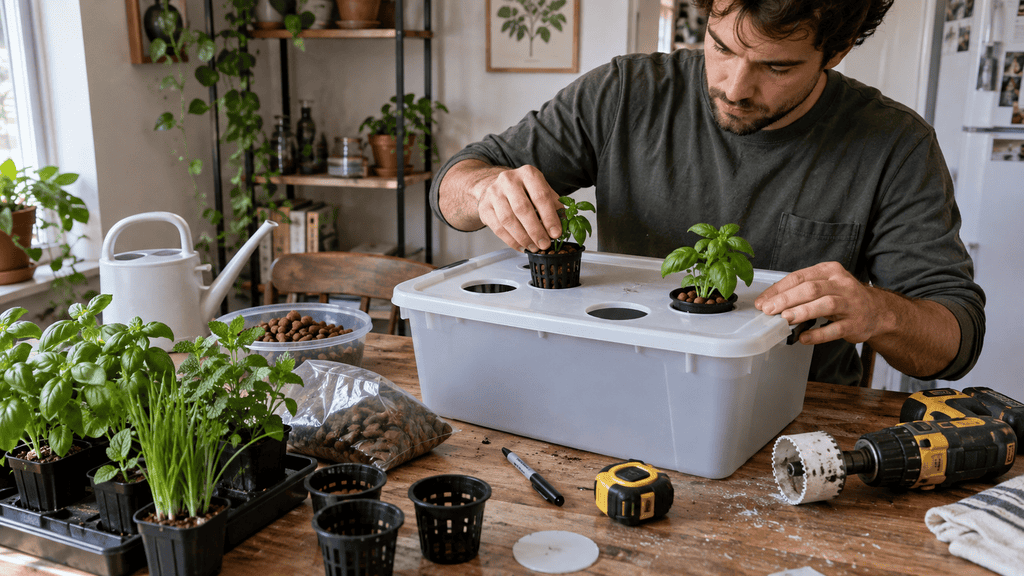
Once you’ve chosen a method, building the system is fairly simple. The details vary between Kratky, wick systems, and DWC, but the basic process stays similar.
- Choose the system and container. Pick a container based on the number of herbs, available space, and whether you want a passive or pump-based setup.
- Prepare the reservoir. Clean it thoroughly, add openings for plant holders, and block light from reaching the nutrient solution to help limit algae.
- Prepare the herbs. Start from seeds, rooted cuttings, or seedlings. If transferring from soil, gently clean the roots first.
- Mix the nutrient solution. Use a complete hydroponic nutrient according to the product instructions, then check pH when possible.
- Set up the root zone. DWC uses aerated nutrient solution, wick systems move moisture through a wick, while Kratky relies partly on the air space above the falling water level.
- Add suitable light. Use natural light or a grow light while keeping the reservoir away from excess heat.
- Monitor before expanding. Watch water levels, roots, plant growth, and equipment performance before adding more plants.
How Do You Maintain a DIY Hydroponic Herb System?
Maintenance shouldn’t feel like running a commercial greenhouse.
For a small home system, build a simple habit around the things that can actually change: water level, roots, nutrient solution, pH, plant growth, and cleanliness.
Take a quick look at the reservoir whenever you harvest.
Healthy roots, stable growth, and clean water tell you a lot before a meter ever comes out.
Useful routine checks include:
- Water level
- Root appearance and smell
- Leaf color
- pH
- Algae
- Pump or air-stone operation
- Sediment and debris
- Plant crowding
You don’t need to interfere every day just because hydroponics looks technical.
When Should You Add More Water?
There isn’t one refill rule for every system.
DWC normally maintains a much more consistent root-to-water relationship because aeration comes from the air pump.
A wick system needs enough nutrient solution to keep its wick functioning properly.
Kratky is different again because a falling solution level contributes to the formation of its air space.
So before topping anything back to the original fill line, think about how your chosen system supplies oxygen to the roots.
The right water level is method-specific, not just container-specific.
When Should You Replace the Nutrient Solution?
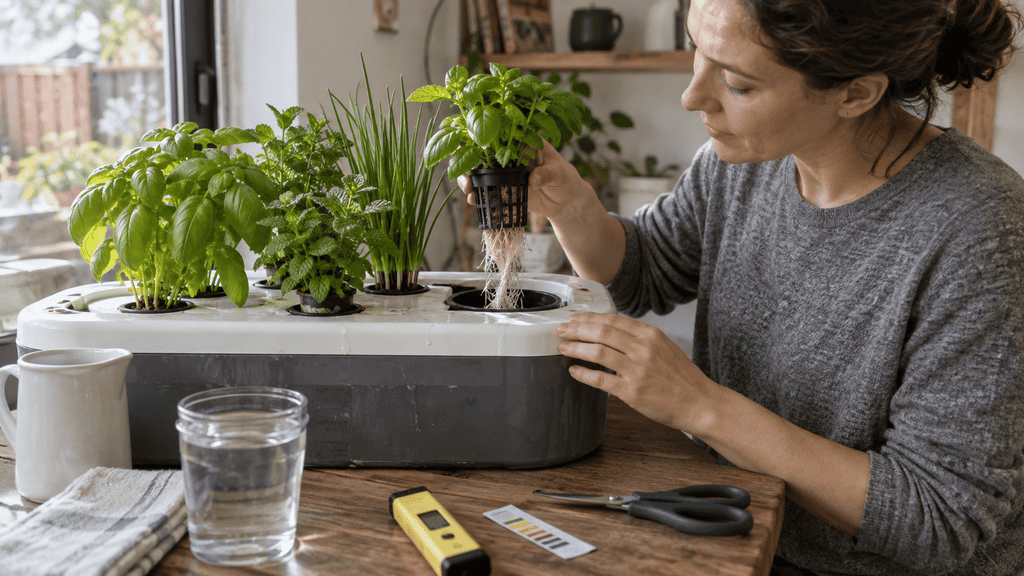
Adding water and replacing the nutrient solution aren’t the same job.
Plants remove water and nutrients at different rates. Over time, what remains in the reservoir may no longer resemble the mix you originally made.
Oklahoma State University advises periodic complete replacement and gives two weeks as a general hydroponic guideline, but reservoir size, crop load, water quality, and system type can change how a small home setup behaves.
Persistent pH instability, sediment, unusual odor, or obviously poor solution conditions are good reasons to inspect more closely instead of endlessly topping up.
How Should You Harvest Hydroponic Herbs?
Harvesting is part of maintenance, especially with leafy herbs.
For basil and similar plants, regular trimming helps control height and branching. Don’t strip most of the foliage in one session just because dinner needs pesto.
Keep healthy growing points intact.
Mint and other vigorous herbs may also need trimming simply to stop them from crowding neighbors.
For herbs grown mainly for leaves, watch flowering too. Once a plant starts shifting strongly toward reproduction, leaf texture, growth habit, or flavor may change depending on the crop.
Small, regular harvests usually keep a compact herb system easier to manage.
What Problems Show Up Most Often in DIY Hydroponics?
Most beginner problems are easier to troubleshoot when you resist the temptation to guess the cause from one symptom.
Yellow leaves don’t automatically mean “add nutrients.” Brown roots don’t automatically mean root rot.
Check the system around the plant first.
| Problem | Check First | Possible Fix |
| Algae | Light entering reservoir | Block light and clean surfaces |
| Yellow leaves | Nutrients and pH | Test before feeding more |
| Drooping herbs | Roots and water access | Inspect the root zone |
| Brown roots | Oxygen, heat, cleanliness | Check several conditions |
| Slow growth | Light and nutrition | Review the full setup |
| Crowding | Plant number and spacing | Prune or separate herbs |
The goal is to find what changed, not throw five fixes at the plant at once.
Why Does Algae Keep Coming Back?
Algae needs light, water, and nutrients.
A hydroponic reservoir already provides two of those things, so letting light reach the solution completes the recipe.
Cleaning the algae without fixing the light leak usually means you’ll repeat the same job later.
Look around net cups, tubing holes, translucent lids, and clear reservoir walls.
Cover unnecessary openings and use opaque materials where possible.
A clean reservoir helps, but prevention starts with making the nutrient solution a bad place for light-loving algae to grow.
Why Are the Roots Turning Brown?
Color alone isn’t enough to diagnose roots.
Some nutrient solutions can stain roots slightly. What matters more is the full picture: smell, texture, water temperature, oxygen availability, and plant behavior.
Slimy roots with a bad odor deserve much more attention than firm roots that happen to look tan.
If you’re running DWC, confirm the air pump and air stone are working.
Also check whether the reservoir has become unusually warm or dirty before assuming one single cause.
Treat the root zone as a system, not just a color chart.
Why Are the Herbs Growing Slowly?
Start with light.
Weak lighting can limit growth even when the nutrient mix is perfect.
After that, check temperature, pH, nutrient strength, root crowding, and whether the reservoir is becoming too small for the mature plant.
Don’t change all of them simultaneously.
Make one sensible correction, then observe the response.
Hydroponic plants can react quickly to their environment, which is useful for troubleshooting, but that also means constant random adjustments can make it harder to figure out what was actually wrong.
How Can You Expand a Small DIY Hydroponic Garden?
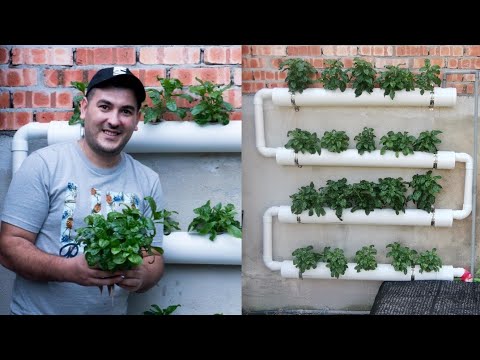
Credits: DIY & GARDEN WITH BIBI
Expansion doesn’t have to mean PVC pipes across an entire room.
Sometimes the easiest upgrade is simply adding a second independent container.
That lets you grow a different herb without forcing both plants to share the same nutrient solution, root space, and maintenance schedule.
You could also:
- Add more individual containers
- Move to a larger reservoir
- Add powered aeration
- Change from a passive setup to DWC
- Build several planting sites around one reservoir
- Add controlled lighting for a larger canopy
Upgrade because your current setup has reached a limitation, not because hydroponics is supposed to look complicated.
Are Separate Containers Better Than One Shared Reservoir?
For a small collection, separate containers are wonderfully forgiving.
You can move one plant, change its nutrient solution, or isolate a problem without disturbing everything else.
Shared reservoirs become more convenient as the number of plants increases. There are fewer containers to fill and test, and expansion can look much cleaner.
The downside is that all those plants now share the same solution and root-zone conditions.
For mixed herbs with different growth habits, individual containers may be easier. For several similar plants, one well-sized shared reservoir can simplify the whole garden.
FAQ
Can I Build a Hydroponic Herb Garden Without Electricity?
Yes. Passive methods such as Kratky and wick systems can work without pumps. DWC and other actively aerated or circulated systems rely on electricity for their equipment.
Can I Use Tap Water for Hydroponic Herbs?
Sometimes. Tap water varies in mineral content, alkalinity, EC, and pH, so test what comes out of your faucet instead of assuming all tap water behaves the same way.
Can I Use Regular Fertilizer in a DIY Hydroponic System?
A complete hydroponic nutrient is the simpler choice. Hydroponic formulas are designed to supply nutrients directly through solution rather than relying on soil chemistry.
Can Hydroponic Herbs Grow on a Kitchen Counter?
Yes, if the location provides enough usable light and space. A countertop that looks bright to people can still be too dim for steady plant growth.
Can I Move Herbs From Soil Into Hydroponics?
You can, but clean the roots carefully and expect some transplant stress. Starting from seed or a clean cutting is usually easier for a first DIY build.
A Small DIY Herb Garden Can Go a Long Way
Building a DIY hydroponic system for herbs doesn’t require an advanced setup. Kratky and wick systems work well for simple builds, while DWC offers active aeration and drip systems make more sense as your garden grows.
Whichever method you choose, focus on the basics: clean water, complete hydroponic nutrients, healthy roots, enough light, and proper spacing. Top Hydroponic Garden has more practical guides to help you improve each part of your setup as you gain experience.
You can visit Top Hydroponic Garden for more hydroponic growing tips, system guides, and beginner-friendly resources.
Start small, watch how your herbs respond, and expand your DIY hydroponic herb garden only when your current setup actually needs it.
References
- https://extension.okstate.edu/fact-sheets/electrical-conductivity-and-ph-guide-for-hydroponics
- https://www.intechopen.com/chapters/80089
Related Articles
- https://tophydroponicgarden.com/best-grow-medium-for-hydroponic-herbs/
- https://tophydroponicgarden.com/how-to-choose-the-best-full-spectrum-led-light/
- https://tophydroponicgarden.com/best-herbs-to-grow-in-a-hydroponic-garden/
Was this helpful?

I’m Barrie L., a passionate hydroponic gardening enthusiast dedicated to cultivating thriving, soil-less gardens. With a focus on all things hydroponic, I share my expertise on innovative growing techniques and sustainable practices through my blog, tophydroponicgarden.com. As a seasoned hydroponics specialist, my goal is to inspire and guide fellow gardeners in harnessing the power of water-based cultivation for bountiful and eco-friendly harvests. I’m also an author of the book “Hydroponics For Absolute Beginners: Your Step By Step Guide For How To Create An Hydroponics System At Home Without Soil, For Growing Vegetable, Fruit And Herbs.” which is sold on Amazon. Join me on a journey of redefining the way we cultivate plants, one nutrient-rich solution at a time. Happy growing!