

Fresh lemon juice can lower water’s pH because its citric acid makes it more acidic. This is a temporary fix, useful for a quick watering but unreliable for long-term hydroponic use. Experts advise measuring pH instead of following set recipes.
So, when does it work, where does it fail, and how do you use it safely? Keep reading.
Key Facts About Correcting pH With Lemon Juice
- Lemon juice can lower pH quickly, but the effect often fades as citric acid breaks down.
- Soil usually tolerates lemon juice better than hydroponic systems because natural microbes and minerals help stabilize the root zone.
- Accurate testing with a digital pH meter is far more important than following a universal dosage.
Why Does Lemon Juice Lower pH?
Lemon juice lowers pH because it’s full of acid. The main one is citric acid, which makes up about 5-6% of the juice. This acid releases hydrogen ions into the water, making it more acidic. That’s why it can work as a quick, natural pH-lowering agent.
The catch is that it doesn’t work the same way every time. If your water is “hard”, meaning it has a lot of dissolved minerals like calcium carbonate, it fights against the acid. You might add a tablespoon and see a small change, while someone with softer water could add the same amount and see a big drop. The water’s starting chemistry changes everything.
Another factor is the logarithmic nature of the pH scale. Moving from pH 8 to 7 represents a tenfold increase in acidity. Dropping from 7 to 6 requires another tenfold increase. Small adjustments therefore require patience instead of large doses.
The chemistry becomes easier to understand with this comparison.
| pH Change | What It Means |
| 8 → 7 | 10× increase in acidity |
| 7 → 6 | Another 10× increase |
| 6 → 5 | Another 10× increase |
Before making adjustments, remember these fundamentals:
- Citric acid is a weak acid, not a strong mineral acid.
- Water chemistry determines how much acid is required.
- Small doses are easier to control than large corrections.
A slow approach almost always produces more consistent results than trying to hit the target in one addition. Knowing precisely when to adjust pH levels and doing so in small stages protects your crop from severe shock.
How Should You Measure Water Before Adding Lemon Juice?

Always measure the starting pH with a calibrated instrument before adding any acid.
Guessing is the quickest path to nutrient lockout. Your water might look fine, but if it has high alkalinity, it can fight the acid you add. You could pour in what seems like enough lemon juice and still not move the pH needle much.
That’s why most growers use a decent digital pH meter, like an Apera or Hanna model. They’re more reliable than guesswork. If you only check pH now and then, a liquid test kit is a solid, cheaper backup.
Getting a true reading isn’t just about pushing a button. You need to calibrate the meter with fresh solution, let its temperature sensor do its job, and keep the probe moist when you store it. Skip those steps, and your numbers won’t be worth much.
Use this checklist before adding lemon juice:
- Measure the initial tap water pH, well water pH, or reverse osmosis water.
- Check electrical conductivity with an EC meter if nutrients are already mixed.
- Record ppm level or total dissolved solids.
- Calibrate the pH meter regularly.
Water hardness matters because it fights the acid you’re adding. Dissolved carbonates and bicarbonates act like a sponge, soaking up hydrogen ions from your lemon juice. The pH won’t budge until you’ve added enough acid to overwhelm that buffer.
Insights from the University of Georgia Extension indicate
“Alkalinity is a total measure of the substances in water that have ‘acid-neutralizing’ ability. Two ways to think of alkalinity are that it is the buffering capacity of water and/or that it is like lime in the water” – University of Georgia Extension
The U.S. Geological Survey notes that hard water is often high in minerals like calcium and magnesium. These minerals are what give the water its high buffering capacity. This means two people using the exact same amount of lemon juice can get completely different results, based purely on what’s in their tap water.
That explains why one grower may need only a few drops while another needs several times more.
How Much Lemon Juice Should You Add?

Credits: Garden Talk Clips
Start with very small amounts and increase gradually after each measurement.
There is no universal formula because every water source has a different buffering capacity, water hardness, and parts per million of dissolved minerals. Even fresh lemons and bottled lemon juice vary slightly in acid concentration.
A practical starting point for minor corrections is approximately 2–3 drops per gallon or roughly 1 mL per 4 liters. Highly alkaline water may require more, but adding too much at once often causes overcorrection
Follow this workflow every time:
- Measure the starting pH.
- Add a few drops of lemon juice.
- Stir for 30–60 seconds.
- Measure again.
- Repeat only if necessary.
Avoid trying to predict the final pH from online charts. Concentrate dilution, mineral content, and total dissolved solids all influence how much the solution responds.
Of course, patience feels slower than pouring in a larger amount. That said, gradual adjustments usually save time because they prevent repeated corrections in both directions.
Why Does Lemon Juice Stop Working After a Day or Two?
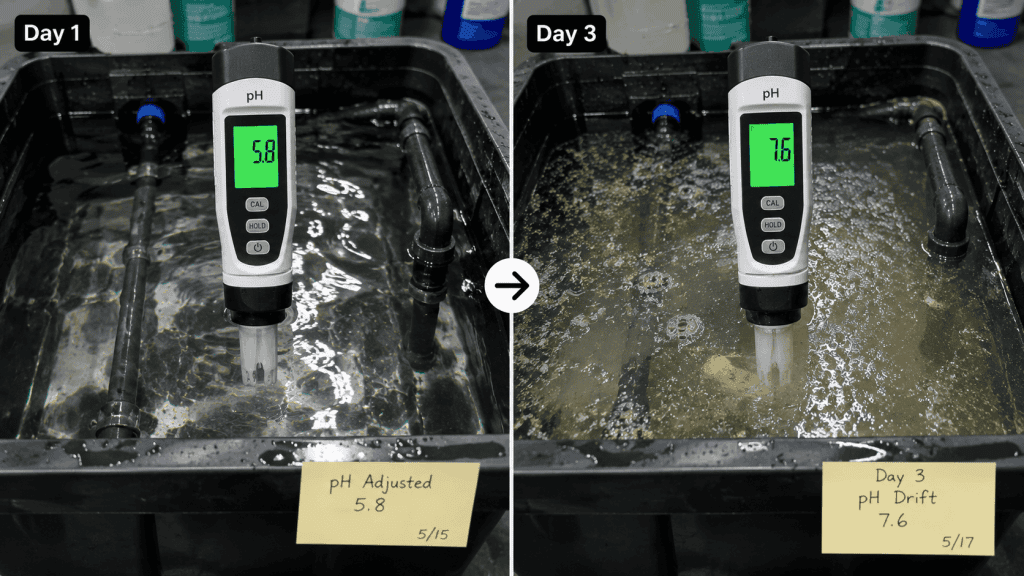
The biggest problem with using lemon juice is that it doesn’t last. The pH will bounce back.
Growers on forums like Reddit call it the “pH rollercoaster.” You might get your water perfectly adjusted to 5.8, only to find it has shot up past 7.0 a day later.
This happens because citric acid is an organic acid. It’s food for the microbes in your water. They break it down, which destroys its ability to hold the pH down. On top of that, if your water is hard, the minerals in it, like calcium carbonate, will steadily neutralize whatever acid is left. The result is a constant, frustrating climb back toward alkaline.
Growers commonly notice:
- Daily pH drift
- Repeated adjustments
- Fluctuating nutrient absorption
- Increased risk of nutrient lockout
This instability explains why experienced growers steer away from unreliable homemade pH adjusters and often recommend commercial pH Down products for reservoirs that remain in use for several days.
Is Lemon Juice Safe for Hydroponics?
Lemon juice is a temporary fix at best. For managing a hydroponic nutrient reservoir long-term, it’s a poor choice.
These systems rely on stable water chemistry. When the pH swings up and down constantly, it stresses the roots. More importantly, it locks up key nutrients. Elements like calcium, magnesium, and iron become less available to the plants just when they need them most.
Research from the Journal of Horticultural Research shows
“Vinegar reduced the yield of all crops in comparison to pH Down. When compared to pH Down, lime juice reduced the yield of basil and Swiss chard but not that of lettuce.” – Journal of Horticultural Research
There’s another issue: raw lemon juice can feed bacteria. In systems like deep water culture or Kratky method, where the same water recirculates, adding organic material like lemon juice can trigger bacterial blooms. This clouds the water and competes with your plants.Risk
| Risk | Why It Happens |
| Slime | Organic material feeds microbes |
| Odor | Increased bacterial growth |
| Root rot | Reduced oxygen around roots |
| pH swings | Citric acid degrades rapidly |
Before switching to lemon juice, consider these situations:
- Temporary emergency correction
- Single watering session
- Small container plants
Avoid it for:
- Large hydroponic reservoirs
- Automated dosing systems
- Commercial production
- Long-term nutrient storage
Commercial pH Down products based on phosphoric acid remain far more stable because they resist biological breakdown.
Why Is Lemon Juice Better for Soil Than Hydroponics?
Soil is far more forgiving than a hydroponic tank. It has a built-in buffer.
Living soil is packed with minerals, decomposed organic matter, and networks of microbes and fungi. All of this works together to absorb and moderate sudden changes in acidity. A splash of lemon juice in your watering can lower the pH of the water, but by the time it moves through the soil, that sharp change has been softened. This protects the roots from getting hit with a sudden shock.
This is why some gardeners use it for plants that crave acidity, like blueberries or azaleas. They aren’t trying to fix their soil’s pH with lemon juice. They’re just taking very alkaline tap water and knocking the edge off it before it goes into the ground already suited for acid-loving plants. It’s a tweak to the irrigation, not a replacement for good soil care.
Healthy soil offers several advantages:
- Better buffering
- Improved microbial activity
- Greater nutrient retention
- Reduced pH fluctuation
According to several university extension services, long-term soil acidity should be adjusted with proper soil amendments rather than repeated applications of household acids.
Even in soil, lemon juice should remain an occasional tool rather than a permanent solution.
What Are the Biggest Risks of Using Lemon Juice?
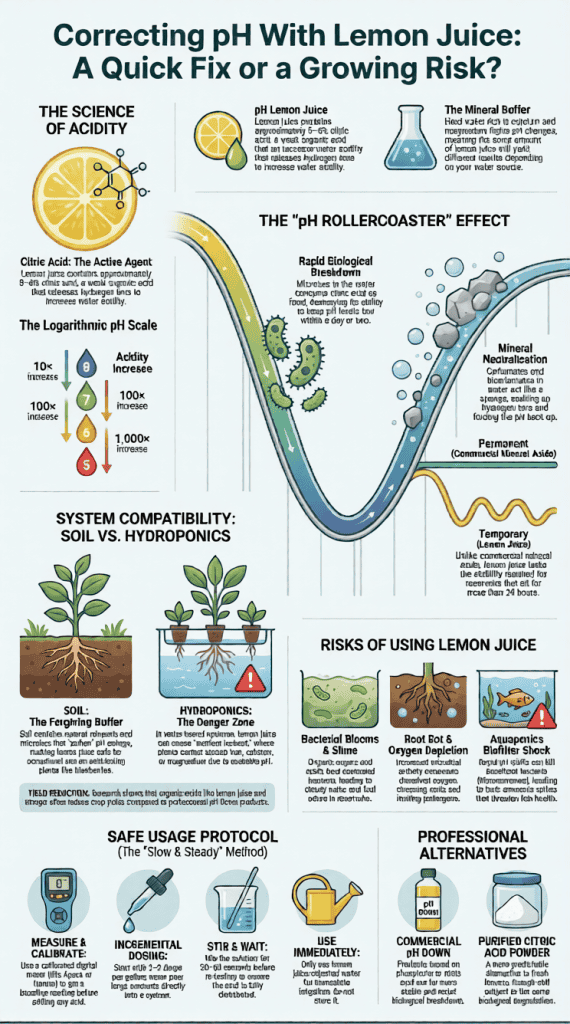
Too much lemon juice can injure roots, destabilize nutrient availability, and feed unwanted microbes.
Pouring highly concentrated lemon juice directly into the soil substrate or nutrient reservoir creates localized zones with extremely low pH. Those acidic pockets may damage delicate root hairs, slowing nutrient absorption.
Plants suffering from unstable pH often display symptoms including:
- Iron chlorosis
- Calcium lockout
- Stunted growth
- Poor root development
Another concern involves biology. Because lemon juice contains natural organic compounds, it can become a food source for bacteria.
This may contribute to:
- Bacterial bloom
- Biofilm formation
- Reduced oxygen
- Increased risk of root rot
In aquaponics, the consequences become even more serious. Beneficial bacteria such as Nitrosomonas and Nitrobacter, which drive the nitrification process within the nitrogen cycle, may become stressed by rapid pH shifts. That can contribute to an ammonia spike, threatening fish health.
Why Can’t You Calculate the Perfect Lemon Juice Ratio?
Every water source has different alkalinity, making fixed recipes unreliable.
Two gallons of water may have identical pH readings but completely different buffering capacity. One could change with only a few drops, while another barely responds.
Several variables affect dosing.
| Factor | Effect |
| Water source | Different buffering capacity |
| Fresh vs bottled | Variable acid concentration |
| Water hardness | Neutralizes acid differently |
| Total dissolved solids | Changes acid demand |
Beyond that, pH measures active hydrogen ions, not total acid content. Professional growers sometimes rely on titration rather than pH alone to understand the complete chemistry.
That explains why dosage charts found online rarely agree.
Should Brewers and Aquaponic Growers Use Lemon Juice?
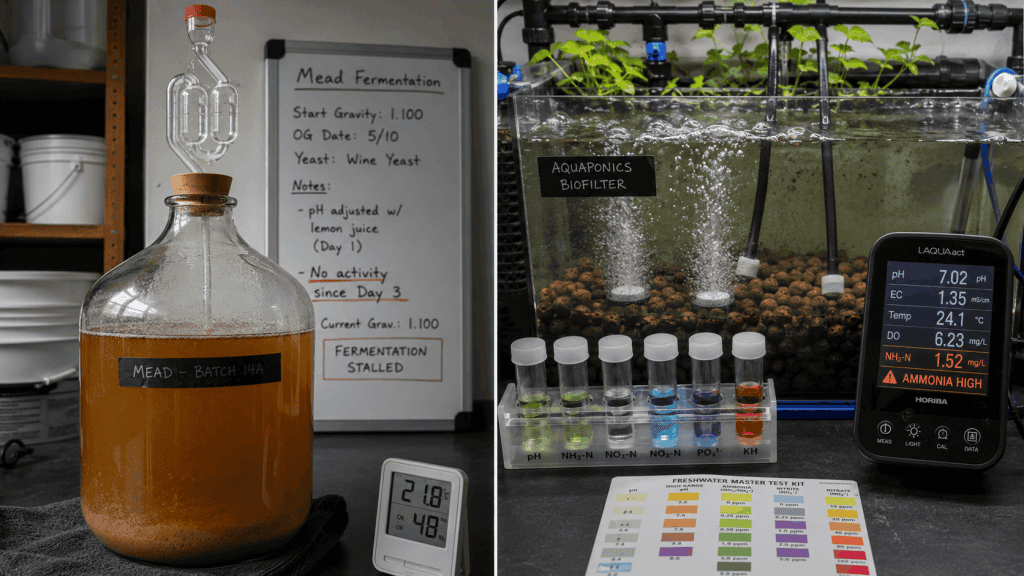
Experienced brewers and aquaponics growers tend to steer clear of raw lemon juice for long-term use. The reasons differ, but the core issue is the same: unpredictable control.
In brewing, whether it’s mead, cider, or wine, adding lemon juice can drop the pH too far, too fast. Many yeast strains perform best within a specific, narrow pH range. Pushing the environment too acidic risks a stalled fermentation, where the yeast simply stops working. That’s why pros don’t just check pH; they often measure “titratable acidity” too, which tells them the total acid content affecting the flavor and stability.
Aquaponics has a different worry: the biofilter. This system depends on a delicate balance of bacteria to convert fish waste into plant food. A rapid pH swing from something like lemon juice can shock those bacterial colonies, slowing down their processing. When that happens, ammonia can build up in the water, which is bad news for both the fish and the plants.
Experienced operators generally prefer:
- Controlled mineral acids
- Continuous monitoring
- Stable reservoir chemistry
Those methods produce far fewer surprises than repeated additions of kitchen ingredients.
What Alternatives Give More Stable pH Control?
Commercial products and purified acids provide much greater consistency than raw lemon juice, making them a better choice for maintaining hydroponic pH for fruiting plants over time.
Purified citric acid powder offers more consistent dosing than squeezed lemons because the concentration remains predictable. Even so, most hydroponic growers still prefer mineral acids for long-term stability.
| Situation | Best Choice |
| Houseplants | Lemon juice occasionally |
| Soil gardens | Citric acid or lemon juice occasionally |
| Hydroponics | Commercial pH Down |
| Commercial production | Phosphoric acid, nitric acid, or sulfuric acid |
Other alternatives include:
- Purified citric acid
- Commercial pH Down
- Proper water testing
- Routine meter calibration
Quality equipment from Hanna Instruments and Apera Instruments helps maintain accuracy regardless of the acid selected.
How Can You Correct pH With Lemon Juice Safely?
Measure carefully, dose gradually, and reserve lemon juice for situations where temporary adjustment is acceptable.
Following a consistent routine reduces mistakes and minimizes the chance of overcorrection.
Use this workflow every time:
- Measure baseline pH.
- Add only a few drops.
- Mix thoroughly.
- Wait 30–60 seconds.
- Test again.
- Water immediately.
For best results:
- Measure every batch.
- Record readings in a log.
- Use lemon juice only for immediate watering.
- Choose commercial pH Down for reservoirs and automated systems.
Small, measured adjustments almost always outperform aggressive corrections.
FAQs
Can Lemon Juice Lower pH Without Causing Nutrient Lockout?
Yes, but the results depend on your growing system and water quality. The citric acid in fresh lemons is a weak acid that releases hydrogen ions, helping lower pH. However, it has limited buffering capacity, so the pH may rise again over time. This pH rebound or pH drift can reduce nutrient absorption and increase the risk of nutrient lockout, especially in hydroponic systems that require stable pH levels.
Does Tap Water pH Affect How Lemon Juice Changes Water?
Yes. Tap water pH, well water pH, water hardness, and total dissolved solids all affect how much lemon juice is needed to change the pH. Water with high mineral content has greater buffering capacity, making it more resistant to pH changes. You should always perform water testing with a digital pH meter or liquid test kit instead of estimating. Measuring electrical conductivity, ppm level, and regularly using calibration fluid for an ATC probe will improve measurement accuracy.
Is Lemon Juice Safe for Hydroponic pH and Aquaponics Systems?
Lemon juice can temporarily adjust hydroponic pH, but it is not the best choice for long-term use in a nutrient reservoir, deep water culture, or the Kratky method. Because lemon juice is an organic material, it can feed beneficial microbes, but it may also promote a bacterial bloom, increase the risk of root rot, and interfere with the nitrogen cycle in an aquaponics biofilter. Stable systems generally require a more consistent method of pH adjustment.
What Is Better Than Lemon Juice for Long Term pH Control?
For long-term pH stability, many growers use a dedicated commercial pH Down solution because it produces more consistent results than lemon juice. These products commonly contain phosphoric acid, nitric acid, or sulfuric acid. Although acetic acid from apple cider vinegar can also lower pH, it is generally less stable over time. Always confirm the final pH with a reliable testing method, such as a digital pH meter, liquid test kit, or titration when appropriate.
Can Lemon Juice Be Used Outside Gardening and Hydroponics?
Yes. Lemon juice is sometimes used for mash adjustment in mead brewing, cider making, and other fermentation projects. The citric acid, ascorbic acid, and other natural compounds found in fresh lemons or bottled lemon juice can affect the environment in which wine yeast ferments. Incorrect concentrate dilution or unstable acidity may contribute to a fermentation stall, so careful measurement and monitoring are essential for consistent results.
Lemon Juice as a Long-Term pH Solution
Lemon juice works in a pinch. If you’re watering potted plants or garden soil and need to lower the pH right now, a little citric acid will do it. But it’s a temporary fix. The effect fades fast as the juice breaks down.
For systems that need steady, precise pH levels, like hydroponics, aquaponics, or brewing lemon juice isn’t reliable. You need a stable adjuster that won’t swing back a few hours later.
As Tophydroponicgarden advises, the right method depends on your water and your system. Don’t just follow a recipe. Use a calibrated pH meter, make small changes, and watch how the level holds over a day or two. Consistent monitoring and gradual adjustments always beat a quick fix for growing healthier plants.
References
- https://fieldreport.caes.uga.edu/publications/B1277/water-quality-assessment/#3#2
- https://agris.fao.org/search/en/records/675ac7f40ce2cede71d15eff
Related Articles
- https://tophydroponicgarden.com/homemade-ph-adjusters-for-hydroponics/
- https://tophydroponicgarden.com/when-to-adjust-ph-levels/
- https://tophydroponicgarden.com/hydroponic-ph-for-fruiting-plants/
Was this helpful?

I’m Barrie L., a passionate hydroponic gardening enthusiast dedicated to cultivating thriving, soil-less gardens. With a focus on all things hydroponic, I share my expertise on innovative growing techniques and sustainable practices through my blog, tophydroponicgarden.com. As a seasoned hydroponics specialist, my goal is to inspire and guide fellow gardeners in harnessing the power of water-based cultivation for bountiful and eco-friendly harvests. I’m also an author of the book “Hydroponics For Absolute Beginners: Your Step By Step Guide For How To Create An Hydroponics System At Home Without Soil, For Growing Vegetable, Fruit And Herbs.” which is sold on Amazon. Join me on a journey of redefining the way we cultivate plants, one nutrient-rich solution at a time. Happy growing!