

Picking the right water pump for your hydroponic system isn’t about getting the most powerful one. It’s about matching the pump’s flow rate and head height to your specific setup. Getting this right saves energy and keeps your plants healthy. Choosing wrong can waste money and hurt your plants. Let’s look at how to find a pump that works perfectly for your system.
Smart Hydroponic Pump Buying Essentials
- Choose a pump based on actual operating flow, not the advertised GPH rating.
- Calculate total dynamic head, including static head, friction loss, and plumbing restrictions before buying.
- Match the pump type and operating pressure to your hydroponic method for healthier roots, lower energy use, and longer equipment life.
What Should You Know Before Buying a Hydroponic Water Pump?
Picking the right pump means looking at a few key numbers: flow rate (GPH or LPH), maximum head height, operating pressure, and your reservoir size. These specs decide if your nutrient solution actually gets to every plant root, or if it’s just sloshing around in the tank.
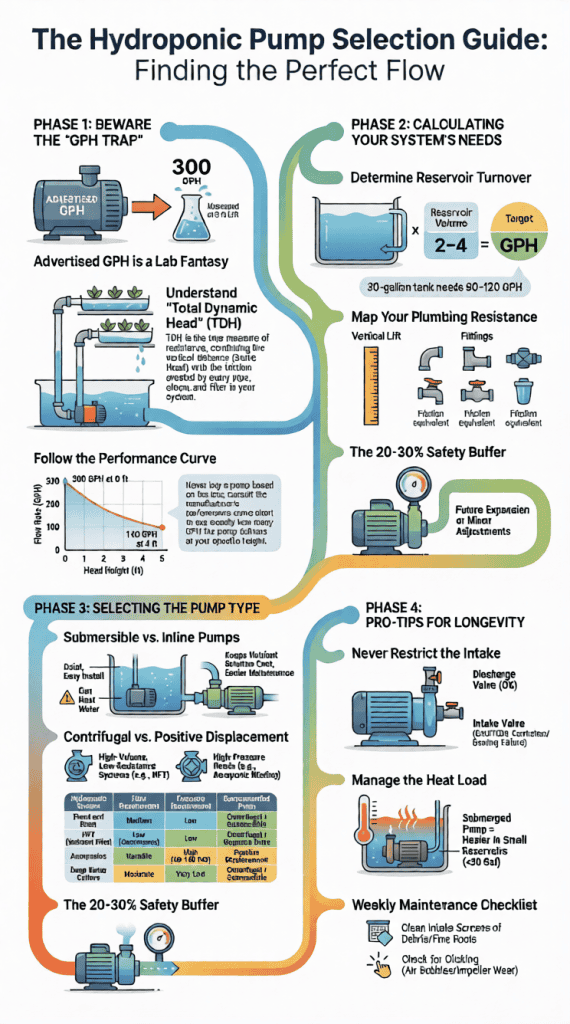
New growers often grab the pump with the biggest GPH number on the box. But that number is misleading. It’s measured in a lab with zero pipes, no lift, and no friction. As soon as you add real plumbing, the actual performance plummets.
A standard recommendation for systems like Flood & Drain or NFT is circulating reservoir volume 2 to 4 times per hour. For a 30-gallon tank, aim for 60–120 GPH at your system’s operational head height.
Before comparing brands, gather these measurements:
- Reservoir volume
- Vertical lift
- Number of growing sites
- Plumbing fittings
- Operating schedule
- Irrigation method
Why isn’t the advertised GPH enough?
When I test a brand-new pump on my bench, the GPH printed on the box means almost nothing. In my shop trials, a standard 300 GPH magnetic drive pump delivering full flow in a flat tub drops to less than 140 GPH the moment I hook it up to a 4-foot vertical climb with two 90-degree elbows. Always plan for real-world drop-off rather than lab baseline numbers.
That’s exactly right. Every pump has a performance curve, a chart that shows you exactly how much its flow rate drops as it works against lift and friction. It’s not a guess; it’s a predictable decline. If you ignore this curve, you’re basically buying blind.
You might get a pump that can technically lift water to the top of your system, but at such a reduced flow that it barely trickles out. Your plants at the end of the line will starve. The chart tells you the real story: at your system’s total dynamic head, this pump will deliver this many gallons per hour. It’s the only way to know for sure if a pump can do the job.
What measurements should you collect first?

Credits:Do it with Pierre
Accurate sizing depends on collecting real measurements instead of estimating.
First, know your reservoir volume. Aim to circulate that entire volume about twice per hour.
Second, measure the vertical lift from the pump to your system’s highest exit point.
Finally, and most critically, account for every piece of plumbing. Each foot of tubing, elbow, valve, and filter adds friction, increasing the total head your pump must overcome. This final number, your total dynamic head, is the only one that matters when checking a pump’s performance curve.
That preparation makes every later sizing calculation substantially more accurate.
How Do Flow Rate and Head Height Work Together?
There’s a big gap between a pump’s ideal lab rating and how it performs in your actual setup. That gap is what makes the difference between a system that waters evenly and one that leaves plants dry.
Flow rate and head height are a package deal. The flow rate tells you how much water moves. The max head height tells you how high it can push that water before the flow stops. You have to look at them together.
A common mistake is grabbing the pump with the biggest GPH number, thinking more is always better. But with centrifugal pumps, output drops steadily as the water has to climb higher. Gravity fights the impeller, and flow diminishes with every added foot of lift or foot of pipe. The highest GPH rating won’t help if the pump can’t push water to the top of your grow bed.
Understanding both values prevents disappointing real-world performance.
| Metric | Why It Matters |
| Flow Rate (GPH/LPH) | Determines nutrient circulation speed |
| Static Head | Measures true vertical lift |
| Total Dynamic Head | Adds plumbing resistance to static head |
| Flow Curve Chart | Shows actual pump output at each height |
The basic principle is simple: a pump moves less water the higher it has to push it. This isn’t a flaw; it’s just physics, a standard part of irrigation design.
Before you even think about special fittings or filters, you need a solid grasp of head calculations. This is the non-negotiable foundation. Getting this right from the start prevents the most common cause of pump failure, asking it to do more than it physically can.
What is static head?
Static head measures the vertical distance between the pump intake and the highest discharge point.
If a pump sits inside a reservoir while supplying a ZipGrow tower layout standing 6 feet tall, that distance represents the starting point for pump selection. Static head ignores plumbing resistance, making it only one part of the equation.
Why does dynamic head matter more?
Total dynamic head combines static head with every restriction inside the plumbing system.
Every fitting in your plumbing acts like an obstacle. Elbows, valves, filters, and even narrow sections of pipe, they all create friction.
This friction has a real, measurable effect. According to standard hydraulic guides (such as the Hydraulic Institute), fittings and friction loss can be calculated using equivalent pipe lengths, where a single 90° elbow adds equivalent friction to several feet of straight pipe. So, a pump rated for a 6-foot lift might actually be struggling against what feels like 8 or 9 feet of resistance in your system.
Research from International Journal of Applied Science and Technology shows:
“Total dynamic head is the major factor that determines the optimal performances of submersible pumps. If the total head on the system increases, the volume of the discharge will be reduced proportionally until its stops.” – International Journal of Applied Science and Technology
The result is a severe drop in actual flow. The water that finally reaches your plants is just a fraction of what the pump’s box promised.
Which Hydroponic System Needs Which Pump?
Different hydroponic systems demand different combinations of flow, runtime, and pressure. Selecting specialized water pumps for nutrient delivery improves root zone oxygenation, reduces maintenance, and stabilizes your feeding schedule across every growing cycle.
A continuous-flow system rarely benefits from the same pump used in a high-pressure misting setup. Likewise, a vertical tower garden experiences very different hydraulic challenges than a deep water culture reservoir.
Selecting equipment according to application produces better long-term reliability.
| Hydroponic System | Flow Requirement | Pressure Requirement |
| Flood and Drain (Ebb and Flow) | Medium | Low |
| Nutrient Film Technique | Low Continuous Flow | Low |
| Micro Irrigation / Drip Emitters | Medium | Low to Medium |
| Aeroponic Misting Nozzles | Variable | High |
| Deep Water Culture | Moderate Circulation | Very Low |
Nutrient Film Technique (NFT) generally requires relatively modest continuous flow per channel instead of extremely high volume, while aeroponic misting nozzles often require specialized pumps capable of delivering 60–100 PSI rather than standard aquarium-style impeller pumps.
Understanding these hydraulic differences prevents both underperformance and unnecessary equipment costs.
Why can’t one pump fit every system?
Every irrigation method places unique demands on water delivery.
An ebb and flow system floods a tray quickly before draining, while an NFT channel relies on steady, uninterrupted nutrient circulation from a continuous run motor. Pairing an incompatible pump type with a specific delivery method is a primary cause of system failure in hydroponics.
Standard magnetic-drive centrifugal pumps excel at moving continuous volume in NFT channels or flood tables, but choke under backpressure. Drip emitter lines require 10–25 PSI, while true aeroponic fog systems bypass centrifugal pumps entirely in favor of positive-displacement diaphragm booster pumps capable of sustaining 60–100 PSI through fine misting nozzles
A single pump rarely excels across every application.
When do you need a high-pressure pump?
You have two main types of pumps for hydroponics, and they work very differently.
Standard centrifugal or magnetic drive pumps are built to move a high volume of water with minimal resistance. They’re great for circulating water in flood tables or deep water culture. But if you try to force that water through a tiny opening, like a misting nozzle, they choke. The pressure builds up, flow drops to almost nothing, and the pump can stall or overheat.
Positive displacement pumps are the opposite. They’re built to create pressure, measured in PSI. They physically push a set volume of water against resistance.
This makes them essential for systems like aeroponics, where you need to force nutrient solution through fine misting nozzles to create a fog. Using a centrifugal pump for that job results in a weak drizzle, clogged nozzles, and constant frustration.
Should You Choose a Submersible or Inline Pump?
For a small home system, a submersible pump is often the easiest choice. You just drop it in the reservoir. It’s simple, the water muffles the sound, and it’s ready to go. Many models for hobbyists use brushless DC motors and ceramic shafts, which are quiet and can run continuously without much trouble.
For a larger setup, an inline or external pump is usually better. These sit outside the tank. The big advantage is that the motor’s heat stays out of your nutrient solution, which helps keep reservoir temperatures down. They’re also easier to access for maintenance or replacement, which is why you see them used in bigger commercial systems or sump designs.
If long-term reliability is your priority, comparing durable water pumps with sealed bearings, corrosion-resistant materials, and continuous-duty ratings can make maintenance much easier. The choice really comes down to your reservoir size, how much heat you can manage, and how easy you need maintenance to be.
| Submersible Pump | Inline Pump |
| Quiet operation | Higher flow capacity |
| Easy installation | Lower reservoir heating load |
| Compact footprint | Easier servicing |
| Lower plumbing complexity | Better for large systems |
According to engineering discussions from Reef Central, nearly all electrical energy consumed by a submerged pump eventually becomes heat inside the water, making motor wattage an important consideration rather than simply operating cost.
Before selecting a pump location, understanding thermal behavior prevents several common root-health problems.
When does pump heat become a problem?
Running a pump non-stop acts like a small heater in your reservoir. Every watt consumed by a submerged pump acts as an internal heater directly inside the reservoir.
Running a continuous 60-watt submersible pump in a compact 15-gallon tank can increase water temperature by 6°F within 24 hours, spiking the reservoir straight into the Pythium root-rot danger zone. For small reservoirs under 30 gallons, utilizing an external inline pump or selecting lower-wattage motors is essential to protect root zone dissolved oxygen.
This is a bigger problem for small systems. A 10-gallon tank will heat up much faster than a 100-gallon one, simply because there’s less water to absorb the warmth.
The consequence isn’t just a warm tank. Warmer water can’t hold as much dissolved oxygen. When oxygen levels drop in the root zone, your plants suffocate and become far more vulnerable to pathogens like Pythium, or root rot. Managing that pump heat is a direct part of keeping roots healthy.
When is an inline pump worth the extra cost?
When your hydroponic setup gets big, or if it’s running non-stop, you should think about using an inline pump. These pumps sit outside your water tank.
Big systems like commercial NFT channels, tall tower gardens, and large drip setups work better with an external pump. The main reason is heat. The pump motor gets warm, and if it’s sitting in your nutrient tank, it heats the whole reservoir. An inline pump keeps that heat out of the water.
They’re also easier to work on. You don’t have to reach into the tank to pull out a pump for cleaning. And it’s simpler to add things like filters or pressure gauges directly into the pipes. For a large, permanent system, the benefits of an inline pump usually outweigh the simpler setup of a submersible one.
Why Do Oversized Pumps Sometimes Cause More Problems?
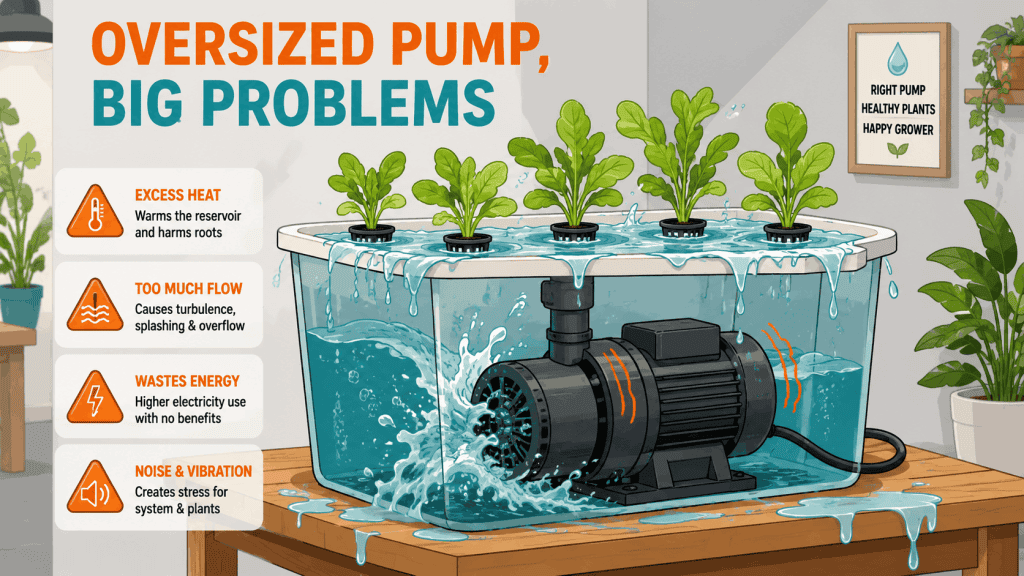
Buying the biggest pump you can find usually causes more problems than it solves. An oversized pump wastes electricity, churns up your reservoir, adds a lot of heat, and puts unnecessary strain on your pipes.
Choosing energy-saving water pumps that closely match your actual flow requirements often reduces unnecessary power consumption while maintaining reliable circulation. Once a pump is moving enough water for your plants, any extra power is just a drawback.
A lot of new growers think a huge pump is good for “future expansion.” But if you read through forums like Reddit, you’ll see the same story over and over. That giant submersible pump ends up overheating the water, vibrating loudly, and flooding the grow channels long before anyone actually expands their system.
The trouble isn’t just wasted energy. Too much flow speed leads to uneven watering. In a vertical tower garden, for example, the top nozzles might get blasted while the lower ones barely drip. Your plants won’t get the consistent feed they need.
Common problems include:
- Reservoir heating
- Overflow
- Excessive splashing
- Plumbing leaks
- Higher wattage consumption
- Accelerated mechanical wear
Only purchase additional capacity when the pump includes reliable flow regulation.
Is buying for future expansion a good idea?
It’s smart to plan ahead, but only if you’re actually going to expand soon. Buying a pump that’s way too big for what you have now is a common misstep.
Getting a pump with some extra capacity can be a good idea, but only if you can turn it down. A model with an adjustable flow rate lets you match your current needs while keeping a little power in reserve for later.
A good rule of thumb is to look for a pump that can handle about 20-30% more than your system currently requires. This gives you a bit of a buffer for adding a few more plants or some extra plumbing, without the major downsides of a massively oversized pump: high electricity bills, extra heat in the reservoir, and over-complicated piping.
Can you reduce flow safely?
You’re right, the plumbing setup is critical.
When balancing manifolds in grow setups, installing a PVC gate valve or precision needle valve on the discharge line ensures fine control. Standard ball valves shift from full flow to a trickle with a simple quarter-turn, making precise adjustments difficult.
Crucially, the intake side of a pump must never be restricted; throttling the intake starves the impeller, triggers severe cavitation, and leads to premature motor bearing failure within weeks. A gate valve lets you make very small, precise adjustments. A ball valve is more of an on/off switch; a tiny turn can cause a big, jarring change in flow, which makes fine-tuning nearly impossible.
As for the pump itself, restricting the output a bit with a valve is usually fine and won’t hurt the motor. But you should avoid completely closing off the discharge line while the pump is running. That creates a lot of backpressure and heat, which can lead to premature wear over time. A little restriction is a tool; a full blockage is a problem.
How Do Friction Losses Affect Pump Performance?
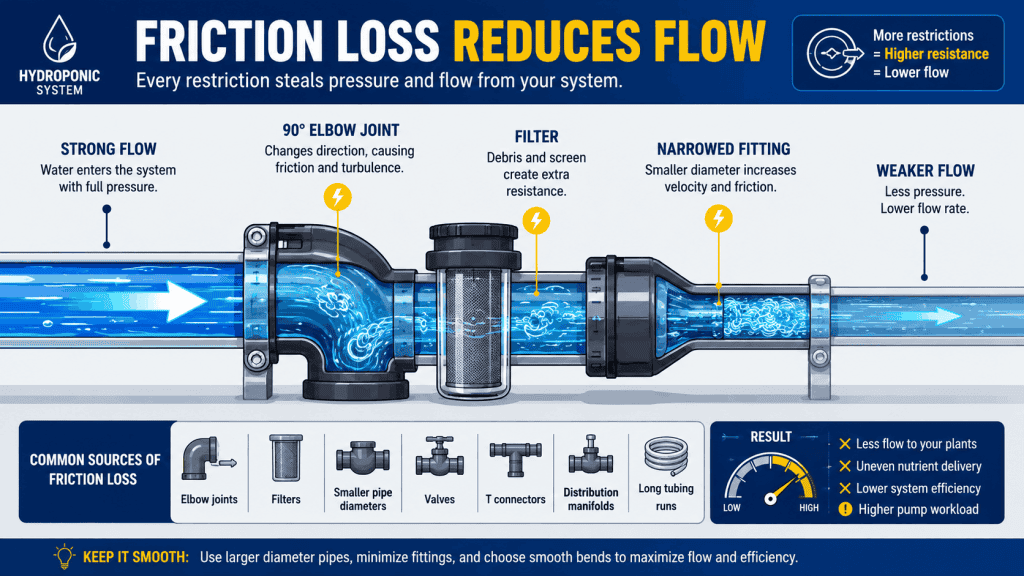
Friction in your pipes is a silent flow-killer. It works just like making the pump lift water higher. If you ignore it, your system will underperform.
Every elbow, valve, filter, and narrow section of tubing adds resistance. It all adds up.
That’s why you need to calculate total dynamic head, not just height. It combines the vertical lift with all the friction from your plumbing. This is the real pressure your pump fights against.
Several small restrictions often produce larger losses than growers expect.
Sources of additional resistance include:
- 90-degree elbow joints
- Long tubing runs
- Small pipe diameters
- Multiple T connectors
- Filters
- Distribution manifolds
Smooth plumbing improves both reliability and energy efficiency.
Why do pipe reductions disappoint growers?
Reducing tubing size does not magically increase useful pressure.
Instead, smaller tubing increases fluid dynamics losses by raising water column velocity, creating greater backpressure, and forcing non positive displacement pumps farther down their performance curve.
The result is lower actual flow despite apparently higher pressure.
Can smoother plumbing improve performance?
Yes.
Replacing sharp elbows with flexible silicone tubing, minimizing unnecessary fittings, and selecting appropriately sized supply lines significantly reduces resistance. Gentle bends preserve flow while lowering strain on the impeller and reducing overall energy efficiency losses.
How Can You Calculate the Right Pump Size?
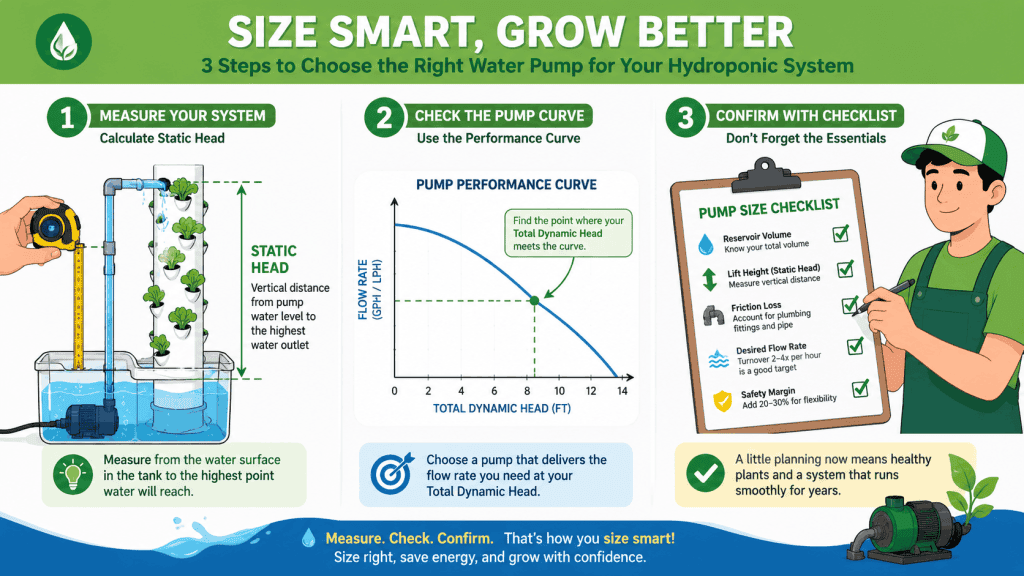
Accurate pump sizing begins with determining the required circulation rate, then confirming that the manufacturer’s flow curve chart delivers that performance at your calculated total dynamic head.
Skipping any part of this process often results in dry plants, poor nutrient circulation, or oversized equipment that wastes energy.
Follow this process:
- Measure reservoir volume.
- Calculate the desired water turnover rate.
- Measure the actual vertical lift.
- Estimate friction loss from plumbing fittings.
- Read the manufacturer’s flow curve chart.
- Leave a reasonable safety margin.
- Verify nominal pressure and compatibility with your irrigation method.
Many manufacturers also publish a pump sizing calculator that estimates expected flow using head height and plumbing characteristics.
Before purchasing, compare several models rather than relying solely on advertised specifications.
Why should you read the performance curve?
The performance curve reveals the pump’s actual operating output.
Unlike marketing labels, the graph shows exactly how GPH rating or LPH rating declines as head increases. This information allows growers to predict real-world performance rather than making expensive guesses.
As noted by Journal of Tekirdag Agricultural Faculty:
“The pumps should be used after their flow-rates are determined according to suction head, peristaltic pumps and solutions” – Journal of Tekirdag Agricultural Faculty
How much safety margin is sensible?
Choose moderate overhead rather than extreme oversizing.
Approximately 20–30% additional capacity typically provides enough flexibility for future plumbing additions while avoiding unnecessary reservoir heating load, electrical waste, and excessive turbulence.
What Problems Do Vertical Towers and Drip Systems Create?
Vertical systems are tricky. Water has to fight gravity to reach the top. Plants at the highest points often get less water, while the ones at the bottom get too much.
When you build a tall tower or stacked system, you’ll find the pump’s advertised power doesn’t mean much. The real test is whether it can push water to your highest plant.
Gardeners online talk about this all the time. Uneven watering is a common reason plants in vertical setups don’t grow well. The pump might look good on the box, but it just can’t get the job done at the top.
Watch for:
- Splashing
- Uneven flow
- Dry upper plants
- Root invasion
- Mineral clogging
- Pump overheating
Proper balancing keeps every growing site productive.
Why do upper plants sometimes dry out?
Actual pump output decreases as total dynamic head increases.
If the pump barely satisfies minimum flow requirements, upper channels may receive insufficient nutrient solution while lower outlets consume most available flow.
How do roots damage pumps?
Fine roots naturally seek moving water.
Over time they wrap around intake screens, clog intake sponge filters, reduce circulation, and increase motor strain. Routine intake sponge cleaning, installing an inline strainer, and regular inspection greatly reduce unexpected failures.
How Can You Troubleshoot Common Water Pump Problems?
Most hydroponic pump failures result from maintenance issues, clogging, or incorrect sizing instead of manufacturing defects.
Regular inspection keeps pumps operating efficiently while preventing crop losses.
| Symptom | Likely Cause |
| Weak flow | Blocked intake or friction loss |
| Buzzing or clicking | Air, debris, or impeller wear |
| Overflow | Excessive flow |
| Warm reservoir | Oversized submerged pump |
| Uneven irrigation | Incorrect manifold balancing |
Routine maintenance significantly extends service life while preserving energy efficiency and consistent nutrient delivery.
Why is the pump making clicking noises?
A clicking sound from your pump usually means one of a few things. Air might be trapped inside, which is a simple fix. It could also be a sign of physical wear, like a worn bearing, or something like a bit of debris or a small root caught in the impeller.
The first step is to turn it off and check. Clean the intake screen, look at the impeller for any blockages or damage, and make sure no plant roots have snuck in. Addressing these issues early often stops the noise and prevents a small problem from becoming a dead pump.
How often should you inspect the pump?
Inspect pumps weekly in heavily planted systems.
Clean intake filters, remove mineral deposits, verify check valve operation, and confirm the automated watering schedule, digital pump timer, or smart plug automation continues functioning correctly.
FAQs
How do I compare GPH rating and LPH rating correctly?
A pump’s GPH rating and LPH rating show how much water it can move under ideal testing conditions. The actual flow decreases as static head, vertical lift, backpressure, and friction loss increase through plumbing fittings, elbow joints, and T connectors. Always check the flow curve chart because it shows the expected flow at different heights and helps you use a pump sizing calculator to maintain steady nutrient circulation.
Can one pump work with different hydroponic growing methods?
One pump can work with several systems, but only if its performance matches the application. A submersible pump, external pump, or inline pump may be suitable for deep water culture, flood and drain, ebb and flow, nutrient film technique, vertical tower garden, micro irrigation, or aeroponic misting nozzles. Compare the required water delivery pressure, PSI rating, distribution manifold, drip emitters, and flow regulation before using the same pump in multiple systems.
What reduces water flow even when the pump seems powerful?
A high-capacity pump can still lose flow because of restrictions in the plumbing. A small pipe inner diameter, long supply lines, multiple gate valve or ball valve fittings, a check valve, a clogged inline strainer, mineral clogging, and root invasion all reduce performance. These factors increase total dynamic head, affect fluid velocity and nominal pressure, and lower the efficiency of your hydroponic system plumbing.
Which pump features improve reliability and reduce maintenance?
Choose a magnetic drive pump or centrifugal pump with a brushless DC motor, a continuous run motor, a ceramic shaft, a stainless steel impeller, and non toxic materials. Strong corrosion resistance, effective heat dissipation, and regular intake sponge cleaning help reduce mechanical wear. These features also minimize reservoir heating load and support dependable operation during continuous use.
How can I automate pump operation without hurting plant roots?
An automated watering schedule works best when it matches your growing system and plant needs. A digital pump timer or smart plug automation can maintain an appropriate water turn over rate, improve root zone oxygenation, and support water temperature regulation while helping with waterlogging prevention. Avoid creating backpressure stall in a non positive displacement pump, and consider suction lift requirements when using a self priming pump or a vortex impeller.
Choose the Right Hydroponic Water Pump with Confidence
A pump that doesn’t match your system can cause weak water flow, poor nutrient delivery, and extra work that quickly becomes frustrating. The good news is that you don’t need the biggest model, you need one that fits your setup. Check the flow rate, total dynamic head, pressure, and plumbing before you buy, because the right choice helps your system run better.
If you want a simple place to learn more, Tophydroponicgarden offers practical guides that make pump selection easier. A little planning now can help you avoid common problems later, so your hydroponic system stays reliable with less effort.
References
- https://vdoc.pub/documents/400-gph-1500l-h-submersible-pump-25w-fountain-quiet-water-pump-for-pool-aquarium-fish-tank-pond-hydroponics-v14hkr6qc600
- https://openurl.ebsco.com/EPDB
Related Articles
- https://tophydroponicgarden.com/choosing-durable-water-pumps/
- https://tophydroponicgarden.com/water-pumps-for-nutrient-delivery/
- https://tophydroponicgarden.com/energy-saving-water-pumps-for-hydroponics/
Was this helpful?

I’m Barrie L., a passionate hydroponic gardening enthusiast dedicated to cultivating thriving, soil-less gardens. With a focus on all things hydroponic, I share my expertise on innovative growing techniques and sustainable practices through my blog, tophydroponicgarden.com. As a seasoned hydroponics specialist, my goal is to inspire and guide fellow gardeners in harnessing the power of water-based cultivation for bountiful and eco-friendly harvests. I’m also an author of the book “Hydroponics For Absolute Beginners: Your Step By Step Guide For How To Create An Hydroponics System At Home Without Soil, For Growing Vegetable, Fruit And Herbs.” which is sold on Amazon. Join me on a journey of redefining the way we cultivate plants, one nutrient-rich solution at a time. Happy growing!