

Yes, you can grow onions from bulbs hydroponically, but what you get depends on your goal. Regrowing fresh green tops is usually easy. Bigger replacement bulbs? That’s a different story.
Onion bulb development depends on factors like day length, nutrition, oxygen levels, and growing conditions, so hydroponic bulb production can be trickier than many people expect.
A lot of gardeners drop leftover onions into water and hope for a steady supply of new bulbs. Sometimes they get healthy green shoots instead. Most people are surprised by that. Mature onions are often better for producing fresh greens than growing large new bulbs.
Keep reading to learn what works, what commonly goes wrong, and how to get the best results from hydroponic onions.
Hydroponic Onion Essentials
- Onion bulbs can regrow successfully in hydroponic systems, especially for green onion production.
- Proper oxygenation and moisture management play a bigger role than nutrient strength alone.
- Full bulb production is possible but requires the correct photoperiod and stable growing conditions.
What Happens When You Put an Onion Bulb in a Hydroponic System?
You can put an onion bulb straight into a hydroponic system. It doesn’t need soil. The bulb has its own stored energy to get started.
Inside an onion bulb are carbohydrates and nutrients it saved up. When the base gets wet and has oxygen, it kicks into gear. Roots form first. Then, a green shoot pushes up from the middle.
In a typical hydroponic setup, you’ll see roots in just a few days. Green tops appear soon after. This is especially fast if the bulb was already starting to sprout before you put it in.
The speed comes from the bulb using its own built-in reserves. At the beginning, it barely uses the nutrients in the water. It’s living off its savings.
You can usually harvest the green tops multiple times. Cut them, let them grow back, and cut them again. The plant will keep going until the bulb’s stored energy runs down and the roots can’t keep up. After that, growth stops.
Are You Growing Green Onions or Full Bulbs?

You’re growing green onions, not full bulbs. The two are very different.
A bulb can sprout new leaves easily, but making another big bulb is a whole separate process. Green onions, or scallions, are mostly about leaf growth. The bulb’s own energy makes the greens shoot up fast, so you get a harvest quickly.
Getting a full-sized onion is much harder. It needs the right day length, specific nutrients, temperature, and the correct variety. For example, research from Cornell shows that onions won’t start bulbing until they get the exact amount of daylight their genetics require.
Green onions are easier because the bulb does most of the work. You don’t have to control the environment as much, and you see results fast.
Growing a full bulb is tough. The day length has to be perfect. If the plant gets stressed, it might bolt and go to seed instead. The mature bulbs can also rot.
For a beginner, sticking with green tops is the way to go. You’re more likely to succeed and you’ll get something to use much sooner. A full onion can take 80 to 120 days to form.
Why Do Store-Bought Onion Bulbs Often Fail?
A grocery store onion is already finished growing. People sometimes think you can put one in hydroponics to make it bigger, but that’s usually wrong. The bulb has mostly done its job.
There’s a problem called the “set trap.” Onion sets and mature bulbs are often set up to flower, not get bigger. They’re looking to make seeds.
Bolting, or going to seed, happens for a few reasons. Temperature swings are a big one. Any kind of environmental stress can trigger it. It’s also just what onions do. They’re biennials.
They make a bulb in year one, and want to flower in year two. A hydroponic system can accidentally push them into that second-year mode.
So, will a mature bulb get larger? Often, no. The plant shifts its energy to making flowers and seeds instead.
The best use for a sprouting grocery store bulb is to grow green onions from the top. Don’t expect a new, full-sized onion. Agricultural extension programs consistently list bolting as a top reason for poor onion yields.
Which Hydroponic System Works Best for Onions?
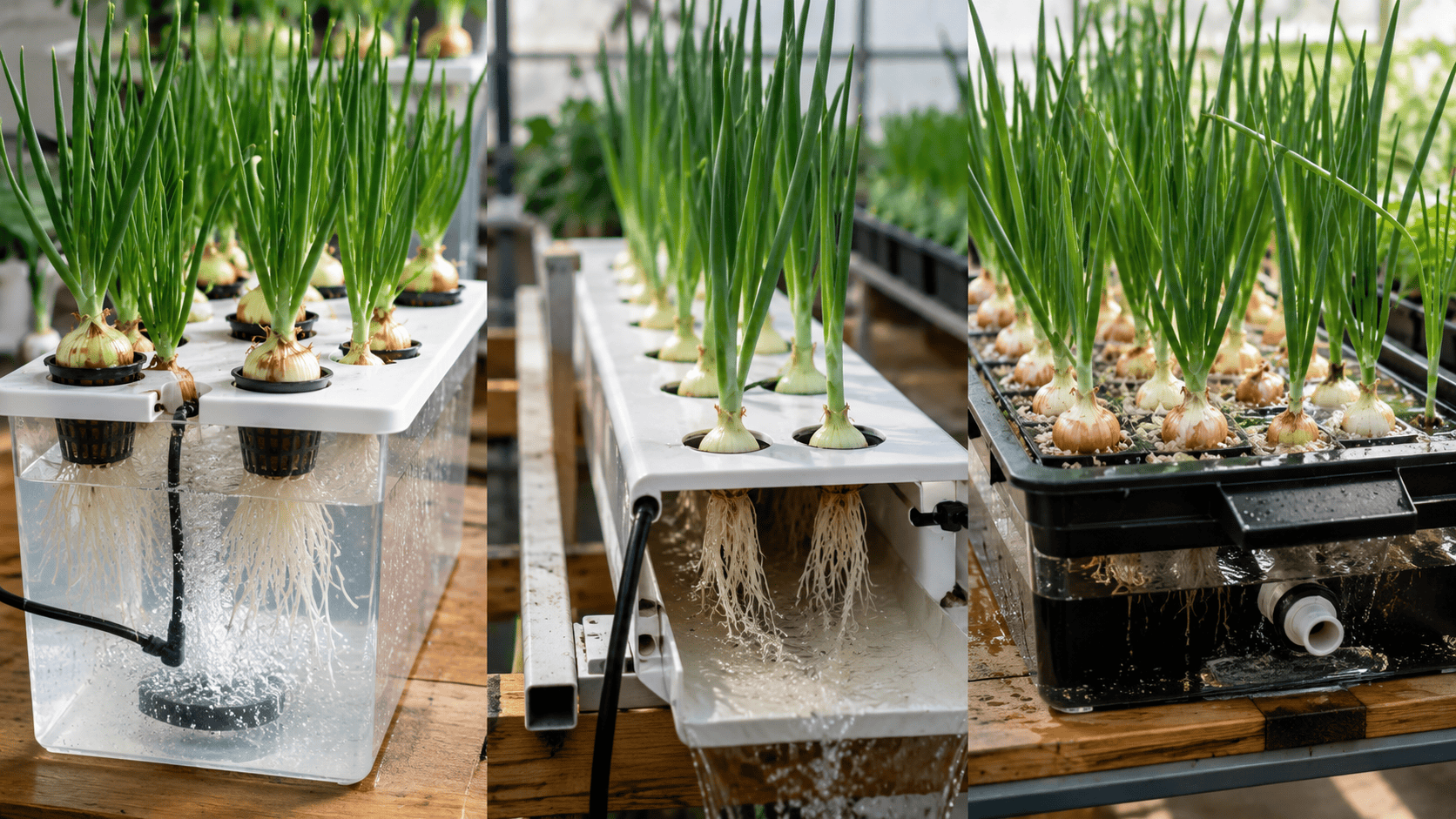
For onions, Deep Water Culture (DWC) and Ebb and Flow systems work best.
You can try other methods like Nutrient Film Technique or aeroponics, but it is worth noting that some plants not suitable for these specific setups can make the process difficult. DWC is effective because the roots are always in the nutrient solution, which leads to fast leaf growth.
DWC is effective because the roots are always in the nutrient solution, which leads to fast leaf growth. It’s also a simple setup for beginners. The main challenges are rot and making sure the water has enough oxygen. If the air pump fails, the roots can suffocate quickly.
Ebb and Flow systems are popular for a different reason. They flood the roots with nutrients and then drain it all away. This cycle gives the roots more air and prevents them from sitting in stagnant water. It greatly reduces the chance of the bulb rotting.
Your choice depends on your priority. Go with DWC for a straightforward, low-maintenance start. If you’re worried about rot, especially with mature bulbs, Ebb and Flow is the safer bet.
Data from Horticulturae (MDPI) demonstrates
“The plants grown in FL [Floating System, similar to Deep Water Culture] and AG [Aggregate System, similar to Ebb and Flow] yielded 7.87 and 7.57 kg m−2, respectively, followed by those grown in AER (6.22 kg m−2), while those grown in NFT produced the lowest yield (5.20 kg m−2).” – Hydroponic Hero
Research from the University of Arizona’s Controlled Environment Agriculture Center backs this up, noting that dissolved oxygen levels are a major factor for root health in hydroponics.
How Do You Prevent Onion Bulb Rot?
The most important rule is to keep the bulb dry. The biggest problem you’ll face is rot.
A lot of people make the mistake of dunking the whole onion in the water. That’s a perfect way to grow bacteria and mush.
Rot sets in fast because of still water, not enough oxygen, and the bulb itself staying wet. You have to place it correctly. The roots should go down into the nutrient solution.
The flat bottom of the bulb, the basal plate, can be near the moisture. But the main body of the bulb must stay completely above the waterline.
You can use a net cup with something like clay pebbles or rockwool to hold it in this position.
Oxygen is non-negotiable. An air stone isn’t optional. It pumps air into the water, which the roots need to breathe. Without it, the roots start to die. Studies on hydroponic roots show they can be damaged from lack of oxygen in just two days, depending on conditions.
What Nutrient Solution Do Hydroponic Onions Need?
Onions don’t need a super-strong nutrient mix. They do best with a moderate solution and a stable pH.
Managing the nutrients is key for how much you’ll harvest. For the electrical conductivity (EC), which measures salt concentration, a good range is 0.8 to 1.0 mS/cm when the plant is first getting established.
During its main growth phase, you can bump that up to 1.4–1.6 mS/cm. Using an EC meter helps you avoid shocking the plant with a solution that’s too strong or too weak.
Keep the pH between 6.0 and 6.5. This range lets the roots absorb the nutrients efficiently.
Watch for signs that something’s off. Look for burnt tips on the leaves, growth that seems too slow, or roots that look weak and thin.
A calcium deficiency often shows up as distorted new growth. In practice, keeping the pH and nutrient levels steady is usually more important than hitting a perfect number every single time.
| Growth Stage | Recommended EC (mS/cm) | Recommended pH | Primary Goal |
| Establishment Stage | 0.8–1.0 | 6.0–6.5 | Root development |
| Active Vegetative Growth | 1.4–1.6 | 6.0–6.5 | Leaf production |
| Bulb Developtment | 1.4–1.6 | 6.0–6.5 | Bulb expansion |
| Ongoing Maintenance | Monitor regularly | Maintain stability | Consistent nutrient uptake |
How Much Light Do Hydroponic Onions Need?
Light is everything for an onion’s life cycle. How long the lights are on each day directly controls whether it makes a bulb or just keeps making leaves.
Onions are divided into groups based on what they need: short-day, day-neutral, and long-day varieties. Picking the right one for your setup is critical. The plant won’t even start forming a bulb until it gets the specific amount of daylight its genetics are programmed for.
As highlighted by Plant & Food Research
“Long-day photoperiods lead to the downregulation of AcFT4 and the upregulation of AcFT1, and this promotes bulbing. The observation that FT proteins can repress and promote different developmental transitions highlights the evolutionary versatility of FT.” – Hydroponic Hero
For hydroponic growing indoors, a standard schedule is 14 to 16 hours of light per day using full-spectrum LEDs, on a consistent timer. If you get the day length wrong for your variety, the plant will just keep producing green tops. Bulb formation gets delayed, and if one does form, it will be smaller.
This is why automated lighting is a cornerstone of controlled environment agriculture. It removes the guesswork and makes the plant’s development predictable.
What Environmental Conditions Support Healthy Growth?

Credits : Everything Hydroponics
Keeping the environment steady is more important than most people realize. Big swings in temperature or humidity cause more trouble than getting the nutrient mix slightly wrong.
For the roots, aim to keep the water temperature between 18 and 20°C (64–68°F). For the air around the plant, a relative humidity of 40% to 60% is ideal. Good airflow is a must to keep that humidity even and prevent disease.
Stability matters because onions hate stress. A sudden temperature spike, a draft, or a change in the water can shock the plant. This stress is a major trigger for bolting, where the plant gives up on making a bulb and tries to flower and seed instead.
Studies on indoor farming show that consistent conditions lead to more uniform plants and better use of nutrients. The plant isn’t wasting energy just trying to cope.
Why Is Aeration More Important Than Most Guides Suggest?
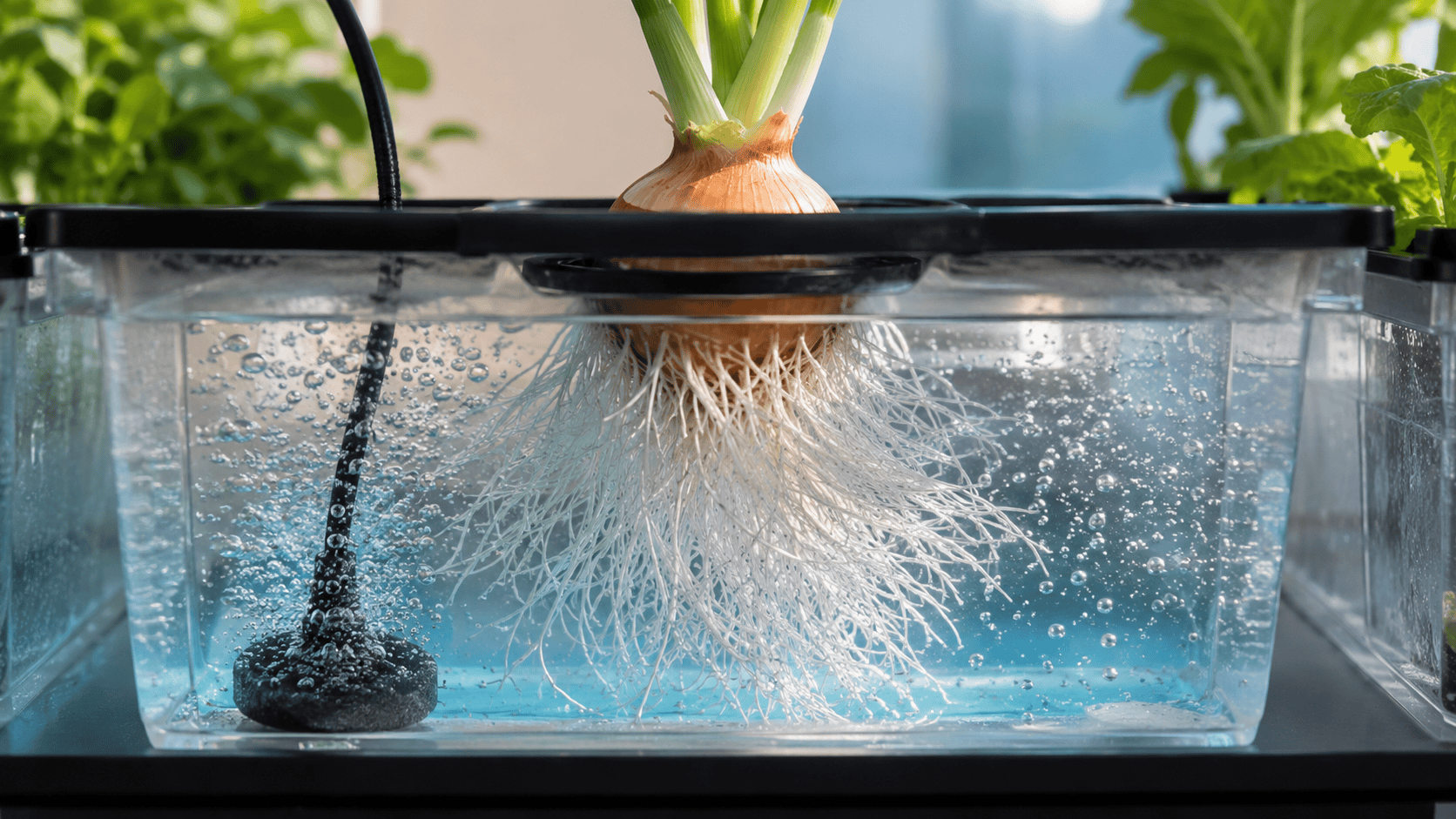
Oxygen is the make-or-break factor. A lot of those popular “regrow your onions in water” videos forget to mention it entirely.
They’ll show you the jar of water and the sunny windowsill, but they skip the most important part: the roots need to breathe. Onion roots require dissolved oxygen in the water to function. They use it for respiration and to move nutrients into the plant.
This is what those tutorials usually leave out: the need for an air stone, water circulation in the reservoir, or some other way to get oxygen to the root zone.
The effect is direct. Oxygen lets the roots take up nutrients. It encourages them to grow thick and white instead of thin and brown. Most importantly, it stops the water from going stagnant. Without oxygen, you create an anaerobic environment where rot-causing bacteria thrive.
In a hydroponic system, especially Deep Water Culture, improving the airflow to the roots will do more for your plant’s health than tinkering with the fertilizer mix.
However, because onions share similar environmental needs as others, it is helpful to know what is not suitable for dwc to keep your reservoir clean.
Stagnant, oxygen-poor water is a fast track to root rot and a dead plant. Stagnant, oxygen-poor water is a fast track to root rot and a dead plant.
Can You Grow New Onion Bulbs From Seeds More Successfully?
If your goal is to grow a full-sized onion, start from seed. It’s more reliable than trying to use a grocery store bulb.
Seeds simply work better. They don’t carry over a history that makes them want to bolt and flower. You have complete control from the very beginning, letting the plant go through its natural stages, first leaf growth, then bulb formation.
You should use seeds if you want large bulbs, a long-term crop, or are running a precise hydroponic setup. A bulb from the store has already done most of its growing. It’s far more likely to just produce seeds instead of another onion.
That doesn’t mean store-bought bulbs are useless. They’re perfect for a constant supply of green onions or scallions for the kitchen, and you can even experiment with your setup to grow garlic alongside them.
But for a true, harvestable onion bulb, most growers see much better results starting from scratch with a seed. But for a true, harvestable onion bulb, most growers see much better results starting from scratch with a seed.
FAQ
Are onion sets or seedlings better for hydroponic onions?
Both onion sets and onion seedlings can be used for hydroponic onions, but they serve different purposes. Onion sets usually establish roots faster and are often used for growing green onions or scallions. Onion seedlings provide greater flexibility for onion variety selection and are commonly preferred for onion bulb production. Choosing healthy planting material helps improve hydroponic yield and reduces early growth problems.
How can I prevent root rot in a hydroponic onion system?
You can prevent root rot by maintaining strong oxygenation in the root zone and keeping the nutrient solution clean. Air stones are commonly used in deep water culture (DWC) systems to increase dissolved oxygen levels. Regular reservoir maintenance, good water quality, and proper root zone temperature management also help. Inspect roots frequently and remove any decaying plant material to reduce disease risks.
Do grow lights affect onion bulb production indoors?
Yes, grow lights directly affect onion bulb production because onions respond to day length. The photoperiod influences bulb initiation in short-day onions, long-day onions, and day-neutral onions. Providing the correct number of light hours encourages proper bulb development. In indoor gardening systems, consistent lighting supports vegetative growth, improves biomass production, and helps produce larger bulb diameter at harvest.
How do I know if my hydroponic onions need more nutrients?
Hydroponic onions may need additional nutrients if they show slow growth, pale leaves, weak roots, or signs of nutrient deficiency. Monitoring electrical conductivity with an EC meter helps determine whether the nutrient solution contains enough dissolved nutrients. Maintaining proper pH balance also supports nutrient uptake. Regular monitoring prevents calcium deficiency, leaf tip burn, and other common hydroponic troubleshooting issues.
Which hydroponic system is most effective for growing scallions?
Scallions and green onions grow successfully in several systems, including nutrient film technique (NFT), ebb and flow, and aeroponics. NFT is often chosen because it delivers a steady flow of nutrient solution to the roots while using water efficiently. Ebb and flow systems work well with hydroponic substrates such as rockwool, LECA, perlite, and clay pebbles placed in net pots.
The Best Way to Grow Onions Hydroponically
Growing onions from bulbs hydroponically is practical when your objective is fresh green tops. Mature bulbs already contain the energy required for rapid regrowth, making them ideal for producing scallions and green onion harvests.
Large replacement bulbs are more challenging. Success depends on oxygenation, photoperiod management, nutrient solution stability, root zone temperature control, and careful hydroponic system design.
DWC and Ebb & Flow systems generally offer the most reliable balance between nutrient access and root health.
For most home growers, harvesting green tops delivers faster rewards with fewer complications. If your goal involves substantial onion bulb production, starting from seed in a properly managed hydroponic system provides the highest probability of success.
REFERENCES
- https://www.mdpi.com/2311-7524/7/11/432
- https://plantandfood.academia.edu/SusanThomson
- https://tophydroponicgarden.com/what-plants-dont-do-well-in-hydroponics/
- https://tophydroponicgarden.com/can-you-grow-garlic-in-aquaponics/
- https://tophydroponicgarden.com/what-plants-are-not-suitable-for-dwc-growing/
Was this helpful?

I’m Barrie L., a passionate hydroponic gardening enthusiast dedicated to cultivating thriving, soil-less gardens. With a focus on all things hydroponic, I share my expertise on innovative growing techniques and sustainable practices through my blog, tophydroponicgarden.com. As a seasoned hydroponics specialist, my goal is to inspire and guide fellow gardeners in harnessing the power of water-based cultivation for bountiful and eco-friendly harvests. I’m also an author of the book “Hydroponics For Absolute Beginners: Your Step By Step Guide For How To Create An Hydroponics System At Home Without Soil, For Growing Vegetable, Fruit And Herbs.” which is sold on Amazon. Join me on a journey of redefining the way we cultivate plants, one nutrient-rich solution at a time. Happy growing!