

Yes, you can grow celery hydroponically, and in many cases it grows cleaner, uses nutrients more efficiently, and develops more evenly than celery grown in soil. Celery is highly sensitive to temperature, especially heat.
Celery yields can reach about 5.25 kg/m² in cooler conditions but may drop to around 2.76 kg/m² during warmer seasons under the same nutrient setup.
Whether you’re planning a small indoor setup, building a DIY system, or exploring commercial production, success depends on a few key factors. Keep reading to learn how to set up a productive hydroponic celery system and avoid the mistakes that slow growth.
Celery Hydroponics: Complete Growing Guide
- Learn how to grow celery hydroponically from seeds or grocery-store scraps for cleaner and more consistent harvests.
- Discover the ideal growing conditions, including pH, EC, temperature, and lighting requirements to support healthy stalk development.
- Find the best hydroponic systems and techniques to grow celery successfully from planting to harvest.
Important Things to Know Before Growing Hydroponic Celery
Hydroponic celery is achievable for beginners, but it requires more precision than lettuce or herbs.
Many growers assume celery behaves like other hydroponic leafy greens. It doesn’t. Hydroponic celery cultivation rewards consistency and patience more than speed. While the crop responds well to controlled environments, it reacts quickly to poor nutrient management and temperature fluctuations.
Before you begin, keep these expectations in mind:
- Celery is slow-growing compared to many leafy greens.
- Target EC 1.8–2.4 mS/cm and stable pH levels.
- Expect roughly 110–130 days from seed to harvest, with germination taking 7–14 days, seedling establishment 3–4 weeks, and stalk thickening occurring during the final 6–8 weeks.
- Cooler temperatures produce better stalk quality.
- DWC celery systems usually offer the highest success rate.
- Regrowing celery hydroponically differs from producing a complete crop from seed.
From our experience, growers who succeed with celery treat it more like a long-term project than a quick harvest crop.
Hydroponics Improves Celery Growth Compared to Soil
Yes, hydroponics can improve consistency, nutrient delivery, and disease management.
One reason growers choose growing celery without soil is control. Instead of relying on changing soil conditions, hydroponic systems deliver nutrients directly to the root zone. That creates more predictable growth and reduces many environmental variables.
| Factor | Hydroponics | Soil |
| Nutrient control | High | Moderate |
| Water efficiency | High | Lower |
| Disease exposure | Lower | Higher |
| Growth consistency | Higher | Variable |
| Yield Potential | Up to 5.25 kg/m² | climate and soil conditions |
Hydroponic systems with controlled water chemistry generally perform better than traditional soil growing methods. Studies show that precisely managed nutrient solutions can significantly improve plant growth compared to unmanaged systems.
For optimal results, maintaining electrical conductivity (EC) between 1.8 and 2.4 mS/cm is commonly used in hydroponic celery cultivation. Keeping nutrient levels within this range helps improve celery stalk quality and overall plant consistency.
Why do growers switch from soil?
The biggest advantage is precision. A hydroponic celery nutrient solution can be adjusted within minutes, while correcting soil deficiencies often takes days or weeks.
That level of control becomes increasingly valuable when growing celery indoors or in vertical farming environments.
The Best Hydroponic Systems for Growing Celery

DWC offers the best balance of simplicity, oxygenation, and root space among different setups for hydroponic systems.
Celery develops an extensive root system. Because of that, the best hydroponic setups provide constant moisture while allowing sufficient oxygen around the roots.
The Tall Utah variety performs best in hydroponic floating raft systems, where stable nutrient delivery supports strong and consistent stalk growth.
Is DWC the safest choice?
For most growers, yes. A DWC celery system gives roots continuous access to oxygenated nutrient solution. Reservoir depth also supports celery root system hydroponics requirements better than many compact systems.
For mature celery plants, reservoirs should hold at least 15–20 liters (4–5 gallons) per plant to support root expansion and nutrient stability for root development to accommodate mature root growth.
When should you use Kratky?
The Kratky method celery approach suits:
- Testing celery scraps
- Small-space hydroponic celery projects
- Beginner learning environments
It requires fewer components than DWC, though growth may be less consistent over a long production cycle.
Can You Grow Celery in NFT Systems?
Yes, celery can grow in NFT systems when channels provide sufficient root space and nutrient flow. However, NFT is generally less forgiving than DWC because roots can dry out quickly during pump failures
How Do You Start Celery Seeds Successfully?
Seed preparation improves germination and early growth.
Many growers struggle during celery germination hydroponics because the seeds are small and naturally slow to sprout.
Follow these steps:
- The Overnight Soak: Celery seeds are notoriously stubborn because of their tough outer coats. I soak mine in lukewarm distilled water for 12 to 24 hours before planting; this softens the hull and cuts germination time nearly in half.
- Medium Preparation: Drop the soaked seeds directly into pre-buffered rockwool plugs or a 50/50 coco-perlite blend. Celery seeds need light to break dormancy, so press them gently into the surface but do not bury them.
- Moisture & Microclimate: Keep the medium damp but never waterlogged. I rely on a standard humidity dome to maintain a steady 70–75°F (21–24°C) environment. Expect to see the first tiny sprouts emerge between days 7 and 14.
- The Transplant Transition: Do not rush them into the main system. Transplant when seedlings reach 3–5 inches (7–13 cm) tall and develop at least two or three sets of true leaves and you see white root tips pushing through the bottom of your starter plug.
Why do celery seeds seem slow?
Patience matters.
- Germination often requires 7–14 days.
- Root growth develops gradually.
- Seedlings may appear stagnant before accelerating.
A common mistake is assuming seedlings have failed when they’re simply progressing slowly.
The Best Growing Media for Hydroponic Celery
Several options perform well:
- Celery rockwool hydroponics
- Coco coir celery hydroponics
- Hydroponic celery perlite blends
Several growing media perform well in hydroponic celery systems. Instead of just listing them, here is how they compare:
| Growing Medium | Water Retention | Aeration | Transplant Ease |
| Rockwool | High | Moderate | Easy |
| Coco Coir | High | High | Moderate |
| Perlite | Low | High | Moderate |
Many experienced growers use a 50/50 coco coir and perlite mixture during the seedling phase.
The Ideal pH Range for Hydroponic Celery
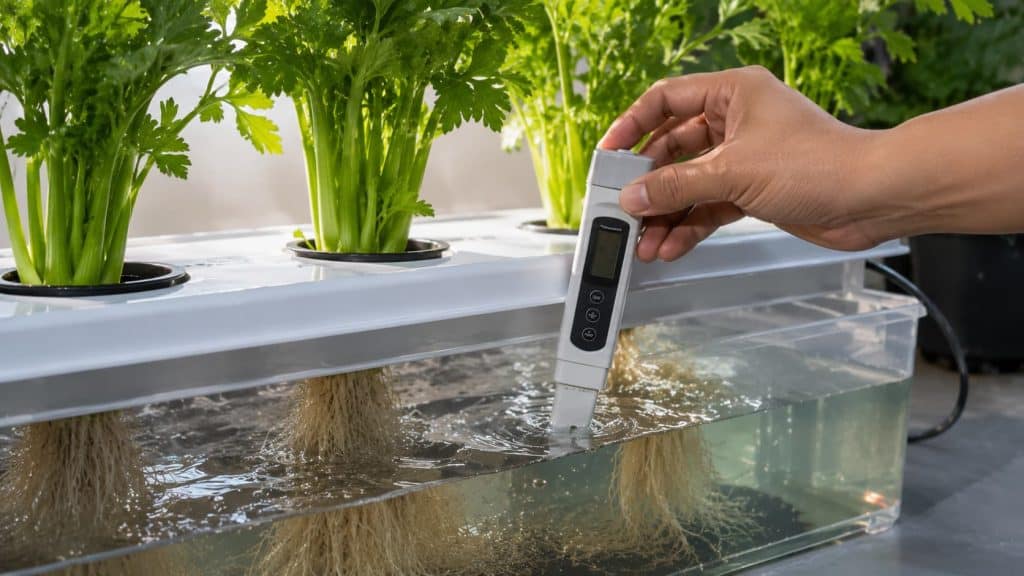
Celery performs best when pH remains stable within recommended ranges.
Hydroponic celery nutrients only work when roots can absorb them efficiently. That’s why pH management plays such an important role.
Check pH daily in active systems and adjust when readings move outside the 6.0–6.5 range. This range supports optimal nutrient uptake and helps prevent deficiencies that can slow growth and reduce stalk quality, especially in systems like DWC and Kratky.
Why does pH matter so much?
- Controls nutrient uptake
- Reduces nutrient lockout
- Supports stronger stalk development
What happens when pH drifts?
Growers frequently notice:
- Slower growth
- Magnesium deficiencies
- Calcium deficiencies
- Reduced stalk quality
Small adjustments often produce large improvements in plant performance.
Nutrient Requirements for Thick and Healthy Celery Stalks
Celery prefers stronger nutrient solutions than many herbs.
A typical hydroponic celery nutrient program supplies higher levels of nitrogen and calcium than fruiting crops, along with adequate magnesium and potassium making best hydroponic plant nutrients an important factor in supporting stalk development.
A common mistake is feeding celery like basil or lettuce. Celery demands higher nutrient concentrations to develop thick, crisp stalks.
Studies found that 1,300 ppm is optimal for the Tall Utah variety, while 1,000–1,200 ppm also produced good growth and higher fresh weight compared to lower nutrient concentrations.
Many commercial celery nutrient solutions maintain calcium concentrations between 150–200 ppm to reduce tip burn risk.
Data from Journal of Plant Production, Mansoura University demonstrates
“A study in the Journal of Plant Production found that for celery grown in a floating hydroponic system, an intermediate nitrogen level of 180 mg/L produced the highest significant values for plant height, fresh weight, and total yield per square meter, while higher levels did not yield additional benefits.” – Journal of Plant Production, Mansoura University
Should you use leafy-green nutrients?
Yes.
Hydroponic celery nutrients should be formulated for leafy vegetables. Fruiting formulas often contain nutrient ratios that limit vegetative growth.
Can seaweed supplements help?
Some growers report benefits from liquid kelp additions.
Common practices include:
- Applying kelp every two weeks
- Using seaweed as a supplement
- Combining it with standard nutrient programs
Never replace a complete nutrient formula with supplements alone.
Understanding the Slow Growth Cycle of Hydroponic Celery
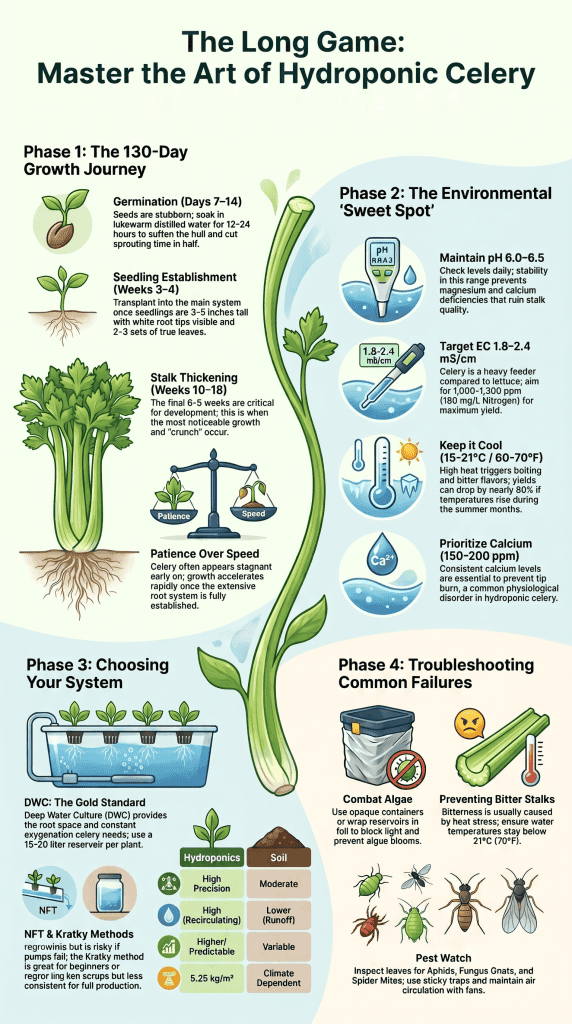
Celery naturally develops slowly, even under ideal conditions.
Many beginners expect rapid growth after seeing lettuce mature in a few weeks. Celery follows a different timeline.
A full hydroponic celery harvest commonly requires about 4 months from seed.
What develops first?
Growth stages usually follow this sequence:
- Germination
- Root expansion
- Leaf development
- Stalk thickening
By week 4, plants typically develop several true leaves. By week 8–10, root systems become well established, and noticeable stalk thickening often begins after week 10.
Is slow growth a sign of failure?
Not necessarily.
Celery often appears inactive during early development. Then growth accelerates as the root system expands and nutrient uptake improves. One-season growers often underestimate how much development occurs below the surface.
Temperature and Light Requirements for Healthy Celery Growth
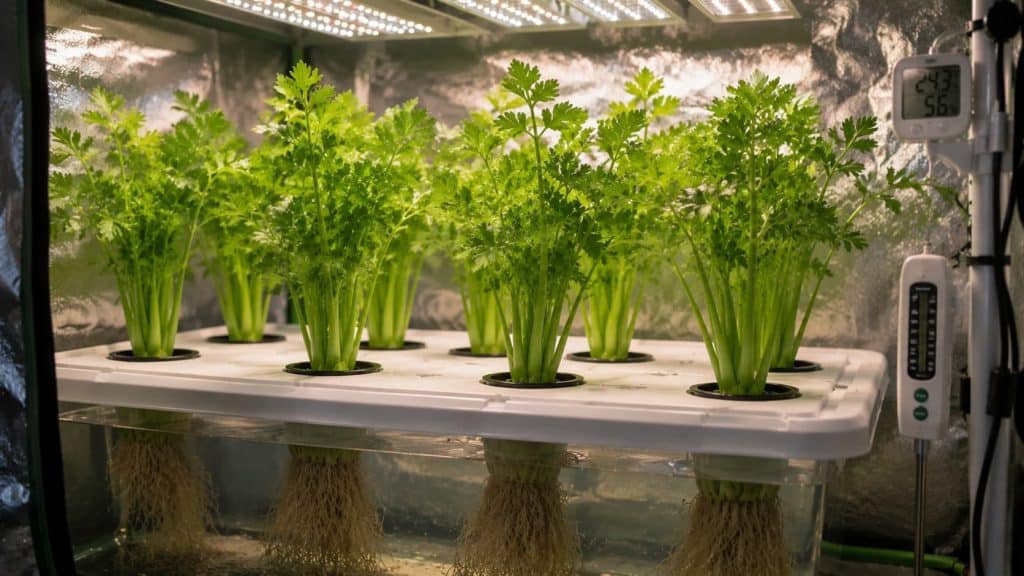
Extremely important; celery prefers cool conditions and long light exposure.
Relative humidity between 50–70% helps reduce excessive transpiration while supporting healthy growth. Temperature affects flavor, growth rate, and stalk quality more than many growers realize.
What temperature prevents problems?
Recommended targets include:
- Daytime: 15–21°C (60–70°F)
- Slightly cooler nighttime temperatures
Why does heat cause trouble?
Excessive heat can trigger:
- Bitter celery hydroponics issues
- Bolting
- Reduced stalk thickness
In controlled hydroponic systems like DWC, the Tall Utah variety performs best when water temperatures are kept below 21°C.
As noted by University of Palermo
“Research on leaf celery’s suitability for hydroponic baby leaf production demonstrated that total yields reached 5.25 kg/m² during the cooler winter-spring season, but dropped to just 2.76 kg/m² during the warmer spring-summer season, even with the same nutrient solution strength.” –University of Palermo
How much light is enough?
Most indoor systems require:
- Most growers target 200–400 PPFD for vegetative growth under LED lighting
- Full-spectrum LED grow lights
- Good air circulation
A celery fan hydroponics setup can improve airflow and reduce moisture-related problems around foliage.
Regrowing Grocery Store Celery in Hydroponics
Yes, but regrowth is different from producing a full celery crop.
Most celery bases produce visible regrowth within 7–14 days, though only a small percentage develop into productive mature plants.
The “save the butts” approach has become popular among beginners because it offers an inexpensive way to experiment with celery in water culture.
What happens after placing the base in water?
Many growers observe:
- Root formation within 1–14 days
- New center growth
- Early leaf development
Why do some scraps fail?
common reasons include:
- Anti-rooting treatments
- Poor sanitation
- Low light conditions
- Algae growth
Several growers recommend thoroughly rinsing grocery celery before placing it into water.
Should beginners start this way?
Yes.
Regrowing celery from grocery store scraps can be a fun experiment, but it usually does not produce high-quality stalks.
Store-bought celery often results in weaker, more bitter growth because it is not bred for regrowth and may be treated before sale. For consistent, crisp, and edible harvests, growing celery from seeds is a better option.
Common Problems That Affect Hydroponic Celery Growth
Most failures come from water chemistry, nutrient imbalance, or environmental stress.
Hydroponic celery problems often begin with small management mistakes that compound over time.
| Problem | Likely Cause | Prevention |
| Tip burn | Calcium deficiency | Maintain stable calcium availability and avoid sudden EC increases above 2.4 mS/cm |
| Bitter stalks | Heat stress | Keep temperatures within recommended range (15–21°C) |
| Algae | Light entering reservoir | Block light exposure and use opaque containers |
| Slow growth | Low nutrients poor pH | Maintain correct EC (1.8–2.4 mS/cm) and stable pH |
| Root issues | Poor oxygenation | Improve aeration and ensure proper root zone oxygen supply |
Common Pests Affecting Hydroponic Celery
Although hydroponic systems reduce many soil-borne issues, pests can still appear in indoor and greenhouse environments. Common pests affecting hydroponic celery include aphids, fungus gnats, and spider mites.
Aphids often cluster on young leaves and stems, sucking plant sap and slowing growth. Fungus gnats are typically linked to overly moist growing media and can damage young roots. Spider mites thrive in dry, warm conditions and may cause leaf discoloration and reduced plant vigor.
To prevent pest outbreaks, maintain good air circulation, avoid overwatering, keep the growing area clean, and regularly inspect plant leaves. Introducing physical barriers or sticky traps can also help reduce pest populations before they spread.
Preventing Algae Growth in Hydroponic Celery Systems
Light management is the key.
- Cover reservoirs
- Block light exposure
- Use opaque containers
- Wrap exposed containers with foil
Many growers report significant algae reduction after shielding reservoirs from sunlight.
The Importance of Calcium for Celery Development
Celery calcium hydroponics management directly influences stalk quality. When calcium uptake declines, tip burn frequently appears. High EC, poor root health, or unstable pH often contribute to the issue.
Healthy roots absorb calcium more efficiently than stressed roots.
The Benefits of Growing Celery Hydroponically
Yes, if you can maintain stable environmental conditions and accept a longer growing timeline.
Hydroponic celery benefits include cleaner production, greater nutrient precision, and efficient water use. Although the crop requires patience, many growers consider the extra effort worthwhile.
Benefits include:
- Strong yields
- Consistent quality
- Better water efficiency
- Greater nutrient control
Hydroponic systems typically use less water than traditional soil gardening because nutrient solution is recirculated rather than lost through runoff.
Hydroponic celery can produce yields of over 5 kg/m² under favorable growing conditions.
Celery adapts well to controlled-environment agriculture and can grow effectively under carefully managed indoor conditions.
Hydroponic Celery Is Worth Trying with Proper Care
Hydroponic celery rewards patience more than speed. The crop grows slowly, but growers gain cleaner production, stronger control, and dependable harvests when conditions remain stable.
If you already grow lettuce, basil, or other hydroponic leafy greens, celery represents a practical next step. Focus on pH, EC, temperature, oxygenation, and calcium management.
As each growing cycle progresses, your understanding of hydroponic celery growing improves, and so do your harvests.For most gardeners, the answer to “can you grow celery hydroponically” is a clear yes provided you’re willing to give the crop the time and precision it demands.
How to Regrow Celery from Scraps at Home

Credits: Wonder Gardening
The video from Wonder Gardening explains how to regrow celery using leftover celery bases instead of throwing them away. It shows the simple process of placing the celery bottom in water, providing enough light, and waiting for new roots and leaves to develop.
The video highlights that this method is easy for beginners, requires minimal equipment, and can be a fun way to explore basic plant regrowth techniques at home.
FAQ
Can I grow celery hydroponically indoors year-round?
Yes, you can grow celery hydroponically indoors throughout the year if you provide the right environment. Indoor hydroponic celery grows best when temperatures remain between 60°F and 70°F (15°C to 21°C). Hydroponic celery light requirements typically include 12 to 16 hours of light daily. If natural sunlight is insufficient, celery grow lights hydroponics setups can provide the light needed for steady growth and healthy stalk development.
What is the easiest celery hydroponics system for beginners?
The easiest celery hydroponics system for beginners is often a simple container-based setup. Many new growers choose a DIY hydroponic celery approach because it requires minimal equipment and is inexpensive to build. Kratky method celery is especially popular because it does not require pumps or complex maintenance. This method allows beginners to learn hydroponic celery growing while keeping costs and daily work relatively low.
How do I start hydroponic celery from seed successfully?
To grow hydroponic celery from seed, start by placing seeds in a moist growing medium and keeping temperatures between 65°F and 75°F (18°C to 24°C). Celery seed soaking hydroponics techniques may improve moisture absorption before planting. Celery germination hydroponics typically takes 10 to 21 days. Once seedlings develop several true leaves, you can follow proper celery transplant hydroponics practices and move them into the main growing system.
Why is my hydroponic celery turning yellow or growing poorly?
Hydroponic celery problems often occur when plants receive incorrect nutrient levels or unfavorable growing conditions. Celery yellowing hydroponics symptoms may result from nutrient deficiencies, improper celery pH hydroponics levels, or unsuitable celery EC hydroponics readings. Most celery grows best at a pH between 6.0 and 6.5. Regularly checking the hydroponic celery nutrient solution and maintaining adequate hydroponic celery air circulation can help prevent these issues.
Can I regrow celery from a grocery store in hydroponics?
Regrowing celery from grocery store scraps can be a fun experiment, but it usually does not produce high-quality stalks. Store-bought celery often results in weaker, more bitter growth because it is not bred for regrowth and may be treated before sale. For consistent, crisp, and edible harvests, growing celery from seeds is a better option.
Final Thoughts on Growing Celery Hydroponically
If your celery isn’t getting the right conditions, you’ll notice it fast. Growth can slow down, stalks may stay thin, and the harvest often falls short of what you expected. That’s the reality. When pH, nutrients, light, and temperature stay in the right range, celery responds well and grows steadily in a hydroponic setup.
The good news is that success doesn’t depend on using one specific system. DWC, NFT, Kratky, and other hydroponic methods can all produce crisp, healthy celery with consistent care. If you’re willing to be patient and make small adjustments along the way, hydroponic growing gives you more control and a cleaner harvest than many traditional soil gardens
References
- https://www.unipa.it/persone/docenti/m/alessandro.miceli/en/?pagina=pubblicazione&idPubblicazione=994715
- https://www.sciencedirect.com/science/article/pii/S0304423826000117?fr=RR-2&ref=pdf_download&rr=a036d8383c851ebf
Related Articles
- https://tophydroponicgarden.com/hydroponic-systems/
- https://tophydroponicgarden.com/leafy-greens/
- https://tophydroponicgarden.com/best-hydroponic-plant-nutrients/
Was this helpful?

I’m Barrie L., a passionate hydroponic gardening enthusiast dedicated to cultivating thriving, soil-less gardens. With a focus on all things hydroponic, I share my expertise on innovative growing techniques and sustainable practices through my blog, tophydroponicgarden.com. As a seasoned hydroponics specialist, my goal is to inspire and guide fellow gardeners in harnessing the power of water-based cultivation for bountiful and eco-friendly harvests. I’m also an author of the book “Hydroponics For Absolute Beginners: Your Step By Step Guide For How To Create An Hydroponics System At Home Without Soil, For Growing Vegetable, Fruit And Herbs.” which is sold on Amazon. Join me on a journey of redefining the way we cultivate plants, one nutrient-rich solution at a time. Happy growing!