

Alt text: Automated home hydroponic system with timer, grow lights, pH and EC sensors, and nutrient pumps for plants
Article description: Can you automate a home hydroponic system? Learn how to build a self-regulating setup that handles feeding, lighting, and monitoring for you.
You can absolutely automate a home hydroponic system, and you don’t need a lab or budget over $100-500 for basics to do it.
With a few smart plugs, basic sensors, and a simple controller, your system can handle feeding, watering, and lighting on a schedule that actually makes sense for your plants.
Pumps can turn on by themselves, lights can follow a set day–night rhythm, and alerts can ping your phone when something drifts out of range. You stay in charge, but the routine work runs itself. Keep reading to see how to build this into your own setup.
Key Takeaways
- Start with simple timers for lights and pumps to build a foundation.
- Integrate pH and EC sensors for precise, automated nutrient management.
- Use a smart controller for remote monitoring and control from anywhere.
Starting with the Rhythm of the Garden

You look at your plants every morning. You check the water level, maybe test the pH with a strip. It’s a ritual. But life gets busy, and a day missed can mean a setback.
Automation isn’t about replacing the gardener. It’s about giving the plants a consistent caretaker, one that never forgets. It starts with a simple idea: let a machine handle the repetition so you can focus on the growth.
This approach is especially helpful if you’re new and navigating the learning curve of hydroponics, where mastering routine tasks early on can save effort and improve results.
The basic rhythm of a hydroponic system is perfect for automation. Lights need to turn on and off. Water pumps need to cycle. These are simple, time-based events.
A basic digital timer from any hardware store is the first step into this world. Plug your grow lights into one. Set it for a 16-hour on cycle. That’s automation. You’ve just eliminated the first daily task.
Next, consider the water pump. In a system like Deep Water Culture (DWC), it runs constantly. But in an ebb and flow setup, it needs to cycle. Another timer can handle this.
A common starting point is to run the pump for 3 seconds every 60 seconds. This simple automation ensures roots get oxygenated water without you manually flipping a switch multiple times a day. This is the core of it. Breaking down each repetitive task and finding a mechanical solution.
The Essential Components for Smarter Control

To move beyond simple timers, you need a system that can perceive and react. This requires three types of components: sensors to see, a controller to think, and actuators to do. Sensors are the eyes of your operation. The most critical ones monitor the nutrient solution itself.
- A pH sensor tracks the acidity, a number that greatly affects nutrient uptake.
- An EC (Electrical Conductivity) sensor measures the concentration of nutrients in the water.
- A water temperature probe ensures the root zone doesn’t get too hot or cold.
- A liquid level sensor acts as a low-water warning light for the reservoir.
The controller is the brain. A microcontroller like an Arduino or an ESP8266 board is the popular choice for DIYers. It’s a tiny, programmable computer that reads data from the sensors and decides what to do. It’s not as intimidating as it sounds.
For beginners, choosing the right system that fits your space and goals is key, whether you start small or plan to scale later, as suggested when choosing your first hydroponic project.
Basic code for reading a sensor can be found online and adapted. For those less inclined to code, commercial smart hubs like Growee offer a plug-and-play brain with a companion app.
Actuators are the muscles. These are the devices that physically change the environment. A relay module connected to the controller can turn high-power devices like lights and pumps on and off safely. Pair with heat sinks for high-power loads.
For adding nutrients or pH adjusters, you need precision. This is where peristaltic pumps shine. They pump tiny, exact amounts of liquid, making them ideal for automated dosing.
| Component Type | Example | Primary Function | Why It Matters |
| Sensor | pH sensor, EC sensor | Measure nutrient balance | Prevents nutrient lockout and plant stress |
| Sensor | Water level sensor | Detect reservoir volume | Avoids pump damage and dry roots |
| Sensor | Temperature probe | Monitor root zone heat | Keeps roots in safe temperature range |
| Controller | Arduino, ESP8266 | Process sensor data | Makes automation decisions |
| Actuator | Relay module | Switch pumps and lights | Enables automatic control safely |
| Actuator | Peristaltic pump | Dose nutrients or pH solution | Allows precise automated dosing |
Automating the Most Critical Task: Nutrient Management

Credits: Research & Development YouTube Channel
Plants eat and drink through their roots. In hydroponics, the quality of that meal is everything. Manual pH and nutrient adjustment is a delicate dance. It’s easy to over-correct. Automation brings a steady hand to this process [1].
The goal is to maintain a stable environment. You set a target range for pH, typically between 5.5 and 6.5 for most plants. The pH sensor constantly reads the value.
If it drifts above 6.5, the controller activates a peristaltic pump connected to a bottle of “pH Down” solution. Recheck after 5-10 min wait to allow mixing.
It doses a small, pre-determined amount. Then it waits, checks the sensor again, and repeats if necessary. It does the same if the pH drops too low, using a “pH Up” solution.
The same principle applies to nutrients using the EC sensor. As plants consume nutrients, the EC value in the water drops. The system can be programmed to add a concentrated nutrient solution when the EC falls below a set point.
This continuous, micro-dosing approach keeps the nutrient solution in a perfect equilibrium, far more stable than most gardeners can achieve manually. It prevents the feast-or-famine cycles that stress plants.
Start small with this. Automate just the pH correction first. Get comfortable with how the sensors read and how the pumps operate. Test the system with a reservoir of plain water before adding plants. Watch the logs if your controller provides them.
You’ll see the system make small corrections, holding the pH line steady. It’s a fascinating thing to observe. Your intervention shifts from daily adjustment to occasional refilling of the nutrient and pH solution bottles.
Bringing It All Together with Remote Monitoring
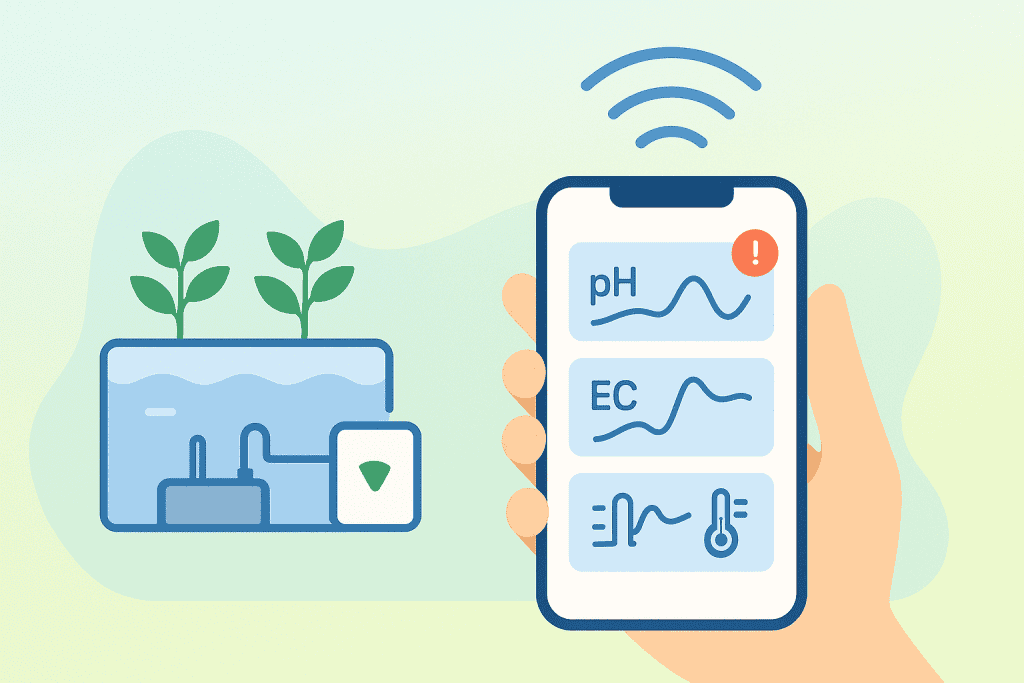
The final piece is connectivity. A system that can email you or send a push notification is a game-changer for peace of mind. Using a controller with WiFi, like an ESP8266, you can send sensor data to a cloud dashboard [2].
Platforms like Blynk or a simple custom webpage can display real-time graphs of your pH, EC, and temperature. Or Home Assistant for open-source flexibility. You can see the health of your system at a glance from your office or while you’re on vacation.
More importantly, you can set alerts. If the water temperature spikes or the pH goes wildly out of range, your phone will buzz. You can then often intervene remotely, triggering a water pump to cool the reservoir or shutting off a doser that’s malfunctioning.
This transforms hydroponics from a hands-on hobby into a truly modern form of gardening. You’re not tied to the garden.
You’re informed about it. The system manages the basics and alerts you to the important things. This is the real benefit of automation. It doesn’t remove you from the process. It makes you a more effective, informed manager of your own food supply.
Your Path to an Automated Garden
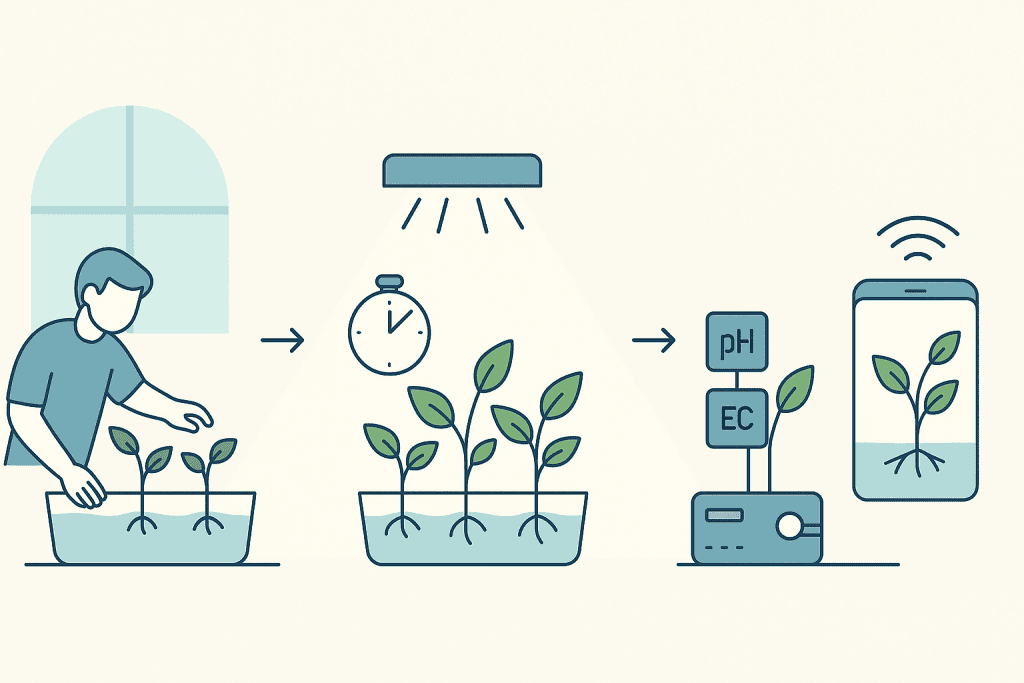
The journey from manual gardening to an automated system doesn’t have to happen all at once. It’s a progression. Start with a light timer.
Then add a pump timer. When you’re ready, introduce a pH sensor and a single dosing pump. Each step builds confidence and adds a layer of freedom.
The question isn’t really if you can automate a home hydroponic system. It’s how much automation will improve your life as a grower.
The tools are available, the community is supportive, and the result is a garden that’s more resilient and productive. Your time is valuable. Let the machines handle the clockwork.
FAQ
How does home hydroponic automation reduce daily work for beginners?
Home hydroponic automation reduces daily work by handling routine tasks automatically. A hydroponic timer system controls pumps and lights on fixed schedules.
Automated grow lights and a hydroponic light timer manage day and night cycles. Automated irrigation hydroponics controls watering without manual input.
This setup creates low maintenance hydroponics and supports a self regulating hydroponic system that runs consistently.
What sensors are required for an automated hydroponic system?
An automated hydroponic system requires hydroponic sensors to track growing conditions. pH sensor hydroponics and EC sensor hydroponics enable automated pH control and automated EC control.
A water level sensor hydroponics supports automated reservoir management. Temperature sensor hydroponics and humidity control hydroponics support climate control hydroponics and improve precision hydroponics performance.
How does automatic nutrient dosing work in smart hydroponics?
Automatic nutrient dosing in smart hydroponics works by adding nutrients when sensor readings change. Automated nutrient delivery uses a hydroponic automation controller to respond to EC readings.
Smart nutrient management prevents overfeeding and underfeeding. This method supports precision hydroponics and smart farming at home by keeping nutrient levels stable without manual mixing.
Can IoT hydroponics be monitored remotely using a phone?
IoT hydroponics can be monitored remotely using a hydroponic monitoring system. A WiFi hydroponic controller sends real time hydroponic data to apps for remote hydroponic monitoring.
App controlled hydroponics allows users to check sensor readings, pump status, and alerts. This setup supports smart indoor gardening and enables faster response to system problems.
Which hydroponic systems work with Arduino or Raspberry Pi controllers?
An Arduino hydroponic system or Raspberry Pi hydroponics can control multiple setups. Supported systems include an NFT automation system, DWC automation setup, drip hydroponic automation, ebb and flow automation, and a recirculating hydroponic system.
These controllers manage automated water pump hydroponics, automated air pump control, and hydroponic data logging for a smart grow system.
Conclusion
Automating a home hydroponic system is less about complexity and more about consistency.
By gradually handing routine tasks to timers, sensors, and smart controllers, you create a growing environment that’s stable, responsive, and forgiving of a busy schedule.
Being aware of the limitations of hydroponics helps you prepare for challenges and design automation that truly supports your system’s needs.
Automation doesn’t replace your role as a grower; it elevates it. With fewer daily chores and better data, you gain healthier plants, higher yields, and the freedom to enjoy gardening on your terms.
References
- https://www.sciencedirect.com/science/article/pii/S2405844024028548
- https://jsa.trunojoyo.ac.id/jsa/article/viewFile/19/14
Related Articles
- https://tophydroponicgarden.com/is-hydroponics-difficult-to-learn/
- https://tophydroponicgarden.com/how-to-choose-your-first-hydroponic-project/
- https://tophydroponicgarden.com/what-are-the-limitations-of-hydroponics/
Was this helpful?

I’m Barrie L., a passionate hydroponic gardening enthusiast dedicated to cultivating thriving, soil-less gardens. With a focus on all things hydroponic, I share my expertise on innovative growing techniques and sustainable practices through my blog, tophydroponicgarden.com. As a seasoned hydroponics specialist, my goal is to inspire and guide fellow gardeners in harnessing the power of water-based cultivation for bountiful and eco-friendly harvests. I’m also an author of the book “Hydroponics For Absolute Beginners: Your Step By Step Guide For How To Create An Hydroponics System At Home Without Soil, For Growing Vegetable, Fruit And Herbs.” which is sold on Amazon. Join me on a journey of redefining the way we cultivate plants, one nutrient-rich solution at a time. Happy growing!