

Yes, you can grow strawberries with the Kratky method, but it’s more demanding than for leafy greens. Strawberries are long-term fruiting plants, so you must carefully manage nutrients, root oxygen, and water conditions. The University of Arizona notes that successful hydroponic strawberries require this close attention. Keep reading to see when Kratky works and when a different system might be better.
What You Should Know About Growing Strawberries with the Kratky Method
- Yes, strawberries can thrive in a non-circulating hydroponic system when the setup is managed correctly.
- Day neutral cultivars and everbearing strawberries generally produce the most reliable harvests in passive systems.
- Success depends on maintaining root zone oxygen, monitoring electrical conductivity EC, adjusting nutrients through each growth stage, and preventing root rot.
Why Is Growing Strawberries with Kratky More Difficult Than Lettuce?
Strawberries grow for months, not weeks. This means you have to pay much closer attention to the water tank and air for the roots compared to fast crops like lettuce.
The Kratky method was made for quick-growing plants that live their whole life in one tank of food water. Strawberries aren’t like that. They keep growing, flowering, and making fruit long after a lettuce is picked. Big farms, like those studied by the University of Arizona, have to keep checking the nutrient mix, the water, and the growing space to get good berries. The plant keeps drinking, but what it needs from the water changes over time.
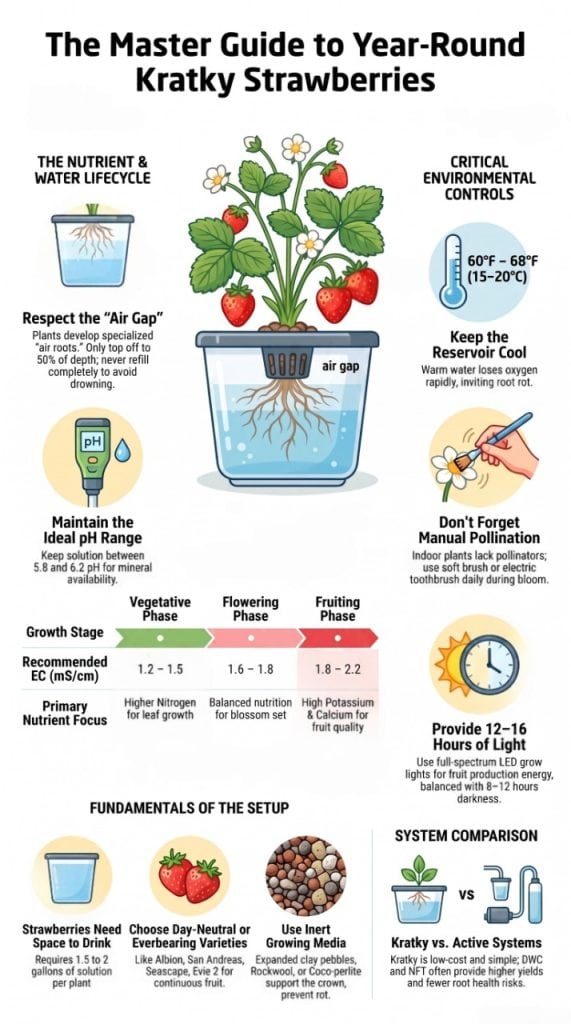
Because of this, you’ll need a bigger tank. A good rule is 1.5 to 2 gallons of nutrient water for each plant. A full-grown strawberry plant drinks a lot more when it’s making fruit than a patch of greens. If you don’t stay on top of things, problems like root rot, crown rot, green algae in the tank, and bad nutrients are more likely to happen.
The main challenges when using Kratky for strawberries are:
- The reservoir will need partial refills.
- The nutrient formula should change between vegetative growth and fruiting stages.
- You’ll likely need to pollinate the flowers by hand indoors.
- Maintaining oxygen for the roots gets more critical as the plants age.
Even with this extra work, the Kratky method is still a cheap and simple way to try growing without soil or electricity. It work
How does plant lifespan change the system?
Lettuce is often harvested before the water quality has a chance to go bad. Strawberries are different. They keep making flowers, fruit, and new runners for months. This long season makes keeping the nutrient tank stable absolutely crucial.
The plants also grow two types of roots. Lower roots stay in the water to drink, while a separate set of “air roots” develops above the solution. For the plants to stay healthy over many months, you must maintain this natural separation.
Why does a passive reservoir become risky?
As water remains still, dissolved oxygen level gradually declines, especially when temperatures exceed 20°C (68°F).
Warm water, declining oxygen, and organic debris create favorable conditions for Pythium, making root rot prevention the highest priority in every passive reservoir.
Pro Tip: Kratky is low maintenance, not maintenance free. Weekly inspections prevent most long-term failures.
Which Strawberry Varieties Work Best in a Kratky System?
Skip the traditional June-bearing strawberries for Kratky. They only give you one harvest. Instead, go for day-neutral or everbearing types. These keep flowering and making fruit over a much longer season, as long as the environment is right.
Some of the best varieties for this are Albion, San Andreas, Seascape, and Evie 2. They’re all proven to adapt well to growing indoors.
| Variety | Why choose it? | Best use |
| Albion | Long harvest season | Beginners |
| San Andreas | Excellent fruit quality | Warm climates |
| Seascape | Reliable indoors | Home growers |
| Evie 2 | Continuous flowering | Compact systems |
Start with healthy bare root crowns or plug transplants instead of seeds. They establish faster and usually produce fruit much sooner. Healthy strawberry plant propagation from vigorous strawberry runners also works well after the parent plant becomes established.
Transitioning to setup, choosing the correct growing media is just as important as selecting the right variety.
What growing medium works best?
Several inert media work well inside net cups because they support the plant without affecting nutrient chemistry.
- Expanded clay pebbles
- Hydroton
- Rockwool cubes
- Coco coir medium blended with perlite
These materials improve drainage while supporting the crown above the nutrient solution. Understanding proper substrate mechanics and root support is essential when learning how to grow hydroponic strawberries at home.
Why must the crown stay dry?
The crown should never remain wet because constant moisture encourages crown rot before roots fully establish.
A simple setup checklist includes:
- Wash all soil from roots before planting.
- Position the crown above the media.
- Maintain a visible vertical air gap.
- Use a dark opaque container for algae bloom prevention.
Most hobby growers successfully use 2–3 inch net cups for individual plants.
How Large Should the Reservoir Be?

A bigger water tank means more stable conditions and less work. It stops you from having to refill it all the time, which stresses the plants.
For example, a standard 5-gallon bucket can handle two or three strawberry plants. A small mason jar might be good for a quick demo, but it won’t work for growing fruit over a full season.
As the water level drops naturally, the roots at the top change. They become “air roots” that breathe oxygen. This only works if you protect the air space they grow into.
Once these air roots form, never fill the tank back up to the top. If you do, you’ll drown them. This mistake is often called “drowning the gap.”
Instead, only top off the nutrient solution. Add new water so it stays below the halfway point of the current water level. A larger reservoir also helps by slowing down changes in nutrient strength and water quality, making everything easier to manage long-term.
What Nutrients Do Strawberries Need During Each Stage?
Strawberries require different nutrient ratios during vegetative growth, flowering, and fruiting.
According to hydroponic production guides, nutrient demand shifts toward potassium and calcium once flowering begins.
| Growth Stage | Recommended EC | Primary Focus |
| Vegetative growth phase | 1.2–1.5 mS/cm | Higher nitrogen |
| Flowering phase nutrients | 1.6–1.8 mS/cm | Balanced nutrition |
| Fruiting phase EC | 1.8–2.2 mS/cm | Higher potassium and calcium |
A lot of growers use a specific recipe for their nutrient water. They mix Masterblend 4-18-38 fertilizer with calcium nitrate and Epsom salt. Together, these give strawberries their main food.
The small nutrients matter too, especially when plants are growing fast. Your mix needs to have chelated iron and other trace elements. If it doesn’t, the plants can start to yellow and show other signs of hunger.
Monitor these factors weekly:
- pH level adjustment
- Electrical conductivity EC
- Water level depletion
- Salt accumulation
- Nutrient lockout
Maintain pH between 5.8 and 6.2 using pH Up and Down solutions.
When your plants start making fruit, a small change to the nutrients can help. Giving them a bit more potassium and phosphorus often leads to more flowers, bigger berries, and sweeter fruit.
Research from HortScience shows:
“Increasing the K concentration from 117 to 348 mg·L⁻¹… reduced the total fruit number by 34% and total fruit fresh mass by 45%” – HortScience
Keep an eye out for common problems. If you see signs like leaf tips burning, poor fruit quality, or what looks like a calcium-magnesium deficiency, it might not mean those nutrients are missing from your tank. Often, it’s a sign the plant isn’t absorbing the calcium properly, which is a different issue to fix.
How Do You Prevent Root Rot in a Passive Hydroponic System?

Credits: Matthew Hall
For healthy roots, oxygen is more important than fertilizer.
Warm water holds less oxygen. In a still system like Kratky, this raises the risk of root rot. Research shows that keeping your nutrient solution cool, between 60 and 68°F (15-20°C), makes a big difference for root health.
Good prevention practices include:
- Maintain proper air gap oxygenation.
- Keep the reservoir shaded.
- Use a dark opaque container.
- Perform clean root washing before planting.
- Remove dead roots immediately.
Healthy roots remain white, firm, and odor free. Brown, slimy roots usually indicate declining oxygen or disease.
Beyond root health, leaves and flowers also require close attention.
Monitor for powdery mildew prevention and spider mite control, particularly during warm indoor conditions where airflow is limited.
Why Do pH and EC Drift Over Time?
Plants don’t use nutrients evenly. As they drink, what’s left in the water changes.
Strawberries drink a lot of water, especially when it’s hot. They take in more water than minerals, which makes the leftover nutrient solution get stronger and saltier over time. On gardening forums, growers often note that low humidity makes this happen faster, because the plants lose even more water into the dry air.
You should check your system every week. Look at:
- The pH level.
- The nutrient strength (EC).
- How much water is left.
- The color and feel of the roots.
- The temperature of the water.
Using a simple digital meter, like those from Bluelab, makes these checks easy. It helps you spot a problem and fix it long before your plants start to look sick.
Do Indoor Kratky Strawberries Need Pollination and Extra Light?
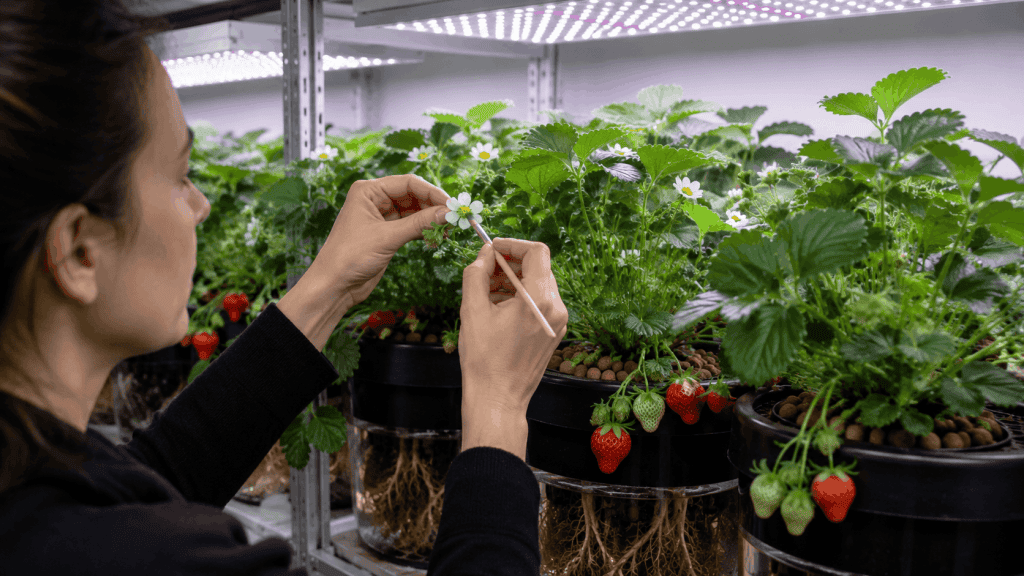
Yes. Indoor strawberries require both supplemental lighting and manual pollination to produce quality fruit.
Most growers provide 12–16 hours of daily lighting using full-spectrum indoor grow lights with an appropriate LED light spectrum.
Aim for an adequate daily light integral DLI while maintaining a consistent daily photoperiod with 8–12 hours of darkness to support normal plant respiration.
Manual pollination is simple.
- Touch each flower center with a soft brush.
- Repeat daily during bloom.
- An electric toothbrush pollination technique also works by gently vibrating the flower.
Consistent pollination improves blossom set, fruit shape, and overall production.
What Advanced Problems Do Experienced Growers Encounter?
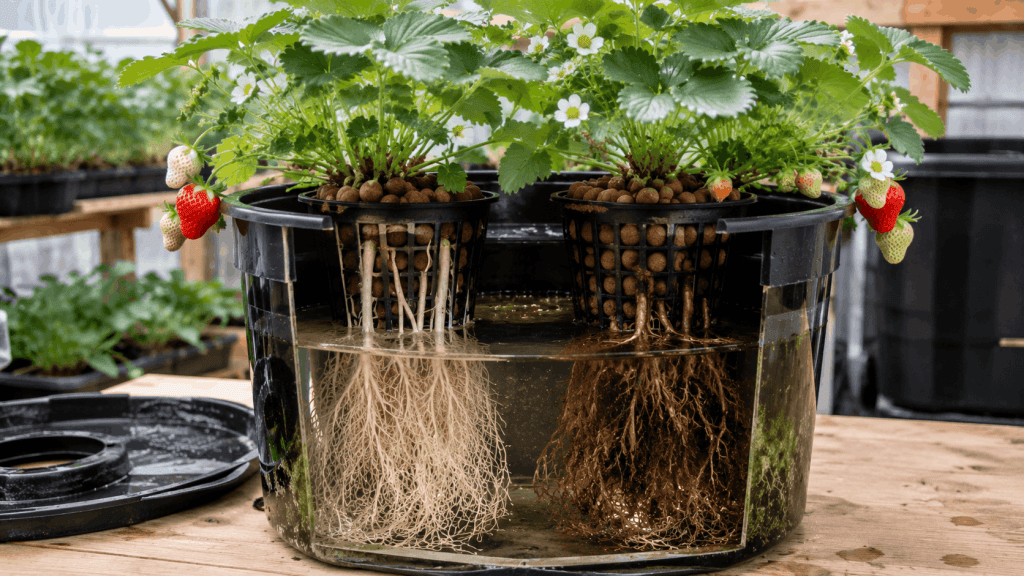
Most failures occur because strawberries push passive hydroponics beyond its original purpose.
Forum discussions on GrowingFruit.org, Permies, and Garden Stack Exchange consistently identify several recurring problems.
The most common include:
- Overfilling reservoirs and drowning established air roots.
- Rising EC caused by high vapor pressure deficit VPD.
- Poor water temperature control.
- Ignoring changing nutrient ratios.
- Wet crowns causing crown rot.
Experienced growers often describe Kratky strawberries as having a higher “futz factor” than lettuce because regular adjustments become part of successful long-term production.
That said, careful observation usually solves problems before they become severe.
Should You Choose Kratky, DWC, or NFT for Strawberries?
The best hydroponic system depends on your goals rather than your budget.
| System | Cost | Maintenance | Yield Potential |
| Kratky | Low | Low to Moderate | Moderate |
| Deep Water Culture (DWC) | Moderate | Moderate | High |
| NFT | Higher | Higher | High |
A deep water culture comparison shows that active aeration continually replenishes dissolved oxygen, reducing many of the challenges associated with passive reservoirs.
As noted by Discover Plants:
“The substrate-based system outperformed the Kratky method in terms of TSS, fruit weight, and deformity rates.” – Discover Plants
Choose the Bernard Kratky method if you want:
- Low startup cost
- Simple equipment
- Passive indoor gardening
- Urban hydroponic gardening
- Learning hydroponics
Weighing these passive factors helps you evaluate the broader benefits of hydroponic strawberries before deciding whether to stick with a static reservoir or upgrade to active systems like DWC or NFT.
FAQS
Can strawberries grow well in a non aerated water system?
Hydroponic strawberries can grow in a non aerated water system when the Bernard Kratky method is used correctly. This passive hydroponics system depends on a non-circulating hydroponic system that creates an air gap as the water level drops. The exposed roots become air roots that absorb oxygen. Maintain the nutrient solution level properly to support healthy growth and improve root rot prevention.
Which growing medium works best for Kratky strawberries?
Several growing media work well for soilless cultivation. Net cups filled with expanded clay pebbles or hydroton provide excellent support and airflow around the roots. Rockwool cubes work well for seedlings, while coco coir medium helps retain moisture for young plants. Bare root crowns and plug transplants can establish successfully in any of these media when they receive proper support.
How do I avoid nutrient problems during fruit production?
Monitor fertilizer concentration, electrical conductivity EC, and pH level adjustment throughout the growing season. Regularly check water quality TDS to reduce the risk of nutrient lockout and salt accumulation. Plants need different nutrient levels during the vegetative growth phase, flowering phase, and fruiting phase EC. Correct deficiencies by supplying calcium nitrate supplement, Epsom salt magnesium sulfate, chelated iron EDTA, and other micro nutrients solution only when necessary.
How can I improve flowering and berry production indoors?
Indoor fruit production depends on providing enough light and reliable pollination. Indoor grow lights should deliver the proper LED light spectrum, daily light integral DLI, and daily photoperiod for healthy flowering. Use a hand pollination technique or gentle electric toothbrush pollination to improve blossom set. Good growing conditions also support larger fruit size development, higher sugar content Brix, and continuous harvesting from everbearing strawberries and day neutral cultivars.
What maintenance keeps Kratky strawberries healthy long term?
Use a dark opaque container with a passive water reservoir or static water reservoir to reduce algae growth and improve algae bloom prevention. Monitor water temperature control, dissolved oxygen level, vapor pressure deficit VPD, transpiration rate, and water level depletion regularly. Inspect roots for crown rot or Pythium root decay, prevent powdery mildew prevention and spider mite control issues, and compare the reservoir top off method with a deep water culture comparison before changing your growing system. A mason jar hydroponics setup or a 5 gallon bucket setup can both support passive indoor gardening and urban hydroponic gardening when managed correctly.
Grow Better Kratky Strawberries with Tophydroponicgarden
Growing strawberries with the Kratky method needs a bit more attention than lettuce, but you get fresh berries for your effort. Focus on keeping your nutrients stable, protecting the roots’ air supply, using consistent light, and hand-pollinating the flowers. These small, consistent steps lead to success.
For more practical tips that make each step easier, from picking the right variety to getting sweeter fruit, check out Tophydroponicgarden. You’ll find straightforward guidance that helps you grow with more confidence and better results.
References
- https://searchworks.stanford.edu/articles/edsdoj__edsdoj.ff26ddc2afc45e8b4faf1302347cf9f
- https://link.springer.com/article/10.1007/s44372-025-00214-3
Related Articles
- https://tophydroponicgarden.com/what-are-the-benefits-of-hydroponic-strawberries/
- https://tophydroponicgarden.com/how-to-grow-hydroponic-strawberries-at-home/
- https://tophydroponicgarden.com/best-strawberry-varieties-for-hydroponics/
Was this helpful?
I’m Barrie L., a passionate hydroponic gardening enthusiast dedicated to cultivating thriving, soil-less gardens. With a focus on all things hydroponic, I share my expertise on innovative growing techniques and sustainable practices through my blog, tophydroponicgarden.com. As a seasoned hydroponics specialist, my goal is to inspire and guide fellow gardeners in harnessing the power of water-based cultivation for bountiful and eco-friendly harvests. I’m also an author of the book “Hydroponics For Absolute Beginners: Your Step By Step Guide For How To Create An Hydroponics System At Home Without Soil, For Growing Vegetable, Fruit And Herbs.” which is sold on Amazon. Join me on a journey of redefining the way we cultivate plants, one nutrient-rich solution at a time. Happy growing!