

You can absolutely do hydroponics outdoors. In fact, it might be the most straightforward way to start. The sun becomes your grow light, the wind your fan.
It feels less like a laboratory experiment and more like actual gardening, just without the soil. You trade total control for natural efficiency. Your plants get the full spectrum of sunlight, which no bulb can truly replicate, and your energy bill drops to zero.
Of course, you also inherit nature’s challenges, the afternoon thunderstorm that dilutes your nutrient tank, the aphids that find your lettuce irresistible. But for many, that trade-off is more than worth it. The key is working with the environment, not against it. Keep reading to learn how to set up a resilient outdoor system that turns sunlight into serious harvests.
Key Takeaways
- The sun provides free, full-spectrum light, drastically cutting energy costs.
- Outdoor systems require robust pest management and weather protection strategies.
- Seasonal awareness is non-negotiable for consistent, year-round success.
What Exactly is Outdoor Hydroponics?
At its core, it’s the same principle as indoor hydroponics. Plants grow in a nutrient-rich water solution, their roots supported by an inert medium like clay pebbles or rockwool. The magic happens without a speck of soil.
But outside, the context changes completely. The system is no longer in a sealed room. It’s part of the wider ecosystem. This means you’re leveraging natural forces.
Photosynthesis is powered directly by the sun. Air circulation is handled by the breeze. This integration is the biggest advantage. It’s also the source of the biggest headaches.
You have to account for variables that are simply absent indoors. The ambient temperature, the intensity of UV rays, the pH of rainwater. It’s a dynamic, living system.
The Unbeatable Advantages of Growing Outside

The benefits are compelling, especially if you have space. The most obvious is light. Sunlight is a complete package for plants. It has the perfect balance of blue spectrum for vegetative growth and red spectrum for flowering and fruiting.
Understanding how to build a simple hydroponic setup can help you maximize natural light use efficiently and avoid pitfalls related to overexposure or insufficient lighting. You’ll notice plants often look sturdier and more vibrant under the sun. Then there’s the cost.
You eliminate the single largest operational expense of indoor growing: electricity for lighting and climate control. This makes outdoor hydroponics incredibly accessible. The initial investment can be surprisingly low.
Natural pollination is another subtle win. Bees and other pollinators will visit your outdoor garden. For fruiting plants like tomatoes and peppers, this can lead to better fruit set compared to the manual pollination sometimes needed indoors. There’s also more room to scale up. You’re not confined by the walls of a tent or a room. You can build larger, more ambitious systems [1].
- Free, full-spectrum lighting from the sun.
- Significantly lower operational costs with no electric bills for lights.
- Stronger plant structure thanks to natural wind stress.
- Easier scalability without spatial constraints.
The Real Challenges You’ll Face Outdoors
https://www.youtube.com/watch?v=3ZXJbE9DaX0
Source : The Plant Enthusiast
It’s not all sunshine, though. Pests are public enemy number one. Your lush hydroponic plants are a salad bar for every insect in the neighborhood. You’ll need a solid Integrated Pest Management (IPM) strategy from day one.
This often means physical barriers like insect netting and a willingness to use organic controls like neem oil. Managing pests outdoors is a crucial part of hydroponic success, as outdoor crops face more risk. For more on understanding common challenges and solutions, exploring common myths about hydroponic growing can deepen your insight.
Weather is the other great variable. A heavy rain can flood your system and dilute your carefully balanced nutrient solution, crashing the Electrical Conductivity (EC). A heatwave can cook the water in your reservoir, leading to root rot.
The equipment itself takes a beating. Sunlight degrades plastic over time. You need to select UV-resistant materials for tubes and reservoirs. Wind can topple unsecured towers or NFT channels.
And perhaps the biggest shift for indoor growers is the loss of seasonality control. Your growth is tied to the natural calendar. You can’t grow cool-weather lettuce in the dead of a hot summer without some serious shading and cooling efforts.
Outdoor vs. Indoor: A Side-by-Side Look
How does it really stack up? The table below breaks it down.
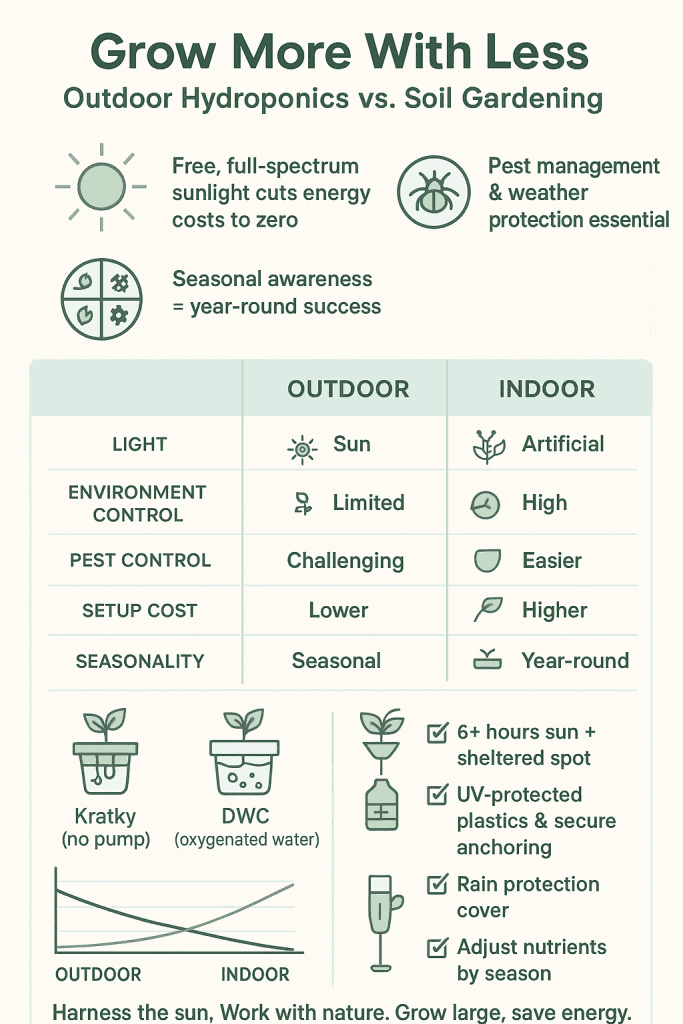
| Feature | Outdoor Hydroponics | Indoor Hydroponics |
| Light Source | Natural Sunlight | Artificial Grow Lights |
| Environmental Control | Limited | High |
| Pest Control | More Challenging | Easier |
| Setup Cost | Lower | Higher |
| Seasonality | Seasonal | Year-Round |
The choice often comes down to your goals and location. If you have a sunny patio and want to grow summer tomatoes, outdoors is a no-brainer. If you want to harvest basil in December, you’ll need an indoor setup.
Picking the Right System for the Elements
Not all hydroponic systems are created equal for outdoor use. Simplicity and durability are key. The Kratky Method is brilliant for beginners outdoors. It’s passive, needing no electricity or pumps.
Just a container, a lid, and nutrient solution. Many new growers fall prey to common misconceptions about hydroponics, such as overcomplicating systems or assuming outdoor setups require high-tech gear. Awareness of these misconceptions helps beginners avoid early mistakes and focus on what really matters.
It’s great for leafy greens. Deep Water Culture (DWC) is another winner. Plants float on a raft or are held in net pots over an oxygenated reservoir. It’s highly effective but requires monitoring water temperature in hot weather.
Drip Systems and Ebb and Flow systems work well but need filters to prevent debris from clogging emitters. The Nutrient Film Technique (NFT) can be tricky outside.
The shallow streams of water in the channels heat up very quickly in direct sun, which is a recipe for root problems. Aeroponics, with its fine misters, is generally too delicate and prone to clogging for an unfiltered outdoor environment.
Your Pre-Grow Checklist for Success
A little planning prevents a lot of problems. First, follow a gardening calendar. Just because it’s hydroponics doesn’t mean you can ignore seasons. Plant heat-loving crops like cucumbers after the last frost, and cool-weather crops like kale in the late summer for a fall harvest.
Protective netting is essential. It keeps out everything from birds to caterpillars. Placement is critical. Find a spot that gets at least 6 hours of direct sun but is sheltered from strong winds. Proximity to a water source makes maintenance effortless.
Manage rainwater by having a cover ready for your reservoir or using a system that can be easily covered. For mosquito control, ensure no standing water is exposed. Airstones in reservoirs keep water moving, discouraging larvae. Water temperature is a constant battle. Use light-colored or insulated reservoirs. Some gardeners even bury their reservoir partially for geothermal cooling [2].
- Use UV-protected plastics for all components.
- Anchor systems securely to withstand wind.
- Plan for rainwater collection to top off your system with soft water.
- Adjust nutrient demands as light intensity changes with the seasons.
FAQ
Can you use outdoor hydroponics if you get full sun most of the day?
You can use outdoor hydroponics with strong sun. You just manage sunlight hydroponics so your plants do not get hydroponics sunburn plants. You can add shading hydroponics outdoor or a simple mesh cover. You also check hydroponics water temperature outdoor and keep the hydroponic nutrient solution outdoor stable so roots stay healthy.
How do you handle rain impact hydroponics in an open-air hydroponics setup?
You protect your hydroponic system outdoor from heavy rain. You add rain protection hydroponics so the hydroponic water reservoir outdoor does not overflow. You keep a cover on the outdoor nutrient film technique or hydroponic water culture outdoor system. You also check rainwater hydroponics impact because it can change hydroponics water pH outdoor.
What outdoor hydroponic challenges should you expect with wind and weather?
You plan for hydroponics wind effects and hydroponics wind damage. You choose hydroponic system materials outdoor that hold up well. You add hydroponic plants support outdoor to keep stems steady. You watch weather effects hydroponics and adjust shading or covers. This helps you keep hydroponics weather resilience as seasons shift.
How do you manage pests in hydroponic gardening outside?
You manage hydroponics pest control outdoors with simple steps. You add barriers for hydroponics protection against pests. You check for insects often because outdoor hydroponic crops face more risk. You keep hydroponics organic control outdoor methods like soap sprays. Good airflow from hydroponics natural ventilation keeps leaves dry and lowers hydroponics disease management outdoor needs.
What should beginners know about a hydroponic setup outside before starting?
You plan your hydroponic setup outside with space in mind. You look at outdoor hydroponics space requirements and outdoor hydroponic setup cost. You track hydroponics nutrients outdoor so plants grow well. You learn hydroponics monitoring outdoor steps like checking the reservoir and airflow. A simple hydroponics outdoor setup guide helps you avoid early mistakes.
Conclusion
So, should you take the plunge? Outdoor hydroponics is ideal if you have a sunny space and are comfortable with a more hands-on, adaptive approach to gardening. It’s perfect for the gardener who wants to maximize yield and minimize cost while working in harmony with natural cycles.
It’s less suited for someone seeking total, year-round control or who lives in an area with extreme, unpredictable weather. Ultimately, it’s a rewarding method that proves you don’t need soil, or a closed room, to grow an astonishing amount of food. Start small, learn from the sun and the rain, and you’ll be amazed at what you can grow.
References
- https://www.mdpi.com/1996-1073/16/4/1690
- https://www.pseau.org/outils/ouvrages/iws_hydroponics_as_a_sustainable_water_efficient_agricultural_strategy_for_enhancing_resilience_and_food_security_in_the_gaza_strip_2025.pdf
Related Articles
- https://tophydroponicgarden.com/common-myths-about-hydroponic-growing/
- https://tophydroponicgarden.com/how-to-build-a-simple-hydroponic-setup/
- https://tophydroponicgarden.com/common-misconceptions-about-hydroponics/
Was this helpful?

I’m Barrie L., a passionate hydroponic gardening enthusiast dedicated to cultivating thriving, soil-less gardens. With a focus on all things hydroponic, I share my expertise on innovative growing techniques and sustainable practices through my blog, tophydroponicgarden.com. As a seasoned hydroponics specialist, my goal is to inspire and guide fellow gardeners in harnessing the power of water-based cultivation for bountiful and eco-friendly harvests. I’m also an author of the book “Hydroponics For Absolute Beginners: Your Step By Step Guide For How To Create An Hydroponics System At Home Without Soil, For Growing Vegetable, Fruit And Herbs.” which is sold on Amazon. Join me on a journey of redefining the way we cultivate plants, one nutrient-rich solution at a time. Happy growing!