

Hydroponic tomatoes grow best when you pick a variety suited to your setup. For most home systems, cherry tomatoes are the most reliable.
Commercial greenhouses use specific hybrids for high yields, where a single plant can produce over 10 kg. Find the right variety for your countertop, Dutch bucket, or greenhouse system below.
Hydroponic Tomato Quick Picks
- The best hydroponic tomatoes for beginners, commercial growers, and indoor gardeners.
- Which hydroponic tomato varieties produce the highest yields.
- How to match tomato cultivars to NFT, DWC, Dutch bucket, and greenhouse systems.
The Best Hydroponic Tomato Varieties Deliver High Yields and Reliable Growth
Cherry tomatoes give the most reliable results in most home systems. For big commercial greenhouses, specific high-yield hybrids are the standard. If space is tight, compact dwarf varieties are a solid choice.
- Best overall: Sakura F1
- Highest-yield cherry: Super Sweet 100
- Best compact variety: Tiny Tim
- Best slicing tomato: Celebrity
- Best beefsteak: Torero
- Best paste tomato: San Marzano
- Best greenhouse hybrid: Trust F1
- Best beginner option: Sweet 100
Growers often talk about Super Sweet 100 tomatoes. They’re known for being prolific. The trusses, or fruit clusters, get so heavy they can bend the support stakes. That’s why it’s one of the most recommended high-yield tomatoes for hydroponics.
The Best Tomato Types for Hydroponics Combine Yield, Flavor, and Growth Performance
Cherry tomatoes usually do better than bigger types. They fruit faster, handle growing mistakes more easily, and keep producing over a long season.
| Type | Best For | Difficulty |
|---|---|---|
| Cherry/Grape | Beginners, maximum harvest | Easy |
| Slicing | Everyday kitchen use | Moderate |
| Beefsteak | Large fresh tomatoes | Advanced |
| Paste | Sauce making | Moderate |
| Dwarf | Small indoor systems | Easy |
Many growers start with cherry tomatoes. They handle changing conditions well and don’t need as much help with pollination as bigger tomatoes do.
Why Do Cherry Tomatoes Dominate Hydroponics?
Cherry varieties offer several advantages:
- Faster fruiting cycles
- Better pollination success
- Less cracking
- Continuous harvests
- Excellent nutrient efficiency
When I transitioned from standard hobby setups to commercial-style management, I leaned heavily on CropKing’s multi-season greenhouse trial data, which standardizes performance metrics for high-density systems.
Commercial favorites like Sweetelle and Sakura F1 aren’t just chosen for flavor; they are bred for truss structural integrity and tight cluster spacing.
In a standard single-leader training system, Sakura F1 consistently hits predictable yields exceeding 10 kg per plant because its clusters resist kinking under their own weight, ensuring uninterrupted sap flow.
The Best Cherry Tomatoes for Hydroponics Offer High Yields and Great Flavor
Cherry tomatoes are the safest choice for most hydroponic growers.
These are some of the most productive and forgiving tomato types you can grow hydroponically.
Which High-Yield Cherry Tomatoes Should You Grow?
- Sakura F1, sweet flavor, strong trusses, greenhouse favorite
- Super Sweet 100 tomatoes, exceptional production
- Sweetelle tomatoes, commercial greenhouse variety
- Edox, known for heavy yields
- Sungold tomatoes, premium flavor and strong hydroponic performance
- Sweet Million tomatoes, dependable commercial-style production
- Gardener’s Delight tomatoes, productive heirloom-style cherry
Growers focused on high harvests often choose Super Sweet 100 or Sweet Million tomatoes. They produce continuously through the season.
Choosing a variety requires matching the tomato’s growth habit to your physical footprint. For vertical setups or large Dutch buckets, indeterminate cherry hybrids like Sakura F1 and Super Sweet 100 are unmatched because they bear fruit continuously ovmier a 12-month cycle, provided you systematically prune their side suckers.
Conversely, if you are limited to a tight indoor shelf setup or a small NFT line, avoid the monster vining types entirely. Instead, look toward micro-dwarfs like Tiny Tim or Red Robin.
These are true determinate plants that naturally cap their vegetative growth at 8 to 12 inches, putting all their energy into a single, massive flush of fruit without requiring a trellising network.
Which Greenhouse Slicers Do Commercial Growers Prefer?
- Torero
- Inspired
- Foreonti
- Rebelski tomatoes
| Variety | Strength |
| Celebrity | Disease resistance |
| Better Boy | High production |
| Torero | Greenhouse performance |
| Inspired | Consistent fruit quality |
Commercial greenhouses prioritize disease-resistant varieties. An outbreak can affect hundreds of plants at once. In controlled environments, greenhouse hybrids usually outperform traditional garden types. They’re more consistent and last longer on the shelf.
The Best Hydroponic Beefsteak Tomatoes Combine Large Fruits, Strong Yields, and Great Flavor

Large-fruited tomatoes can succeed hydroponically but require stronger lighting, support, and nutrient management.
Beefsteak tomatoes give you impressively large fruit. But they demand more from your hydroponic setup.
Which Beefsteaks Produce Well in Hydroponics?
- Beefmaster
- Brutus
- Torero
- Inspired
- Big Beef tomatoes
For growers seeking flavor, some also experiment with heirloom tomatoes hydroponics, including:
- Cherokee Purple tomatoes
- Brandywine tomatoes
- Black Krim tomatoes
Of course, heirloom varieties often trade production efficiency for flavor complexity.
If you want to transition from cherry tomatoes to massive beefsteaks like Torero, you have to upgrade your system’s physics and chemistry. First, beefsteaks are highly prone to blossom-end rot (BER).
This isn’t just a lack of calcium in your reservoir; it’s a transpiration failure caused by stagnant air. You need to maintain an Electrical Conductivity (EC) of 2.2 to 2.8 dS/m during heavy fruiting and position dedicated horizontal airflow fans to keep the plants breathing. Second, the physical weight will snap standard plastic clips.
I use heavy-duty overhead roller hooks and support the individual fruit trusses with specialized plastic arches, otherwise, a single 16-ounce tomato will collapse the vine’s vascular system.
Many first-time growers underestimate trellising requirements.
Beefsteak tomatoes need much stronger support than cherry types. A single fruit can weigh several times more.
The Best Paste Tomatoes for Sauce Production Offer Rich Flavor and Thick Flesh
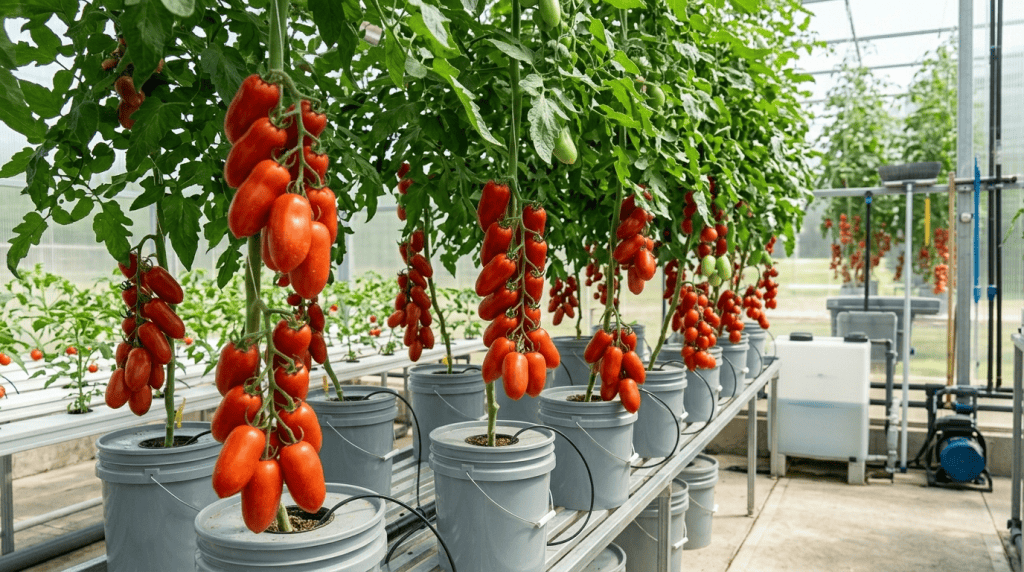
Paste tomatoes are ideal when preserving, canning, or making homemade sauce.
Which Paste Varieties Stand Out?
- San Marzano hydroponics
- Federle
- Roma tomatoes hydroponics
These hydroponic paste tomatoes deliver dense flesh and lower seed counts.
When Should You Choose Paste Tomatoes?
- Sauce making
- Canning
- Soup production
- Bulk harvesting
A grower making weekly pasta sauce might harvest fewer tomatoes. But they’ll get much more usable flesh from each one. Paste tomatoes usually have less water and fewer seeds than slicing tomatoes. That’s why growers focused on preserving food like them.
The Best Dwarf Tomatoes for Indoor Hydroponics Combine Compact Growth and High Yields

Credits: Saluda Grade Farm
Micro-dwarf and dwarf tomatoes dominate countertop hydroponics because size becomes the limiting factor.
Many indoor gardeners discover that plant architecture matters more than yield potential.
Which Varieties Stay Compact?
- Tiny Tim
- Tiny Tom
- Micro Tom
- Venus Micro Dwarf
- Tidy Treats
- Red Robin
These dwarf varieties do especially well under LED lights and in small container hydroponic systems.
When Should You Grow Dwarf Tomatoes?
- Countertop gardens
- Small NFT systems
- Kratky jars
- Apartment growing
- LED-only setups
Research for indoor growing points to Venus Micro Dwarf and Micro Tom. They’re among the best tomato types for small systems. Some micro-dwarf varieties stay under 8 inches tall and still produce fruit you can harvest.
Matching Tomato Varieties to Your Hydroponic System Improves Growing Success
System size matters more than many beginners realize.
| System | Best Varieties |
| Countertop Garden | Tiny Tim, Micro Tom |
| Kratky Jar | Tiny Tom, Venus Micro Dwarf |
| NFT System | Sakura F1, Sweet 100 |
| DWC Bucket | Sakura F1, Celebrity |
| Dutch Bucket | Torero, Better Boy |
| Greenhouse | Trust F1, Rebelski |
Large indeterminate tomato varieties can become several meters long under ideal hydroponic conditions.
Why Does System Size Matter?
Small systems limit root volume and plant size. Large systems support vigorous growth and extended production cycles.
Many growers keep indeterminate tomatoes producing for over a year. They do it with careful pruning, training, and nutrients. Commercial hydroponic operations often use a single-leader training system to make the most of their space.
The Best Tomato Varieties for Hot and Humid Conditions Produce Reliable Harvests
Heat-tolerant cultivars outperform standard varieties in warm climates and greenhouses.
Temperature stress remains one of the most common reasons for poor fruit set.
Which Tomatoes Tolerate High Temperatures?
- Heatmaster
- Solar Fire
- Lizzano
- Sakura F1
- Torero
Why Does Climate Matter?
High temperatures can cause:
- Flower drop
- Poor pollination
- Reduced fruit set
- Lower yields
According to GoPlanter
“In my own greenhouse trials, managing humidity is a constant battle; once your relative humidity climbs past 85%, tomato leaf mold can tear through your canopy in 48 hours, a risk ”. – GoPlanter
Solar Fire was bred for warm climates. It’s often recommended for hot growing areas.
Commercial Hydroponic Growers Choose Tomato Varieties for Yield, Quality, and Consistency
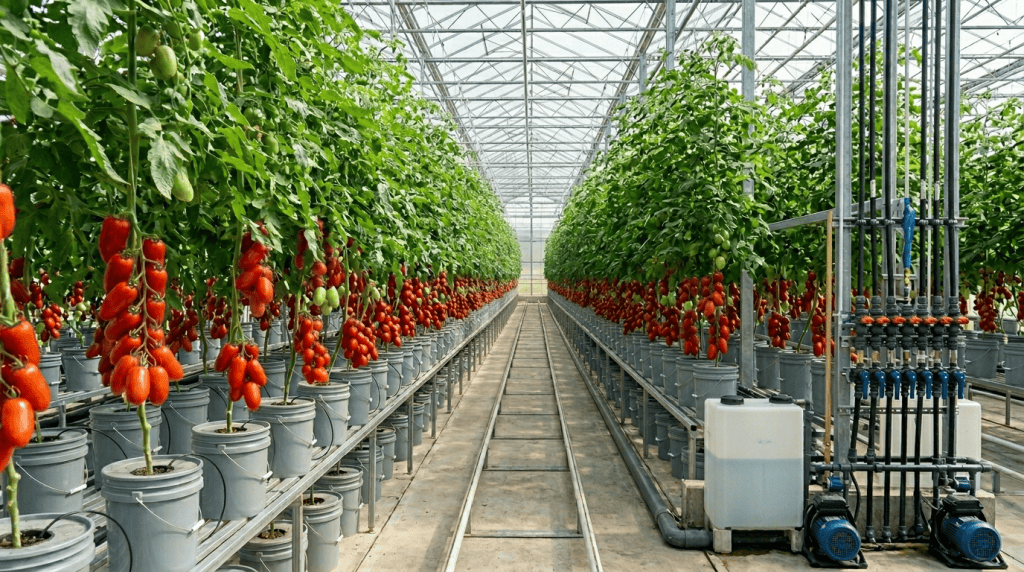
Commercial producers prioritize consistency, disease resistance, and predictable yields.
Before adopting new cultivars, commercial growers often evaluate several seasons of trial data.
Which Greenhouse Hybrids Are Common?
- Trust tomato variety
- Sweetelle tomatoes
- Merlice tomatoes
- Rebelski tomatoes
- Serenity
- Grandise
- Novero
- Riboski
- Favorita tomatoes
- Picolino tomatoes
- Flavorino tomatoes
- Red Delight tomatoes
- Clarance tomatoes
- Tradario tomatoes
- Tricia tomatoes
- Ambiance tomatoes
Why Don’t Commercial Growers Use More Heirlooms?
- Lower uniformity
- Greater disease pressure
- Reduced shelf life
- Variable yields
Professional breeding programs test new tomatoes thoroughly before release. They check the fruit’s weight, how well the clusters hold up, and its resistance to cracking and disease. CropKing’s greenhouse trials, for instance, regularly show off new commercial hydroponic varieties.
The Light Threshold Most Hydroponic Tomato Growers Ignore
The biggest rookie mistake I see indoor growers make is relying on human vision to judge light levels. Tomatoes care about the Daily Light Integral (DLI), the total volume of photons delivered over a 24-hour period.
While a light meter reading of 250 µmol/m²/s (PPFD) looks bright to your eyes, running that light for 12 hours only yields a DLI of 10.8 mol/m²/day, which will leave your clusters thin and sour. indoor cherry tomato
To hit the required 15 to 22 mol/m²/day sweet spot under artificial lights, you must dial your fixtures up to a PPFD of 350 µmol/m²/s and run them on an 18-hour photoperiod timer. I use a mobile PAR app with a calibrated diffuser daily to verify my canopy is getting enough energy.
Peppers can get by with less, around 170–180. This light difference matters a lot when you’re growing cherry tomatoes indoors under lights.
That difference becomes important when growing indoor cherry tomato plants under artificial lighting.
Many disappointing harvests result from insufficient light intensity rather than poor genetics.
pH Precision for Hydroponic Tomatoes: Why 6.0 Is Too Low
Small pH differences can affect nutrient uptake.
While general guides suggest a wide range of 5.5–6.5, hydroponic tomato specialists find the sweet spot sits tightly between 5.8 and 6.2. This optimal window balances macro-nutrient uptake (like Calcium) without binding up essential micronutrients like Iron and Manganese.
According to USDA Ask Extension
“A tiny shift of just 0.2 pH units radically alters nutrient availability. In my systems, letting the pH drift from 5.8 down to 5.6 instantly locked out calcium, leading to signs of tip burn within days.” – USDA Ask Extension
This matters most for nutrient-hungry types. That includes Better Boy, Big Beef, and most commercial greenhouse hybrids.
Common Variety Selection Mistakes Can Reduce Yield and Plant Health
The biggest mistake is choosing tomatoes that outgrow the system.
Many new growers buy seeds based on flavor alone and later discover the plants overwhelm their available space.
Which Mistakes Cause Problems?
- Growing large indeterminates in countertop systems
- Ignoring support requirements
- Choosing flavor over productivity
- Underestimating lighting needs
- Selecting greenhouse hybrids for tiny systems
Why Do Some Tomatoes Fail Indoors?
Large field varieties often become difficult to manage under grow lights.
One contributor on a gardening forum described Black Russian tomatoes as very flavorful. But they also noted the plants give a low yield and the fruit is often misshapen.
Warning: High flavor does not always equal high productivity.
Comparison of Popular Hydroponic Tomato Varieties
| Variety | Category | Primary Strength |
| Sakura F1 | Cherry | Yield and reliability |
| Super Sweet 100 | Cherry | Exceptional production |
| Tiny Tim | Dwarf | Small-system performance |
| Celebrity | Slicer | Disease resistance |
| San Marzano | Paste | Sauce production |
FAQ
How do I choose between determinate and indeterminate tomato varieties for hydroponics?
Determinate tomato varieties hydroponics growers use typically reach a fixed height, produce most of their fruit within a short period, and require less pruning. Indeterminate tomato varieties continue growing and producing tomatoes throughout the season.
If you want continuous harvests from a larger system, indeterminate plants are usually the better choice. If you have limited space, determinate varieties are often easier to manage.
Are cherry tomatoes better than larger tomatoes for hydroponic growing?
Cherry tomatoes for hydroponics are often easier to grow because they mature faster, set fruit more reliably, and place less stress on the plant.
Many of the best hydroponic tomatoes belong to the cherry category because they produce large numbers of fruits over a long period. Hydroponic beefsteak tomatoes can produce larger fruits, but they require stronger support, more pruning, and closer environmental control.
Which tomato varieties are best for small indoor hydroponic systems?
Indoor hydroponic tomatoes grown in small systems perform best when the plants remain compact and manageable. Dwarf tomato varieties and compact tomato varieties require less vertical space and are easier to maintain under grow lights.
These tomato varieties for small systems can produce consistent harvests without overcrowding the growing area, making them suitable for apartments, shelves, and countertop hydroponic gardens.
What factors have the biggest impact on hydroponic tomato yield per plant?
Hydroponic tomato yield per plant depends primarily on light levels, nutrient availability, root health, temperature, and pollination success. High yielding hydroponic tomatoes require sufficient light each day and a balanced nutrient solution throughout their growth cycle.
Proper pruning and airflow also improve productivity. When these conditions are maintained consistently, growers can achieve higher yields and better fruit quality.
Can the same hydroponic tomato varieties grow in different hydroponic systems?
Most hydroponic tomato varieties can grow in several hydroponic systems, but their performance may vary. Large vine-producing plants often perform well in Dutch bucket tomatoes systems because they have more root space and support.
Smaller plants can thrive as NFT tomato varieties or DWC tomato varieties. Matching the plant’s growth habit to the system improves plant health, fruit production, and overall growing efficiency.
Pick the Right Tomato First, Then Grow From There
Choosing the wrong tomato variety for your hydroponic system can leave you with more work and fewer tomatoes than you expected. It’s frustrating. The variety you choose has a big impact on your results, often more than any upgrade you make later.
Success in hydroponics boils down to matching plant genetics to your hardware and your personal daily schedule. Beginners will save themselves hours of frustration by cutting their teeth on forgiving, high-yielding cherry varieties like Sakura F1 or compact dwarfs like Tiny Tim before tackling temperamental beefsteaks.
To help streamline your planning phase, I’ve uploaded my complete comparative database and system-matching calculators over at Tophydroponicgarden, which you can use to filter cultivars by your exact system dimensions, nutrient tank volume, and lighting capacity before buying your seeds.
References
- https://www.goplanter.com/hydroponic-tomato-pests-and-diseases/
- https://ask.extension.org/kb/faq.php?id=678210
Related Articles
- https://tophydroponicgarden.com/growing-cherry-tomatoes-in-dwc-system/
- https://tophydroponicgarden.com/factors-in-choosing-a-hydroponic-setup/
- https://tophydroponicgarden.com/best-dwarf-plant-varieties-for-hydroponics/
Was this helpful?

I’m Barrie L., a passionate hydroponic gardening enthusiast dedicated to cultivating thriving, soil-less gardens. With a focus on all things hydroponic, I share my expertise on innovative growing techniques and sustainable practices through my blog, tophydroponicgarden.com. As a seasoned hydroponics specialist, my goal is to inspire and guide fellow gardeners in harnessing the power of water-based cultivation for bountiful and eco-friendly harvests. I’m also an author of the book “Hydroponics For Absolute Beginners: Your Step By Step Guide For How To Create An Hydroponics System At Home Without Soil, For Growing Vegetable, Fruit And Herbs.” which is sold on Amazon. Join me on a journey of redefining the way we cultivate plants, one nutrient-rich solution at a time. Happy growing!