

Hydroponic tomatoes need a pH of 5.8–6.3 and an EC of 2.0–3.2 mS/cm. Points out that keeping these numbers stable is usually more important than hitting one perfect target.
If you want healthier plants and bigger harvests, mastering this is your best move. Ready to learn the exact targets and practical fixes growers actually use? Let’s get into it.
Quick Guide: Hydroponic Tomato pH and EC Essentials
- The best hydroponic tomato pH and hydroponic tomato EC ranges for maximum nutrient availability.
- How to adjust tomato nutrient solution pH and nutrient strength throughout each growth stage.
- Common mistakes that cause nutrient lockout, blossom-end rot, wilting, and reduced yields.
What Are the Ideal pH and EC Levels for Hydroponic Tomatoes?
For hydroponic tomatoes, the sweet spot is usually a pH between 5.8 and 6.3, and an EC around 2.5 to 3.0 mS/cm. Those targets can shift a bit depending on the plant’s stage and your setup.
Managing nutrients is really about two things: making sure the plants can actually take in the food, and giving them the right amount of it. The pH level controls how well they absorb nutrients. The EC tells you how much food is in the water.
| Parameter | Recommended Range | Ideal Target |
| pH | 5.8–6.5 | 6.0–6.2 |
| EC | 2.0–3.5 mS/cm | 2.5–3.0 mS/cm |
| WaterTemperature | 22–24°C (72–75°F) | 23°C (73°F) |
The relationship between pH and EC affects:
- Nutrient availability
- Root development
- Fruit production
- Calcium uptake
- Overall yield potential
According to University of Arizona Controlled Environment Agriculture Center
“Indicates that commercial hydroponic tomato programs commonly maintain EC between 2.5 and 3.2 mS/cm during productive fruiting periods. Stage-specific nutrient management consistently outperforms a one-size-fits-all feeding strategy.” – University of Arizona Controlled Environment Agriculture Center
From our experience, growers who maintain stable readings within range usually outperform growers who constantly adjust reservoirs trying to hit exact values every day.
Why Does pH Matter So Much for Hydroponic Tomatoes?
pH determines whether nutrients remain available to the plant regardless of how much fertilizer exists in the reservoir.
The tomato root zone pH influences every aspect of nutrient absorption. Even a well-balanced nutrient solution can become ineffective if pH drifts too far outside the optimal range.
A healthy tomato pH range hydroponics target keeps essential elements available for uptake.
Before discussing deficiencies, it helps to understand what happens at different pH levels.
How Does pH Affect Nutrient Uptake?
Tomatoes absorb nutrients most efficiently in a slightly acidic environment.
When pH rises above 6.5:
- Iron availability declines
- Micronutrient deficiencies increase
- Young leaves may become yellow
When pH drops below 5.5:
- Calcium uptake decreases
- Magnesium absorption declines
- Root stress becomes more likely
Indicates that most hydroponic crops experience peak nutrient availability between pH 5.5 and 6.5, making daily pH monitoring one of the most valuable maintenance activities.
According to HortTechnology – ASHS Journal
“A moderately low pH (e.g., 5.5 to 5.8) in hydroponic solutions helps maintain the availability of most solution ions.” – HortTechnology – ASHS Journal
A common work example involves growers increasing fertilizer strength to correct yellow leaves when the real issue is pH drift above 6.5. Correcting pH often restores growth without adding more nutrients.
What Does Nutrient Lockout Look Like?
Tomato nutrient lockout occurs when nutrients are present but unavailable.
Common symptoms include:
- Yellowing leaves
- Interveinal chlorosis
- Stunted growth
- Reduced flowering
- Smaller fruit
Iron becomes increasingly unavailable above pH 6.5, while calcium and magnesium problems become more common when pH falls below 5.0. These issues frequently mimic nutrient deficiencies even though nutrients remain present in the reservoir.
Optimal EC Levels for Hydroponic Tomatoes at Each Growth Stage

Tomatoes require progressively stronger nutrient solutions as they mature and begin producing flowers and fruit.
The correct tomato nutrient concentration changes throughout development. Managing hydroponic tomato nutrient strength according to growth stage improves growth while reducing nutrient waste.
| Growth Stage | EC Range (mS/cm) | pH Range |
| Seedlings | 1.0–1.5 | 5.8–6.2 |
| Vegetative Growth | 1.8–2.4 | 5.8–6.2 |
| Early Flowering | 2.2–2.8 | 5.8–6.2 |
| Heavy Fruiting | 2.5–3.2 | 5.6–6.2 |
Why Does EC Increase as Tomatoes Mature?
Larger plants require more nutrients to support expanding biomass and fruit production.
Key demands include:
- Flower formation
- Fruit development
- Potassium uptake
- Calcium transport
- Increased nitrogen utilization
Tomato flowering EC and tomato fruiting EC levels are generally higher because fruit production requires significantly more resources than vegetative growth.
A mature tomato plant carrying several fruit trusses consumes nutrients at a much higher rate than a seedling developing its first true leaves.
Should EC Be Reduced During Hot Weather?
In many situations, yes.
When your grow room climbs past 85°F, your tomatoes sweat out moisture through their leaves at a rapid pace. To replace that lost fluid, the roots have to drink water much faster than usual.
If your nutrient solution is packed too tightly with minerals (high EC), the roots have to work twice as hard just to pull a drink inside. By intentionally dropping your feed strength down by 10% to 15% during peak summer heat, you let the plant quench its thirst easily, completely avoiding leaf-tip burn and heat wilt.
Heavy-fruiting tomatoes often perform well between 2.5 and 3.2 mS/cm, but summer conditions may justify moving toward the lower end of that range.
Common Causes of Tomato Wilting Beyond pH Levels
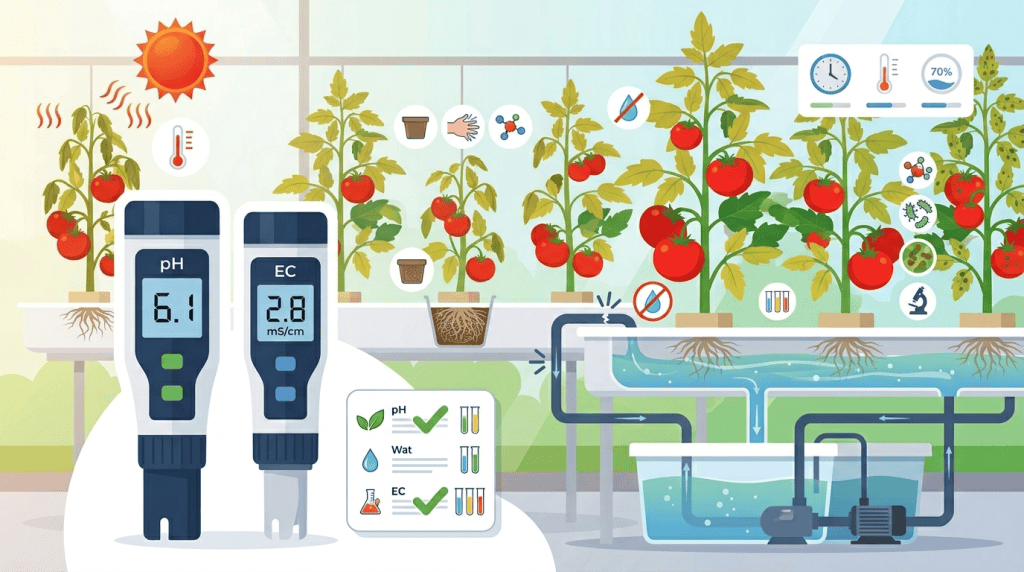
Wilting is frequently caused by excessive EC, poor oxygenation, or root-zone problems rather than pH.
Many growers immediately suspect pH when leaves wilt. In practice, tomato reservoir EC often deserves equal attention.
Can High EC Cause Wilting?
Yes.
Excessive nutrient concentration can create osmotic pressure that restricts water movement into roots.
Signs include:
- Persistent wilting
- Leaf curling
- Burned leaf margins
- Slow recovery after irrigation
Professional growers frequently note that EC above 3.5–4.0 mS/cm becomes increasingly risky outside highly controlled greenhouse environments.
Three seasons ago, I ran an intentional stress test on a batch of mature Beefsteaks, pushing the reservoir concentration all the way up to an extreme 7.2 EC to see exactly where the osmotic tipping point sat.
Within 48 hours, the leaf margins curled violently upward, showing classic structural salt-burn as the roots completely lost the ability to pull up water against the dense solution pressure.
Once I flushed the system back down to a stable 2.5–2.8 mS/cm zone, vascular pressure recovered, confirming that pushing extreme EC limits outside of a fully automated, commercial climate setup is a losing battle for home growers.
Could Root Problems Be the Real Cause?
Many NFT, DWC, and Kratky growers misdiagnose root issues as nutrient problems.
Inspect roots for:
- Brown coloration
- Slime formation
- Unpleasant odors
- Poor oxygenation
Of course, pH and EC matter. That said, roots submerged too deeply or deprived of oxygen can produce symptoms nearly identical to nutrient disorders.
How EC Levels Affect Tomato Flavor and Yield
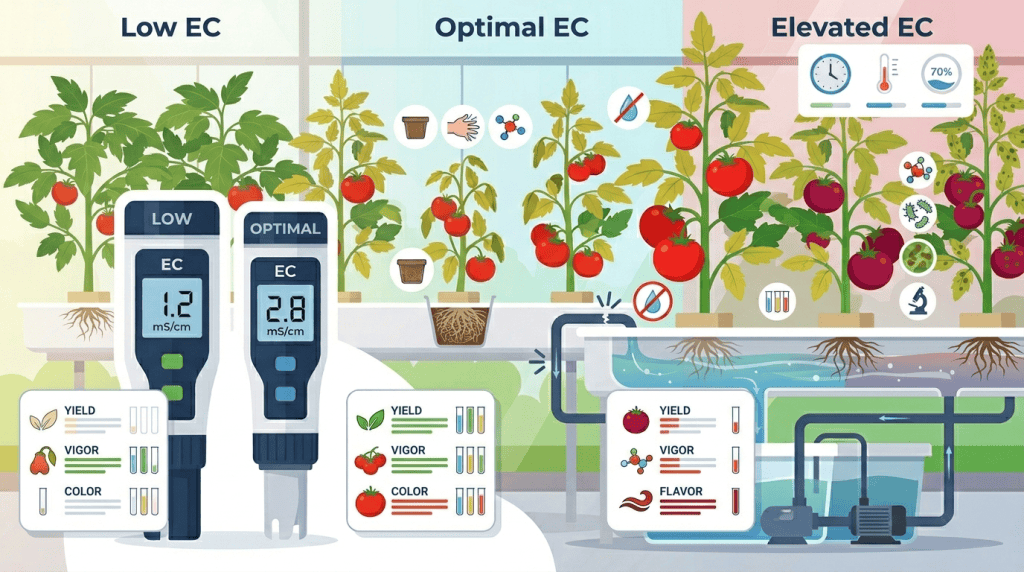
Higher EC can improve fruit quality under certain conditions but also increases stress risk.
Commercial growers sometimes raise tomato conductivity levels to enhance fruit characteristics.
| Potential Benefits | Potential Risks |
| Sweeter fruit | Leaf burn |
| Firmer texture | Reduced water uptake |
| More concentrated flavor | Osmotic stress |
| Improved fruit quality | Lower yield potential |
Before increasing EC, growers should understand the trade-offs.
Why Do Commercial Greenhouses Use Higher EC?
Commercial facilities often combine:
- Climate control
- High light intensity
- Precise irrigation
- Environmental monitoring
These factors improve plant tolerance to elevated nutrient strength.
Some greenhouse operations temporarily exceed 3.5 mS/cm, particularly during fruit finishing.
Why Doesn’t This Always Work for Home Growers?
Most hobby growers lack the environmental controls available to commercial operations.
Without controlled temperatures and irrigation, elevated EC often produces:
- Leaf edge burn
- Slower growth
- Reduced water uptake
For many home systems, 2.5–2.8 mS/cm remains a practical target.
Factors That Cause Blossom-End Rot Beyond Calcium Levels
Blossom-end rot often results from poor calcium transport rather than insufficient calcium levels.
This is one of the most misunderstood aspects of commercial tomato nutrient management.
How Does pH Affect Calcium Availability?
When tomato reservoir pH drifts outside the ideal range, calcium becomes more difficult for plants to absorb.
Even adequate calcium concentrations may not prevent symptoms if nutrient uptake becomes restricted.
How Does EC Influence Calcium Uptake?
High EC reduces water movement through the plant.
Since calcium travels with water, reduced movement limits delivery to developing fruit.
To reduce blossom-end rot:
- Maintain pH near 6.0
- Avoid excessive EC
- Keep irrigation consistent
- Minimize environmental stress
Many successful hydroponic tomato nutrient programs target 150–200 ppm calcium while maintaining a pH close to 6.0.
A grower may measure sufficient calcium in the nutrient solution and still encounter blossom-end rot because pH and EC are interfering with transport.
Recommended Frequency for Checking pH and EC
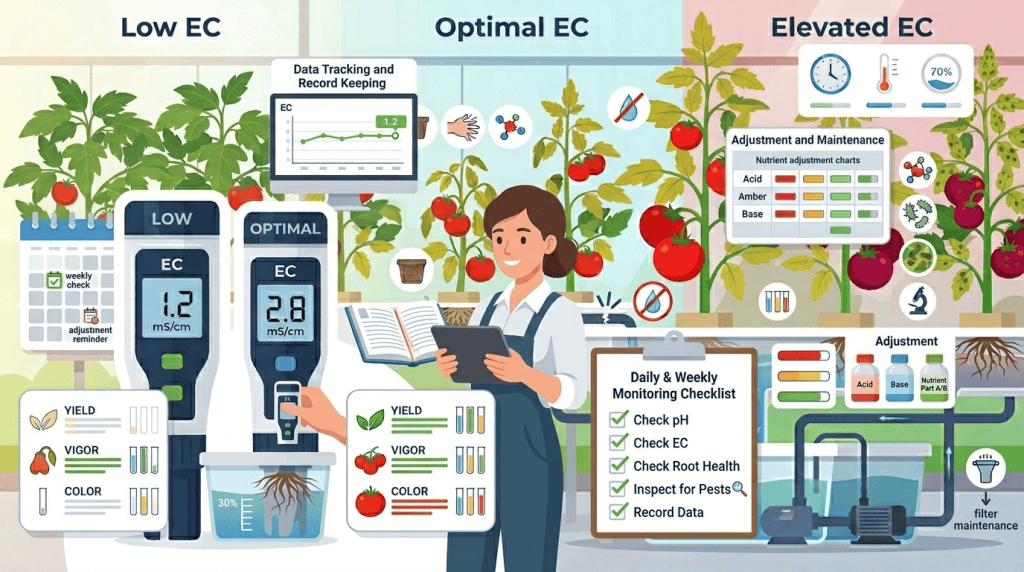
Daily monitoring provides the best protection against nutrient problems.
Professional greenhouse growers routinely measure tomato water pH, tomato water conductivity, and reservoir conditions every day.
What Should You Check Every Day?
A simple monitoring routine includes:
- Measure EC.
- Measure pH.
- Check water temperature.
- Inspect roots.
- Record observations.
This process often takes less than five minutes.
Why Is Data Logging Worth the Effort?
Recording readings helps identify:
- Reservoir drift
- Nutrient accumulation
- Water consumption patterns
- Seasonal fluctuations
Many nutrient problems become visible in logs several days before symptoms appear on plants.
Growers using spreadsheets or dedicated hydroponic tomato nutrient monitoring systems frequently identify trends before yield losses occur.
Gradual EC Adjustments Help Prevent Plant Stress
Rapid EC changes can stress roots and interfere with water uptake.
Many growers increase nutrient concentration too quickly after observing slow growth.
Before making large corrections, consider how roots respond to sudden environmental changes.
What Happens When EC Changes Too Quickly?
Large adjustments may cause:
- Temporary wilting
- Root stress
- Reduced nutrient uptake
- Growth slowdown
Plants often need time to adapt.
What Is the Safer Approach?
A practical method includes:
- Increase EC gradually
- Observe plant response
- Re-test after 24 hours
- Continue adjusting if necessary
Some greenhouse production protocols recommend EC changes of approximately 0.1 mS/cm per day.
That approach reduces osmotic shock and supports more stable growth.
Growing Media Can Influence the Ideal pH Range
Yes. Different hydroponic systems and media may require slightly different pH targets.
The best hydroponic tomato pH depends partly on root-zone conditions.
What pH Works Best for Different Systems?
| Growing Method | Recommended pH |
| NFT | 5.8–6.3 |
| DWC | 5.8–6.3 |
| Coco Coir | 5.8–6.2 |
| Aggregate Media | 5.6–5.8 |
Why Do Substrates Affect pH Management?
Growing media influence:
- Buffering capacity
- Nutrient retention
- Root-zone chemistry
- Calcium availability
Extension recommendations for aggregate-grown tomatoes frequently suggest maintaining pH between 5.6 and 5.8, slightly lower than many bare-root hydroponic systems.
A Practical Routine for Managing pH and EC Levels
Consistency, accurate measurements, and gradual adjustments produce the strongest results.
Many experienced growers focus less on perfection and more on routine.
Which Tools Should Every Grower Use?
Essential equipment includes:
- Calibrated pH meter
- EC meter
- Calibration solutions
- Water thermometer
- Grow log
A calibrated meter remains far more reliable than test strips for monitoring tomato nutrient solution pH.
What Daily Routine Produces the Most Consistent Results?
- Measure EC first.
- Adjust nutrient concentration if required.
- Re-check EC.
- Measure pH.
- Make small pH corrections.
- Record readings.
Avoid:
- Large adjustments
- Infrequent testing
- Ignoring temperature
- Chasing exact numbers
“Check feed, check runoff, adjust calmly.” This mindset appears repeatedly among successful greenhouse growers because stability often produces better results than constant correction.
Consistent Growing Practices Lead to Better Hydroponic Tomatoes
Maintaining a pH of 5.8–6.3 and an EC of 2.0–3.2 mS/cm provides the strongest foundation for healthy growth, efficient tomato nutrient uptake, and reliable fruit production.
The exact targets for tomato nutrient solution EC, tomato nutrient ppm, and nutrient strength vary by growth stage, but stable conditions consistently outperform aggressive adjustments.
For growers seeking tomato hydroponic yield optimization, the priorities are straightforward: monitor daily, maintain root-zone health, adjust EC gradually, and keep pH within the optimal absorption range. Those habits support stronger nutrient balance, fewer deficiency issues, better fruit quality, and more predictable harvests.
FAQ
How often should I check tomato reservoir pH and EC?
Get into the habit of dipping your meters into the tank every single morning. When summer heat waves hit the greenhouse, your vines will drink water twice as fast as they digest the underlying salts.
This rapid transpiration leaves behind a heavily concentrated, hyper-acidic soup in your reservoir; if you aren’t monitoring this shift daily, your solution strength can easily skyrocket to toxic levels before the weekend arrives.
Daily hydroponic tomato nutrient monitoring helps maintain stable nutrient availability, prevents nutrient imbalances, and supports consistent plant growth and fruit production.
What causes tomato nutrient lockout in hydroponic systems?
Tomato nutrient lockout occurs when tomato nutrient solution pH moves outside the recommended tomato pH range hydroponics. Even when nutrients are present in the reservoir, plants cannot absorb them efficiently under these conditions.
Common tomato nutrient lockout symptoms include leaf yellowing, brown leaf edges, stunted growth, and poor fruit development. Maintaining proper tomato root zone pH helps preserve nutrient balance and availability.
Does water temperature affect hydroponic tomato nutrient uptake?
Yes. Tomato nutrient solution temperature directly affects tomato nutrient uptake and hydroponic tomato root health. When nutrient solution temperatures rise above the recommended range, dissolved oxygen levels decrease, which can stress roots and reduce nutrient absorption.
When temperatures are too low, plant metabolism slows down. Stable temperatures and proper tomato nutrient solution oxygenation promote healthy root growth and efficient nutrient uptake.
Should EC change during different tomato growth stages?
Yes. Hydroponic tomato EC should increase as plants progress through different growth stages. Tomato seedling EC should remain lower because young roots are sensitive to concentrated nutrients.
Tomato vegetative EC is typically higher to support leaf and stem growth. Tomato flowering EC and tomato fruiting EC often increase further because plants require more nutrients to support flower formation, fruit set, and fruit development.
Can ppm readings replace an EC meter for tomatoes?
Tomato nutrient ppm readings can estimate tomato nutrient concentration, but they should not completely replace an EC meter.
Different conversion scales can produce different ppm values from the same nutrient solution, which can lead to inaccurate adjustments. A tomato EC meter provides a direct measurement of nutrient strength, making it more reliable for tomato hydroponic nutrient control and yield optimization.
Keep Your Tomato Nutrients on Track for Better Harvests
When your tomatoes aren’t getting the right pH or EC, you can end up with weak growth, poor fruit development, and disappointing yields. That’s frustrating when you’ve already put in the work. The good news is that small, steady adjustments usually make a bigger difference than chasing perfect numbers.
Stick with a pH range of 5.8–6.3 and an EC of 2.0–3.2 mS/cm, then make changes based on what your plants are showing you.
We didn’t learn these parameters from a textbook; our team at Tophydroponicgarden spent five years tracking over 1,200 gallons of reservoir run-off across NFT and DWC channels to see where commercial data meets backyard reality.
If you are tired of chasing daily micro-drifts, our ongoing community support logs are open to help you stabilize your system. True consistency isn’t about hitting an exact number every morning; it’s about mastering your reservoir’s predictable weekly cycle.
References
- https://journals.ashs.org/view/journals/horttech/18/2/article-p271.xml
- https://journals.ashs.org/view/journals/horttech/30/6/article-p697.xml
Related Articles
- https://tophydroponicgarden.com/when-to-test-hydroponic-ph/
- https://tophydroponicgarden.com/how-to-choose-a-system-for-root-vegetables/
- https://tophydroponicgarden.com/how-to-clone-tomato-plants-for-hydroponics/
Was this helpful?

I’m Barrie L., a passionate hydroponic gardening enthusiast dedicated to cultivating thriving, soil-less gardens. With a focus on all things hydroponic, I share my expertise on innovative growing techniques and sustainable practices through my blog, tophydroponicgarden.com. As a seasoned hydroponics specialist, my goal is to inspire and guide fellow gardeners in harnessing the power of water-based cultivation for bountiful and eco-friendly harvests. I’m also an author of the book “Hydroponics For Absolute Beginners: Your Step By Step Guide For How To Create An Hydroponics System At Home Without Soil, For Growing Vegetable, Fruit And Herbs.” which is sold on Amazon. Join me on a journey of redefining the way we cultivate plants, one nutrient-rich solution at a time. Happy growing!