

The best growing medium for most DWC systems is expanded clay pebbles (often called Hydroton or LECA), because they balance root support, airflow, and ease of use better than most alternatives. These round, porous pellets cradle the roots while letting plenty of oxygen circulate, which is the whole point of deep water culture.
They don’t stay soggy, they’re pH-neutral, reusable, and they resist compaction over time. Other media like rockwool or coco can still work well, depending on your setup and style, but clay pebbles are the most forgiving choice for most growers. Keep reading to see why and how to use them.
Key Takeaways
- Expanded clay pebbles offer superior aeration, preventing root rot in submerged systems.
- Their inert, reusable nature makes them a cost-effective and low-maintenance choice.
- Proper preparation and placement in net pots are crucial for optimal plant support.
Why Your DWC Medium Isn’t Just Dirt

I’ve seen a lot of DWC setups where the system looks high-tech, but the growing medium was treated like an afterthought, almost like someone just grabbed whatever was nearby and called it good. In deep water culture, that choice quietly decides whether your plants thrive or crash.
The medium’s main job is to support the plant and promote aeration; nutrient and water supply come from the DWC solution, making oxygen availability at the root zone especially critical, making oxygen availability at the root zone especially critical.
The medium’s main job is to support the plant and promote aeration; nutrient and water supply come from the DWC solution. The nutrient solution in the reservoir handles that part. It’s not even there to store moisture. Its real role is to anchor the plant while giving the roots room to breathe, even though they’re hanging in water the whole time.
That balance is fragile. Pick the wrong medium and it can cling to too much water around the plant’s crown or stem, and that’s where stem rot starts. On top of that, some media compress over time and squeeze the tiny root hairs that actually pull in nutrients, almost like pinching off the plant’s food supply.
You’re not just filling a net pot with some random material, you’re choosing the base structure for how your plant’s entire root “breathing” system will work. The wrong grow media can collapse air gaps, trap moisture, and disrupt oxygen flow right where roots are most vulnerable. Think of the gaps between each particle of the medium as the plant’s lungs. In soil, worms and insects carve out those little air tunnels for free. In DWC, you don’t get that help, you have to create that porous structure on purpose with your media choice.
The best DWC substrate is, strangely, mostly empty space. It should act like a scaffold holding the plant in place, not like a sponge soaking up water. This is where many beginners run into trouble, because they use materials that perform well in regular gardening but fail in hydro.
They might pour in potting soil, which quickly turns into a muddy, low-oxygen sludge in a DWC system. Or they’ll try something fine like sand, which settles, packs tight, and chokes off air flow. Both look harmless at first glance, but they shut down gas exchange around the roots. What you actually want is maximum air movement through the medium, with just enough solid structure to keep the plant upright and stable.
When the medium is wrong, the system usually doesn’t give you much time to react. Root rot can develop in just a few days if the plant’s base stays wet and starved of oxygen. Once you see those slimy, brown, foul-smelling roots, you’re in rescue mode, doing hydrogen peroxide treatments and scrubbing the whole system to stop the spread.
That’s why choosing a well-aerated, stable medium from day one is basically preventative health care for your hydroponic setup.
- The medium’s main roles are physical support and root zone aeration.
- Poor aeration leads directly to root rot and plant failure.
- The structure of the medium itself creates the air pockets roots need.
The Unmatched Advantages of Expanded Clay Pebbles
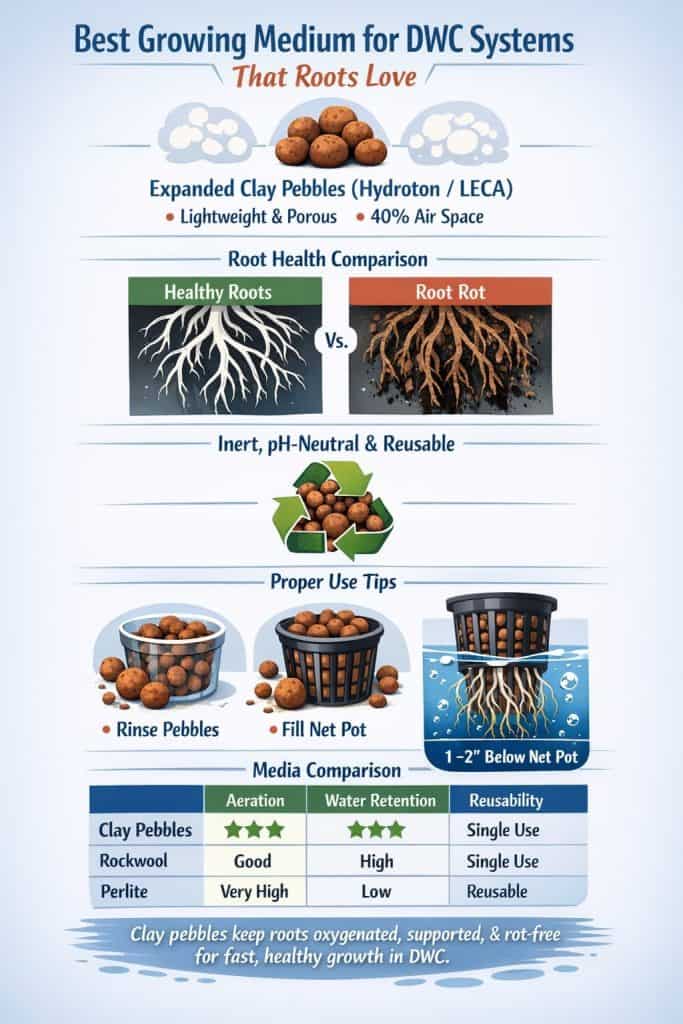
Walk into a good hydroponics shop and you’ll notice something right away, usually stacked in a corner or on a pallet: huge bags of round, reddish-brown pellets that almost look like some strange breakfast cereal. They’re light in the hand, some even float for a bit. These are expanded clay pebbles, and in DWC circles they’re not a trend, they’re a default. There’s a reason so many serious growers reach for them first.
The way they’re made is actually pretty wild. Raw clay gets fed into a rotary kiln and heated to very high temperatures. As it cooks, the trapped gases and minerals inside expand and pop, almost like popcorn. That popping action forms a hard outer shell and a porous, honeycombed interior in each pellet. That inner structure is where the magic happens. Every pebble becomes a tiny air reservoir, a built-in pocket for gas exchange.
Their porosity is what turns them from simple pellets into an ideal DWC medium. When you pack a net pot with clay pebbles, you’re not creating a solid block, you’re building a matrix that’s roughly 40% material and 60% air space. All those open gaps let oxygen from the air move freely around the plant’s crown and upper roots. [1]
So while the lower roots hang in the nutrient solution, the base of the stem stays elevated, well-ventilated, and dry enough to avoid rot. That’s bad news for pathogens that prefer soggy, stagnant conditions. On top of that, the pebbles are chemically inert, so they won’t raise or lower your pH or leach unexpected minerals into your reservoir. You keep full control over what your plants are actually drinking.
Their lifespan is another big selling point. After a harvest, you don’t have to toss them out. You can gather the pebbles, rinse away organic matter, and then sterilize them for another run. Many growers soak them in a hydrogen peroxide bath or a diluted bleach solution, then rinse thoroughly until no residue remains.
Growers sometimes sanitize pebbles (e.g., chemical soak or heat), be careful to fully rinse before reuse. Because they can be cycled over and over, the higher upfront cost spreads out across many grows, which saves money and cuts down on waste heading to the trash.
Functionally, they solve a lot of small but annoying problems. They drain very well, so they don’t trap extra water around the plant stem. That alone prevents many early failures in DWC. They’re also surprisingly light, even when fully saturated. Compare that with a net pot full of wet rockwool, which can feel dense and awkward to move. Lifting lids, checking roots, and adjusting plants is just easier with clay pebbles.
And since they don’t break down, you won’t end up with sludge, dust, or crumbled bits settling at the bottom of your reservoir. That means fewer clogs in pumps and airstones, and less time spent cleaning out fine debris. They hold their shape and structure, run after run.
When Other Media Might Make Sense
DWC Growing Medium Comparison

Credits: Everything Hydroponics
| Growing Medium | Aeration | Water Retention | Reusability | Best Use in DWC |
| Expanded clay pebbles | Excellent | Low | Yes | Main medium for full DWC grows |
| Rockwool cubes | Moderate | High | No | Seed starting and cloning only |
| Coco coir | Low–Moderate | High | Limited | Better for drip or ebb-and-flow systems |
| Perlite | High | Very low | Limited | Mixed with other media for aeration |
| Growstones | Good | Low–Moderate | Yes | Alternative option when available [2] |
Setting Up Your DWC System for Success
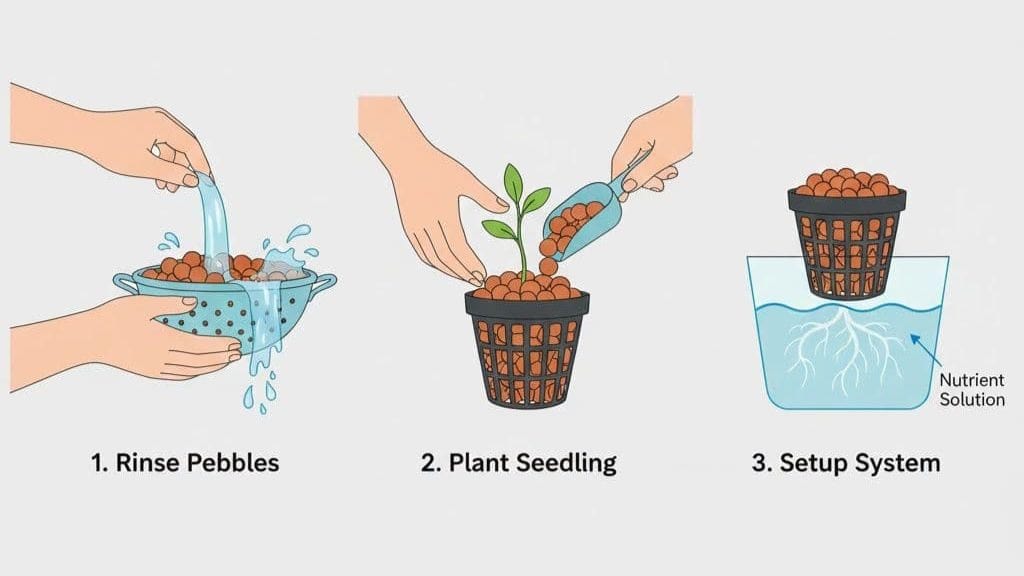
Using the right medium is only half the battle. How you handle it from the start matters just as much. Clay pebbles seem simple, but they still need a bit of prep before they touch your DWC system. Always begin with clean, pre-rinsed pebbles. Even straight out of the bag, they usually carry a layer of fine clay dust.
Pour them into a large bucket or colander and rinse thoroughly with fresh water until what drains off runs clear. That one step keeps your reservoir from turning cloudy. After rinsing, you can choose to soak the pebbles in your nutrient solution for a few hours. It helps them “acclimate,” though it isn’t essential since they don’t hold water the way a sponge does.
When you move to filling your net pot, resist the urge to just dump everything in. Start by placing a thin layer of pebbles at the bottom to cover the holes, creating a stable base. Then, set your plant in place. If you’re working with a seedling in a rockwool cube, position the cube right in the center of the pot.
From there, gently pour clay pebbles around the stem or around the cube, letting them settle naturally. Don’t press them down or pack them tight. You want a loose, airy structure. The plant should stand upright and steady, but the stem shouldn’t be buried deep. The crown, where the stem meets the roots, should sit right at the top layer of pebbles, not hidden beneath them.
Water level is the next key detail. At first, adjust the level in your reservoir so it just kisses the bottom of the net pot, roughly an inch deep. That way, the bubbles from the airstone can pop against the underside of the pot, splashing nutrient solution onto the lower pebbles and tempting the young roots to grow downward toward the water.
After the roots have grown through the net pot and are hanging freely into the solution, you can lower the water level by an inch or two. This creates a larger air gap, letting the upper roots breathe while the lower roots stay submerged and fed. That early staging is what shapes the direction and health of the root system.
Ongoing care stays fairly simple. Between grows, rinse and sterilize your clay pebbles using the cleaning method you prefer, then rinse again so no chemicals remain. During an active grow, just watch the top layer.
If it’s exposed to light, algae may start forming on the surface. Covering the net pot with a lid or using light-proof pots keeps that from getting started. Beyond those checks, the clay pebbles mostly work quietly in the background, holding your plants steady and keeping the root zone protected and aerated from start to finish.
FAQ
How do I choose the best DWC growing medium for my setup?
Choosing the best DWC growing medium depends on how well it supports roots, allows oxygen flow, and manages water retention. DWC hydroponic media should be inert, pH neutral, and stable inside net pots. When comparing deep water culture substrate options, focus on aeration, durability, and ease of cleaning. The best substrate for DWC keeps roots supported without staying overly wet.
What are the pros and cons of different DWC hydroponic media options?
Different hydroponic DWC media options affect root health in different ways. Some media provide high aeration but low water retention, while others hold moisture longer and reduce airflow. A proper DWC grow medium comparison should consider root oxygenation, nutrient uptake media DWC performance, cost, and maintenance needs. Understanding these trade-offs helps prevent root rot and growth slowdowns.
Are organic or synthetic substrates better for deep water culture systems?
Organic hydroponic media can retain moisture well, but they often break down and release particles into the DWC reservoir. Synthetic hydroponic media and inert substrate hydroponics remain stable, pH neutral, and reusable. For deep water culture substrate selection, inert hydroponic media usually performs better over time. Stability and cleanliness matter more than organic content in DWC systems.
What growing media work best for seedlings in DWC systems?
Hydroponic media for seedlings should provide gentle support while allowing roots to expand freely. Lightweight soilless growing media with consistent structure help young roots access oxygen and nutrients. The best media for net pots at this stage balances moisture retention with airflow. Heavy or compact substrates can restrict early root development and slow plant establishment.
How do I maintain and reuse hydroponic growing media in DWC?
Reusable hydroponic media requires consistent cleaning between grow cycles. Old roots, organic debris, and mineral buildup must be removed to maintain sterile growing media hydroponics conditions. Proper grow medium maintenance helps preserve media pH buffering for DWC and ensures stable performance. Durable, long lasting hydroponic media can be reused safely when cleaned thoroughly and stored properly.
The Best Growing Medium for DWC Systems Starts at the Roots
The growing medium is the quiet partner in your DWC setup, always working out of sight, but shaping almost everything that happens above the lid. Down in the dark, it gives your plants a steady, oxygen-rich base so the roots can do their job without stress.
When you choose expanded clay pebbles, you’re picking a medium built specifically for the demands of deep water culture, not just borrowing something from soil gardening and hoping it works. For many growers, this is why it’s often seen as the best deep water culture setup for long-term root health. Clay prioritizes roots first, and in hydroponics, strong roots are the real engine behind every healthy leaf and every heavy fruit.
There’s no need to turn this into a complicated science project. Get a bag of quality expanded clay pebbles, rinse them thoroughly, and load your net pots with a light, loose touch instead of packing them tight. Let the air spaces stay open. Set the water level correctly, keep everything clean, and the medium will quietly handle its job in the background.
In return, your plants will respond with fast growth, bright white roots, and, if everything else is in line, a harvest that makes the simple choice of the right medium feel very smart.
References
- https://files.core.ac.uk/download/595554963.pdf
- https://www.edengreen.com/blog-collection/guide-to-hydroponic-growing-media
Related Article
- https://tophydroponicgarden.com/deep-water-cultu re-guide/
- https://tophydroponicgarden.com/grow-media/
- https://tophydroponicgarden.com/is-deep-water-culture-the-best/
Was this helpful?

I’m Barrie L., a passionate hydroponic gardening enthusiast dedicated to cultivating thriving, soil-less gardens. With a focus on all things hydroponic, I share my expertise on innovative growing techniques and sustainable practices through my blog, tophydroponicgarden.com. As a seasoned hydroponics specialist, my goal is to inspire and guide fellow gardeners in harnessing the power of water-based cultivation for bountiful and eco-friendly harvests. I’m also an author of the book “Hydroponics For Absolute Beginners: Your Step By Step Guide For How To Create An Hydroponics System At Home Without Soil, For Growing Vegetable, Fruit And Herbs.” which is sold on Amazon. Join me on a journey of redefining the way we cultivate plants, one nutrient-rich solution at a time. Happy growing!