

Most hydroponic herb growers run into the same problem early on roots that stay too wet, too dry, or starved of oxygen without an obvious reason why. The growing medium is usually where things go wrong.
Choosing the best grow medium for hydroponic herbs comes down to balancing moisture retention and root zone oxygenation.
Buffered coco coir handles that balance better than most options, which is why it remains the default recommendation for basil, mint, parsley, and other leafy herbs across a wide range of systems.
Expanded clay pebbles and rockwool cubes work well too, but each serves a different purpose.Keep reading to find out which hydroponic substrate fits your herbs and your setup.
What the Best Hydroponic Growers Actually Put in Their Systems
Choosing the right growing medium depends on what stage the plant is in and what the root zone actually needs. No single medium wins every situation.
- Buffered coco coir is the safest all-purpose medium for most hydroponic herbs.
- Expanded clay pebbles (LECA) provide the highest root zone oxygenation and excellent medium reusability.
- Rockwool cubes remain the top choice for seed germination and propagation.
Quick Grower Insights: The Right Medium Depends on Your System and Herbs
Pick coco coir for versatility, clay pebbles for maximum aeration and reuse, and rockwool for starting seeds and cuttings.
Most home herb systems rely on three main media types because each one solves a different root-zone problem. The medium you choose changes how water, oxygen, and nutrients reach your plant roots, and that directly affects how fast your herbs grow.
No growing medium works perfectly for every hydroponic setup. Your choice depends on which herbs you want to grow, how often you can check on the system, and how you choose a home hydroponic system that aligns with your space. Some media hold moisture for a long time, while others let water drain fast and push more air to the roots.
- Use coco coir for basil, mint, parsley, and cilantro in deep water culture.
- Use Hydroton or expanded clay pebbles in ebb and flow, drip, and recirculating systems.
- Use rockwool cubes, rapid rooter plugs, or root riot cubes when propagating.
- Use perlite, vermiculite, or a coco-perlite mix when the budget is tight.
- Consider oasis cubes or Sure to Grow media for specialized seedling work.
The growers who get the best results focus on root health above everything else. Healthy roots absorb nutrients faster, bounce back from stress more quickly, and push out stronger growth throughout the season.
Why Is Coco Coir the Default Choice for Hydroponic Herbs?
Coco coir hits a sweet spot between holding water and letting roots breathe, which makes it forgiving for beginners and productive for leafy herbs.
Coco coir became the go-to recommendation because it keeps roots both hydrated and aerated. Unlike dense soil, it stays loose enough to hold air pockets that roots need to breathe properly.
It also holds onto nutrients through cation exchange capacity (CEC), which helps stabilize what’s available around the root zone. Most growers keep nutrient solutions between pH 5.5 and 6.5 when growing in coco.
Buffered coco coir works especially well with fast-growing culinary herbs. If you are picking the best herbs to grow in a hydroponic garden for your kitchen, both commercial growers and home hobbyists recommend starting with coco because it reduces the risk of roots drying out compared to more porous media.
Consistency is another big reason growers love it. Good coco coir creates a predictable environment, which makes it much easier to manage watering and feeding. That predictability helps beginners a lot while they’re still learning how their system responds.
These herbs do particularly well in coco:
- Basil
- Mint
- Parsley
- Cilantro
- Chives
- Lemongrass
Best Herbs for Coco Coir
Leafy herbs grow well in coco because they appreciate steady moisture. Herbs that produce a lot of soft foliage tend to grow vigorously in coco-based systems.
Because moisture stays available longer, plants experience fewer swings between wet and dry. That stability supports steady growth and lets you harvest more frequently throughout the season.
Key Benefits and Drawbacks
| Benefits | Drawbacks |
| Excellent water retention | Requires buffering before use |
| Good aeration | Needs calcium and magnesium management |
| Beginner friendly | Less reusable than clay pebbles |
| Supports beneficial bacteria | Can compact over time |
Many growers mix in worm castings, biochar, or beneficial microbes to keep roots healthy and nutrients stable over time. These additions build a more biologically active root zone that keeps feeding your herbs through the whole growing cycle.
Clay Pebbles Outperform Coco Coir When Aeration and Reusability Matter Most

Clay pebbles win when root oxygen, fast drainage, and medium reusability matter more than holding onto moisture.
Expanded clay pebbles, often called Hydroton, rank among the most popular inert media in commercial hydroponics.
According to Oklahoma State University Extension
“Their spherical shape and porosity help to ensure a good oxygen/water balance so as not to overly dry or drown the roots.” –Oklahoma State University.
Their porous structure creates outstanding root-zone oxygenation that few other media can match.
Because they drain so fast, clay pebbles dramatically cut the chance of root disease in well-managed systems. Fast drainage (water drains in 2–5 minutes post-irrigation) prevents waterlogging. This high root-zone oxygen (measured 70–80% air-filled porosity) dramatically reduces disease pathogens (Pythium/Phytophthora thrive in anoxic conditions)
Many growers clean and sterilize the same pebbles across multiple growing cycles, making them a smart long-term investment.
Unlike organic media, clay pebbles do not break down over time. That durability attracts growers who want a stable, reusable option that holds up through repeated harvests.
The upfront cost runs higher than some alternatives, but long-term reuse usually makes up for it. Before using clay pebbles, rinse them thoroughly to remove dust and debris.
The best systems for clay pebbles include:
- Drip irrigation
- Flood and drain
- Ebb and flow
- Tower garden
- Vertical hydroponics
- Dutch bucket (where choosing the right size net pots keeps the heavy pebbles contained)
The following herbs often benefit from high-aeration media:
- Rosemary
- Sage
- Thyme
- Oregano
- Lavender
Best Systems for Clay Pebbles
Clay pebbles perform best in systems that irrigate frequently enough to compensate for low moisture retention.
Systems on a regular feeding schedule let you take full advantage Systems irrigating every 15–30 minutes (attribute: irrigation frequency) let you leverage clay pebbles’ high aeration. Longer intervals (>1 hour) risk root drying between cycles of the great airflow LECA provides.
Consistent irrigation keeps roots hydrated while preserving the oxygen-rich environment that Mediterranean herbs especially love.
Best Herbs for High-Aeration Media
Mediterranean herbs prefer drier root conditions and regularly outperform moisture-loving herbs in LECA-based systems.
These herbs evolved in regions with fast-draining soils and naturally thrive where roots get plenty of oxygen. In clay pebble systems, they often build stronger root structures and develop more concentrated flavors, particularly when you manage irrigation and nutrients carefully.
Is Rockwool Better for Starting Herbs Than Growing Them Long-Term?
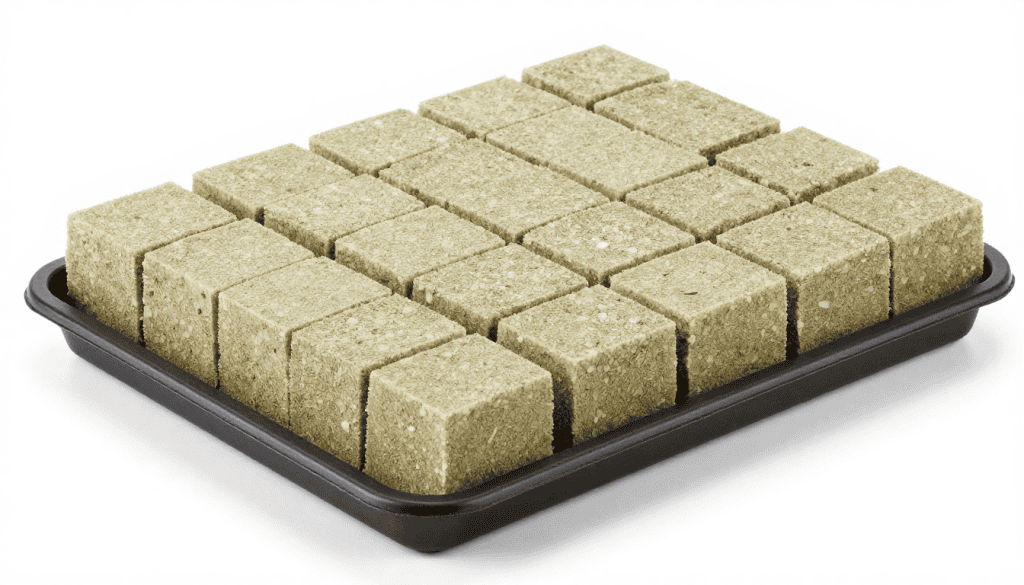
Yes. Rockwool dominates germination and propagation but makes less sense for long-term herb production because of disposal concerns and pH management demands.
Rockwool cubes, including Grodan cubes, lead commercial seedling production because they create an extremely consistent rooting environment. For growers who want reliable germination and uniform plant development, that consistency is a major advantage.
The sterile medium holds moisture while keeping enough oxygen around young roots. This balance reduces stress during the earliest growth stages, when seedlings are most vulnerable. Because moisture distributes evenly throughout the cube, young roots expand quickly without hitting dry patches.
Penn State Extension points out that propagation success depends heavily on moisture consistency and environmental control, both of which rockwool handles effectively.
Rockwool performs exceptionally well for:
- Seed germination
- Propagation
- Cloning
- Early root development
- Transplant production
Many commercial operations rely on rockwool because it produces consistent results across large batches of seedlings. Uniform growth makes transplanting easier and helps ensure crops mature at roughly the same pace.
Where Rockwool Excels
Young herbs build strong root systems quickly in properly prepared cubes. The structure of rockwool lets roots penetrate easily while staying surrounded by a steady supply of moisture and oxygen. This environment often shortens the time seedlings and cuttings need to establish compared with less consistent growing media.
Common Limitations
- Requires pre-soaking rockwool
- Initial pH adjustment needed
- Generally single-use
- Disposal concerns
- Less sustainable than reusable media
Many growers move seedlings from rockwool into coco coir or clay pebbles once roots establish. This approach combines the propagation strengths of rockwool with the long-term benefits of media that are easier to reuse and manage across multiple growing cycles.
Coco Coir, Clay Pebbles, and Rockwool Each Solve a Different Root-Zone Problem
The right medium depends on whether you care more about moisture retention, root oxygen, reusability, or propagation success.
Experienced herb growers consistently focus on three things: water retention, aeration, and maintenance. Every growing medium sits somewhere along that spectrum, which is why no single option works perfectly for every hydroponic setup.
A medium that performs well for leafy herbs may not suit woody Mediterranean herbs at all. Similarly, a system built for maximum automation may need different media than a small home setup that gets daily attention.
Comparison Table
| Medium | Water Retention | Aeration | Reusability | Best Use |
| Coco Coir | High | Moderate to High | Moderate | Most herbs |
| Clay Pebbles (LECA) | Low | Very High | High | Recirculating systems |
| Rockwool Cubes | High | Moderate | Low | Seed starting |
| Perlite-Vermiculite Mix | Moderate | Moderate | Low | Budget systems |
| Growstones | Moderate | High | Moderate | Eco-focused growers |
| Hemp Fiber | Moderate | Moderate | Low | Microgreens and starts |
The comparison reveals a pattern that shows up again and again. Media that hold the most water usually give up some oxygen availability, while highly aerated media demand more frequent irrigation.
That tradeoff affects growth rates more than any marketing claim about a single medium. Understanding how water and oxygen interact around roots leads to better results than jumping between products looking for a perfect solution.
What Is the Hidden Tradeoff Between Water Retention and Root Oxygen?
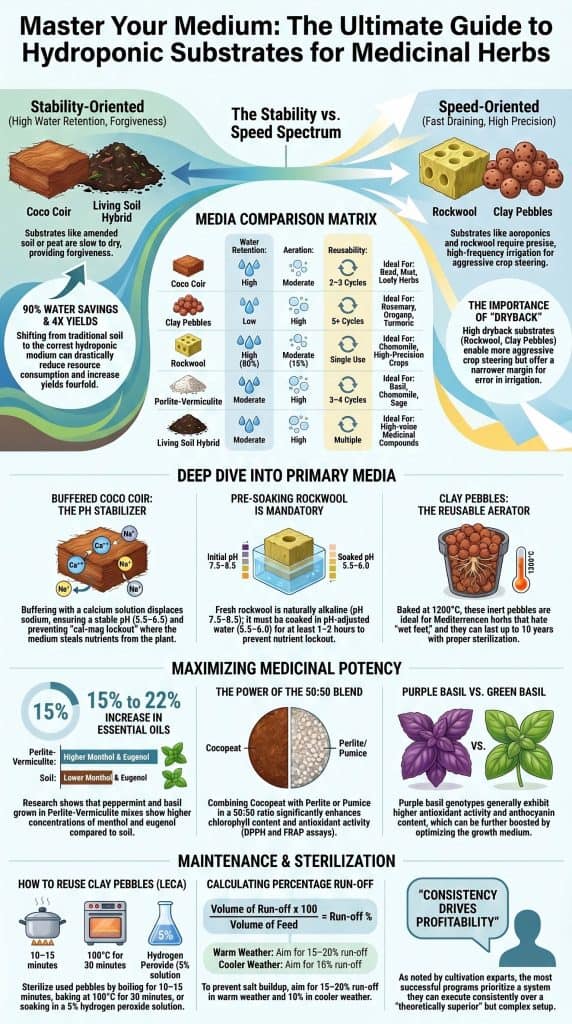
Media that hold more water generally deliver less oxygen, while highly aerated media usually need more frequent watering. Media with water retention >70% typically offer aeration <40%. Media with aeration >70% require irrigation every 15–30 min. Coco coir (65–75% water retention, 40–50% aeration) splits this tradeoff.
Hydroponic roots need oxygen constantly. Low oxygen slows growth even when your nutrient levels and EC readings look perfect.
According to research published in BMC Plant Biology
“The presence of oxygen in the growth medium is absolutely essential for root development and the overall metabolic processes of plants. When plants do not have an adequate oxygen supply for respiration, they can experience a condition known as hypoxia.” – BMC Plant Biology.
Many growers troubleshoot fertilizers, pH, and supplements for weeks before considering root-zone aeration as the actual problem.
Roots use oxygen to generate energy and absorb nutrients. When oxygen runs low, plant performance drops even though the medium still looks moist enough. This explains why two systems running the same nutrients can produce very different results.
Growers spend a lot of time dialing in nutrient recipes while overlooking aeration. Yet root oxygen availability predicts hydroponic performance more reliably than most other factors.
Signs your medium stays too wet:
- Slow growth
- Yellowing leaves
- Root rot
- Algae buildup
- Sour odors
Signs Your Medium Is Too Dry
- Wilting between irrigation cycles
- Brown leaf margins
- Slow nutrient uptake
- Weak root development
- Reduced harvest yields
Dry conditions create a different set of problems. When roots repeatedly run short of moisture, plants slow down to conserve resources. Over time, that affects leaf production, flavor development, and harvest size.
Once you identify moisture issues, fixing them gets much easier. Many successful growers use hydrozyme, beneficial bacteria, and better irrigation scheduling to stabilize root health without giving up oxygen. Small adjustments to watering frequency or media choice often produce bigger improvements than adding more supplements.
System Design Determines the Best Medium More Than the Herb You’re Growing
Your system design usually determines the best medium more than the herb you’re growing.
Small-scale indoor growers often pick media based on how much maintenance they can handle rather than plant species. That approach leads to better long-term success more often than not. A medium that works great in one hydroponic system can create unnecessary headaches in another, even when you’re growing the same herbs.
The relationship between your system and your medium matters more than most beginners realize. Irrigation frequency, water movement, root exposure, and maintenance routines all shape how a medium performs over time. Getting that match right reduces common problems like root rot, nutrient imbalances, and inconsistent growth.
Medium-by-System Table
| System | Best Medium | Why It Works |
| Kratky | Coco Coir | Moisture stability |
| Deep Water Culture | Rockwool + Clay Pebbles | Seed support and aeration |
| Drip System | Clay Pebbles | Excellent drainage |
| Ebb and Flow | Clay Pebbles | Fast drainage and reuse |
| NFT Channels | Rockwool Cubes | Root stability |
| Tower Garden | Rockwool + LECA | Algae control and support |
| Aeroponics | Foam or Rockwool Starts | Minimal root obstruction |
| Wick System | Coco Coir | Strong capillary action |
Each combination solves a specific challenge. Kratky systems need media that hold moisture because plants pull from a passive water source.
Ebb and flow systems, on the other hand, need fast-draining media that quickly restore oxygen to the root zone after each irrigation cycle.
The medium needs to complement your irrigation frequency, root exposure, and maintenance goals rather than just following what’s popular.
A setup that needs less intervention tends to stay productive longer because it’s easier to manage consistently.
What Mistakes Do Herb Growers Make When Choosing a Medium?

Credits : Planting Joy
Most growers pick media based on what’s popular instead of matching it to their system, watering habits, and herb type.
One common mistake is choosing coco coir for systems that already deliver too much moisture. Another is picking expanded clay pebbles without running enough irrigation cycles to compensate. Both situations stress plants unnecessarily and make growers think the medium itself is the problem.
Think of your growing medium as part of the whole system rather than a standalone product. Even the best medium performs poorly when you pair it with the wrong irrigation strategy or growing conditions.
The most common errors include:
- Ignoring irrigation frequency
- Skipping pH preparation
- Choosing based on cost alone
- Not thinking about root oxygen
- Skipping clay pebble rinsing
- Failing to buffer coco coir
- Skipping sterilization with hydrogen peroxide
Cost, maintenance, and algae control come up repeatedly in hydroponic forums as grower frustrations. Budget matters, but picking the cheapest option often raises maintenance demands and lowers overall system performance.
Another mistake is changing multiple things at once. Switching nutrients, media, watering schedules, and lighting simultaneously makes it nearly impossible to figure out what actually caused the problem.
After fixing these mistakes, most growers see stronger root development and fewer disease issues fairly quickly. Healthy roots respond fast once oxygen levels, moisture balance, and nutrient availability all line up correctly.
Common Selection Errors
Matching your medium to your system matters more than chasing the most popular growing option.
Many problems that look like nutrient deficiencies or disease actually start with a mismatch between the medium and the system. Media that stay too wet limit oxygen, while media that dry too fast struggle to deliver consistent nutrients.
Taking time to think through your irrigation schedule, maintenance preferences, and plant requirements before choosing a medium almost always leads to better results than following popularity alone. A well-matched system needs fewer corrections and delivers more consistent growth throughout the season.
FAQ
Can you mix two hydroponic growing media together for better results with herbs?
Mixing media is common and consistently outperforms single-medium setups for most hydroponic herbs. A coco perlite mix works well because coco coir holds steady moisture while perlite increases drainage porosity and root zone oxygenation simultaneously.
For herbs like basil and parsley that need consistent moisture without waterlogging, a 70 percent coco to 30 percent perlite ratio performs reliably across both drip irrigation and ebb and flow systems.
How do you sterilize and reuse expanded clay pebbles between growing cycles?
Rinse clay pebbles thoroughly with plain water to remove all root debris and organic material from the previous growing cycle. Soak the pebbles in a diluted hydrogen peroxide solution for 30 to 60 minutes to eliminate pathogens that cause root rot between cycles.
Rinse completely a second time to remove all remaining residue before reuse. Black biofilm forming on the pebble surface signals sterilization failure and requires a full repeat of the soaking process.
Does the growing medium affect EC levels and nutrient uptake in herbs?
Growing media affects EC levels more than most growers expect. Media with high cation exchange capacity, such as coco coir and zeolite, bind nutrients and release them gradually, which lowers the actual EC concentration reaching the root zone below the level measured in the mixed solution.
Clean inert media like expanded clay pebbles and silica stone interact minimally with the nutrient solution, giving growers precise control over feeding strength in recirculating systems and deep water culture setups.
What growing medium works best for propagating herb cuttings in hydroponics?
Rapid rooter plugs and root riot cubes work well for propagating herb cuttings because their fiber structure holds enough moisture for root initiation while allowing sufficient air exchange to prevent stem rot from developing.
Rockwool cubes perform equally well when pre-soaked in pH 5.5 adjusted water for at least one hour before use to fully neutralize their naturally alkaline surface. Both options support consistent early root development in mint, basil, and oregano cuttings before transplanting into a larger system.
How does growing medium choice affect root rot risk in hydroponic herb systems?
Media with poor drainage porosity trap excess moisture around the root zone, which cuts oxygen availability and creates conditions where root rot pathogens establish rapidly.
Expanded clay pebbles and pumice reduce this risk significantly because water drains freely between particles after each irrigation cycle, restoring oxygen access to roots between feedings.
Adding beneficial bacteria and mycorrhizae to the root zone provides biological protection by outcompeting harmful organisms, which is especially critical in recirculating systems where pathogens spread quickly between connected plants.
Choose the Medium That Fits Your Growing Style
Slow growth, weak roots, and uneven harvests can be frustrating when you’re putting time into your hydroponic garden.
The fix is simpler than it sounds. The right medium depends on three core attributes: water retention, aeration, and reusability. Use the Comparison Table to rank mediums by your priorities (budget, maintenance, herb type).
Match your system type to the Medium-by-System guide and that directly shapes how healthy and productive they become.
If you want a reliable starting point, TopHydroponicGarden makes it easier to figure out where to begin. Whether you go with coco coir, clay pebbles, or rockwool, keeping the right balance between moisture and airflow is what actually grows stronger herbs and delivers more consistent harvests.
Reference
- https://extension.okstate.edu/fact-sheets/soilless-growing-mediums
- https://pmc.ncbi.nlm.nih.gov/articles/PMC11015634/
Related Articles
- https://tophydroponicgarden.com/how-to-choose-a-home-hydroponic-system/
- https://tophydroponicgarden.com/choosing-the-right-size-net-pots/
- https://tophydroponicgarden.com/best-herbs-to-grow-in-a-hydroponic-garden/
Was this helpful?

I’m Barrie L., a passionate hydroponic gardening enthusiast dedicated to cultivating thriving, soil-less gardens. With a focus on all things hydroponic, I share my expertise on innovative growing techniques and sustainable practices through my blog, tophydroponicgarden.com. As a seasoned hydroponics specialist, my goal is to inspire and guide fellow gardeners in harnessing the power of water-based cultivation for bountiful and eco-friendly harvests. I’m also an author of the book “Hydroponics For Absolute Beginners: Your Step By Step Guide For How To Create An Hydroponics System At Home Without Soil, For Growing Vegetable, Fruit And Herbs.” which is sold on Amazon. Join me on a journey of redefining the way we cultivate plants, one nutrient-rich solution at a time. Happy growing!