

When you grow food indoors, space quickly becomes your biggest limitation. Standard plant varieties can overcrowd a hydroponic system, making pruning, maintenance, and harvest more difficult.
After years of running indoor grow tents, I found that dwarf hydroponic varieties solve many of these problems. Their compact size makes them easier to manage while still producing impressive yields.
Popular options such as Micro Tom tomatoes, Tom Thumb lettuce, and Dwarf Greek basil thrive in hydroponic systems ranging from DWC buckets to vertical towers. This guide covers the best dwarf varieties to grow and the common mistakes that can limit their productivity.
Small Plants, Big Hydroponic Harvests
- Most productive dwarf hydroponic plants stay between 6 and 24 inches tall, making them a practical choice for apartments, countertop systems, and vertical farms.
- Micro-dwarf tomatoes can produce 20–40 cherry tomatoes per plant, while compact pepper cultivars such as Mini Bell and Pot-a-Peno often yield 10–30 fruits per season despite occupying less than one square foot.
- Calibrated PAR output, strict plant-to-plant spacing intervals, and stable EC levels impact final crop yield far more than the physical size of the plant cultivar.
Choosing the best dwarf plant varieties for hydroponics is less about finding the smallest plants and more about selecting compact crops that deliver reliable harvests in limited growing space.
Quick Harvest Insights
Oversized, tangled vines are the fastest way to ruin an indoor setup. When a standard tomato plant hits an unexpected growth spurt, it quickly crowds out neighboring crops and smothers your grow tent.
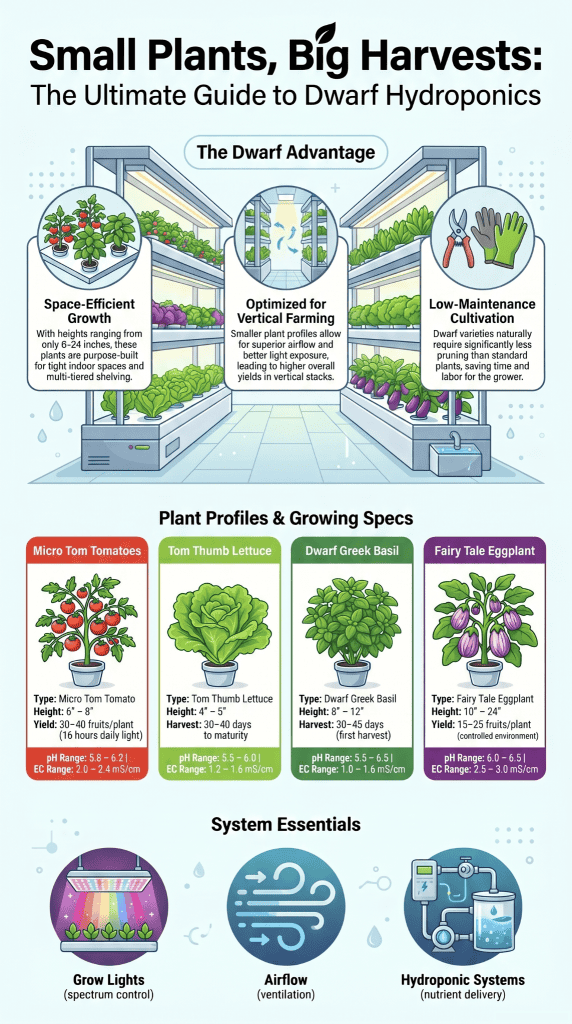
Most dwarf hydroponic cultivars remain between 6 and 24 inches tall, reducing canopy management requirements by maintaining a compact growth habit.
Keeping your crops short keeps every leaf inside your LED grow light’s optimal PAR zone, the specific light spectrum plants use to photosynthesize. This forces the plant to channel its energy into plump fruit production rather than stretching out long, weak stems.
By eliminating chaotic vines and sprawling root masses, these compact cultivars adapt flawlessly to tightly spaced shelves, vertical columns, or basic countertop footprints. That often leads to healthier growth and better harvests.
Which Dwarf Fruiting Plants Perform Best in Hydroponics?

If your goal is fresh tomatoes, peppers, or eggplants, dwarf varieties are usually the easiest place to start.
Micro-dwarf tomatoes have earned a loyal following among indoor growers. Plants such as Micro Tom and Red Robin rarely exceed 12 inches in height but can produce 20–50 cherry-sized fruits per plant within 70–90 days from transplant.
Because they stay so small, they work well in countertop gardens and compact hydroponic systems where a regular tomato plant would quickly run out of room.
Peppers are another reliable option. Compact cultivars such as Mini Bell, Pot-a-Peno, Lunchbox Pepper, and Basket of Fire typically remain between 10 and 18 inches tall while producing 10–30 fruits per plant during a growing cycle. A gentle shake every 2–3 days during flowering is usually sufficient to improve pollination and fruit set.
Fairy Tale eggplant is worth considering if you want something different. The plants typically reach 18–24 inches tall and can produce 15–25 striped fruits per plant under stable hydroponic conditions.
Growing Requirements for Dwarf Fruiting Plants in Hydroponics
While dwarf fruiting plants require less space than standard varieties, they still need the right environmental conditions to reach their full potential. Maintaining proper pH, nutrient strength, temperature, and lighting helps support healthy growth, flowering, and fruit production.
The following guidelines can help growers maximize yields from two of the most popular dwarf hydroponic crops:
- Red Robin Cherry Tomato
- Height: 6–12 inches
- Expert Cultivation Profile: I keep these strictly at a pH of 5.8–6.2 and push the EC to 2.0–2.4 mS/cm once flowering hits. They respond beautifully to an aggressive 16-hour light schedule under high-intensity LEDs without burning or stretching. Maintain daytime temperatures between 68°F and 78°F (20–26°C) for optimal flowering and fruit development
- Fairy Tale Eggplant
- Height: 18–24 inches
- Expert Cultivation Profile: This is a heavy feeder. You need to maintain a pH of 6.0–6.5 and a steady EC of 2.5–3.0 mS/cm. Because it handles high humidity poorly, I always position an oscillating fan directly at the root collar to prevent blossom end rot in tight tents. Root zone temperatures between 70°F and 75°F (21–24°C) support vigorous fruit production.
These plants make far better use of limited space than full-size varieties. Instead of spending months managing excess growth, you can focus on harvesting.
Why are Dwarf Fruiting Plants Easier to Grow Indoors?
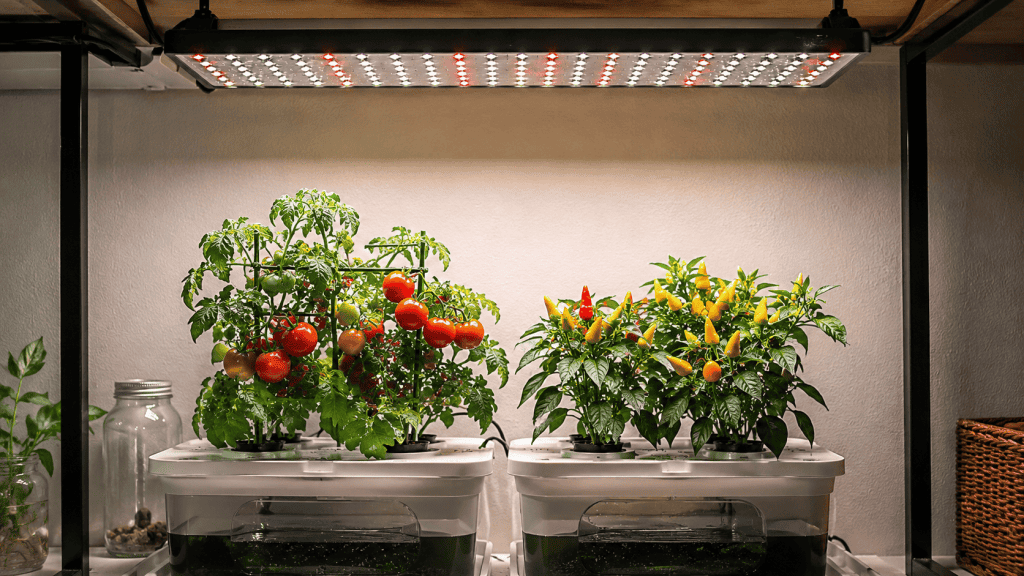
Large fruiting plants often create extra work.
A standard tomato may need constant pruning, support strings, cages, and frequent trimming to keep it under control. In a small hydroponic setup, that can become frustrating fast.
Dwarf plants are different.
Their growth is more predictable. Roots stay smaller. Branches stay shorter. Most need little support compared to larger varieties.
For beginners, that often means fewer problems and a more enjoyable growing experience. This is one reason many growers consider compact tomatoes, peppers, and herbs among the easiest hydroponic plants to manage in small indoor systems.
Which Dwarf Leafy Greens are Worth Growing?
“Leafy greens are a hydroponic staple, but standard heads quickly crowd out the channels. For maximum density, ‘Tom Thumb’ butterhead is the preferred choice.”
It caps out under 5 inches and is typically ready to harvest within 30–40 days, allowing you to drop plant-to-plant spacing down to 6 inches in a standard NFT channel.
Expert Profile: I run these at a target pH of 5.5-6.0 and a low, steady EC of 1.2-1.6 mS/cm to prevent tip-burn during rapid growth phases. Ideal growth occurs between 60°F and 72°F (16–22°C), where leaf quality remains highest.
If you prefer romaine, ‘Little Gem’ is my top pick. Because it grows in a tight vertical wedge, spacing can be reduced to approximately 6–8 inches between plants, increasing density by roughly 30% without sacrificing canopy airflow.
Expert Profile: Maintain a pH of 5.6-6.2 and an EC of 1.4-1.8 mS/cm. Keep your photoperiod at 14 hours to maximize biomass accumulation without triggering early bolting.
Research from Lancaster University shows
“Little Gem romaine is another good choice. It grows upright instead of spreading outward, so plants can be placed closer together without becoming crowded. Researchers at Lancaster University tested Little Gem specifically in a vertical farming system and found that vertical farming increased lettuce yield per unit area compared to conventional horizontal hydroponic systems, a result that underscores why compact, upright varieties are so well suited to tower and column-style growing setups (Touliatos, Dodd & McAinsh, Food and Energy Security, 2016)” –
Lancaster University
If you prefer greens you can harvest them again and again. Dwarf Blue Curled kale typically reaches 10–12 inches tall and allows repeated harvests every 10–14 days after establishment. For best results, maintain a pH of 5.8–6.5 and an EC of 1.5–2.0 mS/cm.
Baby-leaf spinach is often ready for its first harvest within 25–35 days and can be harvested repeatedly for several weeks. Maintain a pH of 6.0–6.8 and an EC of 1.8–2.3 mS/cm for consistent growth.
Best Dwarf Leafy Greens
| Crop | Variety | Typical Size | Best System |
| Butterhead Lettuce | Tom Thumb | About 5 in | NFT |
| Romaine Lettuce | Little Gem | 6–8 in | Vertical towers |
| Kale | Dwarf Blue Curled | Under 12 in | NFT or DWC |
| Spinach | Baby Leaf | About 6 in | NFT |
These crops grow fast, don’t need much attention, and can provide fresh harvests throughout the year. Their compact growth habits also make them excellent examples of crops successfully grown with hydroponics in limited indoor spaces.
Compare Popular Dwarf Hydroponic Varieties
| Variety | Height | Days to Harvest | pH | EC | Temperature | Best System |
| Tom Thumb | 4–5 in | 30–40 days | 5.5–6.0 | 1.2–1.6 | 60–72°F | NFT |
| Little Gem | 6–8 in | 35–45 days | 5.6–6.2 | 1.4–1.8 | 60–70°F | Vertical Tower |
| Red Robin | 6–12 in | 70–90 days | 5.8–6.2 | 2.0–2.4 | 68–78°F | DWC |
| Fairy Tale Eggplant | 18–24 in | 80–100 days | 6.0–6.5 | 2.5–3.0 | 70–75°F | DWC |
Why Do Dwarf Greens Work so Well in Vertical Systems?
If you run vertical towers, you know that oversized leaves are a recipe for disaster. Large varieties quickly create a solid wall of foliage that blocks light from reaching lower tiers.
More dangerously, they trap stagnant, high-humidity air pockets against the tower trunk, inviting powdery mildew and root rot.
Dwarf greens keep the air channels open. By preserving clear space between planting ports, you maintain the consistent airflow and uniform light distribution required for a healthy vertical system. Better airflow also reduces the chance of disease and helps leaves stay healthy.
As noted by University of Florida’s Institute of Food and Agricultural Sciences (UF/IFAS)
“Because they take up less room above and below the growing channel, you can fit more plants into the same system without creating a dense wall of foliage. This matters more than many growers realize: horticulture specialists at the University of Florida’s Institute of Food and Agricultural Sciences (UF/IFAS) have noted that in vertical tower systems, “lack of consistent airflow can also decrease productivity and cause fungal and bacterial disease outbreaks throughout the production cycle.” Compact dwarf varieties, by creating natural gaps between plants, directly address this risk.” – University of Florida’s Institute of Food and Agricultural Sciences (UF/IFAS)
For growers working with shelves, towers, or narrow indoor spaces, dwarf greens are often the simplest way to increase production without expanding the garden.
Which Dwarf Herbs Work Best in Hydroponics?
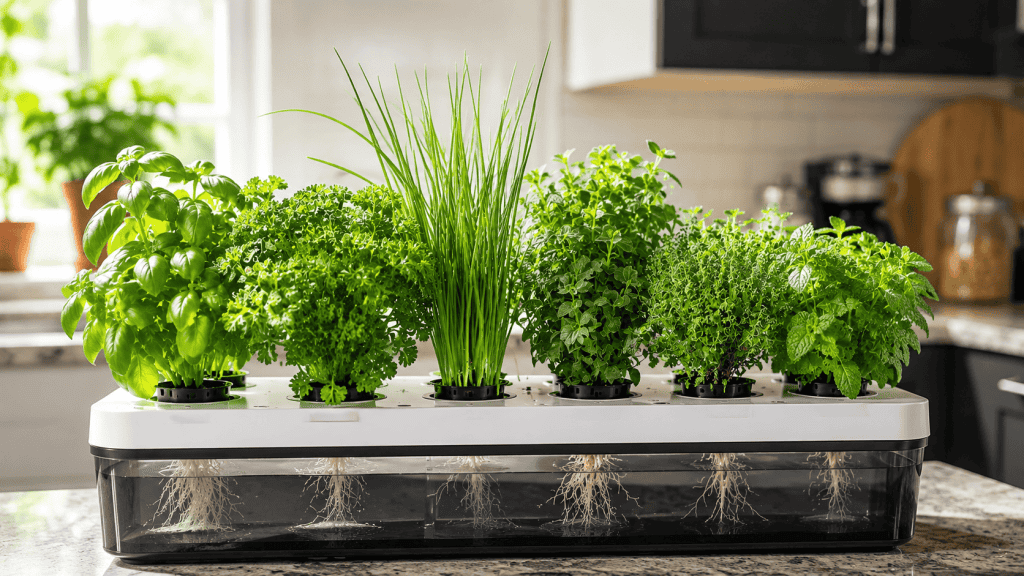
Dwarf Greek basil typically grows 8–12 inches tall and can be harvested within 30–45 days. Maintain a pH of 5.5–6.5 and an EC of 1.0–1.6 mS/cm for vigorous growth.
Dwarf mint generally reaches 8–12 inches in height and can be harvested every 2–3 weeks once established. Maintain a pH of 5.5–6.5 and an EC of 1.0–1.8 mS/cm.
Compact parsley usually grows 6–10 inches tall and reaches harvest maturity within 60–75 days. Maintain a pH of 5.8–6.5 and an EC of 1.0–1.8 mS/cm.
Consistent hydroponic plant nutrients are especially important for herbs because rapid leaf production depends on a steady supply of essential minerals.
Examples of Content They Can Create

Credits: Aerogarden Hydroponics Experiments
The creator shares their top 10 favorite plants to grow in hydroponic systems like AeroGarden, based on over 200 experiments. They chose these plants using factors like productivity, how long they live, consistency, and ease of care .
The first plant is Parris Island Cos Lettuce, a Romaine variety. Among all lettuce types tested, this one performs best in hydroponics. Some plants lasted over 5 months .
You don’t need expensive AeroGarden nutrients, cheaper MaxiGro nutrients work perfectly fine, making it economical to grow . This lettuce variety is reliable, productive, and perfect for beginners wanting fresh salad greens indoors year-round.
FAQ
Which dwarf hydroponic plants work best in very small indoor spaces?
Dwarf cultivars maximize cramped indoor spaces by replacing chaotic, wandering vines with predictable, high-yielding clusters. Dwarf lettuce varieties such as Tom Thumb reach harvest size in 30–40 days, while Dwarf Greek basil can be harvested within 30–45 days.
Both remain compact enough for windowsills and shelving systems. These indoor cultivars fit comfortably on window sills or shelves without outgrowing their reservoirs.
What is the single biggest mistake beginners make with dwarf hydroponics?
Because these plants look small, growers assume they don’t need root management. In reality, while their tops stay under 12 inches, their root masses still expand. If you don’t flush your net cups or if you crowd your DWC reservoir, your roots will choke out your water flow long before the canopy ever becomes an issue.
Can miniature hydroponic plants produce enough food for regular harvesting?
Miniature hydroponic plants can provide regular harvests when several plants are grown at the same time. Dwarf cherry tomatoes, mini bell peppers, baby greens, and culinary herbs will all produce continuously throughout their life cycle if regular harvesting is maintained. A small collection of these plants can supply fresh ingredients for salads, sandwiches, garnishes, and everyday cooking without requiring a large growing area.
Which compact crops grow well in hydroponic towers and vertical systems?
Hydroponic towers and vertical systems work best with compact hydroponic greens that do not outgrow their growing spaces. Butterhead lettuce, dwarf mustard greens, and compact pak choi perform exceptionally well in vertical configurations because they remain upright and preserve cross-canopy airflow. These qualities make them some of the best plants for hydroponic towers and stacked growing systems.
What are the lowest maintenance dwarf plants for hydroponic gardens?
Low maintenance hydroponic plants typically grow quickly, adapt well to indoor conditions, and require minimal pruning. Compact culinary herbs are the easiest, lowest-maintenance options for any indoor setup. Dwarf varieties of thyme, cilantro, dill, and mint require minimal training compared to fruiting crops. To maximize production, maintain a steady vegetative nutrient profile and pinch back the top growth weekly to stimulate lateral, bushy branching.
Dwarf Hydroponic Plants Make the Most of Every Inch of Growing Space
Running out of room is one of the fastest ways to make indoor gardening harder than it needs to be. Compact crops help you grow more in a smaller area while keeping maintenance manageable. That’s the difference. Whether you’re growing tomatoes, peppers, lettuce, or herbs, the right dwarf varieties can deliver steady harvests without taking over your system.
If you want a simpler way to build a productive indoor garden, Tophydroponicgarden can help you get started with the right setup and plant choices. A compact hydroponic system paired with proven dwarf varieties makes it easier to enjoy fresh harvests year-round, even when space is limited.
References
- https://www.semanticscholar.org/paper/Vertical-farming-increases-lettuce-yield-per-unit-Touliatos-Dodd/171873cd7abdffacd8d94f705732e6c14584ac56
- https://ask.ifas.ufl.edu/publication/HS1422
Related Articles
- https://tophydroponicgarden.com/easiest-hydroponic-plants/
- https://tophydroponicgarden.com/best-hydroponic-plant-nutrients/
- https://tophydroponicgarden.com/plant-grown-with-hydroponics/
Was this helpful?
I’m Barrie L., a passionate hydroponic gardening enthusiast dedicated to cultivating thriving, soil-less gardens. With a focus on all things hydroponic, I share my expertise on innovative growing techniques and sustainable practices through my blog, tophydroponicgarden.com. As a seasoned hydroponics specialist, my goal is to inspire and guide fellow gardeners in harnessing the power of water-based cultivation for bountiful and eco-friendly harvests. I’m also an author of the book “Hydroponics For Absolute Beginners: Your Step By Step Guide For How To Create An Hydroponics System At Home Without Soil, For Growing Vegetable, Fruit And Herbs.” which is sold on Amazon. Join me on a journey of redefining the way we cultivate plants, one nutrient-rich solution at a time. Happy growing!