

You don’t need soil to grow plants. That’s the simple truth behind hydroponics. This method uses mineral-rich water to deliver nutrients directly to plant roots, resulting in faster growth and higher yields than traditional gardening.
But to succeed, you need to speak the language. Understanding basic hydroponic terminology transforms confusion into confidence, letting you diagnose problems before they ruin your crop. Think of it as learning the rules of the road before driving a car. This guide covers the essential vocabulary every beginner should know.
Key Takeaways
- System types shape your setup. NFT, DWC, and ebb and flow deliver nutrients in different ways.
- Nutrient management matters. pH and EC show whether roots can absorb what they need.
- Growing media replace soil. Clay pebbles and coco coir hold roots and let air flow.
Core Hydroponic Systems

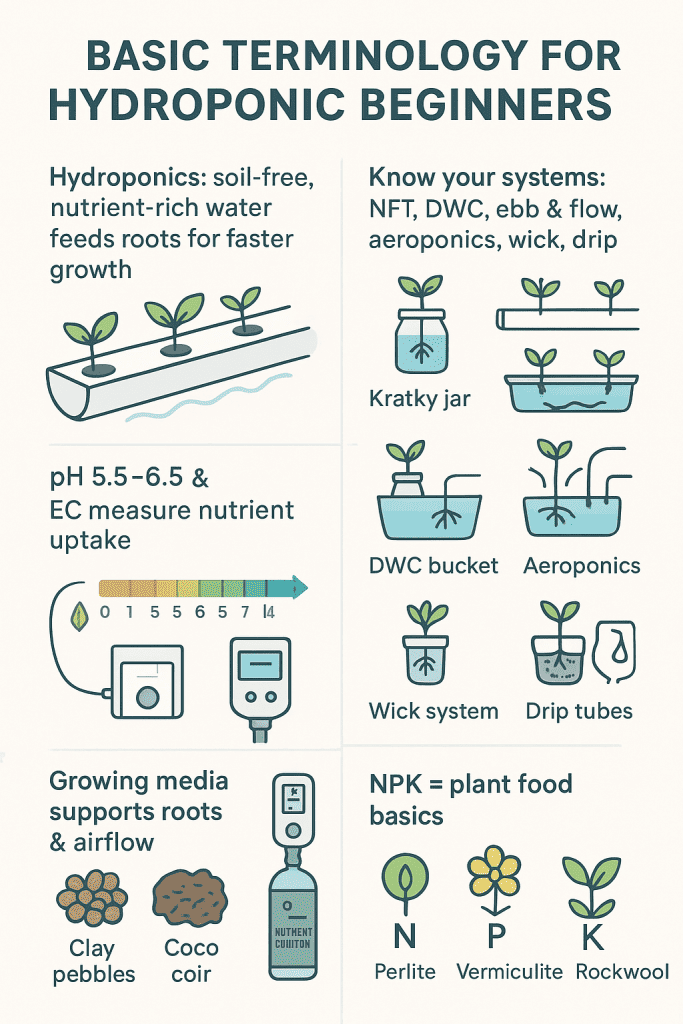
The framework of your garden starts with choosing a system. Each has a distinct way of getting nutrient solution to the roots. One popular approach is the Kratky method, a passive hydroponic technique that requires no pumps or electricity.
It provides a simple, self-regulating environment that balances water, nutrients, and oxygen to promote healthy root development with minimal maintenance.
Nutrient Film Technique, or NFT, uses shallow channels to circulate a thin film of nutrient solution. Plant roots dangle into these channels, absorbing what they need as the water flows past. It’s remarkably efficient with water. But if the pump fails, the roots dry out quickly. People often use NFT for leafy greens like lettuce and herbs.
Deep Water Culture, abbreviated DWC, suspends plant roots directly in oxygenated nutrient solution. An air pump and air stone bubble oxygen through the water, preventing the roots from drowning. It’s one of the simplest systems to build. A five-gallon bucket, a net pot, and an air pump are all you really need. This method works wonderfully for water-loving plants.
Ebb and Flow, also called flood and drain, works on a timer. It periodically floods the grow tray with nutrient solution from a reservoir below. After a few minutes, the solution drains back out. This cycle gives roots a drink and then a breath of air. It’s a versatile system that can accommodate many plant sizes. You do need to ensure the pump and timer are reliable.
Aeroponics is the high-tech end of the spectrum. It suspends roots in the air and mists them with a fine nutrient spray. This provides maximum oxygen exposure, which can lead to explosive growth. The downside is complexity. Clogged misters can spell disaster in minutes. It’s fantastic for propagating cuttings and growing plants that crave oxygen.
- Wick System: The most passive setup. A wick draws nutrient solution from a reservoir up to the growing medium. It’s low-cost and simple, but not suitable for large, thirsty plants.
- Drip System: Uses a network of tubes to drip nutrient solution onto the base of each plant. It can be recirculating or run-to-waste.
The choice depends on your goals. DWC offers simplicity. NFT maximizes space. Ebb and Flow provides a good balance. Aeroponics promises speed for those willing to monitor closely [1].
Key Components and What They Do
Every hydroponic system shares common parts that make it function. The reservoir is the heart. This container holds the nutrient solution. It should be opaque to block light and prevent algae growth. Size matters. A larger reservoir means more stable pH and nutrient levels.
The air pump and air stone are the lungs. Even in systems where roots aren’t fully submerged, oxygenating the water is crucial. The air stone diffuses the pump’s output into tiny bubbles. These bubbles increase the surface area for oxygen to dissolve into the water. Root rot is often a sign of poor aeration.
Growing media replaces soil. It’s an inert material that supports the plant’s weight and sometimes holds moisture. Each type has pros and cons. Clay pebbles are lightweight, pH-neutral, and reusable. They offer great drainage and aeration. Coco coir, made from coconut husks, is sustainable and has a good water-holding capacity. Rockwool is a spun rock fiber that holds both water and air well, though it has a high pH initially. Managing pH precisely is critical in hydroponics for better growth and nutrient absorption.
You mix water with fertilizer to create the nutrient solution. This is the plant’s food. It contains macronutrients like nitrogen and phosphorus, plus essential micronutrients. You can’t just use regular garden fertilizer. It must be water-soluble and complete.
A pH testing kit is your diagnostic tool. Plants absorb nutrients best within a specific pH range, usually between 5.5 and 6.5. If the pH is too high or too low, nutrients become locked out. The plant starves even though food is present. You’ll need to adjust it using pH Up or pH Down solutions.
Grow lights are the sun for indoor gardens. LEDs are popular for their energy efficiency and low heat output. They can provide a full light spectrum. HID lights, like Metal Halide and High-Pressure Sodium, are powerful but generate significant heat. T5 fluorescent lights are a good, affordable option for seedlings and leafy greens.
The Language of Plant Food and Health
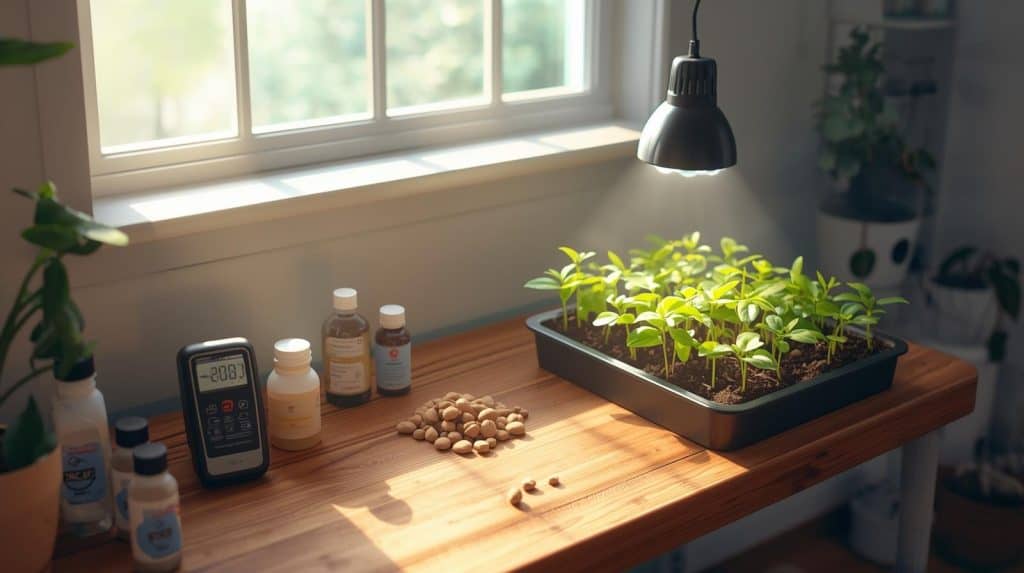
Managing the nutrient solution is where science meets gardening. The NPK ratio on a fertilizer bottle shows the percentage of the three primary macronutrients. Nitrogen (N) is for green, leafy growth. Phosphorus (P) supports strong roots and flowering. Potassium (K) aids in overall plant functions and disease resistance.
But plants need more than just NPK. Micronutrients are essential, just in tiny amounts. These include iron, zinc, and copper. A deficiency in any one can cause specific problems. Yellowing leaves might indicate an iron shortage, for instance.
EC, or Electrical Conductivity, measures the strength of your nutrient solution. It tells you how much dissolved fertilizer is in the water. An EC meter sends a small current through the solution. The more salts (nutrients) present, the better the water conducts electricity. This helps you avoid underfeeding or overfeeding your plants.
PPM, or Parts Per Million, is another way to express the same thing. It’s a conversion from the EC reading. You’ll see meters that use a 500 scale or a 700 scale. The key is to be consistent with whichever scale you choose.
Propagation is how you start new plants. You can begin from seed. Or you can take cuttings from a mature “mother plant.” This is called cloning. The new plant is a genetic copy of the original. Cloning is faster and ensures you know exactly what traits the plant will have.
- Flushing: Running plain, pH-balanced water through the system to wash out excess nutrients. This is done to correct nutrient burn or before harvest.
- Foliar Feeding: Spraying a diluted nutrient solution directly onto plant leaves for quick absorption. It’s a useful supplement but not a replacement for root feeding.
Understanding these terms lets you read your plants’ signals. Crispy leaf tips often mean nutrient burn (too high EC). Pale green or yellow leaves can signal a deficiency or pH problem.
Making Sense of Common Media

Source : NT Hydroponics
The growing medium is the physical environment for the roots. It’s not soil, and it provides no nutrients itself. Its job is support and sometimes moisture retention.
Perlite is those white, lightweight balls you see in many potting mixes. It’s superheated volcanic glass that has expanded. Its main value is aeration. It keeps the root zone loose and oxygenated. It’s often mixed with other media.
Vermiculite is a mica-like mineral that’s also heated until it expands. Unlike perlite, it’s excellent at absorbing water and holding nutrients. It’s great for seed starting or for use in wick systems where water retention is key.
Rockwool is probably the most common commercial hydroponic medium. It’s made by spinning molten rock into fibers, like candy floss. It holds a perfect balance of water and air. New users must soak it in pH-adjusted water first because it’s naturally alkaline.
The term “run-to-waste” describes a system where the nutrient solution is used once and then discarded. It’s simpler because you don’t have to monitor and adjust a recirculating solution. However, it’s less efficient with water and nutrients. Most home systems are recirculating.
“Nutes” is simply slang for nutrients. You’ll hear growers talk about their “nute schedule,” which is their plan for feeding plants through different growth stages [2].
FAQ
How can you pick the right growing medium if you’re new to hydroponics?
You can test a few grow media to see how they hold water and air. Perlite, vermiculite, rockwool, clay pebbles, and coco coir all behave differently. You can check how each supports roots in a simple reservoir. You can watch pH balance and nutrient solution movement to learn which medium works for you.
What helps you measure nutrients safely in a soilless gardening setup?
You can use an EC meter or a PPM meter to track electrical conductivity in your nutrient solution. These tools help you spot imbalances in micronutrients and macronutrients like nitrogen, phosphorus, and potassium. You can read the numbers often. You can adjust before fertilizer burn or root rot appears in your system.
How do you keep roots healthy in systems like NFT or deep water culture?
You can oxygenate roots with an air pump and air stone. You can watch water flow in nutrient film technique setups and in DWC to avoid standing water. You can check for damping off and run a flush cycle if needed. You can move cuttings or clones only when the growth module looks stable.
What should you watch when light affects vegetative growth in early stages?
You can monitor metal halide or fluorescent lights with a simple foot candle check. You can place a reflector or fixture hood so seedlings stay cool. You can track heat with a hygrometer. You can adjust the ballast fixture if needed. You can prevent burn tips by keeping young plants away from harsh light sources.
How do you manage pests in small beginner systems like ebb and flow or drip system?
You can start simple IPM steps. You can use insecticidal soap or pyrethrum when you see insects. You can lift the medium substrate to check for issues. You can watch for zinc deficiency or boron problems while you treat pests. You can use run to waste or a recirculating system to keep things cleaner.
Conclusion
Learning these terms is the first step toward mastering soilless gardening. It demystifies the process. You stop seeing a complicated setup and start seeing individual components you understand. A reservoir holds the food. An air stone provides oxygen.
The pH meter tells you if the food is accessible. With this vocabulary, you can troubleshoot issues, follow instructions, and communicate with other growers. Your plants will respond with vigorous growth. Now, go mix your first nutrient solution and check its pH. You’ve got this.
References
- https://www.sciencedirect.com/science/article/pii/S2405844025007194
- https://www.mdpi.com/1424-8220/23/4/1875
Related Articles
- https://tophydroponicgarden.com/understanding-nutrient-solutions-for-plants/
- https://tophydroponicgarden.com/how-is-ph-important-in-hydroponics/
- https://tophydroponicgarden.com/what-is-the-kratky-method-of-hydroponics/
Was this helpful?

I’m Barrie L., a passionate hydroponic gardening enthusiast dedicated to cultivating thriving, soil-less gardens. With a focus on all things hydroponic, I share my expertise on innovative growing techniques and sustainable practices through my blog, tophydroponicgarden.com. As a seasoned hydroponics specialist, my goal is to inspire and guide fellow gardeners in harnessing the power of water-based cultivation for bountiful and eco-friendly harvests. I’m also an author of the book “Hydroponics For Absolute Beginners: Your Step By Step Guide For How To Create An Hydroponics System At Home Without Soil, For Growing Vegetable, Fruit And Herbs.” which is sold on Amazon. Join me on a journey of redefining the way we cultivate plants, one nutrient-rich solution at a time. Happy growing!