

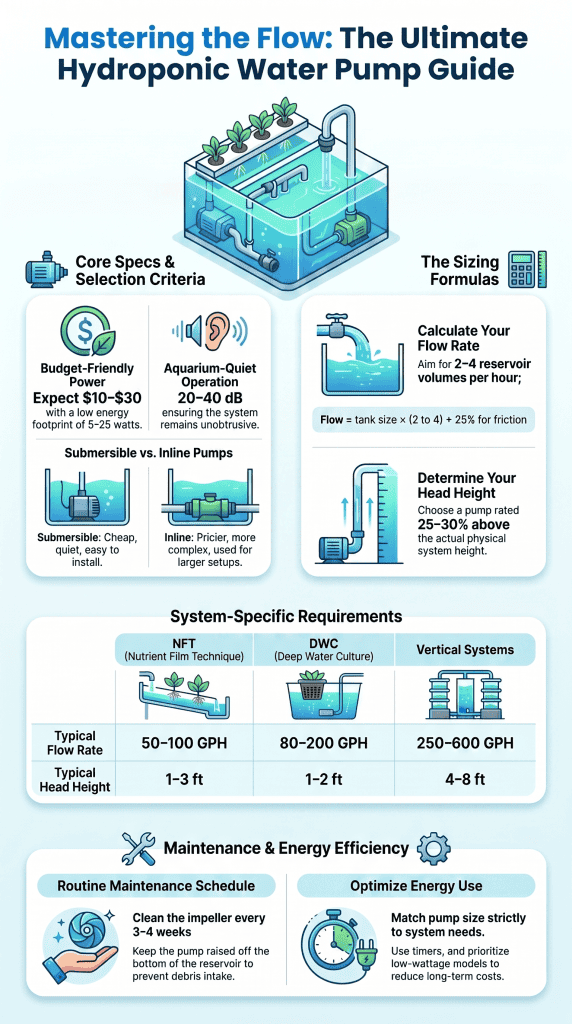
Most affordable hydroponic pumps for home systems cost between $10–$30, typically use 5–25 watts of power, and can circulate nutrient solution reliably when properly sized. For a small home system, a pump costing between $10 and $30 for basic submersible aquarium-style pumps that can work perfectly if it’s properly sized and maintained.
The key is matching the pump’s flow rate and head height to your setup’s needs. This keeps nutrients moving and plants healthy. Keep reading to learn how to pick a reliable, affordable pump.
Quick Pump Essentials for Hydroponics
This section sums up the most important things to remember so your hydroponic pump runs efficiently and keeps your system stable without wasting energy or causing flow problems.
- Aim for 2–4 reservoir volume circulations per hour
- Head height affects real pump performance more than the box rating
- Clean the pump every few weeks or it will slow down fast
What Type of Cheap Water Pump Works Best?
Most home growers use submersible pumps because they typically deliver 80-500 GPH, consume 5-40 watts, and operate quietly inside the reservoir. They sit inside the nutrient tank and push water through tubing.
They are popular for a few simple reasons:
- Most entry-level submersible pumps cost between $10 and $30, while comparable inline pumps often start around $40–$80.
- Easy to install
- Most small submersible pumps operate at approximately 20–40 dB, similar to an aquarium filter. Most small submersible pumps produce noise levels similar to a typical aquarium filter, making them suitable for bedrooms, apartments, and indoor growing areas.
- Works for most small hydroponic systems
You’ll usually find them in small kits for DWC, NFT, or drip setups. Aquarium-style pumps also fall into this group and are often used for very small gardens.
Inline pumps exist too, but they are more common in larger builds. They cost more and need extra plumbing, which can be annoying for beginners.
Submersible vs Inline Pumps
| Feature | Submersible | Inline |
| Price | Lower | Higher |
| Setup | Drop into tank | Needs plumbing |
| Noise | Low | Higher |
| Cleaning | Simple | More steps |
| Best use | Home systems | Large systems |
For most beginners, submersible pumps are enough. No need to overcomplicate it.
How To Size a Hydroponic Pump (Simple Method)

This is where most people go wrong. A cheap pump can still fail if it’s the wrong size.
A simple rule works better than guessing:
- The pump should move the full tank 2-4 times per hour. For reservoirs under 30 gallons, pumps rated between 80–250 GPH are usually sufficient.
This keeps nutrients mixed and oxygenated.
Easy formula:
- Minimum flow = tank size × 2
- Good range = tank size × 4
- Add extra 25–30% for real-world loss from tubing friction, elbows, and vertical lift
Let’s map out a real-world scenario using a standard 20-gallon reservoir.
First, we calculate our baseline ideal volume circulation, aiming to cycle the tank 4 times per hour:
Ideal Base Flow = 20 gallons × 4 = 80 GPH
Next, we must account for real-world friction loss from 90-degree elbows and tubing walls by adding a 25% safety buffer:
True Target Capacity = 80 GPH × 1.25 = 100 GPH
Shopping for a pump that hits exactly 100 GPH ensures your plants actually get the 80 GPH they need after fighting your system’s plumbing restrictions.
Why Real Flow is Always Lower than The Label
Manufacturers provide pump performance curves showing how flow decreases as head height increases. Pump boxes show numbers based on perfect conditions. No tubing. No height. No friction. Many pumps lose 20–50% of their rated flow once tubing, elbows, and vertical lift are added.
Once you add:
- Vertical lift
- Long tubes
- Elbows and connectors
Flow drops fast.
A pump that looks strong on paper may feel weak in a real setup.
Simple rule:
Pick a pump with more power than you think you need, especially if water needs to travel upward.
Head Height Matters More than GPH
Head height is how high the pump can push water upward.
This is usually where beginners get surprised. Most budget hydroponic pumps provide maximum head heights between 3 and 10 feet.
Take it from my experience: a pump rated for 400 GPH looks great on paper, but if you try to push water up a 5 foot vertical tower, that flow rate will tank.
Don’t get tripped up by commercial packaging metrics either, if a cheap pump claims a maximum head height of 6 feet, it will deliver practically zero flow at 5.5 feet.
You want to look at the continuous duty rating and ensure your system’s physical height sits well below the absolute maximum limit of the pump.
Vertical systems expose this problem quickly.
A safer choice is:
- Pick a pump that can handle at least 25-30% more height than your system needs, example : A 4-foot vertical tower should ideally use a pump rated for at least 5–6 feet of head height.
This keeps flow steady instead of fading out at the top.
Basic System Needs (Quick Guide)
Different hydroponic setups need different flow levels.
| System Type | Typical Flow Rate | Typical Head Height |
| NFT | 50–100 GPH | 1–3 ft |
| DWC | 80–200 GPH | 1–2 ft |
| Ebb & Flow | 150–400 GPH | 2–4 ft |
| Drip System | 100–300 GPH | 2–5 ft |
| Vertical Towers | 250–600 GPH | 4–8 ft |
NFT and DWC setups are usually easiest for budget pumps.
A Quick Reality Check
A lot of pump problems are not about quality. They come from mismatches.
Common mistakes:
- Pump too small
- Ignoring height
- Too many bends in tubing
- Expecting label numbers to match real output
Correctly sizing your pump eliminates most performance failures right out of the gate. Even when choosing durable water pumps, incorrect sizing can create the same circulation problems that many growers mistakenly blame on equipment quality.
How To Avoid Overheating Problems
Reservoir temperatures above 72°F (22°C) can reduce dissolved oxygen and increase root disease risk.
Heat builds up in small systems when:
- Pump runs nonstop under heavy load
- Water is already warm
- Tank has poor airflow
Furthermore, stagnant or overheated water chokes out dissolved oxygen, which aggressively damages fragile root systems first. Keep your reservoir cool to keep your plants alive.
Signs something is off:
- Water feels warm to touch
- Plants slow down
- Roots look brown or slimy
- Growth feels uneven
Simple fixes:
- Keep tank in shade
- Don’t run undersized pumps at full stress
- Add air stones if possible
- Use a slightly larger reservoir if space allows
Most of the time, heat issues come from pushing a weak pump too hard.
Maintenance Keeps Cheap Pumps Working
This part is often ignored, but it matters more than brand.
A basic routine every 3–4 weeks is enough:
- Unplug pump
- Open casing
- Remove impeller
- Rinse off buildup
- Soak in diluted vinegar (5 minutes is plenty) to dissolve hard-water scale
- Put it back together
- Inspect intake screens weekly and clean impellers every 3–4 weeks.
That alone prevents most failures. Regular water pump maintenance also helps energy-saving water pumps operate closer to their intended efficiency by reducing strain on the impeller and motor.
What usually goes wrong
- Mineral buildup slows the impeller
- Roots clog intake holes
- Dirt settles at the bottom of the tank
Small clog = weak flow. Weak flow = poor plant growth.
Easy Ways To Prevent Clogs
A few small habits help a lot:
- Keep pump slightly raised off the bottom
- Add a sponge filter
- Clean dead roots regularly
- Avoid dumping organic matter into the tank
- Use opaque tubing to slow algae growth
- A coarse sponge pre-filter can reduce debris reaching the impeller and extend cleaning intervals
As highlighted by University of Minnesota Extension
“The University of Minnesota Extension notes that several parts of a hydroponic system can become clogged during normal operation, plant debris and algae on roots can block tubing, nutrients that precipitate out of solution can build up in the tubing or in the pump itself, and hard water can also cause mineral buildup. –
University of Minnesota Extension
These steps keep water moving instead of slowing down over time.
Are Aquarium Pumps Good Enough?
Sometimes yes, sometimes no.
They work well for:
- Small DWC buckets
- Herbs and leafy greens
- Starter systems
But they struggle with:
- Tall vertical systems
- Long tubing runs
- High demand setups
Aquarium pumps under 150 GPH are often sufficient for single-bucket DWC systems but may struggle in multi-site setups.
Continuous Duty Rating Matters
Not all pumps are designed to run all day. Hydroponic systems often require long operating periods, especially in DWC and NFT setups.
Look for a pump labeled continuous duty if it will run for many hours each day. These pumps are built to handle constant operation without overheating or excessive wear.
As a general guideline:
| Pump Type | Typical Runtime |
| Intermittent Duty | Short cycles |
| Continuous Duty | 24/7 operation |
| Aquarium Pump | Varies by model |
Energy Use And Running Cost
Hydroponic pumps often run all day, so power use matters.
Some pumps use more electricity than needed simply because they are oversized or inefficient.
Simple ways to reduce cost:
- Match pump size to system (don’t overshoot)
- Use timers to cycle pumps (e.g., 15 min on/15 min off) rather than continuous run
- Clean impeller regularly so it doesn’t work harder than needed
- Choose low watt models when possible
Insights from Virginia Cooperative Extension indicate
“Some pumps use more electricity than needed simply because they are oversized or inefficient. Virginia Cooperative Extension advises that pumps used in DWC systems should be rated for continuous duty and sized for good circulation of nutrients, noting that a venturi can be added to the pump output to inject air into the pond and help maintain high dissolved oxygen levels. A pump running at its proper load, not straining, uses less power and lasts longer. –
Virginia Cooperative Extension
A clean, correctly sized pump always uses less power than a struggling one. A 15-watt pump running 24 hours per day uses about 11 kWh monthly. Most small hydroponic pumps operate between 5 and 40 watts
How To Pick The Right Affordable Pump
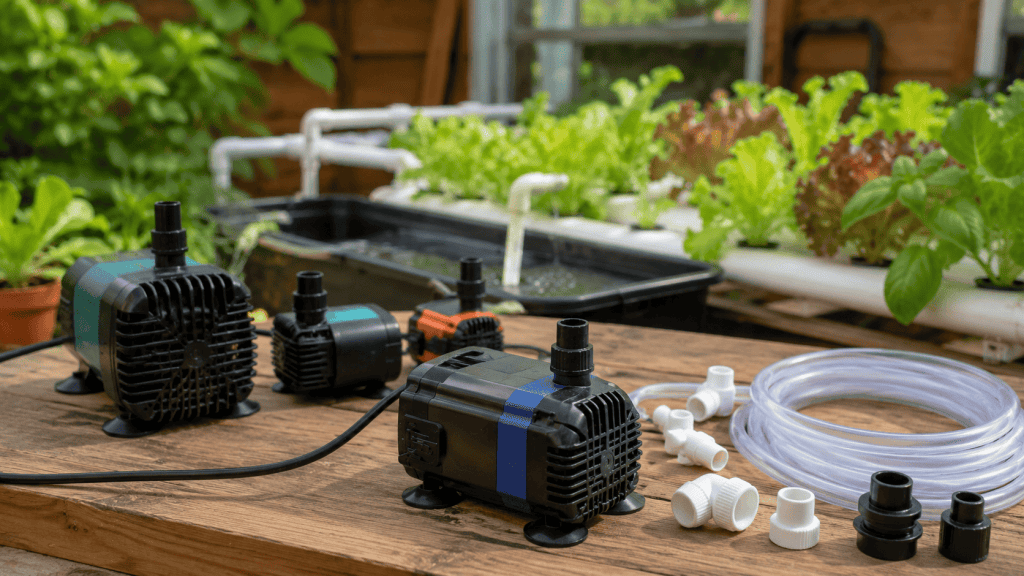
Before buying, check these points:
- Tank size
- Required flow range
- Vertical lift height
- Power usage (watts)
- Ease of cleaning
- Space for future expansion
- Maximum head height
- Continuous duty rating
- Adjustable flow control
- Warranty length (many quality hydroponic pumps include warranties ranging from 1–3 years)
A good rule:
Pick a pump with about 15–30% extra capacity. This becomes even more important when selecting water pumps for large systems, where longer tubing runs and higher flow demands can magnify sizing mistakes.
Not too small. Not wildly oversized.
Examples of Content They Can Create

Credits: LuckieNuckie
When choosing a submersible pump for your hydroponic NFT (nutrient film technique) system, focus on two key specs: head height and flow rate. Head height is how high the pump can lift water, measure from your reservoir bottom to the highest channel, then pick a pump with a head rating slightly higher (like 4 meters for a 3-meter need).
Flow rate is how much water the pump moves per minute. Calculate it by multiplying your number of channels by the flow each needs (e.g., 20 tubes × 2 L/min = 40 L/min), then choose a pump that exceeds this .
Also match voltage to your country’s electrical specs and pick a trusted brand (like AquaSpeed) with accessible replacement parts. The AquaSpeed A5000 (4m head, 5,000 L/hr) worked well in both a 10-channel and 38-channel system .
FAQ
How do I choose the right pump size and flow rate for my system?
To dial in the perfect size, you need to calculate three things: your total water volume, the vertical lift to your highest plant, and the number of delivery emitters. Ensuring steady water movement keeps nutrients evenly distributed. Always prioritize the vertical lift capacity, known as head height, because if the motor can’t fight gravity, your target flow rate won’t matter anyway. For home setups, always round up your final calculation by a quarter to guarantee stable circulation.
What pump works best for NFT, DWC, and ebb and flow setups?
Different systems require different pumping behavior. A pump for NFT systems must deliver a thin, constant stream of nutrient solution. A pump for DWC systems supports oxygen movement and circulation. A pump for ebb and flow hydroponics must handle timed flooding and draining cycles. A hydroponic irrigation pump or hydroponic nutrient delivery pump helps maintain stable hydroponic water flow control.
How often should I maintain or replace a hydroponic pump?
Regular cleaning and inspection are needed every one to two weeks depending on water quality. Hydroponic pump maintenance includes removing debris and checking impellers for wear. A continuous duty water pump or low maintenance hydroponic pump reduces breakdown risk. If flow drops even after hydroponic pump troubleshooting, hydroponic pump replacement is necessary to maintain stable nutrient circulation in system use. Most submersible hydroponic pumps last 2–5 years with regular cleaning.
What makes a pump energy efficient and quiet for indoor hydroponics?
Energy efficiency depends on low power consumption while maintaining stable flow. An energy efficient hydroponic pump or low wattage water pump reduces electricity use in indoor systems. A quiet hydroponic water pump or silent submersible water pump reduces noise near growing areas. Good design also improves hydroponic aeration pump efficiency, supporting oxygen levels and healthy root growth consistently over time. Energy-efficient models often produce 8–15 gallons per hour per watt consumed.
Can I use one pump for multiple hydroponic systems or vertical setups?
Yes, but only if the pump has enough capacity for total system demand. A water circulation system pump or adjustable flow water pump can support multiple channels when properly sized. A hydroponic recirculation system or pump for vertical hydroponics requires balanced distribution. Always check hydroponic pump capacity to maintain steady hydroponic reservoir water movement across hydroponic grow system pump setup.
Hydroponic Pumps Work When the Setup Is Right
You might think a cheap pump is the reason your hydroponic system struggles, but most problems come from sizing and setup. When the pump matches your system and head height is accounted for, even budget options can run a steady cycle for your plants. The key is consistency, not price.
Hydroponics can use up to 10 times less water than traditional farming because water is reused, according to the National Park Service. A well matched pump keeps that loop moving smoothly and helps your system stay stable without extra complexity.
The best affordable hydroponic pumps balance flow rate, head height, energy consumption, and maintenance requirements rather than focusing only on purchase price.
References
- https://www.pubs.ext.vt.edu/content/pubs_ext_vt_edu/en/SPES/spes-464/spes-464.html
- https://extension.umn.edu/how/small-scale-hydroponics
Related Articles
- https://tophydroponicgarden.com/choosing-durable-water-pumps/
- https://tophydroponicgarden.com/energy-saving-water-pumps-for-hydroponics/
- https://tophydroponicgarden.com/water-pumps-for-large-systems/
Was this helpful?

I’m Barrie L., a passionate hydroponic gardening enthusiast dedicated to cultivating thriving, soil-less gardens. With a focus on all things hydroponic, I share my expertise on innovative growing techniques and sustainable practices through my blog, tophydroponicgarden.com. As a seasoned hydroponics specialist, my goal is to inspire and guide fellow gardeners in harnessing the power of water-based cultivation for bountiful and eco-friendly harvests. I’m also an author of the book “Hydroponics For Absolute Beginners: Your Step By Step Guide For How To Create An Hydroponics System At Home Without Soil, For Growing Vegetable, Fruit And Herbs.” which is sold on Amazon. Join me on a journey of redefining the way we cultivate plants, one nutrient-rich solution at a time. Happy growing!