

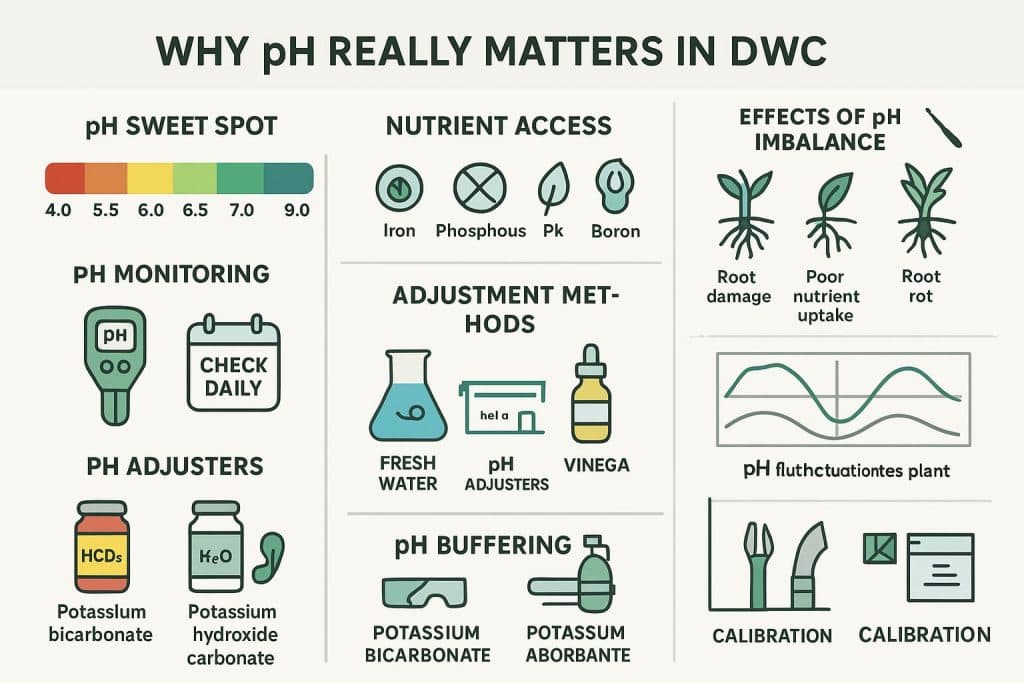
A deep water culture system’s health depends on its pH, and getting it right isn’t rocket science. Plants need that sweet spot between 5.5 and 6.5. It’s where the magic happens for nutrient uptake.
Go too high or too low, and those expensive nutrients might as well be lawn ornaments. That’s why adjusting pH for deep water culture systems is one of the most important steps for keeping plants strong, healthy, and productive.
The roots just can’t grab what they need when pH isn’t right, and that shows up fast in stunted growth or weird leaf colors. Anyone who’s spent time with DWC setups knows the drill: check levels often, adjust carefully, and maybe invest in some pH automation if you’re serious about it.
Key Takeaways
- Plants need pH between 5.5 and 6.5 to actually use those expensive nutrients you’re putting in there
- Get a decent pH meter and check it daily – those cheap ones from Amazon just don’t cut it
- Small tweaks work better than big ones, just like adjusting hot water in the shower
Why pH Really Matters in DWC

Most folks think pH is just another box to check off. Wrong. In deep water culture, it’s everything. Picture a nightclub where pH is working the door, deciding which nutrients get to party with your plants’ roots.
When things get too alkaline, iron and phosphorus can’t even get past the velvet rope. Go too acidic and suddenly you’ve got manganese and boron causing trouble inside. Those roots floating around in there aren’t exactly easy to please. Outside that sweet spot between 5.5 and 6.5, they’re useless.
All those expensive nutrients might be swimming right there, but the roots can’t grab them. And let’s talk about what happens when pH goes wild. The roots get beaten up, stop working right, and might even start rotting. Not good.
Getting Your pH Sorted Out
You’ll need an actual pH meter. Not those cheap paper strips from the garden store that sort of work if you squint at them. Check that meter every single day, especially after adding nutrients or topping off water. Both of those will mess with your pH faster than you’d think.
There are two ways to handle pH problems. You can dump everything and start fresh with a new mix. Sure, it wastes water and nutrients, but at least you know what you’re dealing with. Or you can play it cheap and careful, adding tiny bits of pH adjuster to what’s already there. Takes forever but saves some cash.
Listen up about those pH adjusters though. That phosphoric acid stuff they put in pH down actually helps keep things stable. Phosphoric acid is the usual commercial choice for pH-down because it’s consistent; household vinegar will lower pH but may be temporary and can introduce organics that change stability, not ideal for routine use.
Whatever you’re using, just remember to take it slow. Real slow. Getting impatient with pH is like trying to parallel park in a hurry. Never ends well.
Steady pH Makes Happy Plants
Look. Nobody wants their DWC setup throwing tantrums because of pH. Those sudden changes wreck everything. Just make small adjustments. Let it settle. Sometimes doing less works better.
Potassium bicarbonate can help buffer pH and add potassium in some situations, but most commercial pH-up products use potassium hydroxide or potassium carbonate, choose based on your nutrient program.
It catches those wild swings before they mess up your grow. And yeah, those automatic controllers cost a fortune, but man they’re worth it if you’re sick of being hunched over checking levels all day.
Plants are weird about pH. They’ll actually change it themselves while they’re growing. Up it goes when they’re eating nitrates, down when they switch to ammonium. Watch long enough and you’ll see the pattern.
Getting Serious About pH

credit: Juvar of Dusa
It’s not just about numbers on a meter. The whole root zone’s got this thing going on. Your plants are living there. When pH goes nuts and there’s not enough air? Root rot city. And you gotta watch the temperature too.
Temperature affects pH and system stability (via gas solubility and biological activity); warm conditions often make pH less stable, so monitor more frequently. Meters need love too. They drift. Clean them. Calibrate them.
If you use a probe daily, calibrate weekly (or at least before critical checks); high-quality probes will drift less but still need care. Don’t just dump adjusters in like you’re making jungle juice. Little bits. Wait. Check again. Real boring stuff but your plants won’t hate you.(1)
Real Talk About pH
The chemistry’s actually pretty cool once you get into it. Everything’s connected. But listen. Smart growers buy the right nutrients first. Get something pre-balanced. Saves headaches.
Baby plants though. God they’re fussy. Something that wouldn’t bug a big plant will straight up murder a seedling. Check them twice a day. Get yourself a backup meter. Trust me. The main one always dies at the worst possible time. Usually in the middle of the night. Always on a weekend.
Sunlight’s another thing. Hit that reservoir with direct light and you’re growing algae soup. Black covers help. Some people go full crazy with reflective wrap. Whatever works. Just remember to write everything down. pH, what you added, when you added it. Patterns start showing up. Makes life easier.
And if stuff keeps bouncing around, try that buffer stuff. Or bite the bullet and get an automatic controller. Takes practice. But you’ll get it. Your plants’ll tell you when you’re doing good. Just gotta listen.
Practical DWC pH Tips
- If you use a probe daily, calibrate weekly (or at least before critical checks); high-quality probes will drift less but still need care.
- Ideal DWC checks: pH + EC daily; change solution every 1-2 weeks for small systems.
- If pH keeps drifting, test source water alkalinity/hardness; consider RO water + re-mineralization.
- Cover reservoirs to block light and algae; keep nutrient solution 18–22°C for healthier roots.(2)
FAQ
How do I adjust pH in a DWC system when dealing with low pH or high pH swings?
In a dwc system, water ph can change quickly, sometimes dropping to low pH or climbing to high pH. This ph drift affects plant roots and overall plant health. To adjust ph, growers usually check the ph daily and make small amount changes instead of large ones. Using ro water or tap water can also affect ph balance. The goal is to reach proper ph and keep the ph stable in the right ph range so plant growth continues without problems.
What is the best way to check pH levels and EC levels in small scale DWC systems?
Growers often check the ph with ph meters, ph test kits, or ph paper. These testing tools help measure ph levels and ec levels in small scale dwc systems where swings happen faster. Using an ec meter alongside ph testing lets you track ph and ec together, giving a clear picture of nutes and ph balance. Some people also test the ph with plain water first, then with added nutrients, to see how the water source and additives affect ph in daily growing.
How do ph and ec work together to affect plant roots and plant growth in DWC systems?
Ph and ec are closely linked. Ph and ec together decide how plant roots absorb nutrients and water. A stable ph within the optimal ph range keeps nutrients available. But if ec levels are too high, plant health suffers even when the correct ph is present. Small amount changes in adjusting ph and keeping the desired ec are better than big shifts. Growers check ph and ec often in dwc systems because water levels and plant uptake can quickly shift balance. Getting both right improves plant growth and root strength.
Can grow tents, grow lights, or air pumps affect pH balance in hydro setups?
Yes, what happens in grow tents or a grow room can affect ph balance in water. Heat from grow lights can change water levels and increase ph drift. Air pumps and air stones improve oxygen around plant roots but can also shift water ph over time. Even float valve systems or net pot setups can affect ph if not monitored. Testing with ph meters or test kits helps catch changes early. The key is to check the ph often and keep the ph steady for strong plant health.
What’s the safest way of lowering or raising water pH when adding pH adjusters?
When adding ph adjusters to dwc systems, it’s best to use a small amount at a time. Adding too much citric acid or other acids to lower the ph can shock plant roots. Always check the ph after each change, and re-check the ph a few hours later to be sure it stays stable ph. A ph controller can help automate the process in larger grow tents or ebb and flow setups. For small scale growers, simply test the ph often with proper ph testing methods.
How does dual ph monitoring help manage ph level in a dwc hydroponic setup with an air pump in a grow tent?
Dual ph monitoring lets you compare readings at different spots in the water solution, making it easier to keep a consistent ph level. In a dwc hydroponic setup, using an air pump inside a grow tent helps keep oxygen flowing while supporting healthy growth. Together, these steps improve ph management and reduce ph fluctuations that can hurt plant performance.
Why is tracking ec and ph with ph and tds meters important for water quality and plants absorb rates?
Tracking ec and ph together gives a clearer picture of water quality and how well plants absorb essential nutrients. A ph and tds meter helps you spot ph imbalances or ec management problems before they affect growth. By keeping levels regularly checked, you can ensure optimal nutrient absorption for strong vegetative growth and better plant performance.
Can organic soil be used as a growing medium in dwc hydroponics or hydroponic systems?
While organic soil works well in traditional setups, it is not ideal for dwc hydroponics or other hydroponic systems. A soil-based growing medium can disrupt water quality and cause ph imbalances. In hydroponic setups, a soilless medium ensures optimal nutrient delivery and more consistent ph management, which supports optimal growth and healthy plant performance.
How do I adjust the ph in a hydroponic system for optimum range and consistent ph balance?
To adjust the ph in a hydroponic system, first test the nutrient solution using a liquid ph test or testing equipment. If readings are off the optimum range, use ph down solutions, buffer solution, or reverse osmosis water to adjust the ph. Regular monitoring helps ensure optimal balance, maintain optimal nutrient absorption, and support healthy growth in hydroponic growing.
Conclusion
Managing pH isn’t something you can just set up and walk away from. It needs attention. Every day. But you know what? After a while, checking those levels becomes as natural as checking your phone in the morning.
Some people give up too fast. They want perfect pH right away. Doesn’t work like that. You’ll mess up. Plants might look sad for a bit. Whatever. Keep going. And seriously. Just watch your plants. They’ll straight up tell you when something’s wrong. Yellow leaves. Brown spots. Weird growth. They’re basically screaming at you about pH.
Good pH control means strong roots. Strong roots mean big plants. Simple stuff really. Look. Nobody starts out as a pH genius. But grab that meter, check those levels, make those adjustments. Your garden’s gonna blow up. In a good way.nKeep at it. Your plants need you. That’s pretty much it.
Related Articles
- https://tophydroponicgarden.com/deep-water-culture-system-guide
- https://tophydroponicgarden.com/deep-water-culture-guide/
- https://tophydroponicgarden.com/is-deep-water-culture-the-best/
References
- https://support.bluelab.com/how-does-nutrient-solution-temperature-affect-ph
- https://extension.sdstate.edu/sites/default/files/2025-06/P-00337.pdf
Was this helpful?

I’m Barrie L., a passionate hydroponic gardening enthusiast dedicated to cultivating thriving, soil-less gardens. With a focus on all things hydroponic, I share my expertise on innovative growing techniques and sustainable practices through my blog, tophydroponicgarden.com. As a seasoned hydroponics specialist, my goal is to inspire and guide fellow gardeners in harnessing the power of water-based cultivation for bountiful and eco-friendly harvests. I’m also an author of the book “Hydroponics For Absolute Beginners: Your Step By Step Guide For How To Create An Hydroponics System At Home Without Soil, For Growing Vegetable, Fruit And Herbs.” which is sold on Amazon. Join me on a journey of redefining the way we cultivate plants, one nutrient-rich solution at a time. Happy growing!