

Good pH control starts with stable readings. Aim for readings within about ±0.1 pH. That’s typical for well-maintained digital meters in hydroponics. This accuracy lets your plants absorb nutrients efficiently. It also prevents nutrient lockout.
For most growers, you want a nutrient solution pH between 5.5 and 6.5. Nutrient manufacturers and guides like General Hydroponics support 5.5-6.5. It keeps essential elements soluble for the roots.
Accuracy here isn’t about lab-grade perfection. It’s about consistency. A stable, repeatable reading is what counts, not chasing extra decimal points. Here’s how to test, calibrate, and manage pH properly. Keep reading for the details.
Quick Reads – Hydroponic pH Accuracy Essentials
- Quality digital pH meters used in hydroponics commonly offer ±0.1 accuracy; higher‑end models can reach ±0.01–0.02, making them the standard for hydroponics
- Weekly calibration prevents up to 0.2–0.5 pH drift errors that cause nutrient issues
- Daily monitoring keeps pH within 5.5–6.5, reducing lockout risk and instability
Being a Little Off With pH Can Ruin Your Plants

Hitting a general pH range isn’t enough. A small error, say 0.2 or 0.5 off, can mess up nutrient uptake and stunt growth. This happens even if you follow a perfect feeding schedule.
Plants absorb different nutrients at different pH levels. Iron, needed for green leaves, becomes almost unavailable once pH goes above 6.5. Phosphorus doesn’t fade in and out slowly. Its availability drops sharply within very narrow pH bands.
Here’s the real issue. If your meter says 6.2 but the actual pH is 6.7, your plants might be in a hidden nutrient lockout. On paper, everything looks fine. In reality, leaves yellow because the plant can’t use the nutrients that are right there in the soil.
Many growers blame their nutrients or feeding schedule when plants struggle. Often, the real problem is a pH meter that’s just slightly off. When pH drifts, even a little, it throws off the balance of micronutrients like iron and manganese.
The acceptable margin for error is tiny. Precise pH measurement isn’t a suggestion, it’s a requirement. It’s what separates plants that are just getting by from plants that are growing vigorously.
Getting Hydroponic pH Right Requires Proper Testing
In hydroponics, getting the pH correct is essential, not just a good idea. Look at any serious grower’s setup and you’ll usually see a digital pH meter. These tools are more precise than other methods. Some sources claim they’re often 5-10 times more precise than strips or kits.
Here are the three main ways to check pH.
| Method | Accuracy Range | Pros | Cons | Best Use Case |
| Test Strips | ±0.5 – 1.0 | Cheap, fast, easy | Very low precision | Quick rough checks |
| Liquid Kits | ±0.2 – 0.5 | More consistent than strips | Subjective color reading | Backup or occasional testing |
| Digital Meters | ±0.05 – 0.1 | Highly accurate, clear result | Requires calibration and care | Daily monitoring (recommended) |
Test Strips
- Accuracy: Roughly ±0.5 to 1.0 off.
- Good for: They’re cheap and fast.
- Bad for: They aren’t very precise.
Liquid Kits
- Accuracy: Typically ±0.2-0.5, though subjective color reading reduces reliability.
- Good for: More consistent than strips.
- Bad for: Reading the color can be difficult and subjective.
Digital Meters
- Accuracy: Highly precise, around ±0.05 to 0.1 off.
- Good for: They give you a solid number with no guesswork.
- Bad for: They need regular calibration to stay accurate.
Digital meters are the best choice for precision. You get a clear number, so there’s no trying to match colors. The trade-off is they need regular calibration. For most growers, that’s a small task compared to having reliable data. Hydroponics Planet points out that well-maintained meters are standard in professional setups.
If you want stable readings and better control, investing in a quality pH tester designed for hydroponics will pay off. These testers deliver consistent results, helping you maintain optimal nutrient balance.
This doesn’t make strips and liquid kits useless. Some growers use them as a quick backup to double-check a meter reading that seems odd. But for consistent, repeatable results, a digital meter is unmatched.
Under the same conditions, a good meter will give you the same reading every time. With visual methods, the result can change based on the lighting, your eyesight, or how long you wait to read it.
For a healthy hydroponic system, a quality digital pH meter is a smart investment. It takes the guesswork out of one of the most important parts of growing.
Picking a Hydroponic pH Meter That Lasts
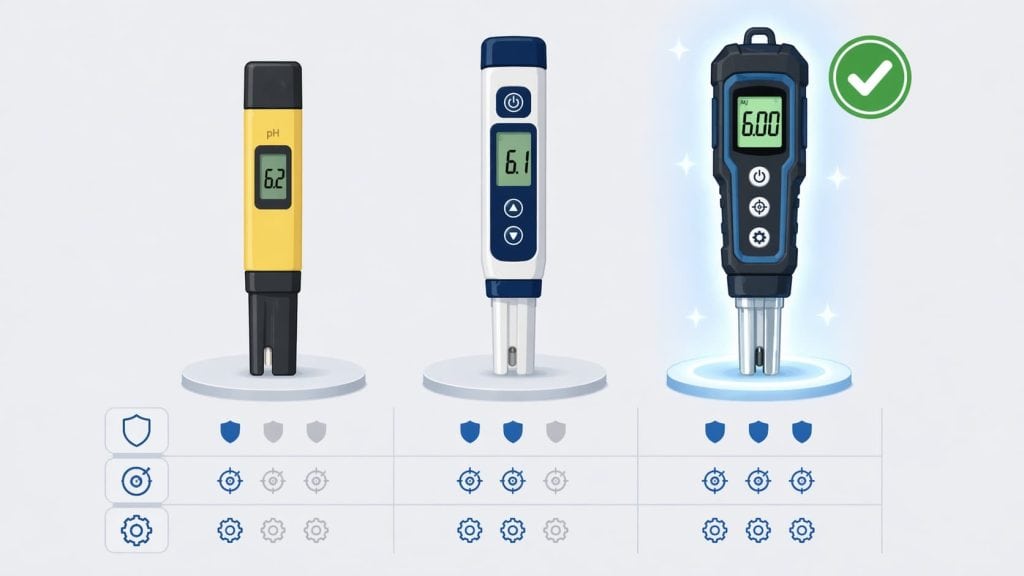
Buying a pH meter for hydroponics isn’t about finding the cheapest one. You need a tool that works reliably in nutrient-rich water, every day.
Look out for features such as easy calibration and robust sensors that can withstand harsh hydroponic solutions. Quality pH adjusters also play a role, helping maintain the correct pH range once you measure accurately with your meter.
The most important feature is automatic temperature compensation, or ATC. Water temperature changes the pH reading. A meter with ATC corrects for this automatically, so your reading is accurate whether your reservoir is warm or cool.
Calibration is just as critical. A good meter lets you calibrate it at two points, usually with pH 4.0 and 7.0 buffer solutions. This two-point check keeps the meter accurate over its lifetime.
Durability matters a lot. Nutrient salts can destroy a cheap sensor fast. Look for a meter with a waterproof body to protect the electronics inside. It’s also wise to pick one with a replaceable probe. When the sensor wears out, you can just swap it instead of buying a whole new meter.
A clear, easy-to-read digital display is helpful. You don’t want to squint at the numbers under your grow lights.
Some high-end models claim an accuracy of ±0.01 or 0.02. That level of precision is useful if you’re making tiny adjustments all the time, but ±0.1 is fine for most growers. For a beginner, that extra precision is overkill. If you’re testing several times a day, though, it might be worth it.
A mid-priced or professional meter is usually a better buy than a budget pen, especially if you use it often. Spending a bit more now can save you money later on a meter that stops working.
Find a meter that’s built to last, handles changing water conditions, and is simple to use. That’s the tool that will help your plants stay healthy.
Regular Calibration Keeps Your pH Meter Accurate
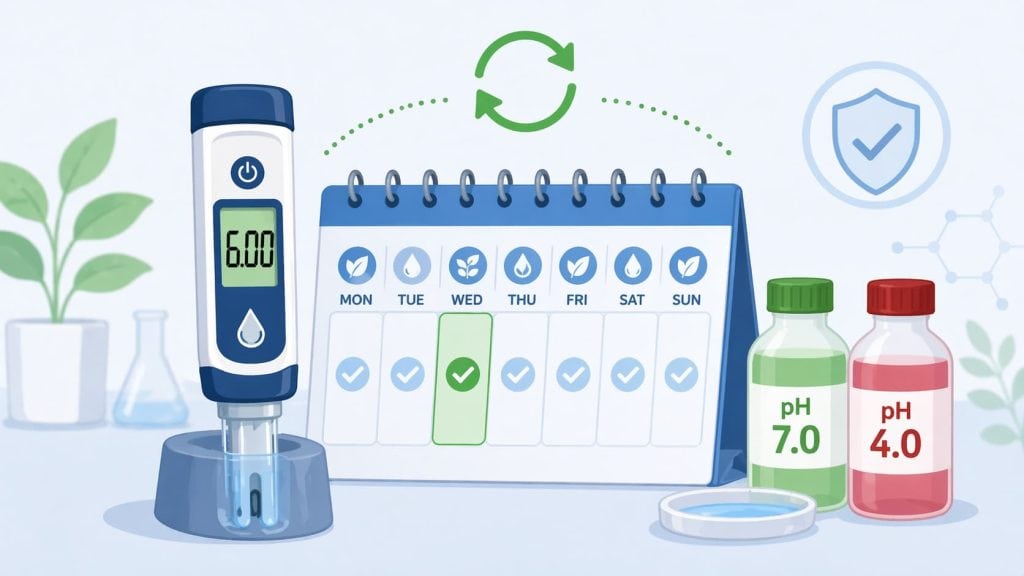
Calibrating your pH meter regularly is what separates a trustworthy reading from a guess. For most growers, a solid rule is to calibrate before you drain and refill your nutrient reservoir, or at least every one to two weeks. Insights from Karimzadeh, S., Li, Z., & Ahamed, M. S. (2025) indicate
“A 2025 study in Computers and Electronics in Agriculture highlights the critical importance of sensor accuracy, noting that drift is one of the primary fault types affecting pH sensors in hydroponic systems. Using machine learning models for fault detection, researchers achieved 96.5% accuracy in identifying faulty pH sensor readings, underscoring that uncalibrated probes can significantly compromise data quality.” – Computers and Electronics in Agriculture
Even good meters don’t stay perfectly accurate forever. Research and real-world use show that uncalibrated probes can drift by about 0.2 to 0.4 pH units in hydroponic conditions. That’s enough to start causing problems for your plants.
Your calibration schedule should depend on how often you use the meter. If you’re checking pH daily or making frequent adjustments, you need to calibrate more often. Some growers calibrate before any major change to their system. Others calibrate once a week, then do a quick check with a buffer solution a few days later to see if the reading is still correct.
A few things can make your meter lose accuracy faster:
- Frequent use wears down the sensor.
- Nutrient solutions with high EC (electrical conductivity) can degrade the probe more quickly.
- Big temperature swings can throw off the calibration.
The key is consistency. Setting up and sticking to a regular calibration routine gives you dependable numbers. This lets you manage your hydroponic system with real data, not just a feeling. Spending a few minutes on this simple task helps keep a stable environment for your plants.
Proper pH Meter Calibration Ensures Reliable Readings
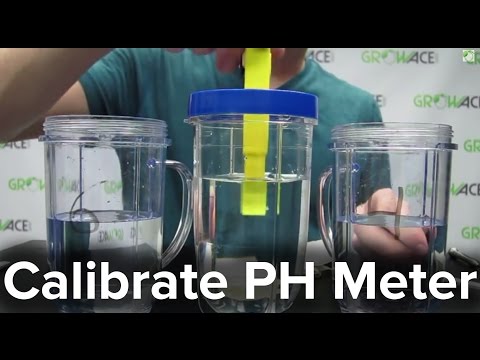
Credits: GrowAce
Doing this right turns your pH meter from a guessing tool into a reliable one. The process isn’t hard, but you need fresh calibration liquids, clean water for rinsing, and you have to check your work when you’re done.
Follow these steps.
Rinse and Dry
Rinse the probe with clean water to wash off any residue. Gently pat it dry with a soft tissue. Don’t rub it, as that can scratch or damage the sensitive glass bulb.
Start with pH 7
Place the probe into a fresh pH 7.0 buffer solution. Wait for the reading on the meter to stop moving and settle. Then, follow your specific meter’s instructions to set or “calibrate” it at this neutral point.
Calibrate at pH 4
Rinse the probe again with clean water and pat it dry. Place it into a fresh pH 4.0 buffer solution. Once the reading is stable, calibrate the meter at this acidic point.
(Optional) Calibrate at pH 10
If your meter allows for three-point calibration, repeat the rinse and dry process. Then calibrate it in a fresh pH 10.0 buffer solution. This covers the basic range.
Verify the calibration
This is the most important step people forget. After calibration, test your meter by putting the probe back into each buffer solution. Check the readings. Meter makers like CoralVue HYDROS say your readings should be within 0.1 to 0.2 pH units of the buffer’s value. If they aren’t, you need to recalibrate.
Making calibrating your tool part of a routine can drastically improve hydroponic success with fewer nutrient problems, as experts on Accurate Measurements emphasize. Using dirty equipment or old, contaminated buffer solutions will give you bad readings from the start. Going through each step carefully makes sure your pH meter gives you facts, not guesses.
Correct pH Readings in Hydroponics Support Healthy Plant Growth
A good pH meter is only half the job. If you don’t collect your water sample correctly, the reading will be wrong no matter how much your equipment costs.
Getting a good sample
First, make sure your nutrient solution is mixed well. Take your sample from the main reservoir, not from a quiet corner or a dead spot where the water doesn’t move. Those spots can have a different pH than the rest of the tank. Collect about a cup (100-200 ml) of the mixed solution.
Timing matters. After you add nutrients or adjust the pH, wait at least 15 to 30 minutes before taking a reading. This gives the chemicals time to dissolve and mix evenly. Taking a measurement right away will give you unstable, unreliable numbers.
Taking the measurement
Let your sample sit until it’s close to room temperature. Very hot or very cold water can change the pH reading and affect how the meter’s probe works.
When you’re ready to measure, fully submerge the probe up to the marked line on its shaft. Don’t just dip the tip. Then, wait. Give the meter 15 to 30 seconds for the reading to settle. Rushing this step, especially with basic models, will give you a number that jumps around.
Always rinse the probe with clean water after each use. Residue from old samples or nutrients will contaminate your next reading.
Accurate pH management isn’t just about buying a good meter. It’s about being patient and careful with every step, from sampling to measuring.
pH Drift Happens for Several Common Reasons
Even a perfectly calibrated pH meter will show your readings moving. The problem usually isn’t the meter. It’s the chemistry and biology happening inside your nutrient tank.
Your plants’ roots are constantly exchanging ions with the water. This process naturally pushes the pH up or down. At the same time, bacteria and other microbes in the system are breaking things down. Their activity can produce acids, which makes the pH drop faster.
Studies and grower experience show that microbial activity and nutrient reactions can push pH down into the 3.5–4.5 range within days if you don’t check it. That kind of swing stresses plants.
Several common things cause this drift.
Plant nutrient uptake
Plants absorb different nutrients at different speeds. When they take up more of one type of ion than another, it changes the water’s chemistry and pH.
Bacterial growth
In systems using organic nutrients, or in any tank that isn’t perfectly clean, bacteria multiply. Their life processes change the pH.
High EC solutions
Nutrient solutions with very high electrical conductivity have less buffering capacity. This means their pH can shift more easily and dramatically.
Carbon dioxide absorption
The nutrient solution absorbs CO₂ from the air. This forms a weak acid, which slowly lowers the pH over time.
pH drift isn’t a sign you’re doing something wrong. It’s a normal part of running a hydroponic system. The goal is to watch for these changes and make small corrections quickly, long before your plants show any stress.
Checking Both Root Zone pH and Tank pH Improves Accuracy
Testing the pH of your nutrient reservoir is necessary, but it might not tell you the whole story. The pH where your plants’ roots actually live can be very different. In some growing setups, the root-zone pH can be a full point or two off from what your tank meter shows.
This happens because the growing medium itself changes the chemistry. Materials like clay pebbles or rockwool can act as a buffer. They hold onto or release ions that alter the pH right around the roots. The reservoir water flows through this environment, but by the time it drains back, its pH has shifted.
Experienced growers have reported cases where their reservoir pH looked fine, but the pH in the root zone had dropped to very acidic levels, like 3.4. That’s a big problem for plants, which need a specific pH range to take up nutrients.
To get the full picture, you need to check both places. Here’s how to test the root zone.
Collect the runoff water that drains from your pots or slabs after you water. This is called leachate.
Test the pH of this leachate right away.
Compare this number to the pH reading from your main reservoir.
If the two numbers are close, your system is balanced. If they’re far apart, it means your growing medium is actively changing the pH, and you need to adjust your reservoir to fix it.
Checking the root zone takes an extra minute, but it tells you what your plants are actually experiencing. It’s the difference between managing the water in your tank and managing the environment for your plants.
Cheap pH Meters May Have Limited Lifespan
A low-cost pH meter might save you money now, but it often becomes a problem later. Many growers find these budget models start giving bad readings or stop working completely after less than a year of normal use. In contrast, many growers report getting five or six years of reliable service from higher-quality meters like Apera or Bluelab pens, as long as they are cleaned and calibrated regularly.
The main issue with cheap pens isn’t just a shorter lifespan, it’s inconsistent performance while they are working.
Common problems with inexpensive meters include:
- They take a long time to give a stable reading.
- The number on the display jumps around instead of settling.
- They need to be recalibrated very often, sometimes before every single use.
A better-quality meter generally holds its calibration longer and gives stable, repeatable readings. This consistency removes a lot of the frustration and guesswork from managing your nutrient solution.
If you add up the cost of replacing two or three cheap pens over a few years, you’ve often spent more than the price of one reliable meter from the start. For a tool you depend on daily, the initial savings of a cheap model can end up costing you more.
“Perfect pH” Nutrients Cannot Fully Replace Regular Testing
Nutrient formulas sold as “pH perfect” or “pH buffered” do not eliminate the need for regular testing. They can help stabilize the solution, but they cannot lock the pH at a perfect number forever.
On grower forums, you’ll find reports of pH still drifting into bad ranges, like 7.7 or higher, even when using these products. The buffers in the nutrients work against small shifts, but they are overwhelmed by stronger forces.
Several factors can overpower buffered nutrients.
Hard water
If your source water has high alkalinity (lots of carbonates), it will keep pushing the pH upward.
Root zone biology
Microbial activity in the growing medium produces acids or other compounds that change the local pH.
Plant uptake
As plants consume nutrients, they change the ionic balance of the solution. This alters the pH over time.
Because of this, you will still need to make manual adjustments. You’ll add pH Down (like phosphoric acid) to lower it or pH Up (like potassium hydroxide) to raise it, based on your test results.
Relying only on buffered nutrients without testing is risky. Even ‘pH-perfect’ nutrient brands advise occasional pH checks and recommend manual adjustment if major shifts happen.
It can hide a gradual pH drift until your plants start showing deficiency symptoms. Regular testing is the only reliable way to know what’s happening in your reservoir and to catch problems early.
Automated pH Controllers Vary in Reliability
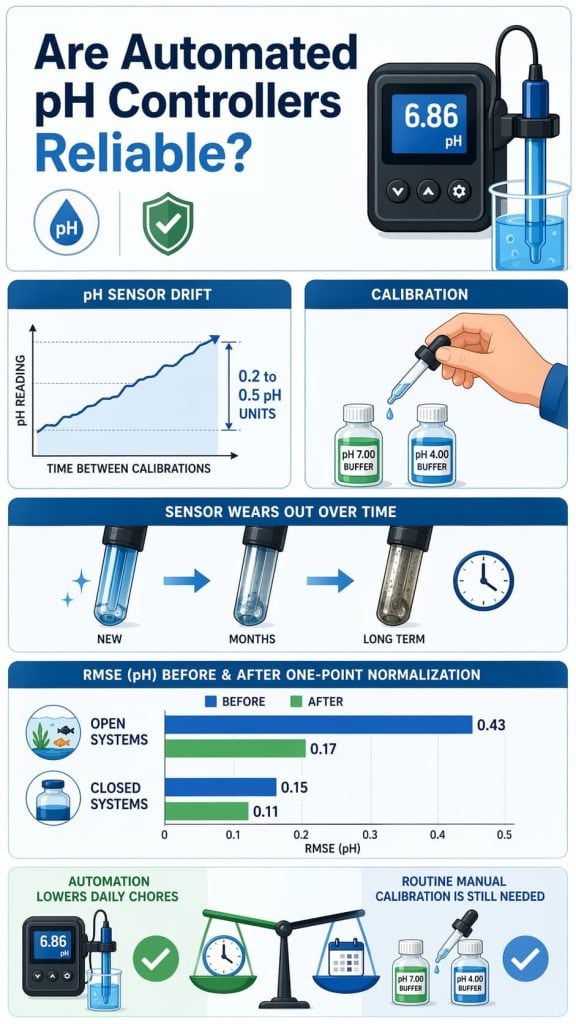
An automated pH controller can help keep things stable, but it isn’t a ‘set and forget’ device. The system is only as accurate as its sensor, and all pH sensors drift over time and need to be calibrated by hand. Research from Cho, W.-J., Kim, D.-W., Kim, H.-J., et al. (2024) shows.
“Research published in the Journal of the ASABE in 2024 confirms that pH probes exhibit signal drift when immersed in nutrient solutions for extended periods. The study found that implementing a one-point normalization system increased pH measurement accuracy, reducing the root mean square error from 0.43 to 0.17 pH in open hydroponic systems and from 0.15 to 0.11 pH in closed systems. This demonstrates that even automated systems benefit significantly from regular calibration routines.” – Journal of the ASABE
Research shows pH sensors in automated systems can drift by about 0.2 to 0.5 pH units between calibrations, depending on the probe’s age and how well it’s maintained. That’s a big enough mistake to mess with nutrient availability for your plants.
Better systems use software to try and fix this. A one-point calibration routine can lower the average error to around 0.17 pH units. A full two-point calibration makes it even more accurate. However, automation can’t fix some basic problems.
- The sensor probe itself wears out with use and will eventually need to be replaced.
- Someone still has to do the calibration by hand using fresh buffer solutions.
- The system’s software can only correct for drift it detects; it can’t always catch a sudden sensor failure or contamination.
An automated system reduces the daily chore of checking and adjusting pH. It does not, however, remove the need for routine maintenance. You must still calibrate the probe on a regular schedule, clean it, and check its readings with a manual test.
For growers who want the technical details, studies on sensor drift compensation explain the math and methods these controllers use to try and stay accurate.
Keep Your pH Routine Tight and Stress-Free
You’re checking your solution, numbers keep shifting, and it’s hard to tell if you’re helping or making it worse. It gets frustrating fast. Small swings can turn into real problems.
Stick with a simple system and let it work for you. Using a steady routine like this, plus a reliable tool from your go-to brand, makes things easier to manage day to day. You don’t need perfect readings every time, you just need consistency so your plants stay healthy without constant guesswork.
FAQ
How often should I check nutrient solution pH for stable hydroponic pH control?
You should perform daily pH monitoring to maintain stable hydroponic pH control in most systems. A weekly pH check alone is not sufficient because nutrient solution pH can change quickly. Regular reservoir pH test routines improve pH testing accuracy and help prevent nutrient lockout pH problems. You should also adjust your schedule based on plant growth stage and environmental conditions.
What is the ideal pH range for different hydroponic crops and systems?
The ideal pH range for most hydroponic systems is between 5.5 and 6.5. This range supports micronutrient availability and efficient macronutrient absorption. NFT pH levels and DWC pH management may require tighter control within this range. Maintaining the correct hydroponic system pH helps prevent iron lockout pH and ensures stable plant uptake pH for healthy growth.
How do I improve pH testing accuracy using different testing tools?
You can improve pH testing accuracy by using a reliable hydroponics pH meter or digital pH pen instead of pH test strips or a liquid pH kit. You should choose temperature compensated pH devices for better consistency. Always follow proper pH meter calibration steps using pH calibration buffer solutions such as buffer solution 4.0 and buffer solution 7.0 to avoid faulty pH reading results.
What causes pH swings in hydroponics and how can I prevent them?
pH swing causes include plant uptake pH changes, inconsistent feeding, poor water quality, and environmental fluctuations. You can reduce these issues by applying pH drift prevention practices such as stable nutrient dosing and controlled conditions. Daily monitoring of hydroponic system pH helps you detect changes early and apply pH adjustment up or pH adjustment down when necessary.
How should I maintain and store a pH probe for reliable readings?
You should perform regular pH probe maintenance to ensure consistent and accurate pH measurement. Clean the probe through proper pH electrode cleaning methods and store it in a suitable storage solution pH such as KCL storage to maintain pH probe hydration. You should replace pH electrode components when readings become unstable to prevent faulty pH reading and maintain long-term accuracy.
References
- https://en.wikipedia.org/wiki/PH_meter
- https://www.researchgate.net/publication/403023424_pH_Measurement_in_Hydroponics_System
Related Article
- https://tophydroponicgarden.com/ph-tester/
- https://tophydroponicgarden.com/how-and-why-to-use-a-ph-tester/
- https://tophydroponicgarden.com/ph-adjusters/
Was this helpful?
